
Citizen Science for the Knowledge of Brazilian Birds: Breeding Aspects of the Horned Sungem (Heliactin bilophus) (Aves, Trochilidae) in the Brazilian Cerrado
Photographic records produced by citizen scientists have been used by professional ornithologists to study tropical birds. Near 90 species of hummingbirds occur in Brazil, and few of them have had aspects of their breeding investigated in detail. The Horned Sungem Heliactin bilophus is a small hummingbird commonly found in central Brazil, and remains poorly known. This study aimed to investigate breeding aspects of H. bilophus in the Brazilian Cerrado through the use of citizen science data. Searches for photographic records were conducted in three online databases in April 2022. Records with evidences of breeding activities (n = 35) were obtained by citizens along 15 years, and included in this study. Most of them (89%) were obtained in the WikiAves database. They were obtained mainly in central and southeastern Cerrado. Nests were cup-shaped, and fixed to forking branches of shrubs. Most records involved nests, while a minor portion referred to young photographed outside nests. Only female adults were associated with nests or young. Clutch size was always two eggs (n = 6). One or two young were found per nest (n = 10). Most records (66%) occurred in the dry season, and fewer of them (34%) were obtained in the rainy season. They were concentrated during the whole dry season, and the late rainy season, having occurred scarcely in other periods of the year. Each phase of the breeding season (nest building, nests with eggs, downy young, greenish young in nests, and fledged young) lasted for 5-7 months. The breeding season of the Horned Sungem in the Brazilian Cerrado comprises at least 10 months, a period much longer than that considered in previous literature. This study suggests that photographic records available in citizen science databases can improve the knowledge of breeding aspects of hummingbird species found in Brazil.
Introduction
Citizen science projects can substantially increase scientific knowledge regarding bird biology and distribution [1, 3]. In Brazil, investigations based on citizen science data are substantially less numerous than those based on data gathered by professional ornithologists; however, it has been widely recognized that studies based on citizen science data can improve the knowledge and conservation of Brazilian birds [4, 5, 6, 7, 8]. The extraordinary bird species richness found in Brazil [9] is one of the factors that call for the contribution of citizen scientists to better understand patterns and processes concerning its avifauna.
Among this highly diversified avian fauna is the Family Trochilidae that comprises 89 species of hummingbirds in Brazil [9]. They are found in a wide range of habitats, including rainforests, savannas, grasslands, and dry forests [10, 11, 12, 13]. The Horned Sungem Heliactin bilophus (Temminck, 1820) is the only species of this genus [13]. It is widely distributed throughout South America, including an extensive area in Brazil, and more restricted regions in northern and eastern Bolivia, and southern Suriname; in Brazil, its distribution substantially overlaps with the Cerrado, but it also occurs spottily in the Amazon, the Caatinga, and northern Atlantic Forest [14].
The Horned Sungem is one of the smallest hummingbird species found in Brazil [11]. In central Cerrado, it occurs in open vegetation physiognomies, being more common in grasslands than in woodland savannas [11, 15]. Populations can be resident or migratory [16, 17]. At Chapada dos Veadeiros National Park, in central Brazil, Horned Sungems were observed consuming nectar of abundant flowers of eight shrubs and herbs in rocky and shrubby grasslands [18]. In western Cerrado, this species was considered a nectar robber of two plant species [19].
Typically, Horned Sungems build cup-shaped nests on forking branches of small shrubs [14]. At Distrito Federal, its breeding season was considered to occur between June and October [16], while the period of nesting activity was estimated to be April and May [20]. As results of these studies differ at some extension, and their observations were based on few nests found in only two protected areas at Distrito Federal, it is likely that the breeding season of the Horned Sungem in the Cerrado has been underestimated. We supposed that the paucity of information on its breeding aspects could be mitigated through the use of citizen science data, similarly as has been conducted for other bird species in Brazil [21, 22]. This study aimed to examine breeding aspects of the Horned Sungem in the Brazilian Cerrado using data from citizen science. We focused on the breeding season, and clutch and brood sizes.
Methods
Study Area
The Cerrado is the vegetation province that dominates central Brazil, being bordered by four major biomes–the Amazon, the Atlantic Forest, the Caatinga and the Pantanal [23, 24]. This savanna eco-region covers about 2 million km2 mainly in Brazil, Paraguay and Bolivia [25, 26, 27]. Native matrix types of landscapes usually are woodland savannas (cerrado sensu stricto and campo cerrado) grasslands, (campos), and semideciduous forests. Other habitats are rocky grasslands, riverine forests, dry forests, and humid areas [25, 26]. Climate in the Cerrado is tropical and characterized by a dry winter, and a rainy summer [28]. Two well-defined seasons occur annually: the dry season occurs from May to September, and the rainy season lasts between October and April. Typically, the annual rainfall ranges from 1,200 to 2,000 mm, and occurs mainly in the rainy season. Temperatures usually vary between 10oC in the winter (June/July) and 40oC in the summer (January/February)] [28].
Data Collection
This study was based on photographic records with evidence of breeding activities of the Horned Sungem in the Brazilian Cerrado. They were obtained in April 2022 by searching three on-line databases. WikiAves (https:// www.wikiaves.con.br) is the largest citizen science database regarding Brazilian birds, currently counting with the contribution of about 41,000 observers, and harboring approximately 4,000,000 records; eBird (https://ebird.org/) and iNaturalist (https://inaturalist.org) databases harbor less expressive numbers of records of Brazilian birds, but also were searched. For all searches, the scientific name of the species was typed in the Species field.
![Figure 1: Photographic records with evidence of breeding activities of the Horned Sungem [Heliactin bilophus] obtained by citizen scientists in the Brazilian Cerrado: [a] nest building by an adult; [b] an incubating adult; [c] a nest with two eggs; [d] a downy young in a nest; [e] an adult feeding young in a nest; [f] young being fed by an adult outside the nest. Photo authors: Fernanda Fernandes [a], Mauríllio de Carvalho [b], Fernanda Fernandes [c], Lorenzo Palma [d], Sandra Beatriz Zarur [e], Lorenzo Palma [f].](/fulltextimages/8706/fig_1.png)
Figure 1: Photographic records with evidence of breeding activities of the Horned Sungem [Heliactin bilophus] obtained by citizen scientists in the Brazilian Cerrado: [a] nest building by an adult; [b] an incubating adult; [c] a nest with two eggs; [d] a downy young in a nest; [e] an adult feeding young in a nest; [f] young being fed by an adult outside the nest. Photo authors: Fernanda Fernandes [a], Mauríllio de Carvalho [b], Fernanda Fernandes [c], Lorenzo Palma [d], Sandra Beatriz Zarur [e], Lorenzo Palma [f].
The resulting photographs were examined to select only those with evidence of breeding activities (here called “breeding records”): copulation, nest building, eggs in nests, incubating adult, young in the nest, or young being fed or not by adults outside the nests. Only breeding records obtained in the Brazilian Cerrado (see Tubelis (29) for map) were included in this study; this procedure was based on information about municipalities and biomes provided by IBGE-Instituto Brasileiro de Geografia e Estatística [https:// cidades.ibge.gov.br/]. When we could note that two or more photographs taken in a given municipality referred to the same nest or bird, only one of them was selected to avoid replicates that could overestimate the number of photographs of an event/situation in any given period. We contacted the authors of the selected photographs in cases of doubt about breeding evidence (e.g., young feeding outside the nest), and to ask about the number of eggs in a given nest. We received permission from citizen scientists to include the photographs in this article (Figure 1).
Data Analysis
Young were grouped into two developmental categories based on their size, bills, and plumage: [1] “downy young”, i.e., nestlings with completely nude skin, or with a downy plumage, a very short and triangular bill, and with open eyes or blind; [2] “greenish young”, i.e., birds with a short bill, a plumage comparable to that of adults, or brownish, but with shorter tail and wings, and with open eyes (Figure 1). The seasonal occurrence of breeding records was examined by dividing each month in three periods - [I]: days 1–10, [II]:
days 11–20, and [III]: days 21–31. We made comparisons between situations (e.g., records in the dry or rainy season) by using percentages (%).
Results
We examined 2048, 276 and 34 photographs of the Horned Sungem deposited in the WikiAves, eBird and iNaturalist databases, respectively. Of these, 35 breeding records (1.5%) were gathered in the Brazilian Cerrado between 2008 and 2022, and included in this study. Most of them (89%) were gathered in the WikiAves database. They were obtained in 16 municipalities located mainly in central and southeastern Cerrado. Distrito Federal, and Minas Gerais state were the regions with more records (Appendix).
Nests were cup-shaped, and were fixed to shrubs by building their lateral sides around 2-3 inclined forking branches. Twenty-two breeding records (63%) involved nests, while a minor portion (37%) referred to young photographed outside nests (Table 1). Those regarding nests involved nest building, incubation, exposed eggs, and downy and greenish young, and occurred in comparable numbers. Only female adults were associated with nests or young. On these occasions, a female was photographed building a nest, incubating eggs, or feeding young in nests or outside them (Table 1, Appendix). Clutch size was two eggs (n = 6). Among the 10 nests with young, three had one, while other seven nests had two young.
| Evidence of breeding activities | Number of records | ||
|---|---|---|---|
| WikiAves | eBird | iNaturalist | |
| Nest Building | 3 | 0 | 0 |
| Incubation | 4 | 1 | 0 |
| Nest with egg[s] | 4 | 0 | 0 |
| Downy young in a nest | 4 | 0 | 1 |
| Greenish young in a nest | 3 | 2 | 0 |
| Greenish young outside the nest | 13 | 0 | 0 |
| Total | 31 | 3 | 1 |
Table 1: Photographic records [n = 35] with evidence of breeding activities of the Horned Sungem (Heliactin bilophus) obtained by
Most breeding records (n = 23, 66%) occurred in the dry season, and fewer of them (n = 12, 34%) were obtained in the wet season (Figure 2, Appendix). They were concentrated throughout the whole dry season (May-September), and the late rainy season (March-April), having occurred scarcely in other periods of the year. Nest building was recorded along a 5-month period (early March to early July). Most records involving exposed eggs or an incubating adult also occurred during this period that involved the late rainy season and the first half of the dry season. Downy young were observed from early March to mid-July. In agreement with young development, greenish young were found in nests about 20-
30 days later – from early April to early August. Greenish young outside nests occurred along a longer (seven months) period, that comprised the late rainy season, the whole dry season, and the early rainy season (Figure 2).
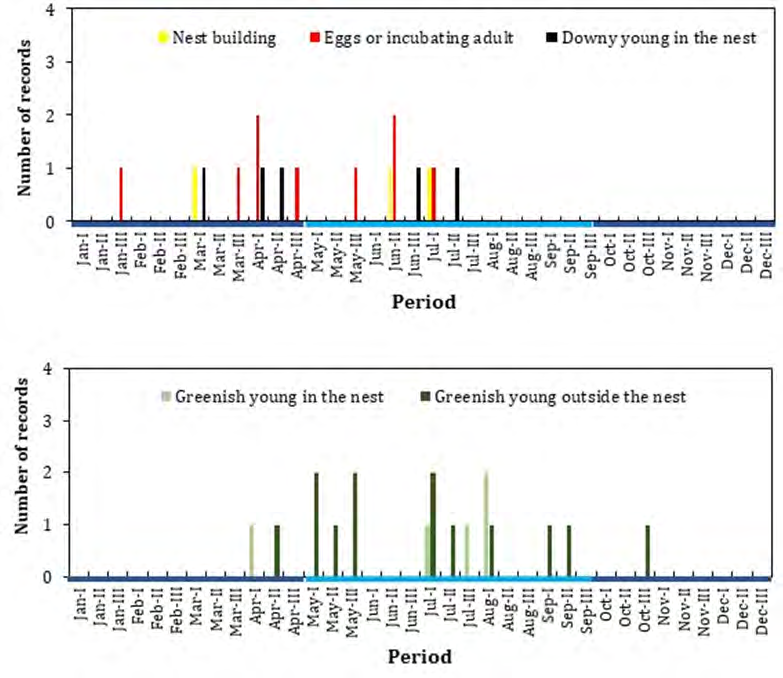
Figure 2: Seasonal distribution of records with evidence of breeding activities of the Horned Sungem (Heliactin biophus) in the Brazilian Cerrado, and obtained by citizen scientists between 2008 and 2022. Data was gathered in the WikiAves, eBird and iNaturalist databases in April 2022. Arabic numerals after each month represent three periods–(I): days 1–10, (II): days 11–20, (III): days 21–31 of each month. The horizontal bars in light and dark blue colors indicate the length of the dry and rainy seasons in the Cerrado, respectively.
Discussion
This is the first study to examine breeding aspects of the Horned Sungem over a large spatial scale. This is because previous studies investigated its breeding in detail only in two protected areas located at Distrito Federal, central Brazil: the Reserva Ecológica do IBGE [16] and the Estação Ecológica de Águas Emendadas [20]. In contrast, breeding records were obtained by citizen scientists in several states and numerous localities, leading to a better representativeness of its geographic distribution than in these previous studies. Also, our study is the first to consider data obtained over a long temporal scale (15 years), as other studies involved only nests found in 1-2 years [16, 20]. As a result, our study was based on the largest number of nests of the Horned Sungem until now, as other investigations were based on a few nests [16, 20].
Nests involved in our study were comparable in structure to those described previously [14]. Similarly, clutch size was two eggs, as noted in other studies [14, 16, 20]. This number of eggs is in agreement with the finding of 1-2 young in nests of our study. Also in agreement with the literature [14], only females (not males) were associated with nests and young in our breeding records. However, as we could not monitor nests, and other studies were based on a few nests, further observations by ornithologists and citizens scientists would be necessary for a more solid conclusion about the role of both parents in the breeding activities.
The breeding season of the Horned Sungem was considered to occur between June and October in central Cerrado [16]. In this same region, its nesting period was estimated to last between April and May [20]. Our results indicate that both studies underestimated the duration of these periods for the Cerrado. First, several breeding records of our study occurred between January and April, and involved a range of phases of the breeding season (nest building to greenish young in nests). This indicates that the onset of the breeding season is not June, as proposed by Negret, et al. [16]. Also, records obtained by citizens that involved nesting activities occurred between January and August, a period substantially longer than that estimated by Marini, et al. [20]. We consider probable that differences between our and their studies regarding spatial and temporal scales contributed to these differences mentioned above.
Considering a 13-days long incubation [14], and our records involving nest building and eggs/ incubation, nesting activities by the Horned Sungem might start along seven months (January to July) in the Brazilian Cerrado. Thus, earlier phases of the breeding season (e.g. pairing, courtship and copulation) might occur since January or even December; observations of these three activities would indicate the onset of the breeding season. Considering the incubation period and a 20-22 days fledging period [14], the occurrence of our records associated with early nesting activities (nest building to incubation) is in agreement with the later occurrence of breeding records with downy and greenish young observed. Our records of greenish young outside nests indicate that the breeding season of the Horned Sungem might end in October, at the latest, in agreement with Negret, et al. [16]. However, the breeding season might finish in earlier months (since April), as supported by records of females feeding young in a few months. The observed sequence of breeding records representing different phases of the breeding season (e.g. incubation or downy young) indicates that our approach of considering citizen science data was adequate to examine this breeding aspect of the Horned Sungem in the Cerrado. Also, our data indicates that pairs can have their breeding activities occurring in different periods within the breeding season (January-October) of the species in the Brazilian Cerrado. Future studies could try to investigate the biotic (e.g. bird age) and abiotic (e.g. elevation) factors that lead to this variation in the occurrence of breeding activities by different pairs during this 10-months period.
We suggest that Brazilian ornithologists make an intense use of the photographic records available in citizen science databases regarding Brazilian birds. Wikiaves and, less expressively, eBird Brasil appear to provide excellent datasets for the study of breeding aspects of the national avifauna. Therefore, we reinforce previous studies [4, 21, 22, 29, 30] that pointed out that citizen scientists can substantially contribute for the conduction of research by professional ornithologists in Brazil.
Authors Contributions
Dárius P. Tubelis (idealization, conceptualization, data collection and analysis, interpretation and writing); Luiz Gonzaga A. Mendonça (idealization, conceptualization, data collection and analysis, interpretation and writing); Thiago J. Cardoso (conceptualization, data collection and analysis, interpretation and writing).
Conflicts of Interest
The authors declare that there are no conflicts of interest.
Acknowledgements
We thank Universidade Federal Rural do Semi-Árido (UFERSA), Conselho Municipal do Meio Ambiente, and SICOOB for logistic support. We are grateful to all citizens that deposited photographs of the Horned Sungem in the WikiAves, eBird and iNaturalist databases. Especially, we thank Fernanda Fernandes, Lorenzo Palma, Mauríllio de Carvalho and Sandra Beatriz Zarur for giving permission to include photographs of their authorship in this paper. The Editorial Committee, two anonymous reviewers and Adriano Campos improved this manuscript with numerous suggestions.
Funding
There was no funding.
References
-
Bonney R, Cooper CB, Dickinson J, Kelling S, Phillips T, et al. (2009) Citizen Science: a developing tool for expanding science knowledge and scientific literacy. BioScience 59: 977-984.
-
Chandler M, See L, Copas K, Bonde AM, López BC, Danielsen F, et al. (2017) Contribution of citizen science towards international biodiversity monitoring. Biological Conservation 213: 280-294.
-
Kelling S, Johnston A, Bonn A, Fink D, Ruiz-Gutierrez V, et al. (2019) Semistructured surveys to improve citizen science data for monitoring biodiversity. BioScience 69: 170-179.
-
Barnett JM, Ingels J, Roos AL, Lima JLG, Naka LN (2014) Observations on the breeding biology of the Pygmy Nightjar Nyctipolus hirundinaceus in the Caatinga of Bahia and Ceará, Brazil. Revista Brasileira de Ornitologia 22: 201-209.
-
Tubelis DP (2020) Breeding of the Horned Screamer (Anhima cornuta) in non-protected areas in the Brazilian Cerrado. Ornithology Research 28: 1-11.
-
Barbosa CKV, Develey PF, Ribeiro MC, Jahn AE (2021) The contribution of citizen science to research on migratory and urban birds in Brazil. Ornithology Research 29: 1-11.
-
Sagot Martin F, Lima RD, Pacheco JF, Irusta JB, Pichorim M, et al. (2020) An updated checklist of the birds of Rio Grande do Norte, Brazil, with comments on new, rare, and unconfirmed species. Bulletin of the British Ornithologists’ Club 140: 218-298.
-
Develey PF (2021) Bird conservation in Brazil: challenges and practical solutions for a key megadiverse country. Perspectives in Ecology and Conservation 19: 171-178.
-
Pacheco JF, Silveira LF, Aleixo A (2021) Annotated checklist of the birds of Brazil by the Brazilian Ornithological Records Committee – second edition. Ornithology Research 29: 94-105.
-
Stotz DF, Fitzpatrick JW, Parker III TA, Moskovits DK (1996) Neotropical Birds. Ecology and Conservation. The University of Chicago Press, Chicago, USA.
-
Sick H (1997) Ornitologia Brasileira. Editora Nova Fronteira, Rio de Janeiro, Brazil.
-
Mata JRR, Erize F, Rumboll M (2006) Birds, South America. Non-Passerines: from Rheas to Woodpeckers. HarperCollins Publishers Ltd, London, UK.
-
Winkler DW, Billerman SM, Lovette IJ (2020) Hummingbirds (Trochilidae). In: Billerman SM, Keeney BK, Rodewald PG, Schulenberg TS, et al. (Eds.), Birds of the World. Cornell Lab of Ornithology, Ithaca, USA.
-
Schuchmann KL, Kirwan GM, Boesman PFD (2020) Horned Sungem [(Heliactin bilophus). In: del Hoyo J, Elliott A, Sargatal J, Christie DA, de Juana E, et al. (Eds.), Birds of the World. Cornell Lab of Ornithology, Ithaca, USA.
-
Tubelis DP, Cavalcanti RB (2001) Community similarity and abundance of bird species in open habitats of a central Brazilian Cerrado. Ornitologia Neotropical 12: 57-73.
-
Negret AJ (1988) Zur Biologie der Sonnenstrahlelfe Heliactin cornuta in Zentralbrasilien. Trochilus 9: 61-64.
-
Negret AJ, Negret RA (1981) As aves migratórias do Distrito Federal, Brasília. Boletim Técnico IBDF 6: 1-64.
-
Ghiringhello GB, Tubelis DP (2009) Species of plants visited by Heliactin bilophus [Aves, Trochilidae] in Chapada dos Veadeiros, standing in a ditch. Biotemas 22: 139-145.
-
Vitorino BD, Frota AVB, Andrade ALP (2016) Comportamento pilhador do beija-flor chifre-de- ouro (Heliactin bilophus) (Aves: Trochilidae) em duas espécies de plantas dos gêneros Amphilophium Kunth (Bignoniaceae) e Sinningia Nees (Gerneriaceae). Biota Amazônia 6: 104-106.
-
Marini MÂ, Borges FJA, Lopes LE, Sousa NOM (2012) Breeding biology of birds in the Cerrado of central Brazil. Ornitologia Neotropical 23: 385-405.
-
Tubelis DP, Mendonça LGA, Vieira IKC, Borges K (2020) Breeding and seasonal occurrence of the Orinoco Goose [Neochen jubata] in Brazil. Ornithology Research 28: 105-114.
-
Tubelis DP, Dornas T (2021) Breeding aspects of the Sunbittern (Eurypyga helias) in Brazil, based on citizen science data. Ornitologia Colombiana 20: 1-10.
-
Ab’Saber NA (1977) Os domínios morfoclimáticos na América do Sul. Primeira aproximação. Geomorfologia 52: 1-21.
-
Rizzini CT (1997) Tratado de fitogeografia do Brasil. Editora Âmbito Cultural Ltda, Rio de Janeiro, Brazil.
-
Eiten G (1972) The cerrado vegetation of Brazil. Botanical Review 38: 205-341.
-
Oliveira PS, Marquis RJ (2002) The Cerrados of Brazil. Ecology and natural history of a neotropical savanna. Columbia University Press, New York, USA.
-
Scariot A, Sousa-Silva JC, Felfili JM (2005) Cerrado: ecologia, biodiversidade e conservação. Ministério do Meio Ambiente, Brasília, Brazil.
-
Assad ED (1994) Chuva nos cerrados. Análise e espacialização. Embrapa/SPI, Brasília, Brazil.
-
Tubelis DP (2022) Breeding aspects of the Toco Toucan and the Chestnut-eared Aracari (Aves, Ramphastidae) in the Brazilian Cerrado. International Journal of Zoology and Animal Biology 5: 000358.
-
Tubelis DP, Sazima I (2021) Nuptial gifts among Brazilian cuckoos: an outline based on citizen science. Ornithology Research 29: 188-192.
- California Red-Legged Frog and Non-Listed Amphibians Response to Non-Native Fish Removal
- Industrial Standardization of the Bio-OS: Algorithmic Codification of Resilience Engineering Guidelines and Version V8 Architecture
- Climate Variability and the Sustainability of Snail Farming in Nigeria: Past Trends, Present Challenges and Potential Outlook
- The Evaluation of the Surveillance System of Anthrax in Gilgit-Baltistan, Pakistan, 2018
- Natural Decline to Extinction of A New Zealand Rabbit Population
- Mitochondrial Bio-Logistics: Steering Co-Enzyme Q10 and Lycopene Synergies within the Science 4.0 Bio-OS Framework