
Fecal Cortisol Dynamics of Captive Giraffes in Zoos in Northern Japan
Animals in zoos are kept under environmental conditions differing from those of their original habitat. Recently, zoos have been attempting to reduce stress by introducing environmental enrichment. Adrenal-derived glucocorticoids are common stress indicators found in blood, saliva, urine, and feces. Fecal cortisol levels have been studied as a stress marker in captive giraffes, but the data are insufficient. In this study, we examined fecal cortisol in captive giraffes in northern Japan to increase basic data on fecal cortisol as an indicator of environmental enrichment. For one month, we collected fecal samples from 14 giraffes [Masai giraffes (Giraffa camelopardalis tippelskirchi) and reticulated giraffes (Giraffa camelopardalis reticulata)] from eight zoos. The fecal samples were stored at –20 °C until fecal cortisol levels were measured using a cortisol EIA kit after drying, grinding, and ethanol extraction. Cortisol levels were compared between males and females, pregnant and nonpregnant animals, by age, and by differences in temperature of the rearing environment. The fecal cortisol levels ranged from 37~10346 pg/g. Among females, pregnant individuals had the highest values. Among nonpregnant females, a female that was harassed by a male had higher fecal cortisol levels than the others. This may be due to chronic psychological distress. In males, values varied greatly among individuals. This study increases the volume of giraffe fecal cortisol data, which will contribute to establishing basic giraffe fecal cortisol values.
Introduction
Giraffes (Cetartiodactyla: Giraffidae) are popular animals in zoos, and there are currently 160 captive-bred giraffes in Japan [1]. However, in captivity, they are reared in a small area that is quite different from their original habitat, African savanna. In Japan, which is long from north to south, some zoos are located in places where the minimum temperature is below 0 degrees Celsius. Therefore, it is quite possible that such an environment is stressful for giraffes adapted to live in warm areas. Giraffe stress behavior is known as stereotypic behavior, such as shaking the head from side to side, licking pillars and fences, and playing with their tongue [2, 3]. Enrichment that uses the tongue, such as foraging enrichment, has been shown to be effective in improving the stereotyped behavior of these giraffes [4]. In assessing enrichment, it is important to focus on behaviors and postures that change depending on the stress state of the animal, but physiological indicators are also important [5, 6, 7].
Adrenal-derived glucocorticoids in giraffe feces are used as a noninvasive objective index of animal stress [8]. In particular, it has been reported that fecal glucocorticoid metabolites (FGMs) are elevated in diseases and physical conditions [7], during transportation [9], during building construction [5], and so on. Wolf, et al. [10] reported that in the giraffe herd, FGMs were higher in young males in the male-only group, and FGM levels in older males were higher in the presence of female individuals in estrus in a mixed male–female population. On the other hand, Malereale, et al. [11] stated that group size and sex affect FGM levels, but no age-related association was found. Jain, et al. [5] reported that stereotyped tongue behavior and FGM levels in captivity were also elevated by the shock of losing a partner. Thus, FGMs are thought to reflect not only direct physical stress but also social stress. However, information on glucocorticoids in giraffe feces is not yet sufficient.
In this study, we focused on the most commonly investigated fecal glucocorticoid (cortisol) and analyzed the fecal cortisol dynamics of giraffes bred in zoos in northern Japan, which is a colder location than their original habitat.
Materials and Methods
Giraffe Information and Profiles
We surveyed the fecal cortisol levels of 14 captive giraffes in zoos in northern Japan. The giraffes included one pair of Masai giraffe (Giraffa camelopardalis tippelskirchi) and 7 male and 5 female reticulated giraffes (Giraffa camelopardalis reticulata). The information on individual giraffes and sampling periods are listed in Table 1.
| Zoo ID | ID | Sex | Species | Age | Sampling period† | Mo. Temp. (Yr.)‡ |
|---|---|---|---|---|---|---|
| Hokkaido area | ||||||
| Zoo K | KM | M | GCR | 5 | 2016/5/9–6/7 (30) | 10.7 (7) |
| KF | F | GCR | 5 | 2016/5/9–6/7 (30) | ||
| Zoo O | OM | M | GCR | 2 | 2016/6/1–7/18 (31) | 15.7 (7.2) |
| Zoo S | MM | M | GCT | 20 | 2016/6/1–6/30 (29) | 16.3 (9.3) |
| MF | F | GCT | 12 | 2015/8/1–8/31 (28) | 22.4 (10) | |
| Zoo A | AM | M | GCR | 9 | 2016/5/6–6/9 (35) | 14.4 (7.2) |
| AF | F | GCR | 3 | 2016/5/6–6/9 (35) | ||
| Tohoku area | ||||||
| Zoo M | RM | M | GCR | 11 | 2018/4/7–5/8 (32) | 11.5 (11.5) |
| RF | F | GCR | 1 | 2018/4/7–5/8 (32) | ||
| Zoo Y | YM | M | GCR | 8 | 2017/5/8–6/1 (25) | 17.7 (13.6) |
| YF | F* | GCR | 6 | 2017/5/8–6/1 (25) | ||
| North Kanto area | ||||||
| Zoo H | IF | F* | GCR | 9 | 2018/4/7–5/8 (32) | 15.1 (15.4) |
| IM | M | GCR | 15 | 2018/4/7–5/8 (31) | ||
| Zoo R | GM | M | GCR | 9 | 2018/4/1–5/13 (29) | 16.4 (15.9) |
Table 1: Table 1: Giraffe information, zoo locations, and sampling periods.
The areas where zoos are located are Hokkaido, Tohoku, and North Kanto in order from north to south. GCT: Masai giraffe; GCR: reticulated giraffe *Pregnant female †Sample number ‡Degrees Celsius; Mo. temp: monthly average temperature; Yr.: yearly temperature
Fecal Sample Collection and Cortisol Measurement by ELISA
Fecal samples were collected in the morning from 14 captive giraffes in zoos in northern Japan. Sand and pebbles were removed from the feces, and then fecal samples were stored at-20 degrees Celsius until processing. The samples were collected from spring to August, when the temperature had not gone below 10 degrees Celsius in a week. For cortisol measurement, cortisol was extracted from feces by ethanol according to the Steroid Solid Extraction Protocol (Arbor Assays, Ann Arbor, MI, USA, info@ArborAssays.com). The fecal samples were dried at 60 degrees Celsius for two days and crushed by a mixer. The powdered fecal samples were vigorously shaken in a clean tube with ethanol for 2 h at room temperature. The supernatants were separated from the debris by centrifugation. The extracted supernatants were evaporated to dryness in a centrifuge evaporator (EYELA CVE-310, EYELA Co. Ltd) overnight. Each pellet was dissolved with ethanol, diluted, and used for assays. Extracted samples were diluted 20 times, and the cortisol levels were quantified using a cortisol ELISA kit (Arbor Assays, Ann Arbor, MI, USA). Standards and diluted samples were loaded in duplicate and read with an iMarkTM Microplate Reader (Bio-Rad Laboratories, Hercules, CA, USA) at 450 nm wavelength. The cortisol concentration was calculated in MyAssays HP (myassays.com). The cortisol values of dried fecal samples were converted to g of wet feces by the dryness factor.
Analysis and Statistics
The data on giraffe cortisol levels were compared to analyze fecal cortisol differences among individuals, in each sex, between pregnant and nonpregnant individuals, among ages, and among areas where the zoos are located. For statistical analysis, ANOVA was used to perform comparisons, and p < 0.05 was considered to indicate a significant difference. The Holm procedure was performed for adjustment. The statistical analyses were performed with R software (The R Foundation for Statistical Computing, Vienna, Austria).
Results
In the present study, fecal cortisol was surveyed in fourteen giraffes reared in zoos in northern Japan.
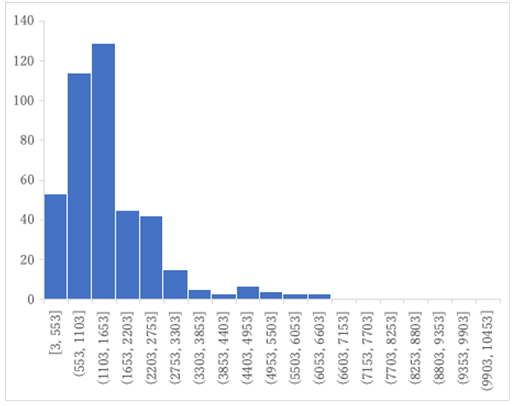
• Fecal cortisol levels of captive giraffes in zoos in northern Japan. The fecal cortisol levels of all 14 giraffes are shown in Figure 1. The mean level was 1546 pg/g, the median level was 1237 pg/g, and the range was between 37 and 10346pg/g.
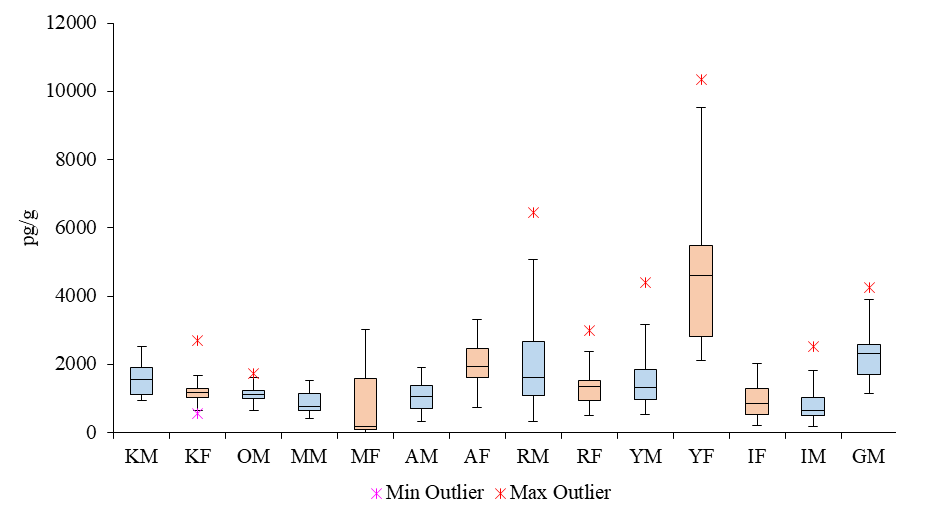
• Fecal cortisol level differences among individuals and with sex, pregnancy status, and age Among all 14 animals, YF was shown to have a cortisol level significantly different from those of all other individuals (p < 0.05). The second highest cortisol level (in GM) was significantly different from those in 9 (YM, RF, KF, OM, AM, IF, MM, MF, IM) of the 14 giraffes (p < 0.05). The third highest (in AF) was found to be significantly different from those of 7 (KF, OM, AM, IF, MM, MF, IM) of the 14 individuals, and the 4th highest (in RM) was also significantly different from those of the same 7 (KF, OM, AM, IF, MM, MF, IM) giraffes (p < 0.05). The fifth highest (in KM) was significantly different from those of 3 (MM, MF, IM) out of 14 animals (p < 0.05). No statistically significant difference was found for the 6th highest or lower levels. The average level of 8 male giraffes was 1385 pg/g, and the average level of 6 female giraffes was 1760 pg/g. SR showed the highest value among all 14 animals and an overwhelmingly high value compared to other female individuals (Figure 2). The average cortisol level in nonpregnant females was 1431 pg/g, and cortisol levels did not differ significantly between females and males. Levels in male giraffes did not vary with age.
• Cortisol level differences with zoo location The area of zoos where all 14 giraffes lived was divided into Hokkaido, Tohoku, and North-Kanto. The average temperature during the fecal collection period at the zoo in Hokkaido was 10.7 to 22.4 degrees Celsius, and the mean cortisol level was 1267 pg/g. The average temperature during the fecal collection period at the zoo in Tohoku was 11.5 to 17.7 degrees Celsius, and the mean cortisol value was 2268 pg/g. The average temperature during the fecal collection period at the zoo in North-Kanto was 15.1 to 16.4 degrees Celsius, and the mean cortisol value was 1312 pg/g. Comparison of the three areas showed that the cortisol levels in the feces of the giraffes at the zoo in Tohoku, which is located in the middle, were significantly higher than those in the other two regions (p < 0.05).
Discussion
We investigated the dynamics of cortisol levels in the feces of 14 giraffes kept in zoos in northern Japan.
Among the 14 giraffes, the mean cortisol levels in the feces were not significantly different except for in 5 giraffes. Among the giraffes that showed higher mean levels than in other giraffes, the female YF with the highest value was an individual at 9 months gestation, but the cortisol level for IF at 13 months was not significantly different from those of other individuals. In some species, FGM levels increase with pregnancy, but they can also change from month to month, as in barren jennies [12]. Female AF showed a high level but was reportedly harassed by cohabiting males (the keeper’s information). It has also been reported that young males tend to feel more stressed and have higher FGM levels in male herds, but it is not clear why cortisol was higher in the older GM but not the younger OM in individual facilities. Giraffa camelopardalis reticulata and Masai giraffe (Giraffa camelopardalis tippelskirchi) have been confirmed to have sperm in the testis and upper body of the testis in all male individuals aged 5.9 years and older in previous studies [13]. From this finding, it is speculated that the 2-year-old OM was not yet a sexually mature male giraffe. The mature male RM and 4-year-old KM living with females may have been socially stressed to maintain the herd [10]. Wolf, et al. [10] also reported that in a herd of mixed males and females, the young males in the herd showed high FGM levels whether or not females were in estrus, while older males showed high FGMs when females in heat were present in the herd. In the present study, it is difficult to consider the effects of herds because the giraffes were paired but not in herds.
Regarding the three rearing areas, giraffes in the Tohoku area were found to exhibit significantly higher cortisol levels than those in the other two areas. The possibility remains that the mean cortisol level in this area may have been elevated due to the presence of YF that showed the highest level. Giraffe cortisol levels have been reported to rise during cold winters [6]. Furthermore, in bottlenose dolphins, lower water temperature has also been shown to increase serum cortisol levels [14]. On the other hand, in red deer (Cervus elaphus), it is known that the FGM values decrease through acclimatization to the minimum temperature and snowfall [15]. The Hokkaido area has the largest amount of snow among the three areas, and the period of snowfall is long. In winter, giraffes are mostly kept indoors with heating, and the rearing method in other cold regions is different. When monitoring cold stress, it seems that sampling can be accomplished before the beginning of winter, but it depends largely on the method of operation of the facility.
Conclusion
The present study reports the fecal cortisol levels of 14 giraffes in zoos in northern Japan. The cortisol levels differed with stress, facilities, age, sex and pregnancy. These results contribute not only to the stress monitoring of captive giraffes but also to understanding of the physiological reactions of giraffes.
Conflicts of Interest
The author declares that there are no conflicts of interest.
Acknowledgments
We are grateful to the managers and other keepers at Asahikawa City Asahiyama Zoo, Obihiro Zoo, Kiryugaoka Zoo, Hitachi City Kamine Zoo, Sapporo Maruyama Zoo, Morioka city animal park, Kushiro City Zoo, and Yagiyama Zoological Park for sampling giraffe feces and general support.
Funding
There was no funding.
References
-
Japan Association of Zoo and Aquariums.
-
Duggan G, Burn CC, Clauss M (2016) Nocturnal behavior in captive giraffe (Giraffa camelopardalis). A pilot study 35(1): 14-18.
-
Okabe K, Fukuizumi H, Kawamura A, Kase C, Uetake K (2022) Effects of browsing enrichment associated with the temperature–humidity index and landscaping trees in giraffes (Giraffa camelopardalis reticulata). Journal of Thermal Biology 104: 103190.
-
Fernandez LT, Bashaw MJ, Sartor RL, Bouwens NR, Maki TS (2008) Tongue twisters: feeding enrichment to reduce oral stereotypy in giraffe. Zoo Biology: Published in affiliation with the American Zoo and Aquarium Association 27(3): 200-212.
-
Jain N, Santymire R, Wark J (2021) Evaluating physiological and behavioural responses to social changes and construction in two zoo-housed female giraffes. Journal of Zoo and Aquarium Research 9(4): 228-238.
-
Razal CB, Bryant J, Miller LJ (2017) Monitoring the behavioral and adrenal activity of giraffe (Giraffa camelopardalis) to assess welfare during seasonal housing changes. Animal Behavior and Cognition 4(2): 154-164.
-
Wolf TE, Valades GB, Simelane P, Bennett NC, Ganswindt A (2018) The relationship between physical injury, body condition and stress-related hormone concentrations in free-ranging giraffes. Wildlife Biology 2018(1).
-
Bashaw MJ, Sicks F, Palme R, Schwarzenberger F, Tordiffe AS, et al. (2016) Non-invasive assessment of adrenocortical activity as a measure of stress in giraffe (Giraffa camelopardalis). BMC veterinary research 12(1): 1-13.
-
Scheijen CP, Van der Merwe S, Ganswindt A, Deacon F (2021) Anthropogenic influences on distance traveled and vigilance behavior and stress-related endocrine correlates in free-roaming giraffes. Animals 11(5): 1239.
-
Wolf TE, Bennett NC, Burroughs R, Ganswindt A (2018) The impact of age-class and social context on fecal glucocorticoid metabolite levels in free-ranging male giraffes. General and Comparative Endocrinology 255: 26-31.
-
Marealle WN, Eggen GS, Roskaft E (2020) Faecal Glucocorticoids Metabolite Response in Giraffes (Giraffa camelopardalis tippelskirchi) in Relation to Protected Area Management Objectives in Tanzania. East African Journal of Forestry and Agroforestry 2(1): 47-58.
-
Fazio E, Medica P, Galvano E, Cravana C, Ferlazzo A (2011) Changes in the cortisol and some biochemical patterns of pregnant and barren jennies (Equus asinus). Veterinarski arhiv 81(5): 563-574.
-
Katano R, Kusuda S, Kusunoki H, Murata K, Kimura J (2006) Breeding Age in the Captive Male Giraffe. Japanese Journal of Zoo and Wildlife Medicine 11(2): 67-71.
-
Houser DS, Yeates LC, Crocker DE (2011) Cold stress induces an adrenocortical response in bottlenose dolphins (Tursiops truncatus). Journal of Zoo and Wildlife Medicine 44(2): 565-571.
-
Huber S, Palme R, Arnold W (2003) Effects of season, sex, and sample collection on concentrations of fecal cortisol metabolites in red deer (Cervus elaphus). General and comparative endocrinology 130(1): 48-54.
- California Red-Legged Frog and Non-Listed Amphibians Response to Non-Native Fish Removal
- Industrial Standardization of the Bio-OS: Algorithmic Codification of Resilience Engineering Guidelines and Version V8 Architecture
- Climate Variability and the Sustainability of Snail Farming in Nigeria: Past Trends, Present Challenges and Potential Outlook
- The Evaluation of the Surveillance System of Anthrax in Gilgit-Baltistan, Pakistan, 2018
- Natural Decline to Extinction of A New Zealand Rabbit Population
- Mitochondrial Bio-Logistics: Steering Co-Enzyme Q10 and Lycopene Synergies within the Science 4.0 Bio-OS Framework