
Three Globally Threatened Waterbird Species in Pokkali Farming, Central Kerala
The documentation of Waterbird communities in Pokali wetland was carried out during the winter season 2021-2022. A total of 48 species of birds were recorded from the pokali wetland. During present study, 31 species of waterbirds were recorded. Waterbirds belong to 8 orders and 14 families. In addition, we can count the terrestrial bird species (17 species). All bird species are included in Least Concern except three species of the IUCN Category. Three bird species are Near Threatened birds and these are recorded from Pokali wetland. They are: Oriental Darter (Anhinga melanogaster), Spot-billed Pelican (Pelecanus philippensis) and Black headed Ibis (Threskiornis melanocephalus). Many factors, which threaten the birds in pokali wetland and it affects the decreasing level of bird population. These factors are: Habitat loss, High water level like flood, Climate change, poaching or hunting of birds, Electric lines, Nets used for fishing activities, loss of employees, Predators, Plastics and other types of pollution, etc. Most threats to birds are the cause of human actions.
Introduction
Wetlands are highly productive ecosystems and it provides the home of many threatened bird species [1]. It is intermediate between terrestrial and aquatic environments [2]. Birds are one of the indicators for concentrating ecological issues [3]. Wetlands support different activities of birds like foraging and feeding, moving, resting, calling, preening, chasing etc [4]. Pokkali farming is a unique system of rice cultivation in coastal regions of Alappuzha, Ernakulam and Thrissur districts in Kerala [5]. Pokali system utilizes the relationship between Rice farming and Shrimp or fish farming [6]. Rice cultivation is not profitable but the pokkali farming includes both rice and prawn cultivation and it is highly profitable [7]. The economic importance of pokali is high. Pokali requires no pesticides or fertilizers through their farming time. Pokali is an organic salt resistant rice variety [8]. Rice cultivation can start in May or June and end in September or first week of October. In April and May, the farm can be prepared for Rice cultivation. October time can be ready for prawn or fish farming. Prawn or fish farming starts in November to March. The present study was aimed to document the Waterbird diversity, globally threatened bird species in winter season and their current Threats in pokkali farming, Central Kerala.
Materials and Methods
Study Area
The Pokali field (Kochuvavakkad padashekharam) was located near Pallithode Bridge (9° 46’ 35.99”N, 76° 17’ 9.71”E), Thuravoor. Pallithode is a village in the Alappuzha district in the state of Kerala, India, on the shores of the Arabian Sea.
Pallithode is within the Gram Panchayat of Kuthiathode, Pattanakkad Block of Cherthala Taluk. Pallithode is a green, palm-fringed, scenic village in the coastal region of Kerala, on a narrow strip of land, with white, sandy beaches bordering the Arabian Sea to the west, and a lake (kayal)-the Pallithode Pozhi, a part of the Cochin estuary-to the east, as well as extensive, interconnected paddy fields and backwaters to the east of the Pozhi. Chappakadavu beach, in South Pallithode, provides local fishing boats access to the sea. Chellanam is to the north; Valiathode, Parayakad, Chavadi, and Thuravoor are to the east; Andhakaranazhy (4 kilometres (2.5 mi) west of National Highway 66 at Pattanakad), Manokkam Harbor, Azheekal, and Ottamassery are to the south.
Methodology
The study sites were observed four times in a month during 6:00h-12:00 h. Observations were made using binoculars (10 × 50 Nikon) and 4k series DSLR Video Camera (Nikon Coolpix p1000). Data were collected following methods - Direct Observation method Hoves JG, et al. [9], Point Count Ralph CJ, et al. and Hamel PB, et al. [10, 11] and Line Transect Method [12]. Bird species can be identified with the help of Field Guide [13, 14]. The present study was conducted during the winter season 2021-2022. The wetland birds can be recorded using binoculars (10×50) at a fixed scanning point across the habitat by using direct observation method. Different activities of birds were recorded as foraging and feeding, moving, resting, calling, preening, chasing etc [4]. Using the Point count method the observer reaches at the Centre of the point count plots and records all birds seen or heard for a period of 10 or 15 minutes [15]. Point counts were performed in the morning, beginning with high bird activity. To avoid performing point counts in days with heavy rain and stronger wind [16]. Line transect method, walk through a transact will be used to record the total number of water birds from one scanning point to adjoin one (approximately 500m) along a designated transect line [12]. When standing at each transacted sample point for a ten minute period, birds seen or heard were recorded [17].
Results
The present study documented the diversity of waterbirds and globally threatened birds. The study site was observed four times in a month during 6:00h–12:00 h. Observations were made using binoculars (10 × 50 Nikon) and 4k series DSLR Video Camera (Nikon Coolpix p1000). Data were collected following methods - Direct Observation method Hoves JG, et al. [9], Point Count Ralph, et al. and Hamel, et al. [10, 11] and Line Transect Method [12]. A total of 31 species of waterbirds identified from the study area were recorded with greater abundance in January - March, June and Oct-Nov. Waterbirds were identified using “The Book of Indian Birds’’ by Salim Ali and “Birds of the Indian Subcontinent” by Richard Grimmet, et al. [18, 19].
A total of 48 species of waterbirds were recorded from the field area. During present study, 31 species of waterbirds were recorded (Table 1). Waterbirds belong to 8 orders and 14 families. The different water birds are Cotton Pygmy Goose (Nettapus coromandelianus), Lesser Whistling Duck ( Dendrocygna javanica), Garganey (Spatula querquedula), White – throated kingfisher (Halcyon smyrnensis), Stork- billed kingfisher (Pelargopsis capensis),Common kingfisher (Alcedo atthis), White breasted waterhen (Amaurornis phoenicurus), Purple swamphen (Porphyrio porphyrio), Oriental darter (Anhinga melanogaster), Little cormorant (Microcarbo niger) Great cormorant (Phalacrocorax carbo), Indian cormorant (Phalacrocorax fuscicollis), Little egret (Egretta garzetta), Great egret (Ardea alba), Median egret (Ardea intermedia), Indian pond heron (Ardeola grayii), Grey heron (Ardea cinerea), Purple heron (Ardea purpurea), Western reef heron (Egretta gularis), Cattle Egret (Bubulcus ibis), Spot – Billed Pelican (Pelecanus philippensis), Black- headed ibis (Threskiornis melanocephalus), Painted stork (Mycteria leucocephala), Little greb (Tachybaptus ruficollis), Green sandpiper (Tringa ochropus), Wood sandpiper (Tringa glareola), Whiskered tern (Chlidonias hybrid), Little ringed plover (Charadrius dubius), Red wattled lapwing Vanellus indicus, Yellow wattled lapwing (Vanellus malabaricus), Black-winged stilt (Himantopus himantopus).
| Sl.No. | Order & Family | Scientific Name | Common Name | IUCN status |
|---|---|---|---|---|
| 1 | Anseriformes | |||
| Anatidae | Nettapus coromandelianus | Cotton Pygmy Goose | LC | |
| Dendrocygna javanica | Lesser Whistling Duck | LC | ||
| Spatula querquedula | Garganey | LC | ||
| 2 | Coraciiformes | |||
| Alcedinidae | Halcyon smyrnensis | White – throated kingfisher | LC | |
| Pelargopsis capensis | Stork – billed kingfisher | LC | ||
| Alcedo atthis | Common kingfisher | LC | ||
| 3 | Gruiformes | |||
| Rallidae | Amaurornis phoenicurus | White breasted waterhen | LC | |
| Porphyrio porphyrio | Purple swamphen | LC | ||
| 4 | Suliformes | |||
| Anhingidae | Anhinga melanogaster | Oriental darter | NT | |
| Phalacrocoracidae | Microcarbo niger | Little cormorant | LC | |
| Phalacrocorax carbo | Great cormorant | LC | ||
| Phalacrocorax fuscicollis | Indian cormorant | LC | ||
| 5 | Pelecaniformes | |||
| Ardeidae | Egretta garzetta | Little egret | LC | |
| Ardea alba | Great egret | LC | ||
| Ardea intermedia | Median egret | LC | ||
| Ardeola grayii | Indian pond heron | LC | ||
| Ardea cinerea | Grey heron | LC | ||
| Ardea purpurea | Purple heron | LC | ||
| Egretta gularis | Western reef heron | LC | ||
| Bubulcus ibis | Cattle egret | LC | ||
| Pelecanidae | Pelecanus philippensis | Spot-billed pelican | NT | |
| Threskiornithidae | Threskiornis melanocephalus | Black-headed ibis | NT | |
| 6 | Ciconiiformes | |||
| Ciconiidae | Mycteria leucocephala | Painted Stork | LC | |
| 7 | Podicipediformes | |||
| Podicipedidae | Tachybaptus ruficollis | Little greb | LC | |
| 8 | Charadriiformes | |||
| Scolopacidae | Tringa ochropus | Green sandpiper | LC | |
| Tringa glareola | Wood sandpiper | LC | ||
| Laridae | Chlidonias hybrid | Whiskered tern | LC | |
| Charadriidae | Charadrius dubius | Little ringed plover | LC | |
| Vanellus indicus | Red wattled lapwing | LC | ||
| Vanellus malabaricus | Yellow wattled lapwing | LC | ||
| Recurvirostridae | Himantopus himantopus | Black-winged stilt | LC |
Table 1: Checklist of Waterbirds recorded in the Pallithodu area.
In addition, we can count the terrestrial bird species (17 species). Terrestrial birds belong to 5 orders and 11 families. The different terrestrial birds are: Brahminy kite (Haliastur indus), Black kite (Milvus migrans), Greater coucal (Centropus sinensis), Asian koel (Eudynamys scolopaceus), Rock pigeon (Columba livia), Rufous treepie (Dendrocitta vagabunda), House crow (Corvus splendens), Large – billed crow (Corvus macrorhynchos), Oriental magpie (Pica serica), Black-hooded oriole (Oriolus xanthornus), Indian golden oriole (Oriolus kundoo), Black drongo (Dicrurus macrocercus), Common myna (Acridotheres tristis), Red vented bulbul (Pycnonotus cafer), Jungle Babbler (Argya striata), Purple-rumped sunbird (Leptocoma zeylonica) and White – cheeked Barbet (Psilopogon viridis).
All bird species are included in Least Concern of the IUCN Category. In India, 153 bird species are Globally Threatened Deepa KM, et al. [22]. Three species are Near Threatened birds and these are recorded from Pokali wetland (Table 2, Figures 1 & 2). They are: Oriental Darter (Anhinga melanogaster), Spot-billed Pelican (Pelecanus philippensis) and Black headed Ibis (Threskiornis melanocephalus).
| Sl. No. | Species (Common Name) | Scientific Name |
|---|---|---|
| 1 | Oriental Darter | Anhinga melanogaster |
| 2 | Spot-billed Pelican | Pelecanus philippensis |
| 3 | Black headed Ibis | Threskiornis melanocephalus |
Table 2: Globally Threatened Birds from Pokali wetland.
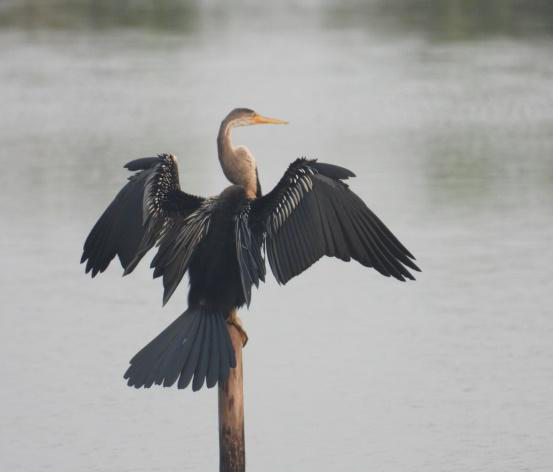
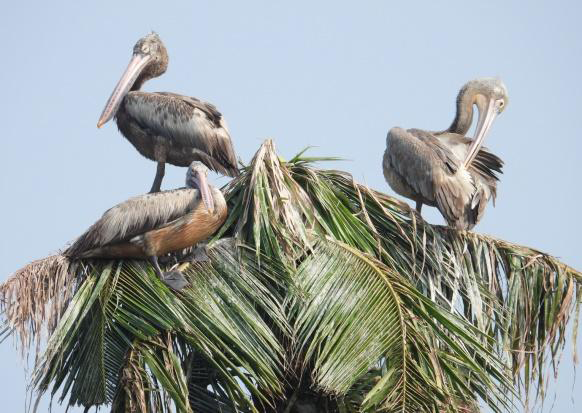
All these wetlands also support the globally threatened waterbirds. Most of the bird species are included in Least Concern of the IUCN Category. In India, 153 bird species are Globally Threatened. Three species of waterbirds are Near Threatened birds and these are observed from our sampling sites. They are: Oriental Darter (Anhinga melanogaster), Spot-billed Pelican (Pelecanus philippensis) and Black headed Ibis (Threskiornis melanocephalus).
During the winter season (Jan to March 2021 and Jan. 22), we had observed few nests of Spot-billed Pelicans (Figures 3 & 4). The nesting and parental care of Spot-billed Pelicans are very interesting. Using their large beaks they damage the top of coconut trees and construct their nest. Interesting behaviour about that, all the time they care for their family members and young ones.
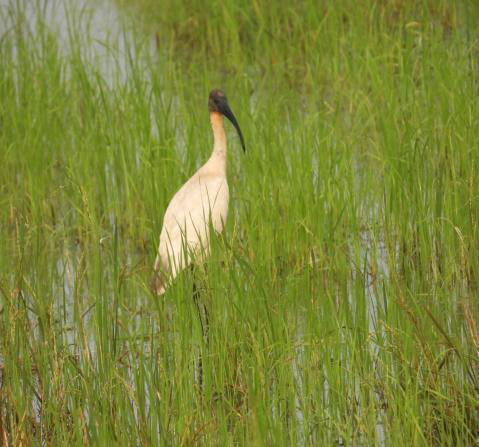
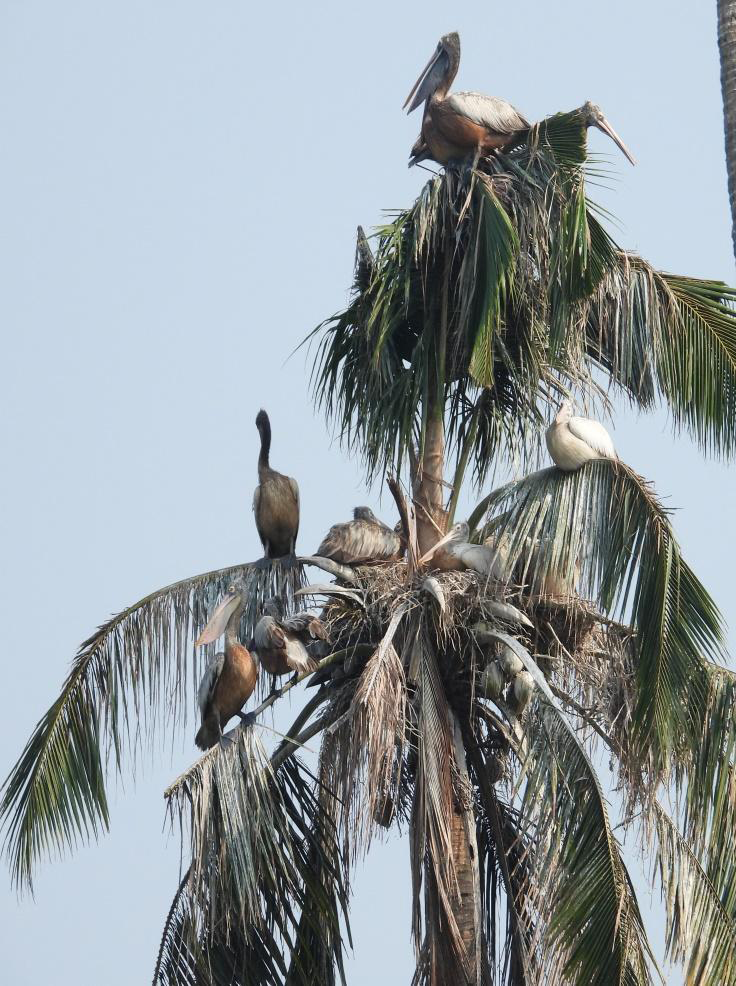
In addition to water birds we had counted the shorebirds also. They are Green Sandpiper, Wood Sandpiper, Whiskered tern, Little ringed plover, Red wattled lapwing, Yellow wattled lapwing and Black-winged stilt. Shorebirds are small wading birds and these birds are under the Avian Order Charadriiformes. They are migratory and resident birds inhabiting different ecological conditions, mainly shorelines, inland and coastal wetlands, agricultural fields Gutierrez S, et al. [20] and interior grasslands [21].
Many factors, which threaten the bird population, were identified during the study. Most threats are the cause of human actions. The leading threats observed in our sampling sites include Electric lines, Fishing net, Predators, Communication tower, Pesticides and Habitat destruction ,flood, climate change, hunting, loss of employees, plastics, water and soil pollution.
Discussion
The present study documented the waterbird diversity of different sampling sites from the winter season. Along with that, we had observed different types of waterbirds including shore birds and globally threatened ones. Sampling sites are the major feeding grounds of many Egrets, Herons, Cormorants and other waterbirds. The abundance of waterbirds is high in the Saline agroecosystem. Saline Agroecosystem consists of two farming practices (Pokkali farming)-Rice farming and Prawn farming. Most of the time the farm contains water sources. All water birds prefer their habitat in Open water and Water edges. This is the reason where the most waterbirds are observed in saline Agroecosystem.
All these wetlands also support the globally threatened waterbirds. Most of the bird species are included in Least Concern of the IUCN Category. In India, 153 bird species are Globally Threatened [22]. Of these, Common pochard (Aythya farina), Marbled duck (Marmaronetta angustirostris), White- headed duck (Oxyura leucocephala) are three globally threatened waterbirds collected from Morocco at winter time [23]. Three species of waterbirds are Near Threatened birds and these are observed from our sampling sites. They are: Oriental Darter (Anhinga melanogaster), Spot- billed Pelican (Pelecanus philippensis) and Black headed Ibis (Threskiornis melanocephalus). 13 species of globally threatened shorebirds had been observed at Nijhum Dwip National Park [24]. The Blue winged Goose (Cyanochen cyanoptera) observed from Lake Arekit, Southern Ethiopia. The abundance of globally threatened waterbirds has been reduced by the effect of invasive plant species, water hyacinth in Nepal [25]. Globally threatened waterbirds are mainly threatened from anthropogenic factors [23].
The different shorebirds had been observed in rice paddies, ie, black-tailed godwits (Limosa limosa), common greenshanks (Tringa nebularia), and wood sandpipers (T. glareola) [26]. Lesser Yellowlegs (Tringa flaviped) is a medium sized shorebird and it can be identified from interior Alaska [27]. 12 Plovers including Piping Plover (Charadrius melodus) from Michigan’s Lake Superior Shoreline [28]. In our sampling sites, we counted the shorebirds. They are Green Sandpiper, Wood Sandpiper, Whiskered tern, Little ringed plover, Red wattled lapwing, Yellow wattled lapwing and Black-winged stilt. They are migratory and resident birds inhabiting different ecological conditions, mainly shorelines, inland and coastal wetlands, agricultural fields Gutierrez S, et al. [20] and interior grasslands [21].
Habitat protection is important to conserve bird communities. Major threats being faced by the wetlands are Habitat loss Yasue M, et al. and Wang C, et al. [29, 30], Climate change Gutiérrez, et al. [31], Solid waste dumping Aarif, et al. [32], Reclamation Nameer PO, et al. [33], Pollution Veeramani, et al. and Aarif, et al. [18, 19], waterfowls hunting at wetlands Stewart, et al. [34], Use of chemical pesticides Anoop, et al. [35], Flood or sea level rise Marchesiello P et al. [36] waste disposals, siltation, and intensive agricultural expansion Tilahun, et al. [37], building dams Hasan, et al. [38], Disturbance by livestock (feral Water Buffalo Bubalus bubalis and domestic cows) grazing has been listed as key threat to the high-tide roosts of waterbirds Mohsanin [39], accidental by catch shore fishing nets . Chowdhury, et al. [24] results in the decline in bird population. Migrant birds were disturbed by the action of tourists and local fishermen Aarif, et al. [19], Poaching Aarif, et al. [32], Illegal killing (deliberate hunting, poisoning and trapping) [40]. Threats identified for the shorebirds are trapping, lime shell mining and pesticide contamination Kannan, et al. [41], shorebirds in fishing gear [24].
Conclusion
Wetlands are the most productive ecosystems and it is the home of many waterbirds and shorebirds. It helps in maintaining the biodiversity of flora and fauna. Waterbirds use the wetland habitat for feeding, roosting, preening and parental caring, etc. Wetland ecosystems are important for feeding and roosting the area of many egrets, herons, cormorants, Shorebirds and other migratory birds and also support important populations of Globally Threatened waterbirds - Oriental Darter, Spot-billed Pelican and Black headed Ibis.
Acknowledgement
The research was supported by the University Junior Research Fellowship from Kerala University.
References
-
Kaur R, Brraich OS (2021) Abundance and Diversity of threatened birds in Nangal wetland, Punjab, India. J Threatened Taxa 13(12): 19733-19742.
-
Babu S, Thomas R (2022) The comparative study on the wetland Avifauna in the Pokkali fields of Ernakulam District, Kerala. Book: Impact of climate change on Hydrological cycle, Ecosystem, Fisheries and Food Security (1st Edn.), CRC Press.
-
Ali R, Shrivastava P, Gautham V (2022) Study on the Avifaunal diversity and Species Richness in and around UPPER Lake, Bhopal, India. Int J Appl Res 8(2): 121-126.
-
Akhtar S, Kabir MM, Hasan MK, Begum S (2009) Activity pattern of Bronze-winged Jacana (Metopidius Indicus) at Jahangirnagar University Campus, Bangladesh. J Life Sci 21(2): 111-120.
-
Ranjith P, Karunakaran KR, Avudainayagam S, Samuel ADV (2019) Pokkali Rice Cultivation system of Kerala: An Economic Analysis. I J Multi Res pp: 14-19.
-
Vijayan R (2016) Pokkali Rice Cultivation in Kerala. Agriculture Update 11(3): 329-333.
-
Jayan PR, Nithya S (2010) Overview of farming practices in the Water-logged areas of Kerala, India. Int J Agric & Biol Eng 3(4): 18.
-
George T, Jose S (1984) Pokali cultivation in kerala. Technical bulletin pp: 1-20.
-
Hoves JG, Bakewell D (1989) Shorebird Studies Manual. AWB publication 55: 362.
-
Ralph CJ, Droege S, Sauer JR (1995) Managing and Monitoring Birds Using Point Counts: Standards and Applications. Gen Tech pp: 161-168.
-
Hamel PB, Smith WP, Twedt DJ, Woehr JR, Morris E, et al. (1996) A land manager’s guide to point counts of birds in the Southeast. Gen Tech pp: 36.
-
Burnham PK, David RA, Jeffrey L (1980) Estimation of Density from Line Transect Sampling of Biological Populations. Wildlife Monograph 72: 3-202.
-
Grimmett R, Inskipp C, Inskipp T (2000) Birds of the Indian Subcontinent. Oxford University Press pp: 384.
-
Ali S, Daniel (2002) The Book of Indian Birds. In: 13th (Edn.), Oxford University Press pp: 326.
-
Mogaka DM, Muya S, Ndwigah F, Ndanganga P (2019) Diversity, Abundance, Richness and Birds of Conservation Interest in Nyando Sugar Belt, Muhoroni Sub-county, Lake Victoria Basin, Western Kenya. Open J Animal Sci 9(3): 268-285.
-
Volpato GH, Lopes EV, Mendonca LB, Boncon R, Bisheimer MV, et al. (2009) The use of the Point count Method for Bird survey in the Atlantic Forest. Zoologia 26(1): 74-78.
-
Buckland ST, Anderson DR, Burnham KP, Laake JL (1993) Distance Sampling: Estimating Abundance of Biological Populations. Chapman and Hall, London, pp: 446.
-
Veeramani A, Vinoth B, Ramakrishnan B, Mohanakrishnan H, Samson A (2018) Diversity and Habitat Selection of Wetland Birds in Nilgiris, South India. Int J Zoo Animal Biol 1(3): 000114.
-
Aarif KM, Basheer M (2012) The Waterbirds of Mavoor wetland, Kerala, South India. World J Zoo 7(2): 98-101.
-
Gutierrez S, Jorge M, Gomez A, Guzman MJS, Navedo JG, et al. (2015) Large numbers of shorebirds consistently use temperate inland freshwater habitats during winter and migration. Plos One.
-
Sivaperuman C, Jayson EA (2012) Population fluctuations of shorebirds in Kolebirds of kerala, India. Annals of Forestry 20(1): 129-144.
-
Deepa KM, Geoge JM (2017) Globally Threatened species of birds recorded from Pokali wetland, Kerala, South India. J G Bio Sci 6(9): 5222-5226.
-
Ouassou A, Dakki M, Agbani DM, Qninba A, Hamoumi (2021) Distribution and Numbers of Three Globally Threatened Waterbird Species Wintering in Morocco: The Common Pochard, Marbled Teal, and White-Headed Duck. I J of Zoo 2021: 8846203.
-
Chowdhury S, Foysal M, Shahadat O, Prince NU, Mohsanin S, et al. (2021) Globally threatened shorebirds of Nijhum Dwip National Park and management implications. IWSG 127(3): 244-251.
-
Basaula R, Sharma HP, Belant J, Sapkota K (2021) Invasive Water Hyacinth Limits Globally Threatened Waterbird Abundance and Diversity at Lake Cluster of Pokhara Valley, Nepal. Sustainability 13(24): 13700.
-
Choi SH, Choi G, Nam HK (2022) Impact of rice paddy agriculture on habitat usage of migratory shorebirds at the rice paddy scale in Korea. Sci Rep 12: 5762.
-
Martin EC, Doherty PF, Jochum KA, Bagley CF (2022) Abundance and habitat use estimates show Lesser Yellowlegs (Tringa flavipes) breed in high numbers in interior Alaska. Avian Conservation and Ecology 17(1): 8.
-
Waterman R, Garvon J (2022) Cathemeral Behavior of Piping Plovers (Charadrius melodus) Breeding along Michigan’s Lake Superior Shoreline. Birds 3(1): 72-83.
-
Yasue M, Dearden P (2009) The Importance of Supratidal Habitats for Wintering Shorebirds and the Potential Impacts of Shrimp Aquaculture. Environmental Management 43: 1108.
-
Wang C, Yu X, Xia S, Liu Y, Huang J, et al. (2022) Potential Habitats and Their Conservation Status for Swan Geese (Anser cygnoides) along the East Asian Flyway. Remote Sensing 14(8): 1899.
-
Gutiérrez J, Moore J, Donnelly P J, Dorador C, Navedo J G, et al. (2022) Climate change and lithium mining influence flamingo abundance in the Lithium Triangle. Proc R Soc B 289(1970): 20212388.
-
Aarif KM, Prasadan PK (2014) Conservation issues of KVCR, the wintering ground and stop-over site of migrant shorebirds in south west coast of India. Biosystematica 8(1-2): 51-57.
-
Nameer PO, Jayadevan P, Tom G, Sreekumar, Sashikumar C (2015) Long term population Trends of Waterbirds in Kerala over three decades. In: Gopi GV, et al. (Eds.), ENVIS Bulletin Wildlife and Protected Areas in India: Waterbirds of India, pp: 44-69.
-
Stewart C, Garrick E, McDougall M, Moss Z (2021) Waterfowl hunting wetlands as habitat for two New Zealand eel species. New Zealand J of Z 49(1): 67-77.
-
Anoop N, Mathews TJ, Vinayan PA, Jayakumar S, Sujin NS, et al. (2015) Status and conservation of water birds in Panamaram heronry, Kerala and implication for management. Asi J of Con Bio 4(1): 76-80.
-
Marchesiello P, Nguyen NM, Gratiot, Loisel H, Anthony EJ, et al. (2019) Erosion of the coastal Mekong delta: assessing nature against man-induced processes. Conti Shel Res 181: 72-89.
-
Tilahun B, Hailu A, Abie K, Kidane T, Alemkere A (2022) Avifauna diversity and conservation challenges in Lake Arekit, Southern Ethiopia. Israel Journal of Ecology and Evolution.
-
Hasan S, Evers J, Zwarteveen M (2020) The transfer of Dutch Delta Planning expertise to Bangladesh: A process of policy translation. Environmental Science & Policy 104: 161-173.
-
Mohsanin S (2014) Survey of wintering Indian Skimmer Rynchops albicollis in Bangladesh. Birding ASIA 21: 105- 106.
-
Cajiao EG, Morrison TH, Woodworth BK, Lees AC, Naves LC, et al. (2020) Extent and potential impact of hunting on migratory shorebirds in the Asia-Pacific. Biological Conservation 246: 108582.
-
Kannan V, Pandiyan J (2012) Shorebirds (Charadriidae) of Pulicat Lake, India with Special Reference to Conservation. World Journal of Zoology 7(3): 178-191.
- California Red-Legged Frog and Non-Listed Amphibians Response to Non-Native Fish Removal
- Industrial Standardization of the Bio-OS: Algorithmic Codification of Resilience Engineering Guidelines and Version V8 Architecture
- Climate Variability and the Sustainability of Snail Farming in Nigeria: Past Trends, Present Challenges and Potential Outlook
- The Evaluation of the Surveillance System of Anthrax in Gilgit-Baltistan, Pakistan, 2018
- Natural Decline to Extinction of A New Zealand Rabbit Population
- Mitochondrial Bio-Logistics: Steering Co-Enzyme Q10 and Lycopene Synergies within the Science 4.0 Bio-OS Framework