
First-Time Event in Lebanon: Releasing 2 Birds with GPS Trackers
Lebanon is situated on one of the most important lines of migration in the world, the African-Eurasian Flyway. Unfortunately, millions of birds are killed/taken each year in an illegal way. Some of them were retained from poachers or reported by environmental activists or civilian as alive, transmitted to the Raptor Rescue Center managed by the Lebanese Association for Migratory Birds to follow a program of rehab and release after achieving a successful assessment of state of health with a GPS tracker on their back, to monitor the choice of their second chanced life. None of the birds continued his migration, the Black Kite Milvus migran went to Syria and came back to the Lebanese bords. The Short-toed Snake Eagle Circaetus gallicus stayed roaming in the area until the GPS tracker shutdown.
Introduction
Each year, millions of birds pass over Lebanon. Hundreds of thousands of these birds are migratory raptors, storks and other large soaring birds, along with millions of passerines and other species. Unfortunately, the estimate number of killed/taken birds is approximately more than two million birds on average each year. Brochet, et al. [1] making it one of the worst countries for bird poaching on the African- Eurasian Flyway. In 2021, this number raised to be ranging from three million and a half and 5 million each year [2]. As a bird conservative Non-Governmental Organization, the Lebanese Association for Migratory Birds took the initiative since 2009 to rescue wounded birds, rehabilitate them, and release those capable to perform their role in nature without any defect. This time, the experience was to monitor the released birds after spending more than 6 months in the Rescue Center. These birds were equipped by a GPS transmitter.
Methods
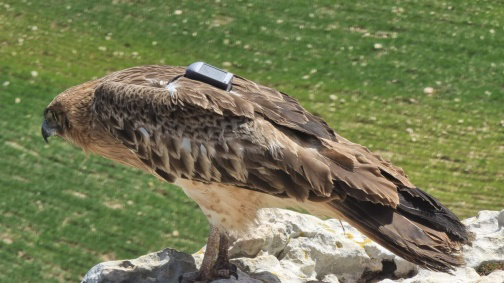
On the 2nd of April 2022, two of us, Michel Sawan and Charbel Namnoum released 2 raptors with GPS trackers from Terbol, Minieh-Dannieh District in north Lebanon. The first one was a Black Kite Milvus migran (Figure 1), a spring passage migrant and winter visitor, that was shot earlier on the 9th of September 2021, treated for a broken bone (humerus) and the second one was a Short-toed Snake Eagle Circaetus gallicus (Figure 2), a summer breeder and passage migrant, that was shot on the 22nd of October 2021 and treated for a dislocated elbow and a broken Ulna.
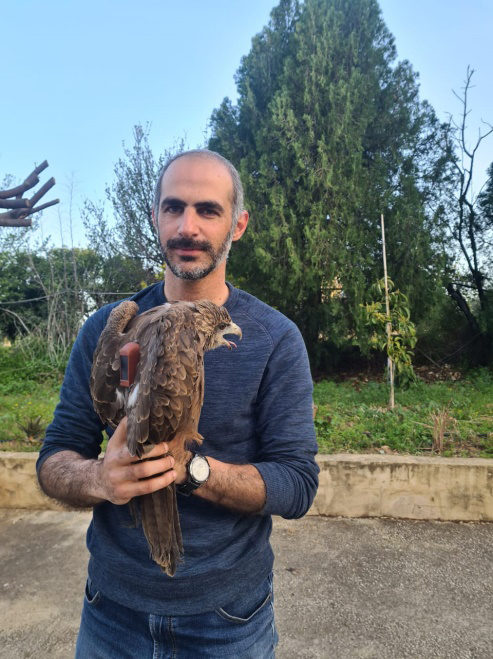
Black Kite (Milvus migran) is a common passage migrant and scarce winter visitor. One of Afro-Eurasia’s most widespread raptors, often foraging close to humans, even in cities and rubbish tips. With a distribution that spreads over four continents, the Black Kite is probably the world’s most abundant bird of prey where it occupies a wide variety of natural and artificial habitats. Overall, the population has declined owing to poisoning, shooting, pollution of water and over-use of pesticides [3].
Short-toed Snake Eagle (Circaetus gallicus) is Large, slightly ungainly raptor with long and very broad wings, a shortish tail, and a conspicuously big head. Pale belly and underwings contrast with the darker head in most adults, but juveniles have pale heads. All age groups have a tendency to look a bit disheveled. On perched birds look for the owl-like face and unfeathered legs. Hunts over open areas, spending lots of time hovering with rowing wingbeats into the wind, feeds mostly on snakes and lizards [4].
These birds were under rehab for the whole period in a cage sizing 12x6x3 meters and fed at least 4 times a week. They spent more than 6 months in the rescue center. The aim was to know what is their destiny of the released raptors in Lebanon since it was a first-time event, and many birds were released before without having any clue about their fate. The GPS trackers were wrapped in a form of Bag-pack on the back of the birds.
The GPS trackers were sent to us by Ornitel Company, the aim was to study the migration of the rehabilitated birds released from the area that they were shot at. Neither of the birds was tamed. They were fed in large cages without direct human contact beside the treatment period that lasted for 14 days. They were given food and water independently. The Black Kite was feeding on rodents, mammals and insects and the Short-toed-snake eagle was feeding on lizards most [5]. Before they were released, the assessment consisted on their ability and endurance to fly and to hunt. They were given living food to catch and eat in a sense to conserve their instinct of hunting. Then the birds were equipped by a GPS tracker (OrniTrack-10 – Solar Powered Transmitter). Data was collected by email and direct access to the company website every 6 hours for the first month, once every 24 hours, then once per week.
The GPS model used is “OrniTrack-10 - solar powered transmitter” This model is suitable for birds weighing 300 grams and up. Key characteristics:
- Housing: backpack design, aerodynamic, strong and waterproof, can be made in one of four available colors: white, grey, black or brown
- No external antennas
- Size: weight 10-12 grams, dimensions 47×18×12 mm (modification with elevated solar panel weights 12 grams)
- GPS receiver: high sensitivity 72 channel module
- GSM/GPRS/3G transceiver OR GSM/4G transceiver
- Internal battery: Lithium-Polymer with under- and over- charge protection
- Fully charged battery is sufficient for logging about 800 positions without additional recharge (under optimal GPS satellite view and good GSM network coverage, GPS intervals - 5 minutes, GSM intervals - 12 hours)
- Solar charger: high efficiency multi-junction solar panel
- GPS logging intervals: from 1 second to 48 hours (user selectable)
- Data storage: 2 MB flash memory capable of storing at least 30,000 records
- Data upload: via GSM/GPRS/3G network
- GSM/GPRS/3G network connection interval: from 10 minutes to 192 hours (user selectable)
- SMS message with 10 GPS positions when GPRS/3G network is not available
- Logged data are stored in memory if GSM network is unavailable
- Geofences: 2 zones with separate sets of parameters. Zones defined by user by multiple rectangles (up to 10 per zone)
- High frequency (up to 50 Hz) sensor (accelerometer, magnetometer, temperature, light intensity) data collection on a separate schedule
- Day & night mode
- Operational temperature: from -10 to +60 °C
- Control: user remotely controls GPS & GSM schedules, day & night mode settings, sensor data recording settings and geofence settings via online control panel.
- Main data record includes: UTC date & time, GPS position, GPS altitude, speed, direction, HDOP, battery voltage, battery charging current, instant acceleration (3 axes), temperature, magnetic field strength (3 axes)
- Transmitter firmware update over the air (OTA)
Results
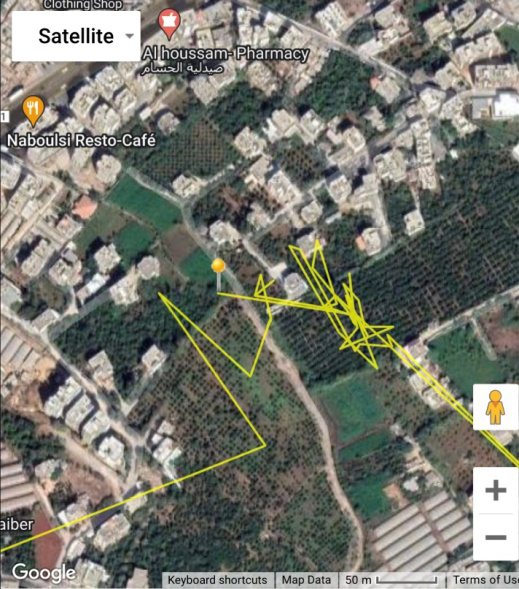
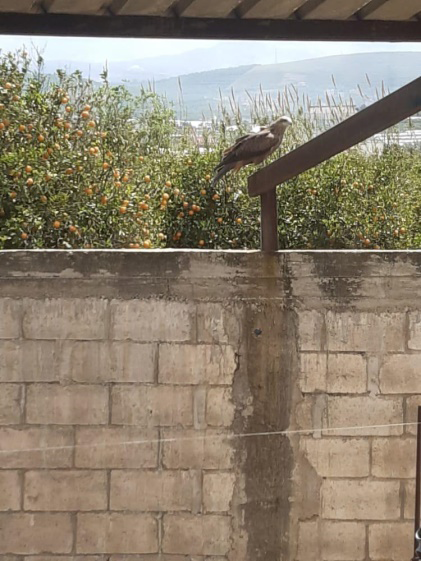
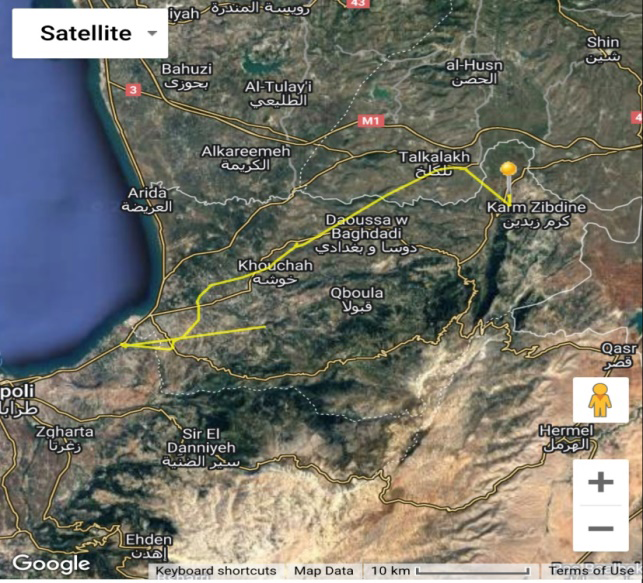
The results came deceiving at the beginning. The Black Kite failed to fly from the first attempt. It was tagged with the GPS tracker on its back and released which made it fly uncommonly with something wrapped on its back and started screeching trying to remove it. We had to catch it back and release it in the rehab cage for 5 days so it got used to it before we decided to release it again. The second tryout was successful and the Black Kite left the area where it was released and stayed for 2 weeks in a small town (Figure 3), 6 km away from that point. After investigation, the Black Kite was found alive, resting on the roof of a house (Figure 4). The householder said that he saw it coming and eating chicken necks with his cats every day, then go to rest on the top of a pine tree. Then, the kite took a way straight up to the north of Lebanon and left the borders toward Tal-Kalakh, Syria, where it stayed for 3 days and then came back to Lebanon for its final destination where the coordinates from the GPS tracker send the exact same location till the 20th of June 2022, in a green field near stone quarry in Machta Hammoud, Aakkar District-north Lebanon, 2 km away from the Syrian borders (Figure 5).
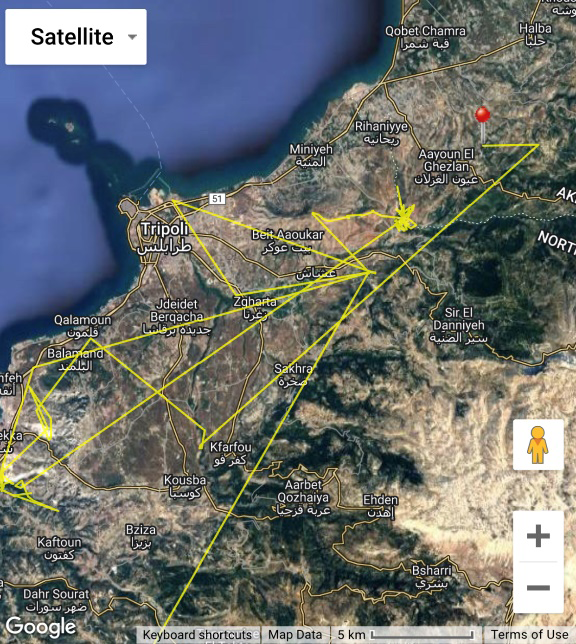
The Short-toed snake Eagle stayed in the area where it was released for a week. It was roaming for up to 126 meters altitude, flying from a rocky cliff to another, not affected by thousands of birds from the same species that were flying across the sky. Then, it moved to another area for another week that was 10 km away from the start point and then all of a sudden, the eagle flew 45 km way back south to Al Heri (Chekka-Batroun District) and stayed there till the 15th of June 2022 without moving until the GPS battery turned off because it was not recharging properly for unknown reasons, assuming the stripes were cut off or the solar panel was covered by the feathers. Then a signal came from the GPS tracker indicating that the bird travelled again for more than 50 km distance up to the north to a town in Akkar District named Saysouk in north Lebanon, and the signal continues to come from the same area (green area with bush and trees) till today the 20th of July 2022 (Figure 6).
Analyzing the results, the theory that might came up to our mind is that not all the birds that were released previously were able to go back successfully to wildlife. Maybe they were shot again due to the high rate of poaching in the country. Maybe there were not able to blend again into the wilderness. The 2 birds failed to complete their task, they couldn’t continue their migration also, and decided to stay in the nearby areas. Assuming that the injury was not successfully treated or healed with a bad bone consolidation is to be omitted because the GPS trackers were active for a certain period enough to prove that the birds were foraging to survive for more than 10 weeks. Add that the altitude diagram showed that the birds reached up to 300 m altitude of height and more than 45 km of distance in one day which indicates that they can fly normally. Tracking the birds on the field failed, because the given coordinates from the tracker were not exact.
Conclusion
Maybe wounded birds should not be kept too long in rehabilitation rescue center, they might find themselves comfortable enough to stay roaming in the area and lose the ability to blend into wilderness. Even the least positive signal from human, can create a link of dependence for living (case of the Black Kite with food dependency).
Acknowledgment
Many thanks to Matthias Prommer and Myndaugas Dagys and Ornitel for the GPS trackers, to Fadi Habib who was feeding the birds and monitoring all their long stay at the rescue center.
References
-
Brochet AL, Jbour SH, Sheldon RD, Porter RI, Jones VR, et al. (2019b) A preliminary assessment of the scope and scale of illegal killing and taking of wild birds in the Arabian peninsula, Iran and Iraq. Sandgrouse 41: 154- 175.
-
Fraine A, Hirschfeld A, Attard GM, Scott L, Ramadan- Jaradi G, et al. (2021) The international dimension of illegal bird hunting in Lebanon. Sandgrouse 43: 230-240
-
Porter R, Aspinal S (2010) Birds of the Middle East. Helm, UK.
-
Svensson L, Mullarney K, Zetterstrom D (2009) Collins Bird Guide (2nd Edition). Harper Collins, London, UK.
-
David TS, Orta J, Marks JS, Garcia EFJ, Kirwan GM (2021) Black Kite (Milvus migrans), version 1.1. In Birds of the World (S. M. Billerman, Editor). Cornell Lab of Ornithology, Ithaca, NY, USA.
- California Red-Legged Frog and Non-Listed Amphibians Response to Non-Native Fish Removal
- Industrial Standardization of the Bio-OS: Algorithmic Codification of Resilience Engineering Guidelines and Version V8 Architecture
- Climate Variability and the Sustainability of Snail Farming in Nigeria: Past Trends, Present Challenges and Potential Outlook
- The Evaluation of the Surveillance System of Anthrax in Gilgit-Baltistan, Pakistan, 2018
- Natural Decline to Extinction of A New Zealand Rabbit Population
- Mitochondrial Bio-Logistics: Steering Co-Enzyme Q10 and Lycopene Synergies within the Science 4.0 Bio-OS Framework