
Daytime Behavior Patterns of Captive South China Tiger with Seasonal Differences
The daytime behavior of South China tiger was studied in Hangzhou Safari Park from March 2019 to February 2021. The south China tiger was watched and recorded by instantaneous scanning method. The ethogram of the South China tiger was defined according to the actual observation. During the observation, 6 times were recorded every hour, and the interval of each recording was 5-10 min. The results showed that the dominant behaviors of South China tiger (Panthera tigris amoyesis) (behavior frequency ≥ 10%) were moving (29.73±4.96%), lateral lying (20.14±3.66%), prone lying (16.44±11.56) and watching (13.67±4.33%); The common behaviors (behavior frequency between 1% and 10%) were embellishing (5.85±0.81%), turning over (2.43±0.57%), marking (2.44±0.84%), feeding (2.21±1.04%), playing (1.33±0.96%), defecation (1.18±0.46%), vocalizing (1.14±0.44%) and grabbing (1.01±0.98%); The rare behaviors (behavior frequency < 1%) were sniffing (0.71±0.37%), holding objects (0.64±0.64%), cunnilingus (0.54±0.81%), supine (0.36±0.29%), straddling (0.11±0.22%) and yawning (0.10±0.20%). Therefore, South China tiger has the problem of long rest time, short moving and feeding time. In the long run, it will lead to some psychological and physiological problems, so it may be one of the effective ways to improve this situation by increasing the feeding difficulty of South China tiger. Principal component analysis showed that the behavior pattern of South China tiger was mainly formed by marking, lateral lying, prone lying, watching, embellishing and moving. Owe to oestrus and physiological factors, the marking behavior time in spring and summer was significantly higher than that in autumn and winter. Related to climate, the lateral lying behavior time in autumn and winter was very significantly higher than that in spring and summer, the prone lying behavior time in spring and summer was very significantly higher than that in autumn and winter, so it is speculated that moderate interference is conducive to improve the behavior diversity of South China tiger. The time of embellishing behavior in spring was significantly higher than that in the other three seasons, which was related to hair changing. The time of watching behavior has very significantly different among autumn-winter, spring and summer, while the time of moving behavior in summer was very significantly lower than that in the other three seasons, indicating that certain measures need to be taken to appropriately reduce the time of stereotyped behavior in autumn, winter and spring.
Introduction
Animal behaviour studies can provide basic information for the conservation of endangered and rare animals [1]. However, descriptive behaviour does not serve this purpose, so comparative behavioral studies of animals have emerged. Comparative studies can reveal which animal behaviour is influenced by environmental conditions, as well as revealing differences in animal behaviour between environmental conditions and the reasons for them.
Panthera tigris amoyesis is one of the most endangered subspecies in the eight existing tiger subspecies [2]. Protection of South China tiger faces severe challenges because the wild population is almost extinct [3, 4]. Due to the small number of established species in captive south China tigers, there are problems such as loss of genetic diversity and low reproductive rate [5]. Therefore, behavioral studies on the South China tiger mainly focus on captive individuals, including maternal and juvenile behavior [6], physiology and ecology [7], behavioral rhythm of free-range individuals [8], the effect of abundance on behavior [6, 9] wild release [8, 10], and comparison of juvenile warning behavior under different living conditions [11]. These studies revealed part of the behavioral information of the South China tiger, but the difficulty of captive breeding of the south China tiger remains.
In this research, the south China tiger had obvious problems such as poor physical fitness and inflexible behavior, which may be one of the reasons for the reproduction difficulties. This paper conducted a comparative study on the behavior of south China tiger in different seasons to explore the seasonal differences and influencing factors of its behavior. Through the comparative study of behavior, this paper aims to reveal the causes of the problems of low physical fitness and rigid behavior of south China tiger, and provide scientific reference for improving the breeding environment, optimizing the seasonal breeding management and improving the fecundity.
Research Location
The research site is located in the Hangzhou Safari Park (hereinafter referred to as the zoo) in Fuyang District, Hangzhou. The zoo covers an area of 270 hm2. It is the largest wildlife park in East China, with the best ecological environment and the most abundant species. It has been listed as “Key Laboratory of Animal Protection and Breeding, Scientific Research Base”, “Zhejiang Endangered Wildlife Rescue Center”, “Zhejiang Youth Science Education Base”.
Located in the subtropical monsoon climate zone, the zoo has four distinct seasons with cold winters and hot summers. There are abundant rainfall and light. The vertical change of climate is obvious, and there are more disastrous weather. In spring, warm and wet air flow begin to be active, the weather turns warm, often change violent weather, the temperature is wavy rise. The average temperature in spring is 19.1℃, the precipitation is 426.80 mm, the rainy days are 41.7 days, and the sunshine is 351.1 hours. In summer, warm and humid ocean air flow and cold air from the north often meet in the Jianghuai Region, forming continuous rainy weather, and sometimes heavy rain and flood occur. It is humid and muggy plum rain season. The average summer temperature is 26.5℃, the precipitation is 546.60 mm, and the rainy day is 44.7 days. The sunshine is 649.4 hours. The average temperature in autumn is 14.5℃, precipitation is 144.80 mm, rainy days are 20.5 days, and sunshine is 297.1 hours. Controlled by cold air masses in winter, the climate is cold and dry; the average temperature in winter is 6.4℃, precipitation is 339.60 mm, rainy days are 45.4 days, and sunshine is 365.6 hours.
Since 2014, the zoo has introduced 4 South China tigers and gradually established a captive breeding area for South China tigers. Up to now, the captive population has grown to 10 adults and 5 larvae. The tiger enclosure has a concrete floor. There is a sink and a board in each enclosure for the tiger to drink water and lie down. The tiger enclosure are connected to each other and to the playground through iron gates controlled by pulleys. The activity site is 2 ~ 3M deep and is equipped with rocks, artificial caves, ponds, fallen trees and pavilions.
Research Methods
Seven adult South China tigers of similar size were selected, including 2 males and 5 females. The daily observation time is 7:00 ~ 18:00 (close to the sunrise and sunset time in winter). Therefore, from March 2019 to February 2021 (due to COVID-19’s pause), each individual carried out a 39 days observation, including spring (3~5) 9 days, summer (6~8), autumn (9~11) and winter (12~2) 10 d, at least 3 days per month, the total observed days were 78 days.
The target animals were sampled by instantaneous scanning and recorded 6 times per hour with an interval of 5 ~ 10 min. When recording, the instantaneous behavior record takes the lead, regardless of the duration; other behavior records shall last for more than 30 s. The so-called instantaneous behavior in this paper refers to the behavior with a very short duration, which is generally no more than 1 min, such as vocalization, turning over, etc.
Referring to Jiang ZG, et al. [12, 13], the behavior spectrum of South China tiger is defined as follows according to the actual observation:
• Moving: The movement of the limbs changes the position of the body, including walking, running, and jumping. It is often expressed as moving back and forth or turning in a circle indoors.
• Watching: Standing or squatting, looking ahead or around.
• Prone lying: lying on stomach in one place, with abdomen touching the base ground, eyes are open or closed, or open eyes without looking around, and body relaxes.
• Supine: Lying in one place with the waist touching the base ground, eyes open or closed, eyes open without looking around, body relaxes.
• Lateral lying: Lying in one place, the left or right side of the body touches the base ground, the eyes are open or closed, the eyes are open without looking around, and the body relaxes.
• Embellishing: The act of scratching with claws and licking each part of the body with the tongue (including licking each other); in addition, the act of licking the ground or surrounding objects can be regarded as cleaning the enclosure, so it is regarded as an act of embellishment.
• Feeding: The body is standing or squatting or lying down, eating the food or water provided by the breeder, and drinking water in the play pool. Sometimes the duration is short, so it is recorded as an instantaneous behavior.
• Vocalizing: The body is standing or lying or squatting, sometimes facing visitors or other tigers, sometimes not facing any object, making a sound (large or small) in the mouth, recorded according to instantaneous behavior.
• Turning over: During the rest, tiger will turn its body at regular intervals to change sleeping posture, and record it as an instantaneous behavior.
• Defecation: Standing up, squatting down with hind limbs, expelling urine or feces, and recording according to instantaneous behavior.
• Planning: The limbs are upright, and the two forelimbs are scratching the ground, walls, trees or doors and windows. Sometimes they seem to be climbing walls or trees. Since the differences between them are not clear, they are all classified as planing. Record by momentary behavior.
• Sniffing: Use your nose to perceive the ground or other objects; when recording, as long as the behavior occurs, the duration is not considered.
• Holding objects: Biting grass or other objects on the ground or lawn with your mouth. This is a kind of play behavior and is recorded as an instantaneous behavior.
• Marking: The body is standing, the hind limbs are generally not squatting, the buttocks are aligned with an object, the tail is upturned, and a small amount of urine is quickly discharged or the body rubs, thereby leaving an odor; the male tiger uses this to indicate his domain range, The female tiger uses this to indicate its heat state, and records it according to instantaneous behavior.
• Cunnilingus: Generally, a female tiger licks her own pubic area. It may be caused by the physiological changes in the pubic area. It is recorded as an instantaneous behavior.
• 16 Straddling: The male tiger climbs on the female tiger’s back and intends to mate. The female tiger accepts or rejects it as this behavior, and is recorded as an instantaneous behavior.
• Playing: A game play behavior, manifested as playing with objects or rolling alone, or screaming, touching, chasing or non-harmful fights between two parties, which are recorded as instantaneous behaviors.
• Yawning: The tiger opened his mouth and breathed in deeply, and then exhaled. It may be due to drowsiness. Recorded according to instantaneous behavior.
All data shall be sorted and processed on Excel and plotted. Taking the daily behavior time distribution as the basic unit, the average value of the percentage of each behavior frequency is calculated, which is called behavior frequency for short. The calculation formula is as follows: Because this percentage has the same meaning as the proportion of behavior time, it can be used to explore the behavior time distribution and activity law of South China tiger. SPSS statistics 24.0 is used for data analysis, and K-S test is used to judge whether the data samples obey normal distribution. Analysis of variance was used for behavior time allocation, multiple comparative analysis was conducted for those with significant or extremely significant differences, and the composition of behavior patterns affected by seasons was found out through principal component analysis. Because the time period is paired and the selected South China tiger individuals are relatively close in size, the difference of behavioral rhythm adopts nonparametric paired data signed rank sum test. The significance level is set to α=0.05.
Results
Behavioral Time Allocation and Rhythm
The diurnal behavior of South China tiger can be divided into three categories: dominant behavior (behavior frequency≥10%), moving (29.73±4.96%), lateral lying
(20.14±3.66%), prone lying (16.44±11.56) and watching
(13.67±4.33%); The common behaviors (behavior frequency
between 1% and 10%) were modification (5.85±0.81%),
$$ \text{turning over} (2. 4 3 \pm 0. 5 7 \%), \text{ marking} (2. 4 4 \pm 0. 8 4 \%), $$
feeding (2.21±1.04%), playing (1.33±0.96%), defection
(1.18±0.46%), cocalizing (1.14±0.44%) and scratching
(1.01±0.98%); The rare behaviors (behavior frequency < 1%)
were sniffing (0.71±0.37%), object holding (0.64±0.64%), cunnilingus (0.54±0.81%), supine (0.36±0.29%), climbing (0.11±0.22%) and yawning (0.10±0.20%).
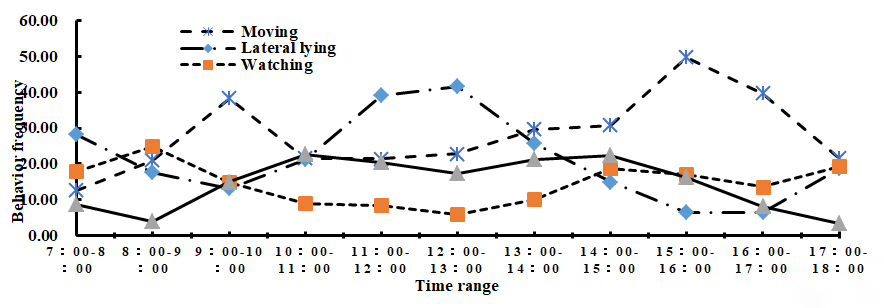
From the perspective of behavioral rhythm, the dominant behavior is mainly manifested as follows: the peak of mobile behavior occurs at 9:00-10:00 a.m. and 15:00-16:00 p.m., the peak of lateral lying (11:00-13:00) and prone lying behavior (10:00-15:00) occurs at noon, the waiting behavior maintains a high level, and decreases slightly at noon (Figure 1).
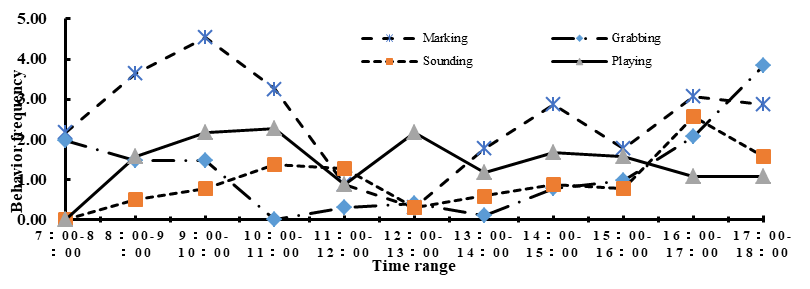
Common behaviors mainly include: modification, turning over and grabbing behaviors. They have two peaks in the morning and afternoon (7:00-8:00 and 17:00-18:00), defecation (8:00-9:00), play (10:00-11:00) and marking (9:00-10:00). Feeding and vocalizing behaviors only have one peak in the afternoon (16:00-17:00) (Figure 2).
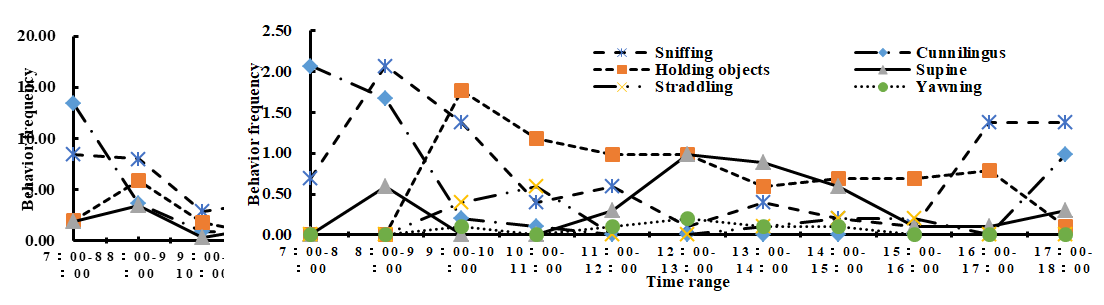
The main manifestations of rare behaviors are:
the behaviors of sniffing (8:00-9:00 and 17:00-18:00), cunnilingus (7:00-8:00 and 17:00-18:00) mainly have two peaks in the morning and afternoon, the behaviors of holding objects (9:00-10:00) and straddling (10:00-11:00) only have one peak in the morning, and the behaviors of supine and yawning only have one peak in the noon (12:00-13:00) (Figure 3).
Comparison of Seasonal Differences in Behavioral Time Allocation
Except straddling only occurs in winter, yawning only occurs in spring, and cunnilingus only occurs in spring and summer, other behaviors occur in all seasons. By K-S test, the data of the four seasons obey the normal distribution (P > 0.05), and the analysis of variance can be carried out. The analysis of variance showed that the seasonal differences of behavior time were moving, watching, prone lying, modifying, turning over, marking, defection, feeding, playing, holding objects, sniffing and grabbing (P < 0.01); There were significant differences in lateral lying and supine (P<0.05);
There was only vocalizing with no significant difference (P>0.05).
From the perspective of dominant behavior, the time of moving in summer was significantly lower than that in other three seasons (P < 0.01); The time of lateral lying in spring was significantly lower than that in autumn and winter (P < 0.01); There was a significant difference in the time of watching behavior among summer, spring, autumn and winter (P < 0.01); The time of prone lying in summer and spring was significantly higher than that in autumn and winter (P < 0.01) (Table 1).
| Behavior types | Spring | Summer | Autumn | Winter |
|---|---|---|---|---|
| Martingale | 1.86B | 1.59B | 3.00A | 2.97A |
| Lateral lying | 15.77B | 18.34AB | 23.23A | 25.06A |
| Sounding | 1.65 | 1.36 | 0.86 | 0.72 |
| Turning over | 1.79bC | 3.07Aa | 2.17BbC | 2.81AaB |
| Yawning | 0.41 | 0 | 0 | 0 |
| Prostrating | 20.45B | 31.20A | 9.15C | 5.34C |
| Watching | 11.91B | 8.24C | 18.08A | 17.44A |
| Straddling | 0 | 0 | 0 | 0.47 |
| Defecation | 0.83Bc | 1.20AaBb | 1.90Aa | 0.88Bbc |
| Feeding | 3.10A | 1.05B | 1.61B | 3.22A |
| Cunnilingus | 0.41 | 1.75 | 0 | 0 |
| Playing | 0.21B | 2.21A | 0.83B | 2.16A |
| Holding objects | 0.41B | 0.51B | 1.50A | 0.06B |
| Embellishing | 7.99Aa | 6.18ABb | 4.72Bc | 4.84Bbc |
Table 1: ** Seasonal differences in the time distribution of South China tiger behaviors.
Note: For the letters in the upper right corner of the numbers in the table, the difference is not significant if there are the same letters, otherwise the difference is very significant if there are different uppercase letters (P < 0.01), and the difference is significant if there are different lowercase letters (P < 0.05). Table 1: Seasonal differences in the time distribution of South China tiger behaviors.
In terms of common behavior, the time of modification was significantly higher in spring than in summer (P < 0.05), and significantly higher in summer than in autumn and winter (P < 0.05); The feeding time in winter and spring was significantly higher than that in autumn (P < 0.01), and that in autumn was significantly higher than that in summer; The time of turning over in winter and summer was significantly or very significantly higher than that in spring and autumn;
The time of grabbing in autumn was significantly higher than that in other three seasons (P < 0.01); The time of marking and playing in spring and summer was significantly higher than that in autumn and winter (P < 0.01); The time of defection in autumn was significantly higher than that in winter and spring (P < 0.01) (Table 1).
In terms of rare behavior, the time of sniffing behavior in autumn was significantly or extremely significantly higher than that in other three seasons, and that in winter was significantly higher than that in summer (P < 0.05); The time of holding objects in autumn was significantly higher than that in other three seasons (P < 0.01); The time of supine in winter was significantly higher than that in autumn (P < 0.01) (Table 1).
Principal component analysis was conducted for behaviors with significant or extremely significant seasonal differences and time accounting for more than 1%. The results showed that the cumulative contribution rate of five principal components was 83.74% (Table 2). Select the principal component with the absolute value of the eigenvector≥0.7, combined with the analysis results of the above multiple comparisons, and draw the following conclusions.
| Behavior type | Principal Component | ||||
|---|---|---|---|---|---|
| 1 | 2 | 3 | 4 | 5 | |
| Marking | 0.901 | -0.209 | -0.058 | -0.207 | -0.030 |
| Lateral lying | 0.185 | -0.885 | -0.022 | 0.061 | -0.134 |
| Turning over | 0.51 | 0.565 | -0.128 | 0.463 | -0.157 |
| Prone lying | -0.058 | 0.007 | 0.744 | -0.023 | 0.112 |
| Watching | -0.596 | 0.069 | -0.699 | 0.063 | 0.181 |
| Feeding | -0.231 | 0.548 | 0.613 | -0.176 | -0.268 |
| Embellishing | -0.175 | -0.076 | -0.03 | 0.925 | 0.108 |
| Moving | -0.049 | 0.054 | 0.027 | 0.075 | 0.958 |
| Eigenvalue | 1.859 | 1.758 | 1.222 | 0.999 | 0.86 |
| Cumulative (%) | 23.24 | 45.22 | 60.5 | 72.99 | 83.74 |
Table 2: Principal component analysis of the time distribution of South China tiger behaviors. There are seasonal differences in
Table 2: Principal component analysis of the time distribution of South China tiger behaviors. There are seasonal differences in the behavior time distribution of South China tigers, mainly as follows: the first principal component contributes the most is marking behavior, which was significantly higher in spring and summer; The second principal component contributed the most is lateral lying, which was significantly higher in autumn and winter; The third principal component contributed the most is prone lying and watching, which were significantly higher in spring, summer, autumn and winter, respectively; The fourth principal component contributed the most is modification, which was significantly higher in spring; The fifth principal component contributed the most was moving, which was significantly higher in winter and spring.
Comparison of Seasonal Differences in Behavioral Rhythm
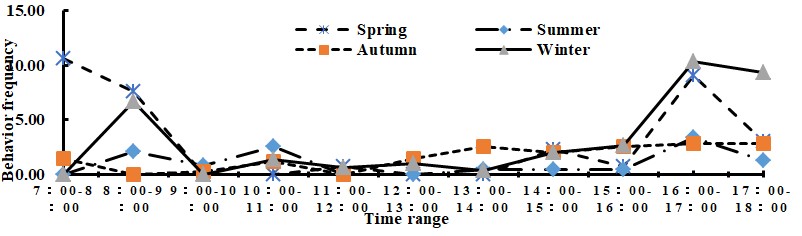
From the perspective of moving, the behavioral rhythm of South China tiger in summer is significantly different from that in spring (P < 0.01), significantly different from that in winter (P < 0.05), and there is no significant difference between other seasons (P > 0.05) (Figure 4).
From the lateral lying behavior, the behavioral rhythm of South China tiger was significantly different between spring and autumn (P < 0.01), significantly different from winter (P < 0.05), and there was no significant difference between other seasons (P > 0.05) (Figure 5).
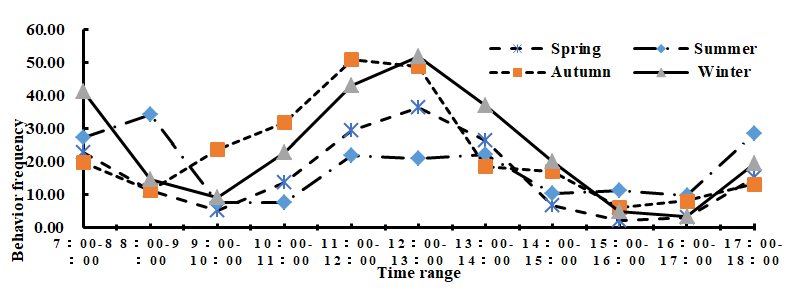
From the perspective of watching behavior, the behavioral rhythm of South China tiger was significantly different between summer and autumn (P < 0.01), significantly different from winter (P < 0.05), and there was no significant difference between other seasons (P > 0.05) (Figure 6).
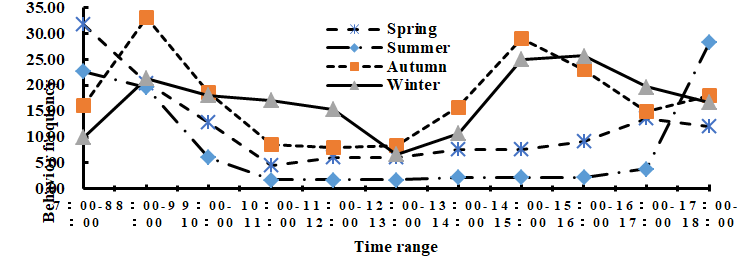
From the perspective of prone lying, the behavioral rhythm of South China tiger has no significant difference between spring and summer (P > 0.05), significant difference between autumn and winter (P < 0.05), and extremely significant difference between other seasons (P < 0.01) (Figure 7).
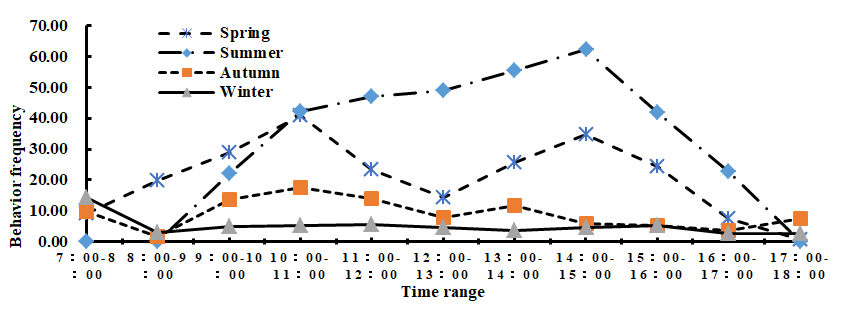
From the perspective of feeding, the behavioral rhythm of South China tiger was significantly different between summer and winter (P = 0.05), and there was no significant difference between other seasons (P > 0.05) (Figure 8).
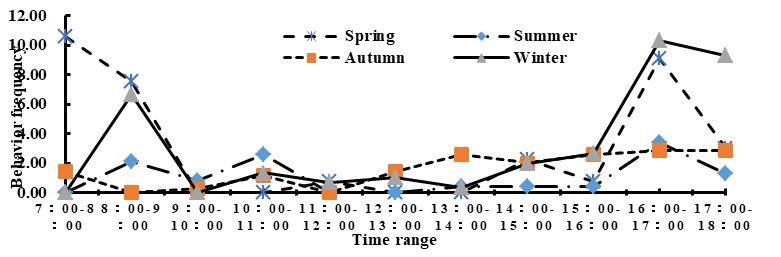
From the perspective of playing, the behavioral rhythm of South China tiger was significantly different between spring and summer, winter (P < 0.01), significantly different between summer and autumn (P < 0.05), and no significant difference between other seasons (P > 0.05) (Figure 9).
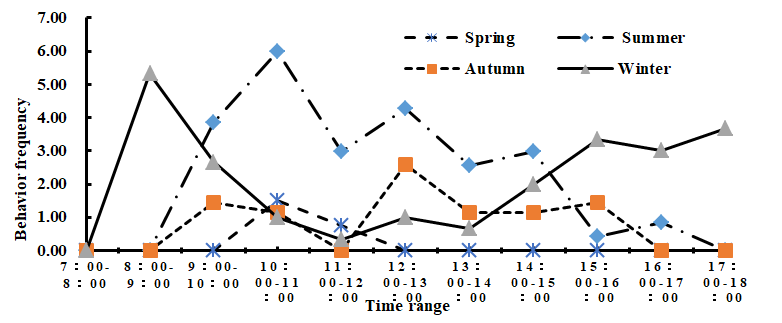
From the perspective of grabbing, the behavioral rhythm of South China tiger was significantly different between spring and autumn (P = 0.01), significantly different between summer and autumn (P < 0.05), and no significant difference between other seasons (P > 0.05) (Figure 10).
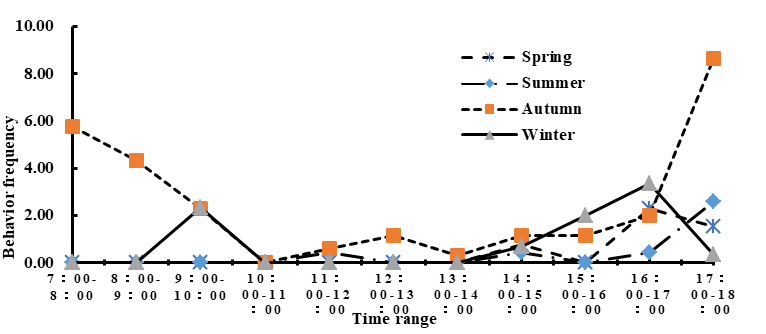
From the perspective of vocalizing, the behavioral rhythm of South China tiger was significantly different between summer and winter (P < 0.05), and there was no significant difference between other seasons (P > 0.05) (Figure 11).
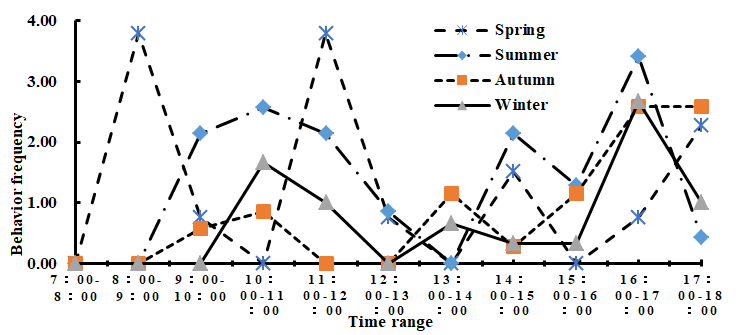
From the perspective of holding objects, the behavioral rhythm of South China tiger is extremely significant or significant in autumn and other three seasons, extremely significant in spring and winter (P < 0.01), and no significant difference in other seasons (P > 0.05) (Figure 12).
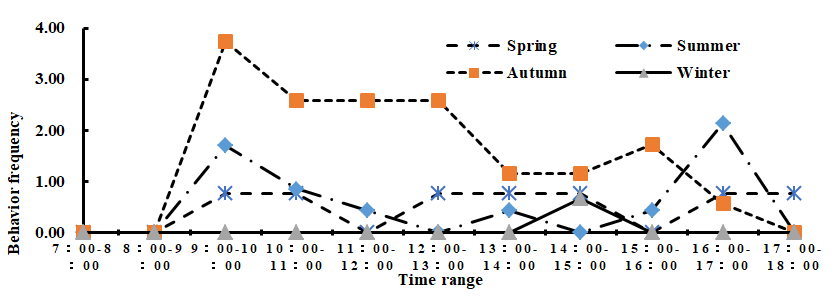
Statistical analysis showed that there was no significant difference among seasons in the behavioral rhythm of South China tiger, such as marking, turning over, defection, modification, sniffing and supine (P > 0.05).
In summary, there are seasonal differences in the behavioral time rhythm of South China tigers, mainly as follows: there are significant or extremely significant differences in lateral lying and play between spring and other seasons; There were significant or extremely significant differences in moving and watching between summer and other seasons; There were significant or extremely significant differences in grabbing and holding objects between autumn and other seasons; There were significant or extremely significant differences in prone lying, feeding and vocalizing between winter and other seasons.
Discussion
The time distribution and activity law of animal behavior are related to many factors such as its living environment and its own physiological conditions [14, 15]. The biggest difference between captive South China tigers and wild tigers is that food resources are regularly provided by people and the range of activities is limited. Wild tigers spend more time on hunting, so they spend more time on behavior related to feeding and movement, and less time on behavior related to rest. Due to the lack of research data on wild South China tiger, comparative analysis cannot be carried out. However, according to the study of non-captive Amur tiger, the rest time accounts for 30.40 ~ 34.50%, the moving time accounts for 34.92 ~ 40.14%, and the feeding time accounts for 8.68 ~ 11.57% [16]; In this study, the average rest time of South China tiger accounted for 49.25 ~ 58.71%, the average moving time accounted for 27.71 ~ 29.55%, and the average feeding time accounted for 1.75 ~ 2.54%. It can be seen that the behavior time allocation of captive South China tiger is very different from that of wild tiger. According to the research of Siberian tiger and Bengal tiger (Panthera tigris tigris) in captivity, their average rest frequency is greater than 65%, their average moving frequency is less than 25%, and their average feeding frequency is not less than 2.3% [17, 18]. It can be seen that the behavior time of South China tiger is in the middle, but the wild state is more healthy. Therefore, the South China tiger may have the problem of long rest time and short movement and feeding time. Moreover, the behavior of moving back and forth meaninglessly (stereotyped behavior) accounts for the majority, and the real meaningful movement accounts for less. In the long run, this situation can lead to psychological and physiological problems, which can eventually lead to a decline in reproduction and productivity. Based on this, artificially increasing the feeding difficulty of South China tigers, such as hanging food high, feeding meat with bones, and putting food into a special mechanism structure, may be one of the effective ways to improve this situation.
This study found that some behaviors of South China tiger only occur in some seasons, indicating that these behaviors of South China tiger are periodic and have seasonal differences. If the climbing behavior is only found in winter (November to February), it can be seen that winter is at least one of the main estrous periods of South China tigers. The Siberian tiger also has similar records, and its estrus period is mainly concentrated from November to early April Ma YQ, et al. [19, 20] believe that the peak estrus of semi wild South China tigers is in July and November. Maybe when you are not pregnant in winter, you will have a second estrus in summer half a year later, which needs further research. Yawning is only found in spring, which may be spring sleepiness, which is related to physiological factors; the cunnilingus only occurs in spring and summer festivals, which seems to have nothing to do with estrus, but at this time, the female tiger’s pudenda shrinks gradually from swelling. This process may cause skin itching and other discomfort, leading to the occurrence of cunnilingus, which is related to physiology.
Generally, marking is considered as one of the ways for animals to declare the field with odorous substances [21]; However, it is reported that female Amur tigers often have marking during estrus [22]. Therefore, the marking behavior of South China tiger in this study increased significantly in autumn and winter. It is not so much a domain marking behavior as one of the manifestations of oestrus Liao BL, et al. [23] defined the scratching behavior of South China tigers, but its seasonal variation is unknown. This study found that the frequency of scratching, smelling and holding behavior of South China tiger increased significantly in autumn, resulting in seasonal differences, which may be caused by physiological changes in early estrus. As for vocalizing, Tian L, et al. [24] believe that it is an audio behavior of animals to express the meaning of anxiety, calling and courtship. In this study, there is no significant seasonal difference in the vocalizing of South China tiger, but there is a significant rhythm difference between summer and winter, that is, there is a certain difference in the vocalizing. It indicates that the vocalizing may not be affected by physiological factors.
It seems that some behaviors cannot be explained by the influence of a single factor, such as modification, movement, watching, etc. They should be affected by a variety of factors, resulting in seasonal changes. Embellishing is a way for individuals to seek fitness [16, 17]. This means that when the South China tiger feels unwell, it will show an increase in the frequency of embellishing. A more reasonable explanation is that South China tigers feel their hair is not smooth and lose more hair, so they will lick it, which is significantly higher in spring than in the other three seasons. This is obviously related to hair changing, but in addition to its own physiological factors, it is also closely related to the length of sunshine. Some studies suggest that the daily peak of tiger movement is located in the early morning and dusk respectively Teng LW, et al. [16] believed that the movement of Amur tiger in winter was significantly different from that in other three seasons, and the influencing factor was temperature. However, in this study, frequently movement of South China tiger in summer is significantly lower than that in other three seasons, which is slightly different from the former. For wild animals, the root causes of movement are foraging, reproduction and climate change. For captive animals, there is no foraging problem. The South China tiger in this study may be in the breeding interval and hot weather, thus reducing the time of movement in summer, which is the result of the comprehensive action of multiple factors. As for the watching, other literature do not have the same definition, some are the same as the standing behavior and some are the same as the squatting behavior. There are very significant differences in the time of watching in autumn, winter, spring and summer, and the behavior rhythm in summer is significantly different from that in other seasons, and there are many influencing factors. Since back and forth movement and watching behavior are generally classified as stereotyped behavior, the time of such behavior should be appropriately reduced and meaningful behavior time (such as feeding, playing, etc.) should be increased in autumn, winter and spring in a certain way.
Teng LW, et al. [16] believed that the sleeping behavior of Amur Tigers had no significant difference in four seasons. In this study, if lateral lying, prone lying and supine were combined into lying and resting behavior, the difference was not significant. Lying on the side is a more relaxed rest than lying on the stomach, because the body is not completely relaxed when lying on the stomach, so it can get up faster and carry out the next behavior; When lying on the side, tigers need to turn over to the approximate prone state, and then they can get up. Obviously, the increase in the frequency of such lateral lying behavior in the daytime will inevitably lead to the loss of many other flexible behaviors, thus reducing the diversity of animal behavior [25]. The most obvious difference between spring, summer, autumn and winter is the climate. Although it is captive, the climate can still affect the outdoor playground. The recumbent behavior was divided into three categories: lateral lying, prone and supine. It was revealed that the prone lying of South China tiger in spring and summer was significantly higher than that in autumn and winter, and the lateral lying in autumn and winter was significantly higher than that in spring and summer. The significance of subdividing recumbent rest is also to find that the time of supine behavior is the highest in winter [26]. Compared with the other three seasons in winter, in addition to the lowest temperature, the South China tiger in this study is still in the period of estrus and less tourists. Lying on the back is more relaxed than lying on the side, because lying on the back exposes the soft ribs of the animal, and they need to lie on the side and prone before they can get up. More relaxed rest (supine) can save energy, so that more energy can be used for climbing and related behaviors, or with less interference from tourists, South China tigers spend more time on more relaxed rest, or both. From this point of view, moderate interference is beneficial to South China tiger because it increases the diversity of its behavior.
References
-
Shang YC (2014) Animal Behavior. Beijing: Peking University Press, pp: 1-2.
-
Zhang WP, Xu X, Yue BS, Hou R, Xie JJ, et al. (2019) Sorting out the genetic background of the last surviving South China tigers. Hered 110(6): 641-650.
-
Tilson R, Hu DF, Muntifering J, Nyhus PJ (2004) Dramatic decline of wild South China tigers Panthera tigris amoyensis: field survey of priority tiger reserves. Oryx 38(1): 40-47.
-
Ma JZ, Zhang MH, Jiang GS, Lu J (2015) Challenges and strategies for conservation of tigers and their habitats in China. Chin J Wildlife 36(2): 129-133.
-
Wang W, Shen QY, Yin YZ (2003) Demographic studies on captive South China tigers. Acta Theriologica Sinica 23(1): 6-9.
-
Liu QX, Wang AS, Xia JX, He WG (2014) Scent enrichment to reduce the stereotypic behavior of captive South China tiger (Panthera tigris amoyensis). Chin J Wildlife 35(4): 376-380.
-
Zhong YK (2006) Studies on behavior and ecophysiology of captive South China tiger. East China Normal University, pp: 17-23.
-
Cao Q, Hu DF, Lu J, Huang ZF, Fu WY (2009) A comparison on behavioral rhythm of South China tiger (Panthera tigris amoyensis) in different age groups. Acta Ecol Sinica 29(6): 2767-2774.
-
Wu ZY, Li DT, Liu DQ (2012) Effects of enrichment on the behavior of captive South China tiger. Chin J Wildlife 33(6): 313-314.
-
Fàbregas MC, Fosgate GT, Koehler GM (2015) Hunting performance of captive-born South China tigers (Panthera tigris amoyensis) on free-ranging prey and implications for their reintroduction. Biol Conserv 192: 57-64.
-
Day S, Fu WY, Lan ZM, Zhang Y, Lu CH (2018) Vigilance behavior comparison of Panthera tigris amoyensis cubs rned in cages and artificial caves. Sichuan J Zool 37(1): 15-21.
-
Jiang ZG (2000) Behavior coding and ethogram of the Pere David’s deer. Acta Theriologica Sinica 20(1): 1-12.
-
Qiao ZL, Zhang HH, Ma JZ, Wei QG (2015) PAE coding ethogram in breeding of semi-free-ranging Amur tiger (Panthera tigris altaica). Chi J Ecol 34(3): 736-743.
-
Miller B, Reading RP, Forrest S (1996) Prairie night: black-footed ferrets and the recovery of endangered species. Washington, D. C: Smithsonian Institution Press, pp: 47-62.
-
Snycler NRF, Derrickson SR, Beissinger SR, Wiley JW, Smith TB, et al. (1996) Limitations of captive breeding in endangered species recovery. Conver Biol 10(2): 338- 348.
-
Teng LW, Song YL, Liu ZS, Wang XM, Wang YZ (2003) Time budget of behavior of Amur tiger (Panthera tigris altaica) in captivity. Acta Theriologica Sinica 23(1): 1-5.
-
Teng LW, Feng L, Liu ZS (2003) Time bedget of behavior and activity rhythm between male and female Amur tiger (Panthera tigris altaica) under enclosed habitat. Acta Theriologica Sinica 23(2): 93-97.
-
Yang SL, Liu N, Li C (2011) Diurnal time behavior differences of mature and sub-mature captive Bengal tiger. J West Chin Forest Science 40(4): 73-76.
-
Ma YQ, Lan W (1998) Progress in conservation of tigers. Chin J Wildlife 19(1): 3-7.
-
Chen LC, Li SZ, Lei SQ, Xie HP (2016) Study on behavior of South China tiger under the condition of semi-natural. Forest Environ Science 32(5): 74-76.
-
Qin YY, Nyhus PJ, Larson CL, Carroll CJW, Muntifering J, et al. (2015) An assessment of South China tiger reintroduction potential in Hupingshan and Houhe National Nature Reserves, China Biol Conserv 182: 72- 86.
-
Liao BL (2018) Study on assess enrichment effect of South China tiger in Fuzhou zoo. Fujian J. Anim. Husbandry and Veterinary Med 40(1): 11-14.
-
Liao RZ, Liang HM, Pan DC, Li YZ, Zhuo JQ (2019) Observation on the breeding behavior of captive Siberian tiger. Chin J Wildlife 40(2): 448-452.
-
Tian L, Zhou CQ, Wu KJ, Wang Q, Mao J, et al. (2009) Behavior ethogram of Panthera pardus in captive. Sichuan J Zool 28(1): 107-110.
-
Jiang ZG, Li CW, Peng JJ, Hu HJ (2001) Structure, elasticity and diversity of animal behavior. Biodivers. Science 9(3): 265-274.
-
Ma JH, Shi WB, Xu WN, Zhang XF, Lu QB (2020) Study on the individual behavior of captive female South China tigers during parturition. Chin J Wildlife 41(3): 746-752.
- California Red-Legged Frog and Non-Listed Amphibians Response to Non-Native Fish Removal
- Industrial Standardization of the Bio-OS: Algorithmic Codification of Resilience Engineering Guidelines and Version V8 Architecture
- Climate Variability and the Sustainability of Snail Farming in Nigeria: Past Trends, Present Challenges and Potential Outlook
- The Evaluation of the Surveillance System of Anthrax in Gilgit-Baltistan, Pakistan, 2018
- Natural Decline to Extinction of A New Zealand Rabbit Population
- Mitochondrial Bio-Logistics: Steering Co-Enzyme Q10 and Lycopene Synergies within the Science 4.0 Bio-OS Framework