
Knowledge of Tropical Birds through Citizen Science Data: Trophic Habit of the Roadside Hawk (Rupornis magnirostris) (Aves, accipitridae) in the Caatinga And Atlantic Forest, Brazil
Professional ornithologists have been using citizen science data to investigate aspects of the biology of birds around the world. This approach is improving the knowledge of birds in Brazil, including aspects of their feeding ecology. The Roadside Hawk Rupornis magnirostris is widely distributed in the Neotropical region, where it is commonly found in numerous landscapes. Despite this, detailed information on its trophic habit remains scarce and restrict to a few localities. The objective of this study was to examine the trophic habit of the Roadside Hawk in the Caatinga and Atlantic Forest through the use of citizen science data. Searches for photographic records with evidence of feeding activities were done in early 2021 in the WikiAves, the major citizen science project regarding Brazilian birds. Records of Roadside Haws with prey [n = 143] were obtained by citizen scientists along 11 years, and included in this study. Records obtained in the Atlantic Forest [n = 111] were more numerous than those obtained in the Caatinga [n = 32]. Vertebrate prey included animals of four classes: Mammalia, Aves, Reptilia and Amphibia. Invertebrate prey included three classes: Insecta, Arachnida and Clitellata. In both biomes, the number of vertebrate prey was substantially higher than that of invertebrate prey, throughout the year. In the Atlantic Forest, preyed birds and reptiles were significantly more numerous than mammals and amphibians, and invertebrates, in the dry period. A similar pattern was observed in the rainy period, but differences were not significant. In the Caatinga, prey of the classes Aves and Reptilia were the most frequent, followed by those of the classes Amphibia and Mammalia. Invertebrates were uncommon. Therefore, Roadside Hawks feed on similar prey in the Brazilian Atlantic Forest and Caatinga, with a preference for vertebrates, especially birds and reptiles.
Introduction
Data obtained by citizens around the world have been used in scientific research regarding wild birds [1, 2, 3]. This is also true for Brazil, where an increasing number of ornithological research based on citizen science data has been produced [4]. These studies involve a wide range of aspects of the biology of birds, such as migration [5, 6, 7, 8], behavior [9, 10, 11], feeding ecology [12, 13] and breeding [14-
18]. As a result, it has becoming widely recognized that the knowledge about the high diversity of birds found in Brazil [19] can be improved through the use of citizen science data [4, 11, 20].
Among this avifauna is the Family Accipitridae that includes 69 genera and 250 species around the world [21]. This family includes eagles, hawks and falcons, and occurs is most regions, except in Antartida [21]. These species use all types of terrestrial habitats, from deserts and semiarid regions to savannas, forests, humid areas and arctic tundra [21]. Typically, species of this cosmopolitan group have hooked bills, strong legs and talons, and wide and rounded wings; body size is highly variable, and females are larger than males [21, 22]. They usually nest in trees, on rocky structures or on the ground, and are monogamous with biparental care. Near a third of the accipitrid species have been negatively affect by habitat loss, hunting, and contamination with poisoned prey as they usually are top-chain predators [21].
Most accipitrids are carnivorous, feeding on a wide range of prey [21]. Several species have a generalist diet, feeding on both vertebrates and invertebrates; on the other hand, some species are specialists on particular vertebrate groups, such as fish, reptiles, birds and mammals. Also, specialization on invertebrates often involves smaller species that feed exclusively on snails, insects, or crustaceans. On the other extreme are generalists such as caracaras that consume even dead animals and vegetal matter [21].
Among the most common and widespread accipitrid species is the Roadside Hawk Rupornis magnirostris. It is found from Mexico to Argentina, and occurs throughout Brazil [22, 23]. These raptors use a wide range of habitats, including several types of tropical and subtropical forests, savannas, wetlands, and agricultural areas and the urban environment with enough trees [22, 23, 24, 25]. This species lives in pairs, and captures their prey by leaving a perch, and flying quickly towards nearby animals [22, 23, 24, 25]. It is highly opportunist in relation to its trophic habit, that includes both invertebrates and small vertebrates [23, 25].
A few studies examined the trophic habit of the Roadside Hawk in detail. Its diet was based mainly on insects, amphibians and rodents in the alluvial valley of Rio Paraná in Argentina [26]. Also, a study on its feeding ecology of nesting birds conducted in Guatemalan forests showed that major prey types were reptiles and amphibians, with the eventual consumption of insects, mammals and birds [27]. In the Argentine Pampa, the most frequent prey were rodents, but birds, amphibians and insects also were part of the diet [28]. In Brazil, no studies have examined in detail the trophic habit of Roadside Hawks. Only qualitative information is available in books about the national or regional avifaunas [22, 24, 25].
This study aimed to examine the trophic habit of the Roadside Hawk in two Brazilian eco-regions [the Caatinga and the Atlantic Forest] through the use of citizen science data. We considered that quantitative information on its diet could be obtained through the examination of photographic records available in databases such as that of WikiAves [https://www.wikiaves.com.br], the largest citizen science project regarding Brazilian birds. The numbers of photographs showing Roadside Hawks with vertebrate and invertebrate prey were compared. Our first hypothesis was that its diet would be distinct in the two eco-regions. This would occur due to regional variation in prey availability due to substantial differences between their fauna and environment. Our second hypothesis was that it would occur differences in the diet due to seasonality, as it might affect prey availability for Roadside Hawks.
Material and Methods
Study Area
The Caatinga eco-region covers about 845,000 km2 exclusively in Brazil. It occurs in nine states, corresponds to 11% of the national territory, and is bordered by the Atlantic Forest, the Cerrado and the marine environment (Figure 1). This dry forest region harbors a high biodiversity, including thousands of animal and plant species, and a remarkable level of endemism [29, 30]. Its landscapes and vegetal physiognomies are diversified due to climatic, historic, topographic, geomorphologic and anthropic factors. The major matrix types of landscapes are arboreal and shrubby xeromorphic vegetation called caatinga [31]. The regional climate is tropical semiarid, marked by high temperatures, that might reach 42°C. Mean daily temperatures usually vary between 26°C and 28°C, and lowest temperatures might reach 4°C at high elevation areas.
Annual precipitation is about 750 mm, and rainfall is usually of short duration and irregular throughout the year [32].
The Atlantic Forest originally covered about 1.3 million km², corresponding to 15% of the Brazilian territory, where it occurs in 17 states [33, 34]. Due to the colonization and development of the country, its extension was reduced to 8% of its original cover [33, 35]. It is remarkable for its extraordinary high biodiversity that includes a high level of endemism [34, 35]. Landscapes are dominated by semideciduous and coastal forests [34, 35, 36]. The regional climate is predominantly tropical humid, but subtropical climate also occurs in southern regions [37]. Mean annual temperatures vary considerably due to its extensive geographic distribution. The mean annual precipitation is about 1,000-1,500 mm, with drier months occurring from May to September [33, 37].
Record Obtention
Data included in this study was obtained through searches for photographic records in WikiAves [http://www.wikiaves. com.br], a citizen science project that coordinates the largest database regarding Brazilian birds. This database currently receives the contribution of 42,000 citizen scientists, and harbors about 4,140,000 photographic and sound digital vouchers of more than 1,900 species. These searches were done in February 2021 through the option “Busca Avançada” [Advanced Search]. The name “Rupornis magnirostris” was typed in the “Espécie” [Species] field, and them a term related to the trophic habit of birds - “Alimentando-se/ Caçando” [Foraging/Hunting] and “Alimento” [Food Item] - was selected. For each of these terms, individual searches were done for all Brazilian states that encompass areas of the Caatinga and the Atlantic Forest eco-regions. Information on the eco-region regarding each municipality with records of feeding Roadside Hawks was obtained in IBGE - Instituto Brasileiro de Geografia e Estatística [https://cidades.ibge. gov.br].
The photographic records resulting of these searches were examined, and only those with evidence of feeding activities of the Roadside Hawk were included in this study. This evidence referred to individuals holding potential prey [invertebrates or vertebrates] with the bill and/or foot. When we could note that two or more records referred to the same bird photographed in the same date and municipality, we selected only one of them, randomly. This procedure was adopted to avoid that replicates/repetitions leaded to an increase of a given feeding event in a certain period or locality. We received permissions from citizens to include photographs of their authorship in this manuscript.
Data Analysis
The date of each record was classified as part of rainy or dry periods by consulting information available in the Instituto Nacional de Pesquisas Espaciais [http://clima1. cptec.inpe.br/monitoramentobrasil/pt]. At this site, we selected the “Clima” [Climate] option, and “Monitoramento” [Monitoring], to access the “Dados diários” [Daily data] section. Here, we selected “Precipitação” [Precipitation] and used the date of record available in the WikiAves database, for each record included in this study. Then, we examined the quantity of rainfall that occurred in the previous 4-5 weeks, and included the record in dry or rainy periods.
Prey were initially classified as vertebrate or invertebrate; some could not be identified due to their size, structure and position. After this, each prey was classified according to its class, thus leading to five prey types. We considered that the numbers of photographs of different prey types could represent their proportions in the diet of the Roadside Hawk. Thus, for a given period and biome, we summed the number of photographs of each prey type, and examined their proportion in relation to the total number of photographs obtained by citizens. The Chi-square test was used to compare the number of records with different prey types by using the BioEstat 5.3 program [38]. For each biome, we compared record numbers for three periods: dry period, rainy period, and total. The comparisons involved: 1. vertebrates versus invertebrates, and 2. vertebrate classes - Mammalia, Aves, Reptilia and Amphibia – and invertebrates. Due to the low of records, classes of invertebrates were not compared. A level of significance of 5% was considered in this study.
Results
Record Distribution and Prey Types
A total of 143 photographic records with evidence of feeding activities of the Roadside Hawk were obtained by citizen scientists in both biomes, and included in this study. They showed a vertebrate or an invertebrate prey hold with the bill and/or feet. Of these, 111 records were produced in the Atlantic Forest (Table 1), and involved 14 of the 17 states that comprise portions of this eco-region in Brazil. These records occurred throughout the extension of the Atlantic Forest, and were more numerous in its southeastern portion (Figure 1). Most records [86%] had a vertebrate prey, while 10% showed an invertebrate being consumed. About 4% of the records had prey that could not be identified. Thirty-two records were obtained in the Caatinga (Table 1). They were mainly produced in its eastern and central portions, and involved seven of the nine states that encompass portions of this dry forest region (Figure 1). Most records [81%] involved a vertebrate prey, and a minor portion [9%] had an invertebrate being consumed. Some prey [9%] could not be identified (Table 1).
| Biome | Prey | |||
|---|---|---|---|---|
| Vertebrates | Invertebrates | Non-identified | Total | |
| Atlantic Forest | 95 | 11 | 5 | 111 |
| Caatinga | 26 | 3 | 3 | 32 |
Table 1: Number of records with evidence of feeding activities of the Roadside Hawk, that were obtained by citizen scientists in
Table 1: Number of records with evidence of feeding activities of the Roadside Hawk, that were obtained by citizen scientists in the Brazilian Atlantic Forest and Caatinga between 2010 and 2021. Prey were classified as invertebrates or vertebrates, and some could not be identified. Records were gathered in the WikiAves database by TVG in February 2021.
![Figure 1: Geographic distribution of photographic records with evidence of feeding activities of the Roadside Hawk [Rupornis magnirostris] in the Caatinga and the Atlantic Forest, Brazil. Records were obtained by citizen scientists between 2010 and 2021, and gathered in the WikiAves database in February 2021. This map was produced with QGIS Desktop 3.22.8.](/fulltextimages/9311/fig_1.png)
Figure 1: Geographic distribution of photographic records with evidence of feeding activities of the Roadside Hawk [Rupornis magnirostris] in the Caatinga and the Atlantic Forest, Brazil. Records were obtained by citizen scientists between 2010 and 2021, and gathered in the WikiAves database in February 2021. This map was produced with QGIS Desktop 3.22.8.
Vertebrate prey included animals of four classes: Mammalia [orders Rodentia and Chiroptera] was mainly represented by rodents. Records involving the class Aves had mainly Columbiformes and Passeriformes, but also Galliformes, Gruiformes and Strigiformes. The class Reptilia referred to the Order Squamata, and included mainly lizards but also snakes. The class Amphibia had records of the orders Anura and Gymnophiona in comparable abundance (Figures 2 & 3; Appendix)]. Invertebrate prey included three classes: Insecta [orders Orthoptera, Mantodea and Lepidoptera], Arachnida [order Araneae] and Clitellata [order Haplotaxida] (Figure 4; Appendix).
![Figure 2: Photographic records of vertebrate [birds and mammals] prey captured by Roadside Hawks [Rupornis magnirostris], and gathered by citizen scientists in the Caatinga and the Atlantic Forest, Brazil: [a] a preá [Rodentia] being preyed at Cambuquira-MG; [b] a rodent [Rodentia] captured at Natal-RN; [c] a bat [Chiroptera] captured at Salvador-BA; [d] a domestic chicken [Gallus gallus] being preyed at Olinda-PE; [e] a Bananaquit [Coereba flaveola, Thraupidae] captured at Fortaleza-CE; [f] a Burrowing Owl [Athene cunicularia, Strigidae] being preyed at Carapicuíba-SP. Photo authors: Graziela Alves [a], Ulisses Nemetz [b], Argemiro Garcia [c], Rodrigo Purificação [d], Marcelo Holderbaum [e], Carla Moura [f].](/fulltextimages/9311/fig_2.png)
Figure 2: Photographic records of vertebrate [birds and mammals] prey captured by Roadside Hawks [Rupornis magnirostris], and gathered by citizen scientists in the Caatinga and the Atlantic Forest, Brazil: [a] a preá [Rodentia] being preyed at Cambuquira-MG; [b] a rodent [Rodentia] captured at Natal-RN; [c] a bat [Chiroptera] captured at Salvador-BA; [d] a domestic chicken [Gallus gallus] being preyed at Olinda-PE; [e] a Bananaquit [Coereba flaveola, Thraupidae] captured at Fortaleza-CE; [f] a Burrowing Owl [Athene cunicularia, Strigidae] being preyed at Carapicuíba-SP. Photo authors: Graziela Alves [a], Ulisses Nemetz [b], Argemiro Garcia [c], Rodrigo Purificação [d], Marcelo Holderbaum [e], Carla Moura [f].
![Figure 3: Photographic records of herpetofauna preyed by Roadside Hawks [Rupornis magnirostris], and produced by citizen scientists in the Caatinga and the Atlantic Forest, Brazil: [a] a snake [Squamata] being preyed at Petrópolis-RJ; [b] a toad [Anura] captured at Vila Maria-RS; [c] a snake [Squamata] being preyed at Silva Jardim-RJ; [d] a gecko [Squamata] captured at Natal-RN. Photo authors: Zeca Neiva [a], Cláudio Longo [b], Cesar Francischetti [c], Jorge Dantas [d].](/fulltextimages/9311/fig_3.png)
Figure 3: Photographic records of herpetofauna preyed by Roadside Hawks [Rupornis magnirostris], and produced by citizen scientists in the Caatinga and the Atlantic Forest, Brazil: [a] a snake [Squamata] being preyed at Petrópolis-RJ; [b] a toad [Anura] captured at Vila Maria-RS; [c] a snake [Squamata] being preyed at Silva Jardim-RJ; [d] a gecko [Squamata] captured at Natal-RN. Photo authors: Zeca Neiva [a], Cláudio Longo [b], Cesar Francischetti [c], Jorge Dantas [d].
![Figure 4: Photographic records of invertebrate prey captured by Roadside Hawks [Rupornis magnirostris], and obtained by citizen scientists in the Caatinga and the Atlantic Forest, Brazil: [a] a spider [Arachnida] captured at São Marcos-RS; [b] a grasshopper [Orthoptera] being preyed at Cabedelo-PB; [c] a grasshopper [Orthoptera] captured at União da Vitória-PR; [d] a praying mantis [Mantodea] captured at Timbé do Sul-SC; [e] a caterpillar [Lepidoptera] being preyed at Piracicaba-SP; [f] an earthworm [Haplotaxida] captured at Carapicuíba-SP. Photo authors: André Corá [a]; Thiago Zanetti [b], Joaquim Ribas [c], Michelle Ramos [d], Davi P. Silva [e], Carlos Moura [f].](/fulltextimages/9311/fig_4.png)
Figure 4: Photographic records of invertebrate prey captured by Roadside Hawks [Rupornis magnirostris], and obtained by citizen scientists in the Caatinga and the Atlantic Forest, Brazil: [a] a spider [Arachnida] captured at São Marcos-RS; [b] a grasshopper [Orthoptera] being preyed at Cabedelo-PB; [c] a grasshopper [Orthoptera] captured at União da Vitória-PR; [d] a praying mantis [Mantodea] captured at Timbé do Sul-SC; [e] a caterpillar [Lepidoptera] being preyed at Piracicaba-SP; [f] an earthworm [Haplotaxida] captured at Carapicuíba-SP. Photo authors: André Corá [a]; Thiago Zanetti [b], Joaquim Ribas [c], Michelle Ramos [d], Davi P. Silva [e], Carlos Moura [f].
In the Atlantic Forest, the number of records with a vertebrate prey was significantly higher than that with an invertebrate (Figure 5), considering the dry period [χ² = 34.306, p = 0.0001], the rainy period [χ² = 25.78, p = 0.0001], and the total sampling period [χ² = 59.259, p < 0.0001]. In the dry period, the number of records with specimens of the class Aves was significantly higher than those with Mammalia [χ² = 3.846, p = 0.0499], Amphibia [χ² = 8,909 p = 0.0028]
and Invertebrates [χ² = 8.909, p = 0.0028], and the number of records with specimens of Reptilia was significantly higher than those with Amphibia [χ² = 4.765, p = 0.0290] and invertebrates [χ² = 4.765, p = 0.00290] (Figure 6). In the rainy period, records with specimens of the classes Aves and Reptilia were dominant, while those with Mammalia, Amphibia and Invertebrates were less frequent. Differences between the numbers of records with these five taxonomic groups were not significant during this period.
![Figure 5: Number of records with evidence of feeding activities of the Roadside Hawk, that were obtained by citizen scientists in the Brazilian Atlantic Forest [AF] and Caatinga [CA]. Prey were classified as invertebrates [Inver] or vertebrates [Vert], and record numbers were shown for dry and rainy periods, and for the total period of sampling. Records were gathered in the WikiAves database by TVG in February 2021.](/fulltextimages/9311/fig_5.png)
Figure 5: Number of records with evidence of feeding activities of the Roadside Hawk, that were obtained by citizen scientists in the Brazilian Atlantic Forest [AF] and Caatinga [CA]. Prey were classified as invertebrates [Inver] or vertebrates [Vert], and record numbers were shown for dry and rainy periods, and for the total period of sampling. Records were gathered in the WikiAves database by TVG in February 2021.
Considering the total sampling period, the number of records with specimens of the classes Aves and Reptiles were dominant and differences between them were not significant (Figure 6). The number of records with specimens of the class Aves was significantly higher than those with Mammalia [χ² = 4.083, p = 0.0433], Amphibia [χ² = 9.524, p = 0.0020] and Invertebrates [χ² = 6.422, p = 0.0113]. The number of records with specimens of Reptilia was significantly higher than that with Amphibia [χ² = 6.081, p = 0.0137].
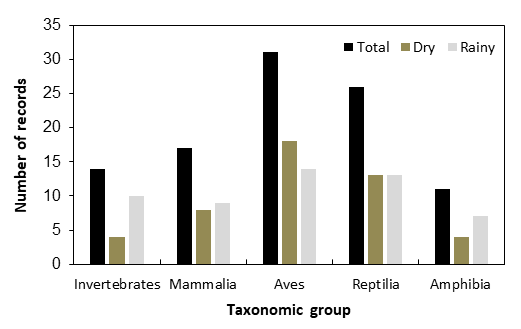
Figure 6: Number of records with evidence of feeding activities of the Roadside Hawk, that were obtained by citizen scientists in the Brazilian Atlantic Forest. Prey were grouped in five taxonomic groups, and record numbers were shown for dry and rainy periods, and for the total sampling period. Records were gathered in the WikiAves database by TVG in February 2021.
In the Caatinga, the number of records with a vertebrate prey was significantly higher than that with an invertebrate (Figure 5), considering the dry period [χ² = 10.286, p = 0.0013], the rainy period [χ² = 9.308, p = 0.0023], and the total sampling period [χ² = 18.241, p < 0.0001]. Prey of the classes Aves and Reptilia were the most frequent, followed by those of the classes Amphibia and Mammalia; invertebrates were uncommon (Figure 7). Considering the seasonal variation, it was not possible to make statistical comparisons for these taxonomic groups due to the low number of records.
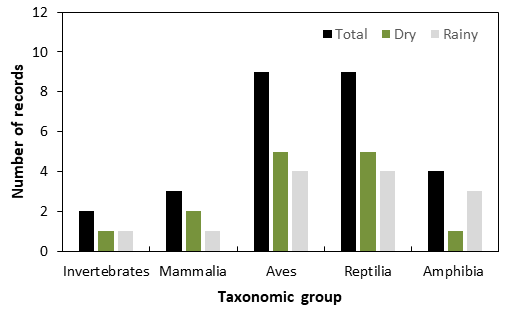
Figure 7: Number of records with evidence of feeding activities of the Roadside Hawk, that were obtained by citizen scientists in the Caatinga, Brazil. Prey were grouped in five taxonomic groups, and record numbers were shown for dry and rainy periods, and for the total sampling period. Records were gathered in the WikiAves database by TVG in February 2021.
Discussion
Our study is the first to examine the diet of the Roadside Hawk over large spatial scales. This is because previous studies on this aspect of its biology have been conducted in a few localities in Argentina [26, 28] and Guatemala [27]. Also, our study is first to provide quantitative information on its diet in Brazil, as previous information is qualitative, and available in books about regional avifaunas [22, 24, 25]. Further, the approach of using citizen science data allowed us to examine its trophic habit in distinct biomes [the Atlantic Forest and Caatinga], a type of comparison not reached previously elsewhere. Thus, the use of citizen science data can be used to obtain information on its trophic habit throughout more representative areas of a given biome, when compared with studies based on field observations by professional ornithologists in one or few localities.
In both biomes, food items were primarily vertebrates, while invertebrates represented a minor portion of its diet. This pattern is in agreement with previous investigations of the Roadside Hawk in other Neotropical regions [26, 27, 28], and is expected for a raptor of its size, as shown by a review of Accipitrids [21]. This dominance of vertebrate prey was observed for the whole period of study, and in both the dry and rainy periods, in both biomes. This means that Roadside Hawks search mainly for vertebrates, instead of less nutritious invertebrates, regardless of biome or period.
Prey were mainly of the classes Aves and Reptilia in both biomes. Prey of the classes Mammalia and Amphibia were less frequent in the diet, and slightly more numerous than that of invertebrates. Thus, Roadside Hawks feed on similar prey types in both the Atlantic Forest and the Caatinga. These results differ in some aspects from those of previous studies. This is because insects, amphibians and rodents were the main prey types in Argentina [26]. Also, dominant prey types were reptiles and amphibians in Guatemala [27]. Other study conducted in Argentina showed that the most frequent prey were rodents [28]. Thus, major differences between our and their results refer to the high frequency of birds and reptiles as prey in the Atlantic Forest and the Caatinga. As Roadside Hawks are opportunist predators [22, 23], it is likely that the proportion of different prey types in its diet reflects the availability of distinct animals for Roadside Hawks in landscapes.
In the Atlantic Forest, the diet of the Roadside Hawk was comparable in dry and rainy periods. Major differences between its diet in these two periods refer to a relatively higher importance of [1] birds in the dry period, and [2] reptiles and invertebrates in the rainy period. These seasonal changes in the proportion of different prey types in its diet might reflect their availability in dry and rainy periods. As
our approach involved the obtention of data throughout huge spatial scales, it was not possible to measure prey availability. Further photographic records are necessary to examine seasonal variation in the diet of Roadside Hawks in the Caatinga.
WikiAves and other databases harbor millions of photographic records of birds found in Brazil, due the collaboration of thousands of citizens. Recently, some studies have investigated aspects of the feeding ecology of birds through the use of photographs gathered in Brazil and deposited in WikiAves [11, 12, 13, 39]. This study suggests that professional ornithologists and students make a great use of records available in databases such as WikiAves to increase our knowledge about the feeding ecology of Brazilian birds.
Authors Contributions
Tayonara Viana Gomes [idealization, conceptualization, data collection and analysis, interpretation and writing]; Dárius P. Tubelis [idealization, conceptualization, data analysis, interpretation and writing].
Conflicts of Interest
The authors declare that there are no conflicts of interest.
Acknowledgements
We thank Universidade Federal Rural do Semi-Árido [UFERSA] for logistic support, and the scholarship for TVG. We are grateful to all citizen scientists that deposited their photographs of the Roadside Hawk in the WikiAves database, especially André Corá, Argemiro Garcia, Carlos Moura, Carla Moura, Cláudio Longo, Cesar Francischetti, Davi P. Silva, Graziela Alves, Joaquim Ribas, Jorge Dantas, Michelle Ramos, Marcelo Holderbaum, Rodrigo Purificação, Thiago Zanetti, Ulisses Nemetz and Zeca Neiva for giving permission to include their photographs in this article. Two anonymous reviewers and the Editorial Committee improved this manuscript with numerous suggestions.
References
-
Sullivan BL, Wood CL, Iliff MJ (2009) eBird: a citizen- based bird observation network in the biological sciences. Biological Conservation 142(10): 2282-2292.
-
Chandler M, See L, Copas K, Bonde AM (2017) Contribution of citizen science towards international biodiversity monitoring. Biological Conservation 213: 280-294.
-
Callaghan CT, Martin JM, Major RE (2018) Avian monitoring-comparing structured and unstructured citizen science. Wildlife Research 45: 176-184.
-
de Camargo Barbosa KV, Develey PF, Ribeiro MC, et al. (2021) The contribution of citizen science to research on migratory and urban birds in Brazil. Ornithology Research 29: 1-11.
-
Lees AC, Martin RW (2015) Exposing hidden endemism in a Neotropical forest raptor using citizen science. Ibis 157(1): 103-144. **6.** Lees AC (2016) Evidence for longitudinal migration by a “sedentary” Brazilian flycatcher, the Ash-throated Casiornis. Journal of Field Ornithology 87(3): 251-259.
-
DeGroote LW, Hingst-Zaher É, Moreira-Lima L (2021) Citizen science data reveals the cryptic migration of the Common Potoo Nyctibius griseus in Brazil. Ibis 163(2): 380-389.
-
Lopes LE, Schunck F (2022) Unravelling the migratory patterns of the Rufous-tailed Attila within the Neotropics using citizen science and traditional data sources. Ornithology Research 30: 87-98.
-
Cunha FCR, Fontenelle JCR (2014) Registros de tumulto em aves no Brasil: uma revisão usando a plataforma WikiAves. Atualidades Ornitológicas 177: 46-53.
-
Tubelis DP, Sazima I (2021) Hopeful robber: piracy attempts by the Black-collared Hawk on a Cocoi Heron in the Brazilian Pantanal wetland. Ornithology Research 29: 38-41.
-
Tubelis DP, Sazima I (2021) Nuptial gifts among Brazilian cuckoos: an outline based on citizen science. Ornithology Research 29: 188-192.
-
Tubelis DP, Wachlevski M (2021) Citizen science for the knowledge of tropical birds: the diet of the Maguari Stork (Ciconia maguari) in the Pampa ecoregion of southern Brazil. North-west Journal of Zoology 17(1): 106-110.
-
de Souza E, Lima-Santos J, Entiauspe-Neto O (2022) Ophiophagy in Brazilian birds: a contribution from a collaborative platform of citizen science. Ornithology Research 30: 15-24.
-
Barnett JM, Ingels J, Roos AL (2014) Observations on the breeding biology of the Pygmy Nightjar Nyctipolus hirundinaceus in the Caatinga of Bahia and Ceará, Brazil. Revista Brasileira de Ornitologia 22: 201-209.
-
Marçal BF, Lopes LE (2019) Breeding biology of the Helmeted Manakin Antilophia galeata in an ecotone between the Atlantic Forest and the Cerrado. Revista Brasileira de Ornitologia 27: 1-9.
-
Tubelis DP (2020) Breeding of the Horned Screamer (Anhima cornuta) in non-protected areas in the Brazilian Cerrado. Ornithology Research 28: 1-11.
-
Tubelis DP (2022) Breeding aspects of the Toco Toucan and the Chestnut-eared Aracari (Aves, Ramphastidae) in the Brazilian Cerrado. International Journal of Zoology and Animal Biology 5(2): 000358.
-
Tubelis DP, Mendonça LGA, Cardoso TJ (2022) Citizen science for the knowledge of Brazilian birds: breeding aspects of the Horned Sungem (Heliactin bilophus) (Aves, Trochilidae) in the Brazilian Cerrado. International Journal of Zoology and Animal Biology 5: 000375.
-
Pacheco JF, Silveira LF, Aleixo A (2021) Annotated checklist of the birds of Brazil by the Brazilian Ornithological Records Committee – second edition. Ornithology Research 29: 94-105.
-
Develey PF (2021) Bird conservation in Brazil: challenges and practical solutions for a key megadiverse country. Perspectives in Ecology and Conservation 19(2): 171- 178.
-
Winkler DW, Billerman SM, Lovette IJ (2020) Hawks, Eagles, and Kites (Accipitridae). In: Billerman SM, Keeney BK, Rodewald PG, Schulenberg TS, et al. (Eds.), Birds of the World. Cornell Lab of Ornithology, Ithaca, USA.
-
Sick H (1997) Ornitologia brasileira, uma introdução. Editora Nova Fronteira, Rio de Janeiro, Brazil.
-
Bierregaard RO, Boesman PFD, Kirwan GM (2020) Roadside Hawk (Rupornis magnirostris)]. In: del Hoyo J, Elliott A, Sargatal J, Christie DA, de Juana E, et al. (Eds.), Birds of the World. Cornell Lab of Ornithology, Ithaca, USA.
-
Antas PTZ, Cavalcanti RB (1988) Aves comuns do Planalto Central. Editora Universidade de Brasília, Brasília, Brazil.
-
Antas PTZ (2004) Pantanal - Guia de aves: espécies da reserva particular do Patrimônio Natural do SESC Pantanal. Editora SESC, Rio de Janeiro, Brazil.
-
Beltzer AH (1990) Biologia alimentaria del Gavilan Comun Buteo magnirostris saturatus (Aves: Accipitridae) en el valle alluvial del Rio Parana medio, Argentina. Ornitología Neotropical 1: 3-8.
-
Panasci T, Whitacre D (2000) Diet and foraging behavior of nesting Roadside Hawks in Petén, Guatemala. The Wilson Bulletin 112(4): 555-558.
-
Baladrón AV, Bó MS, Malizia AI, Bechard MJ (2011) Food habits of the Roadside Hawk (Buteo magnirostris) during the nonbreeding season in the southeastern Pampas of Argentina. Journal of Raptor Research 45(3): 257-261.
-
MMA (2021) Biodiversidade - Caatinga.
-
Tabarelli M, Leal IR, Scarano FR, Silva JMC (2018) Caatinga: legado, trajetória e desafios rumo à sustentabilidade. Ciência e Cultura 70: 25-29.
-
Araújo-Filho J (2013) Manejo pastoril sustentável da Caatinga. Projeto.
-
Dom Helder Camara, Recife, Brazil.
-
Prado DE (2013) As Caatingas da América do Sul. In: Leal I, Tabarelli M, Silva JMC, et al. (Eds.), Ecologia e conservação da Caatinga. Universidade Federal de Pernambuco, Recife, Brazil, pp: 3-73.
-
Morellato LPC, Haddad CFB (2000) Introduction: the Brazilian Atlantic Forest. Biotropica 32: 786-792.
-
Metzger JPW (2009) Conservation issues in the Brazilian Atlantic Forest. Biological Conservation 142: 1138-1140.
-
SOSMA (2022) Mata Atlântica.
-
MMA (2022) Biodiversidade - Mata Atlântica.
-
Pereira AB (2009) Mata Atlântica: uma abordagem geográfica. Nucleus 6: 27-53.
-
Ayres M, Ayres MM, Ayres DL, Santos AS (2007) BioEstat 5.0 – Aplicações estatísticas nas áreas das ciências biomédicas. Sociedade Civil Mamirauá/MCT-CNPq/ Conservation International, Belém, Brazil.
-
Teixeira FD, Mesquita EP, Ferreira MA, Araújo FC (2019) Diet of the Ornate Hawk-Eagle (Spizaetus ornatus). Revista Brasileira de Ornitologia 27: 31-39.
- California Red-Legged Frog and Non-Listed Amphibians Response to Non-Native Fish Removal
- Industrial Standardization of the Bio-OS: Algorithmic Codification of Resilience Engineering Guidelines and Version V8 Architecture
- Climate Variability and the Sustainability of Snail Farming in Nigeria: Past Trends, Present Challenges and Potential Outlook
- The Evaluation of the Surveillance System of Anthrax in Gilgit-Baltistan, Pakistan, 2018
- Natural Decline to Extinction of A New Zealand Rabbit Population
- Mitochondrial Bio-Logistics: Steering Co-Enzyme Q10 and Lycopene Synergies within the Science 4.0 Bio-OS Framework