
Larval Development of Boulengerella cuvieri (Characiformes: Ctenoluciidae) in the Middle Tapajós River, Eastern Amazon, Brazil
Larvae of Boulengerella cuvieri (Spix & Agassiz, 1829), popularly known as bicudas, were collected in the middle Tapajós River (state of Pará, Brazil) with plankton net through horizontal trawling in the subsurface of the water column and characterized using morphological analysis, meristic and morphometric, in order to provide valuable characters for identification of this species during early ontogeny. The larvae are altricial and had a standard length ranging from 3.06 to 30.06 mm, elongated and low body, head ranging from small to moderate, eyes from large to small, and from the flexion stage the maxilla and mandible began to elongate and form a pointed beak with teeth. The total myomeres range from 49 to 50 segments (32-36 preanal and 14-18 postanal). In more developed individuals, the dorsal and anal fins do not overlap, a taxonomic characteristic that, together with the total number of myomeres, differs from other sympatric congeners. We hope this study will expand the knowledge about the developmental biology of freshwater fish species from the Neotropical region.
Introduction
Boulengerella is a genus of fish belonging to the Ctenoluciidae family and occurs in the rivers of the Guianas, in the basins of the Orinoco, Amazonas, and Tocantins rivers, also in the rivers of Amapá, Pará, and the north of Mato Grosso, where they inhabit regions of shallow and fast- flowing waters on the banks of rivers and lakes. Currently, in the Amazon Basin, the genus has five species, but only three of them are found in the Tapajós River: Boulengerella cuvieri (Spix & Agassiz 1829), B. maculata (Valenciennes, 1850), and B. lucius (Cuvier, 1816) [1, 2]. They are pelagic and predatory fish that feed on small fish and insects, are voracious and great jumpers [3, 4, 5].
The specie B. cuvieri is popularly known in the Amazon region as “bicuda” or pike-characids, considered medium to large and can reach up to one (1) meter in length, and is valuable in the ornamental market, sport and subsistence fishing [6]. The species has a reproductive period recorded between November and March, coinciding with the periods of rainfall and flooding in the Amazon region [7, 8], however, its reproductive behavior and spawning sites are unknown.
Although in recent years, studies describing the initial stages of Amazonian freshwater fish have increased [9, 10, 11, 12, 13], there is still a lot of gaps regarding the larval characterization of other species, such as “bicuda”. In this context, we describe the larval ontogeny of B. cuvieri captured along of the middle Tapajós River (state of Pará, Brazil) based on morphological, meristic, and morphometric characteristics. The information generated will expand the knowledge about the initial characteristics of this neotropical fish species, allowing researchers to distinguish the larvae of B. cuvieri from other sympatric species. In addition, improving the biological and physiological understanding necessary to understand the dispersion processes and assist managers to implement conservation measures.
Materials and Methods
The analyzed specimens came from samples carried out in the middle Tapajós River, in the state of Pará, Brazil. Larvae were collected by horizontal trawls on the subsurface of the water column with a plankton net (300 μm). All specimens used in this study were captured with authorization issued by the environmental licensing board of the Instituto Brasileiro do Meio Ambiente e dos Recursos Naturais Renováveis – IBAMA (número 75271-1/2020), issued based on Normative Instruction No. 154/2007 and followed euthanasia protocols according to the norms of the Conselho Nacional de Controle e Experimentação Animal [14].
After capture, the larvae were euthanized and fixed in 10% formalin solution buffered with calcium carbonate, which better maintains their size and shapes for measurement and morphological identification [15], making identification through molecular analysis impossible. The larvae of B. cuvieri were identified through the regressive sequence of development, which consists of the morphological comparison of juveniles to smaller stages. Subsequently, the larvae were classified according to the developmental stage in yolk-sac larval, preflexion, flexion, and postflexion as suggested by Ahlstrom EH, et al. [16], modified by Nakatani K, et al. [17].
For the analysis of morphometric relationships, standard length (SL), head length (HL), snout length (SNL), eye diameter (ED), head depth (HD), body depth (BD), snout- dorsal fin distance (SND), snout-anal fin distance (SNA), snout-pelvic fin distance (SNV) and snout-pectoral fin distance (SNP) were measured using a binocular stereomicroscope (Leica S9i) coupled to an integrated color digital camera for image capture and analysis software (Leica LAS EZ). The morphometry of SNL, HD and ED are presented as percentage of HL, the other variables are presented as percentage of SL. Meristic counts of pre, postanal and total number of myomeres, spines and rays of dorsal, anal, pectoral and pelvic fins were performed, when present. The larvae used in this study are stored in the Reference Collection of Fish Eggs and Larvae of the Laboratório de Ecologia do Ictioplâncton e Pesca em Águas Interiores (CROLP-LEIPAI) of the Universidade Federal do Oeste do Pará (UFOPA). The catalog numbers of the examined specimens are: LEIPAI 00300, LEIPAI 00516, LEIPAI 00517, LEIPAI 00518 and LEIPAI 00519.
Results and discussion
Larval development A total of fifteen individuals were analyzed (8 yolk-sac larval, 5 preflexion, 1 flexion, and 1 postflexion).
Yolk-sac (Figure A-B): the individuals in stage had a standard length ranging from 3.06 to 3.93 mm (mean = 3.30 ± 0.26). Initially, the eyes are large and unpigmented but become fully pigmented from 3.93 mm SL. The head is small, the mouth is not functional, the posterior tip of the mandible has a bulge or prominence, and the yolk sac is elliptical. The body is elongated and surrounded by a hyaline embryonic membrane (finfold) that originates dorsally in the middle region of the body and extends posteriorly to the yolk. The intestine is relatively long and straight, extending beyond the middle region of the body, but it is not open, and it is possible to see a bulge near it. The pigmentation consists of dendritic chromatophores, spread along the yolk, in the frontal region of the head, and mainly in the ventral and lateral regions of the body, with greater intensity near the caudal peduncle. The pectoral fin button is present.
Preflexion (Figure 1 C): The larvae at this stage had a standard length ranging from 4.02 to 4.42 mm (mean = 4.29 ± 0.15), rectilinear notochord, small head, functional mouth in a subterminal position, and upper jaw slightly smaller than the lower one. The nostrils are simple, and the eyes are pigmented and spherical. The body remains elongated, surrounded by the finfold, and the yolk is not present. The swim bladder is inflated and visible through transparency. The intestine remains long and straight with its end section protruding. Pigmentation remains with the same pattern as in the previous stage, with greater intensification throughout the body, forming a cluster of melanophores in the caudal peduncle. However, chromatophores appear in the upper part of the maxilla, in the pectoral fin button and in the occipital region of the head. The pectoral fin button becomes more developed but without the presence of rays or spines. The total number of myomeres varies from 49 to 50 segments (32 to 33 preanal and 17 to 18 postanal).
Flexion (Figure 1 D): the specimen at this stage was 6.88 mm SL. The final section of the notochord is flexed. The head becomes tapered and moderate, and the eyes moderate. The elongated body still has remnants of finfold that decreases and occupies only the ventral region between the pectoral and anal fins. The intestine remains elongated, and it is possible to visualize the bulge near the anus. The pigmentation pattern remained similar to the previous stage, and it was possible to verify the formation of a longitudinal band of chromatophores that extends throughout the ventral region. It is possible to observe the formation of the rays of the caudal, dorsal and anal fins. The total number of myomeres is 50 segments (33 preanal and 17 postanal).
Postflexion (Figure 1 E): the individual analyzed at this stage presented 30.06 mm SL. The snout becomes pointed (beak) and corresponds to 50.51% of the HL, there are canines and sharp teeth arranged in the upper and lower jaw, the latter being shorter. The nostrils are double, and the eyes are small. The body remains elongated, cylindrical, and slightly compressed. The intestine remains relatively long. The swim bladder is no longer visible through transparency. There is an intensification of the pigmentation pattern, resulting in a darker coloration in the dorsal and ventral region of the body that extends to the anal and caudal fins, and there is an increase in dendritic and punctate chromatophores in the region of the snout, close to the eyes and on the operculum, in addition to the appearance of an oblique band of dark pigmentation in the posteroventral portion of the third infraorbital. All fins are already present, but only the pectoral fin is not fully formed at this stage. The dorsal and anal fins do not overlap, as the dorsal fin base is situated anterior to the vertical through the anal fin origin and slightly behind the pelvic fin. The number of spines and fins rays corresponded to: caudal= 32, dorsal= I+8, anal= I+8, pelvic= I+7, adipose= present. The total number of myomeres is 50 (36 preanal and 14 postanal).
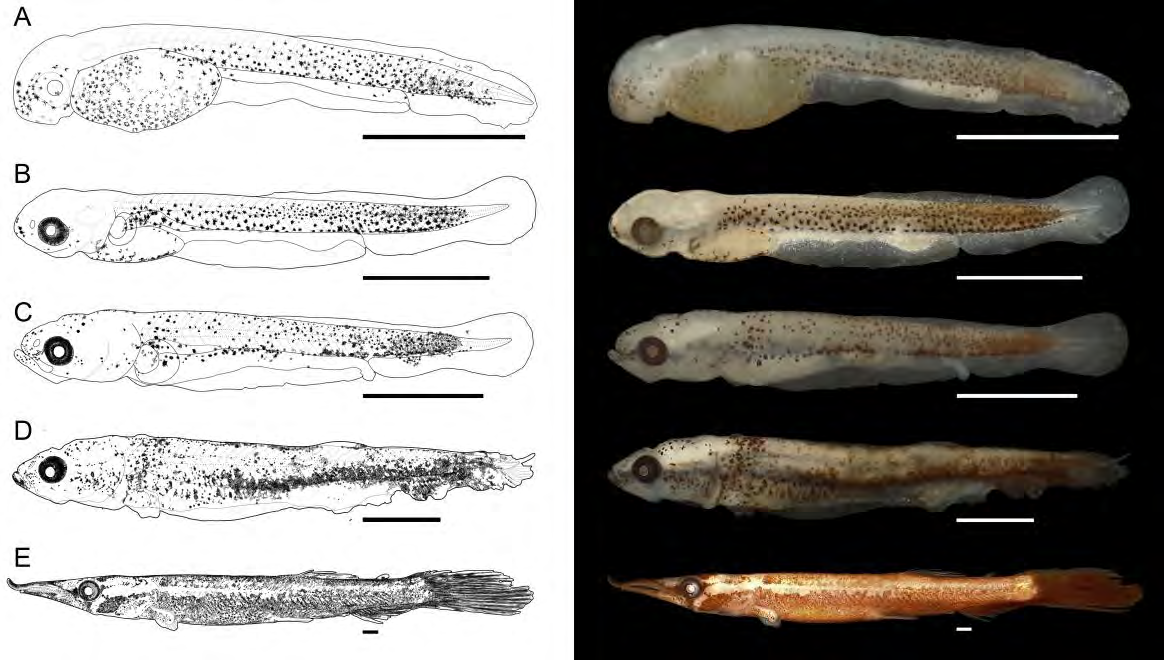
Morphometric Relationships During early development, B. cuvieri had eyes ranging from large to small (84.07 to 15.45%), a head from small to large (8.94 to 33.65%) and a body from long to very long (13.67 to 6.90%). The other morphometric variables showed an increase in their body proportions, such as head, snout and body lengths, with the exception of head depth, which remained constant (Table 1).
| Variables | Yolk-sac | (N=8) | Preflexion | (N=5) | Flexion | (N=1) | Postflexion | (N=1) |
|---|---|---|---|---|---|---|---|---|
| (mm) | Min-Max | X ± SD | Min-Max | X ± SD | Min-Max | X ± SD | Min-Max | X ± SD |
| SL | 3.06 - 3.93 | 3.30 ± 0.26 | 4.02 - 4.42 | 4.29 ± 0.15 | 6.88 | NA | 30.06 | NA |
| HL | 0.32 - 0.39 | 0.35 ± 0.02 | 0.92 - 0.98 | 0.95 ± 0.02 | 1.39 | NA | 10.12 | NA |
| SNL | 0.10 - 0.14 | 0.12 ± 0.01 | 0.11 - 0.18 | 0.16 ± 0.03 | 0.27 | NA | 5.11 | NA |
| ED | 0.20 - 0.30 | 0.25 ± 0.04 | 0.24 – 0.29 | 0.27 ± 0.02 | 0.41 | NA | 1.56 | NA |
| HD | 0.40 - 0.48 | 0.44 ± 0.03 | 0.54 - 0.58 | 0.55 ± 0.02 | 0.85 | NA | 2.92 | NA |
| BD | 0.23 - 0.29 | 0.26 ± 0.02 | 0.41 - 0.50 | 0.45 ± 0.03 | 0.94 | NA | 3.58 | NA |
| SnP | 0.74 - 0.80 | 0.77 ± 0.02 | 0.86 - 0.99 | 0.92 ± 0.05 | 1.44 | NA | 10.37 | NA |
| SnA | NA | NA | NA | NA | NA | NA | 24.64 | NA |
| SnD | NA | NA | NA | NA | NA | NA | 20.93 | NA |
| SnV | NA | NA | NA | NA | NA | NA | 19.29 | NA |
| Morphometric proportions (%) | ||||||||
| SNL/HL | 28.53 - 41.00 | 11.45 - 19.78 | 19.47 | 50.51 | ||||
| ED/HL | 55.96 - 84.07 | 25.03 - 29.79 | 29.31 | 15.45 | ||||
| HD/HL | 117.39 - 139.53 | 55.66 - 60.63 | 60.78 | 28.86 | ||||
| HL/SL | 8.94 - 12.01 | 21.41 - 22.79 | 20.23 | 33.65 | ||||
| BD/SL | 6.90 - 8.84 | 9.44 - 11.23 | 13.67 | 11.9 | ||||
| SnP/SL | 19.58 - 24.77 | 20.41 - 22.81 | 20.87 | 34.48 | ||||
| SnA/SL | NA | NA | NA | 81.95 | ||||
| SnD/SL | NA | NA | NA | 69.63 | ||||
| SnV/SL | NA | NA | NA | 64.17 | ||||
| Number of myomeres | ||||||||
| Preanal | NV | 32-33 | 33 | 36 | ||||
| Postanal | NV | 17-18 | 17 | 14 | ||||
| Total | NV | 49-50 | 50 | 50 | ||||
| Number of spines and rays | ||||||||
| Pectoral | NA | NA | NA | NA | ||||
| Anal | FA | FA | NA | I+8 | ||||
| Dorsal | FA | FA | NA | 8 | ||||
| Pelvic | FA | FA | NA | I+7 | ||||
| Caudal | FA | NA | NA | 32 |
Table 1: Morphometric variables, minimum values (Min), maximum values (Max), mean (X), standard deviation (SD) and morphometric p
Table 1: Morphometric variables, minimum values (Min), maximum values (Max), mean (X), standard deviation (SD) and morphometric proportions (%) found for the morphometric and meristic variables obtained in larvae of Boulengerella cuvieri (Spix & Agassiz, 1829). SL: Standard length; HL: Head length; SnL: Snout length; ED: Eye diameter; HD: Head depth; BD: Body depth; SnP: Snout-pectoral fin distance; SnA: Snout-anal fin distance; SnD: Snout-dorsal fin distance; SnV: Snout-pelvic fin distance; N: number of individuals analyzed; FA: absent fin; NA: not available; NV: not visible.
This study provides, despite the small number of individuals analyzed, the first description of the entire larval development of B. cuvieri focusing on morphological and morphometric changes, and it is the first study addressing a species of the Ctenoluciidae family in Brazil [18]. In addition, this study is the pioneer in the larval characterization of a fish species from the Tapajós River and may support future taxonomic and ecological studies of the ichthyoplankton community [19]. It is noteworthy that hardly all stages of development of the species are captured in field collections, as these organisms have different environmental requirements, occurring in different habitats according to the stages of development, requiring a great sampling effort as mentioned by Cabacinha FK, et al. [20], Ticiani D, et al. [19] and Silva FKS, et al. [21].
Boulengerella cuvieri larvae are born poorly developed at hatching and are considered altricial [22, 23] and show important meristic, morphological and morphometric variations during their initial ontogeny until they acquire the characteristics of the adult specie. The larvae in question are definitely not Siluriformes (absence of barbels), Pleuronectiformes (dorsal profile of the concave head), Clupeiformes (39 to 42 myomeres), Perciformes (robust body and oblique mouth), Tetraodontiformes (robust body and short intestine) and Gymnotiformes (terminal mouth and falciform body) and also can be immediately excluded from Cichliformes (protactile mouth) and Synbranchiformes (vermiform body) based on size, morphology and spawning habits. Morphologically, the larvae belong to the order Characiformes, family Ctenoluciidae, because they have an elongated, cylindrical, and slightly compressed body, with a long intestine that extends to the posterior region of the body, moderate eyes and subterminal mouth, elongated head and in more developed stages have a distinctly protruding mandible and maxilla with small teeth. In addition, it differs from Acestrorhynchidae which has a taller body, large eyes throughout the entire development, an anal fin with a developed anterior lobe, and 46 total myomeres in maximum. Morphologically, the elongated, cylindrical, and slightly compressed body presents a greater performance in pelagic regions and reaches considerable swimming speed, an alternative to assist in the capture of food, especially in clear water rivers, since they are excellent visual predators [5].
The anatomical characteristics of B. cuvieri larvae have a very similar morphology to other species of the genus. However, they can be easily distinguished from their congeners with recorded occurrences in the Tapajós River basin by the size, morphology, the position of dorsal and anal fins, length of the intestine that extends much further along the body, and myomeres count (49-50). These characters exclude the larvae of B. lucius which have the dorsal fin base distinctly anterior to the vertical through the anal fin origin, in addition to 46-47 myomeres [47] and of B. maculata which have the dorsal fin base extending posterior, at least in part, to the vertical through the anal fin origin, the tip of the dorsal fin rays, when depressed, reach or pass the adipose fin and have 47 to 48 myomeres [48], indicated by Vari RP [24]. Based on the combination of the various lines of evidence described above, we are confident in our taxonomic classification of pike-characid larvae despite the lack of genetic identification.
Acknowledgements
The authors would like to thank the TNC (The Nature Conservancy Brazil) for financial and logistical support through the “Águas do Tapajós” project. We are especially grateful to Zaqueu Santos (LEIPAI/UFOPA) for him assistance in the photographs and illustrations.
Conflicts of Interest
The authors declare that there are no conflicts of interest.
Funding
The Nature Conservacy - TNC Brazil
References
-
Buckup PA, Menezes NA, Ghazzi MS (2007) Catalog of freshwater fish species in Brazil. Museu Nacional, Rio de Janeiro, pp: 195.
-
Dagosta FCP, Pinna MD (2019) The Fishes of the Amazon: Distribution and Biogeographical Patterns, with a Comprehensive List of Species. Bulletin of the American Museum of Natural History 431: 1-163.
-
Vari RP (2003) Family Ctenoluciidae. In: Reis RE, Kullander SO, Ferraris JRC, et al. (Eds.), Check list of freshwater fishes of South and Central America, Porto Alegre, pp. 252-253.
-
Santos GM, Merona B, Juras AA, Jégu M (2004) Fish from the lower Tocantins River. 20 years after the Tucuruí Hydroelectric Power Plant. Eletronorte, Brasília.
-
Montaña CG, Layman CA, Winemiller KO (2011) Gape size influences seasonal patterns of piscivore diets in three Neotropical rivers. Neotropical Ichthyology 9: 647- 655.
-
Queiroz LJ, Torrente-Vilara G, Ohara WM, Pires THS, Zuanon J, et al. (2013) Peixes do Rio Madeira. São Paulo, Dialeto Latin American Documentary.
-
Mendes YA, Ferreira MAP, Lobato CMC, Silva GMF, Montag LFA, et al. (2017) Reproductive characteristics of pike-characids Boulengerella cuvieri (Ctenoluciidae) in the middle Xingu River, Eastern Amazon. Journal of Fish Biology 91(1): 346-353.
-
Fonseca AS (2021) A dinâmica reprodutiva da bicuda Boulengerella cuvieri (Spix & Agassiz, 1829) capturada no lago da hidrelétrica de Tucuruí, Pará. Monografia apresentada no curso de Graduação em Engenharia de Pesca da Universidade Federal Rural da Amazônia (UFRA).
-
Zacardi DM, Santos JA, Oliveira LS, Cajado RA, Pompeu PS (2020) Ichthyoplankton studies as referential for the management and monitoring of fishery resources in the brazilian amazon basin. Acta Limnologica Brasiliensia 32: 1-9.
-
Silva FKS, Cajado RA, Oliveira LS, Ribeiro FRV, Zacardi DM (2021) Early ontogeny of Pimelodus blochii Valenciennes, 1840 (Siluriformes: Pimelodidae): Neotropical catfish. Zootaxa 4948: 83-98.
-
Cajado RA, Oliveira LS, Silva FKS, Zacardi DM (2021) Early development of the Neotropical fish known as long sardine Triportheus auritus (Valenciennes 1850) (Characiformes, Triportheidae). Journal of Applied Ichthyology 37(5): 759- 769.
-
Oliveira LS, Cajado RA, Silva FKS, Bialetzki A, Zacardi DM (2021) Larval development of the freshwater croaker Pachypops fourcroi (La Cépède 1802) (Perciformes: Sciaenidae). Journal of Fish Biology 99(6): 2056-2059.
-
Oliveira LS, Cajado RA, Silva FKS, Andrade MC, Zacardi DM (2022) Early development of two commercially valuable fish from the lower Amazon River, Brazil (Characiformes: Serrasalmidae). Neotropical Ichthyology 20(1): e210024.
-
CONCEA (2013) Diretrizes da prática de eutanásia do Conselho Nacional de Experimentação Animal. Ministério da Ciência Tecnologia e Inovação, Brasília, DF, pp: 1-49.
-
Cunningham MK, Granberry WF, Pope KL (2000) Shrinkage of inland silverside larvae preserved in ethanol and formalin. North American Journal of Fisheries Management 20: 816-818.
-
Ahlstrom EH, Butler JL, Sumida BY (1976) Pelagic stromateoid fishes (Pisces, Perciformes) of the eastern Pacific: Kinds, distributions, and early life histories and observations on five of these from the Northwest Atlantic. Bulletin of Marine Science 26(3): 285-402.
-
Nakatani K, Agostinho AA, Baumgather G, Bialetzki A, Sanches PV, et al. (2001) Ovos e larvas de peixes de água doce: desenvolvimento e manual de identificação. EDUEM.
-
Reynalte-Tataje DA, Lopes CA, Massaro MV, Hartmann PB, Sulzbacher R, et al. (2020) State of the art of identification of eggs and larvae of freshwater fish in Brazil. Acta Limnologica Brasiliensia 32: e6.
-
Ticiani D, Delariva RL, Iquematsu MS, Bialetzki A (2022) Larval development of Characidium orientale (Actinopterygii: Crenuchidae) a small Neotropical fish. Iheringia. Série Zoologia 112: e2022003.
-
Cabacinha FK, Rosa GR, Santos GM, Salvador GN, Bialetzki A, et al. (2019) Analysis of three sampling methods of early life history of fish in marginal lagoons of southeastern Brazil. Fisheries Research 219: 105327.
-
Silva FKS, Oliveira LS, Cajado RA, Santos Z, Zacardi DM (2022) Morphological description of the early life stages of Brachyplatystoma rousseauxii (Castelnau, 1855), a large migratory catfish from the Amazon. International Journal of Zoology and Animal Biology 5(4): 000394.
-
Bialetzki A, Garcia DAZ, Orsi ML (2016) O estudo de ovos e larvas de peixes. In: Orsi ML, Almeida FS, Swarça AC, Claro-Garcia A, Vianna, NC, et al. (Eds.), Ovos, larvas e juvenis dos peixes da Bacia do Rio Paranapanema, uma avaliação para a conservação. Assis, Triunfal Gráfica e Editora, pp: 17-24.
-
Silva FKS, Cajado RA, Oliveira LS, Santos Z, Santos JA, et al. (2022) Early development of Prochilodus nigricans Spix & Agassiz 1829 (Characiformes: Prochilodontidae) in captivity. Aquaculture Research 53(12): 4540-455.
-
Vari RP (1995) The Neotropical Fish Family Ctenoluciidae (Teleostei: Ostariphysi: Characiformes): Supra and Intra- familial Phylogenetic Relationships with a Revisionary Study. Smithsonian Contributions to Zoology pp: 1-91.
- California Red-Legged Frog and Non-Listed Amphibians Response to Non-Native Fish Removal
- Industrial Standardization of the Bio-OS: Algorithmic Codification of Resilience Engineering Guidelines and Version V8 Architecture
- Climate Variability and the Sustainability of Snail Farming in Nigeria: Past Trends, Present Challenges and Potential Outlook
- The Evaluation of the Surveillance System of Anthrax in Gilgit-Baltistan, Pakistan, 2018
- Natural Decline to Extinction of A New Zealand Rabbit Population
- Mitochondrial Bio-Logistics: Steering Co-Enzyme Q10 and Lycopene Synergies within the Science 4.0 Bio-OS Framework