
Note about the New Distribution Area of Atlantoxerus getulus LINNAEUS, 1758 ( Mammalia, Rodentia ) in Algeria
A rodent of the family of the Sciuridae, the Barbary ground squirrel Atlantoxerus getulus is one of the 111 species of mammals living in Algeria, it is listed in the IUCN Red List as "Least Concern". It is the only species of squirrel to inhabit Africa north of the Sahara in arid rocky ground at the South Western of Algeria and Morocco. It is a small colonial species growing to a length of between 160 and 220 millimetres with a bushy tail of a similar length. It weighs up to 350 grams and has short wiry hair and its belly is paler grey and the tail is longitudinally barred in black and grey. It feeds on plants and a major part of its diet is the fruit and seeds of the argan tree (Argania spinosa). Initially since 1991 several authors stipulated that the species is only present in the western part of Saharan Atlas from the Moroccan border to the vicinities of Bechar ( Labiod Sidi cheikh, Bechar, Ain Sefra ). Recently the species was observed in the Targent locality near Tindouf distant of 807 km from Bechar, 1191 km from Labiod Sidi Cheikh, and 1057 km from Ain Sefra . This is the first time this species has been reported in this region, this led us to suggest that its range has extended to the South West and further studies of its ecology in this new area is recommanded.
Introduction
The Barbary ground squirrel Atlantoxerus getulus is a species of rodent in the family Sciuridae, It is monotypic within the genus Atlantoxerus and its habitat is arid rocky ground and it is found in mountainous regions up to an altitude of about 4,000 meters [1]. The Barbary ground squirrel is found on the Barbary Coast of Western Sahara, Morocco and Algeria on the seaward side of the Atlas Mountains and was introduced into the island of Fuerteventura in the Canary Islands in 1965 [1]. It is the only species of squirrel to inhabit Africa north of the Sahara it is found in the Atlas Mountains in Morocco and western Algeria [2, 3, 4].
Its natural habitats are subtropical or tropical dry shrubland, temperate grassland and rocky areas where it lives colonially in burrows. It was first described by Linnaeus in 1758. It is a small species growing to a length of between 160 and 220 millimeters with a bushy tail of a similar length. It weighs up to 350 grams and has short wiry hair. The general colour is greyish-brown or reddish-brown and there is a white stripe running along each side, and sometimes another along the spine. The belly is paler grey and the tail is longitudinally barred in black and grey [5, 6, 7, 8, 9, 10, 11, 12].
It is a colonial animal and lives in family groups in burrows in dry grassland, bushy and rocky areas including disturbed agricultural land, or in dens among rocks. It needs access to water but is not found in irrigated fields. They generally live in close proximity to water [7]. It tends to come out to feed early in the morning and again in the evening, retreating into its burrow during the heat of the day. It feeds on plant material and a major part of its diet is the fruit and seeds of the argan tree (Argania spinosa). The females give birth to litters of up to four young, twice a year. It feeds on nuts and seeds, including those of the commercially valuable argan (Argania) [4].
For Algeria, based on the work of Kowalski, et al. [5], the species is only present in the western part of Saharan Atlas from the Moroccan border to El Abiodh Sidi Cheikh (32.832737, 0.562746) in the east, and along the Moroccan border it reaches Bechar (31.594197, -2.241514) in the south. It was first discovered by Lataste F [6] who reported its presence in the region of Ain Sefra (32.832737, -0.563352) and Moghar Tehtani (32.591784, -0.563736). Pomel A, et al. [8] noted its presence at new from Algeria in Mekter Mts (32.666862, -0.554232). Kowalski, et al. [5] reported that it was mentioned from Ain Ouarka (32.731518, - 0.153568) where Comminardi observed numerous individuals. Seurat LG [10] mentioned it from Bechar (31.594197, -2.241514) and later from Beni ounif (32.125726, -1.238687), other specimens were observed in Forthassa Gharbia and Moghar Foukani (32.591784, -0.563736).
The species is listed in the IUCN Red List of Threatened Species as being of “Least Concern” [1]. Recently this species was observed in the Targent locality near Tindouf distant of 807 km from Bechar, 1191 km from Labiod Sidi Cheikh, and 1057 km from Ain Sefra where it has been pointed out by different authors. This is the first time this species has been reported in this region, this led us to assume that its range has extended to the South West.
Material and Methods
The data collected are based on the direct observations of the authors between 2014 to 2015 and also on the testimonies of local residents and volunteer explorers since 2020.
During various field trips in the southwestern region of the Algerian Sahara, photos of this species were taken with cameras. We used Canon cameras (Canon D600) with a 7-300 mm zoom for distant shots so as not to frighten the animals. One individual was captured and identified using the identification guide entitled “Mammiferes d’Europe, d’Afrique du Nord et du Moyen-Orient” [2] and was formally identified by Mourad Ahmim.
Results and Discussion
Recently, from 2014 to 2015 and in 2020 by amateur explorers , individuals of this species were observed in Targent locality near Tindouf (27.676613, -8.053699) , and many other groups all along the Jebel Ouarkzis which is crossed by several wadis ( River) whose steep terraces form small canyons. This region is distant of 807 km from Bechar, 1191 km from Labiod Sidi Cheikh, and 1057 km from Ain Sefra where it was pointed by different authors. This is the first time this species has been reported in this Saharan region, the first location is around Bechar and the second is around Tindouf. According to Lopez-Darias et al. [7], Aulagnier S [1], Steppan, et al. [11] Barbary ground squirrels are only known to migrate in times of food scarcity. If the population builds up and is scarce, the Barbary ground squirrel may migrate, so for Algeria, it may be that its range has increased following a migration.
Field surveys carried out in the Tindouf Cultural Park have shown that the squirrel is present in the Jebel Ouarkziz region north of Tindouf, which rises to more than 660 meters. It is a sandstone-limestone formation, dating from the Jurassic, with very pronounced rocky escarpments.
The squirrel was met with variable abundances in the following localities: The wet zone of Tafagoumt, Oum Laachar, Targant, Embed, Gatarat Baydha, Gatarat Aouinet Lmaiz, Dfila, Nkhal Labraber, Gatarat tedfil, Gatarat elbaydha, Fouahat enazk , Essouihat (Figure 1).
The main characteristics of these habitats are the presence of water and rocky escarpments (Figure 2). These are important animal shelters against predators and excessive heat in the area. The geological ruptures have given rise to hilly areas forming rocky escarpments of scree and many cliffs that are crossed by wadis often temporary that in some areas form gueltats, cascades known as Guettaras.
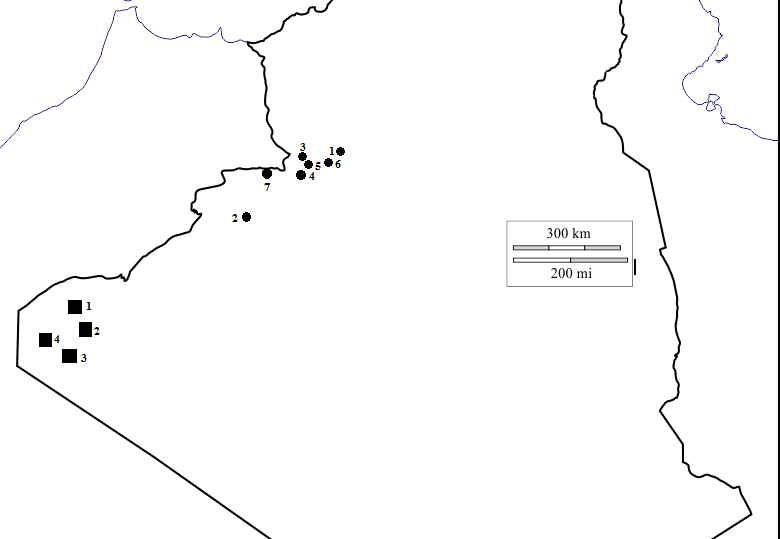
(Circles : Old distribution area (1 – Labiod Sidi Cheikh , 2 – Bechar , 3 – Ain Sefra , 4 – Moghar , 5- Mekter Mts, 6 – Ain Ouarka, 7 – Beni Ounif); Squares: New localities (1-Souihat ,2- Oum Lassel, 3 – Targent, 4- Tindouf). Figure 1: Map of old and new location and new area of Repartition of Atlantoxerus getulus in Algeria.
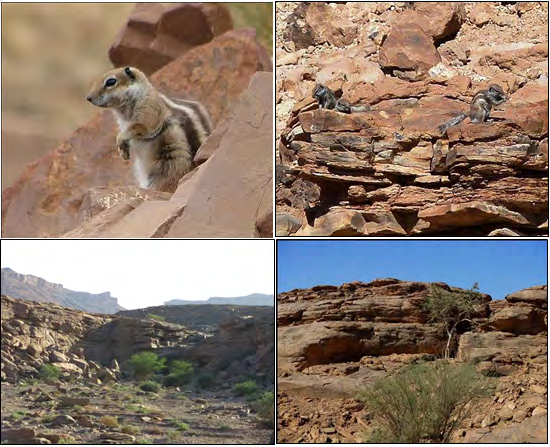
The vegetation of these habitats is typical of the Saharan regions. It reflects the bioclimatic conditions of arid environments. The tree layer is often composed of different species of acacias (Acacia tortillis, Acacia albida, Acacia ehrembergiana, Acacia radiana), Argan (Argania spinosa) and Balanites eagyptiaca. In some stations we find some individuals of Tamarix gallica and Calotropis procera.
The shrub layer is represented by Rhus tripartitus, Retama retam, Randonia africana Coss and Launea arborecans. The herbaceous layer is composed of Anabasis aretioides, Pancratum saharae, Anvillea radiata coss. At the level of permanent water bodies the vegetation is composed of Tamarix gallica, Phragmites australis, Juncus maritima and Nerium oleander.
Conclusion
The new localities where the Barbary ground squirrel Atlantoxerus getulus has been found are very far from the old localities where it was mentioned (807 to 1191 km). Knowing that is not solitary individuals have been seen but troops, it would imply that the species distribution area has been extended to the southwest where it has eventually found favorable conditions. Another possibility would come from the fact that it was troops from Morocco who settled in the region in Tindouf. A follow-up is recommended to have a clear idea on this evolution of the range of a species which is protected by law in Algeria.
References
-
Aulagnier S (2008) Atlantoxerus getulus. IUCN Red List of Threatened Species. Version 2008. International Union for Conservation of Nature.
-
Aulagnier S, Haffner P, Mitchell-Jones AJ, Moutou F, Zima J, et al. (2020) Mammiferes d’europe, d’Afrique du Nord et du Moyen-Orient. Guide Dealachaux et Niestlé. Nouvelle edition pp: 319.
-
Foley H (1922) Contribution à l’etude de la faune saharienne. Bull Soc Hist nat Afr N 13: 70-76.
-
Kingdon J (1997) The Kingdon Field Guide to African Mammals. Academic Press, London, UK.
-
Kowalski K, Rzebik-Kowalska B (1991) Mammals of Algeria-Polish academy of sciences pp: 353.
-
Lataste F (1888) Un reptile interessant de la faune algerienne. CrAss fr Avanc Sci sessOran1 :197.
-
Lopez-Darias M, Lobo J (2008) Factors affectig invasive speciesabundance: The barbary ground squirrel on Fuerteventura Island. Spain Zoological Studies 47: 268- 281.
-
Pomel A (1892) Sur l’ecureuil de Barbarie.Cr AcadSci Paris 114: 53-54.
-
Seurat LG (1924) Zoologie forestiere de l’Algerie. Direct Forets Alger pp: 57.
-
Seurat LG (1943) Faune du Maroc meridional et du sud Oranais. faune des mammiferes à Bull Soc Sci Nat Maroc 23: 151-158.
-
Steppan SJ, Hamm SM (2000) “Atlantoxerus”. Tree of Life Web Project.
-
Thorington RW, Hoffman RS (2005) Family Sciuridae. Mammal Species of the World a Taxonomic and Geographic Reference. Johns Hopkins University Press, pp: 754-818.
- California Red-Legged Frog and Non-Listed Amphibians Response to Non-Native Fish Removal
- Industrial Standardization of the Bio-OS: Algorithmic Codification of Resilience Engineering Guidelines and Version V8 Architecture
- Climate Variability and the Sustainability of Snail Farming in Nigeria: Past Trends, Present Challenges and Potential Outlook
- The Evaluation of the Surveillance System of Anthrax in Gilgit-Baltistan, Pakistan, 2018
- Natural Decline to Extinction of A New Zealand Rabbit Population
- Mitochondrial Bio-Logistics: Steering Co-Enzyme Q10 and Lycopene Synergies within the Science 4.0 Bio-OS Framework