
A Latitudinal Gradient in Species Richness of Subgenus Tetraconasoma Verhoeff, 1924, not Sphaerotherium Brandt, 1833 (Diplopoda: Sphaerotheriida)?
The Tropical Conservativism Hypothesis and Biogeographical Conservativism Hypothesis were tested in forest millipedes. Latitudinal diversity gradient (LDG) was measured in the genus Sphaerotherium and Tetraconasoma to distinguish between the two hypotheses. There was a marginally significant correlation between the number of species and latitudinal degrees away from the equator in Tetraconasoma (r=-0.78091517, Z score=-1.48168825, n=5, p=0.06921166), not Sphaerotherium (r=-0.73029674, Z score=-0.92936295, n=4, p=0.17635049). The relationship in Tetraconasoma was shown to be significant (Spearman's Rho rs=-0.89443, p (2-tailed) = 0.04052). An evolutionary preference for temperate environments appearing to have led to climatic constraints on dispersal based primarily on precipitation seasonality gradients was previously suggested. The antennal cone cells in the Tetraconasoma are suggested to be responsible for this sensory adaptive radiation and variation.
Introduction
Species richness is the number of species represented in an ecological community, landscape, or region [1, 2]. Species richness and biodiversity increase from the poles to the tropics for a wide variety of terrestrial and marine organisms and is referred to as a latitudinal diversity gradient (LDG) [3, 4]. Inverse LDG includes aphids, Chinese litter-dwelling thrips, diving beetle subfamily Colymbetinae, European bryophytes, freshwater zooplankton, Holarctic tree frogs, ichneumonids, marine benthic algae, marine bivalves Anomalodesmata, New World snake tribe Lampropeltini, North American breeding birds, penguins, peracarid crustaceans, pitcher plant mosquito, pond turtles, Shallow- water mollusks, shorebirds, southeastern United States trees, subarctic forests, and tropical leaf-litter ant communities [5, 6, 7, 8, 10, 11, 12, 13, 14, 15].
The LDG is measured and tested in the Oniscomorph forest millipede subgenera Sphaerotherium Brandt, 1833 and Tetraconasoma Verhoeff, 1924.
These forest clades belonging to the Order Sphaerotheriida are distributed along the eastern coast of southern Africa consisting of species with concentrations around coastal bush and forests [3]. The null hypothesis is the Tropical Conservativism Hypothesis which suggests processes of speciation, extinction, and dispersal result in higher species richness in the tropics and decline away from the equator [9]. The alternative is the Biogeographical
Conservativism Hypothesis which suggests the processes invoked are not intrinsic to the tropics but are dependent on historical biogeography to determine the distribution of species richness [11].
Materials and Methods
49 valid species were identified as belonging to the genus Sphaeotherium Brandt [3]. These were split into two subgenera (based on the presence of four cone cells on the antenna in Tetraconasoma) and tabulated and known localities also listed (Appendix 1,2). Localities were obtained from a checklist of southern African millipedes [3]. GPS coordinates were obtained from internet sources for known localities using the locality followed by the keyword “GPS”. Latitude and longitude coordinates were obtained. When coordinates were not in decimal degrees, they were converted to decimals by dividing the seconds by 60 and adding these to the minutes divided through 60 to get the decimal behind or following the degree. Species accepted were per MilliBase (http://www.millibase.org).
Results
Tetraconasoma
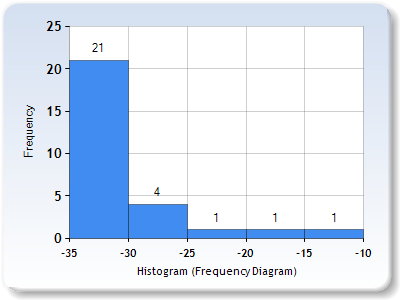
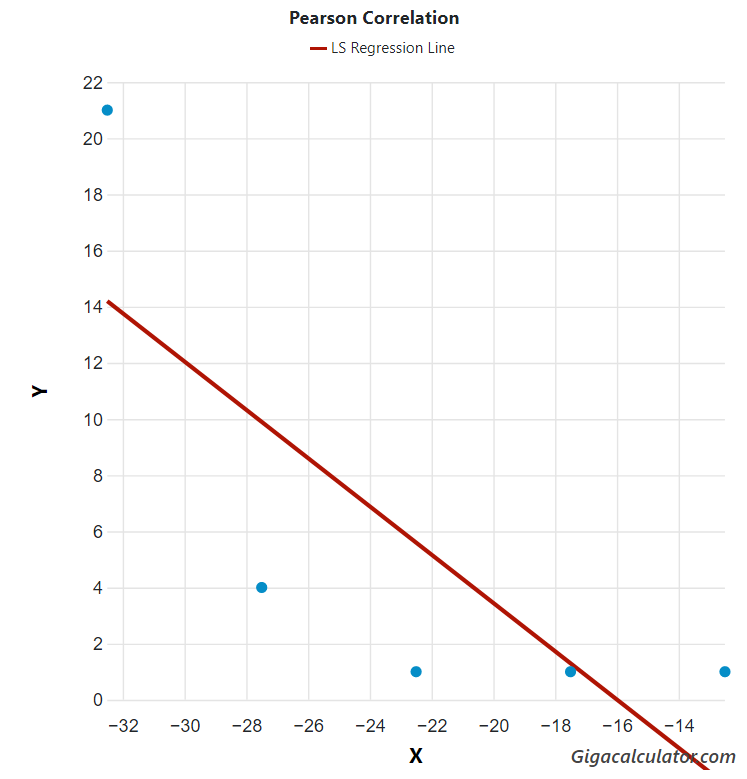
21 species were found between -35°S and -30°S, four between -30°S and -25°S, one between -25°S to -20°S, one between -20°S and -15°S, and one between -15°S and -10°S (Figure 1). Skewness was 2.52489 and kurtosis was 6.6084. There was a marginally significant correlation between the number of species and latitudinal degrees away from the equator in Tetraconasoma (r=-0.78091517, Z score=-1.48168825, n=5, p=0.06921166) (Figure 2).
Sphaerotherium
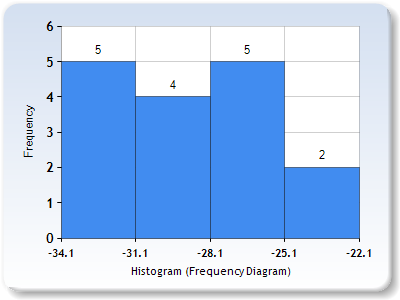
Five species were found between -34.1°S and -31.1°S, four between -31.1°S and -28.1°S, five between -28.1°S and -25.1°S, and two between -25.1°S and -22.1°S (Figure 3). Skewness was -0.00311 and kurtosis was -1.48539. There was no significant correlation between the number of species and latitudinal degrees away from the equator in Sphaerotherium (r=-0.73029674, Z score=-0.92936295, n=4, p=0.17635049).
Discussion
For skewness (−1, 1) and (−2, 2) for kurtosis is an acceptable range for being normally distributed. So Tetraconasoma species richness is not normally distributed across latitudes while Sphaerotherium species richness is normally distributed across latitudes. This suggests the significant correlation between the number of species and latitudinal degrees away from the equator in Tetraconasoma is probably meaningful of a relationship between species richness and latitude. In contrast, the absence of a relationship between species richness and latitude in Sphaerotherium is meaningless. The Tropical Conservativism Hypothesis in Sphaerotherium and Biogeographical Conservativism Hypothesis in Tetraconasoma were accepted, respectively. If the number of antennal cone cells is a significant phylogenetic character it may explain different sensory cues in the Tetraconasoma manifest as a biogeographical difference with Sphaerotherium. Tetraconasoma biogeography may make the status of this group acceptable.
Conclusion
A latitudinal gradient in species richness of subgenus Tetraconasoma was found and not Sphaerotherium.
References
-
Cooper M (2019) Latitudinal gradient in species richness of Sphaerotherium. Arthropods 9(4): 164-170.
-
Cooper M (2022) Does Sexual Size Dimorphism Vary With Species Richness In Forest Millipedes Centrobolus Cook, 1897?. Universe International Journal of Interdisciplinary Research 2(10): 25-29.
-
Hamer ML (1998) Checklist of Southern African millipedes. Annals of the Natal Museum 39(1): 39-43.
-
Hillebrand H (2004) On the Generality of the Latitudinal Diversity Gradient. The American Naturalist 163(2): 192-211.
-
Kindlmann P, Dixon AFG, Traxmandlová-Schödelbauerová I (2007) Inverse latitudinal gradients in species diversity. In: Scaling Biodiversity. Storch D, Marquet PA, (Eds.), Cambridge University Press, Cambridge, UK.
-
Kwon Y, Lee T, Lang A, Burnette D (2019) Assessment on latitudinal tree species richness using environmental factors in the southeastern United States. Peer J 7: e6781.
-
Marshall KE, Baltzer JL (2015) Decreased competitive interactions drive a reverse species richness latitudinal gradient in subarctic forests. Ecology 96(2): 461-470.
-
Mateo R, Broennimann O, Normand S, Petitpierre B, AraѸújo MB, et al. (2016) The mossy north: An inverse latitudinal diversity gradient in European bryophytes. Scientific Reports 6: 25546.
-
Mittelbach GC, Schemske GW, Cornell HV, Allen AP, Brown JM, et al. (2007) Evolution and the latitudinal diversity gradient: speciation, extinction and biogeography. Ecology Letters 10: 315-331.
-
Morinière J, Van Dam MH, Hawlitschek O, Bergsten J, Michat MC, et al. (2016) Phylogenetic niche conservatism explains an inverse latitudinal diversity gradient in freshwater arthropods. Scientific Reports 6: 26340.
-
Pyron RA, Burbrink FT (2009) Can the Tropical Conservatism Hypothesis explain temperate species richness patterns? An inverse latitudinal biodiversity gradient in the New World snake tribe Lampropeltini. Global Ecology and Biogeography 18: 406-415.
-
Rivadeneira MM, Thiel M, Gonzalez ER, Haye PA (2011) An inverse latitudinal gradient of diversity of peracarid crustaceans along the Pacific Coast of South America: Out of the deep south. Global Ecology and Biogeography 20(3): 437-448.
-
Silva RR, Brandão CRF (2014) Ecosystem-wide morphological structure of leaf-litter ant communities along a tropical latitudinal gradient. PLoS ONE 9(3): e93049.
-
Sime KR, Brower AVZ (1998) Explaining the latitudinal gradient anomaly in ichneumonid species richness: evidence from butterflies. Journal of Animal Ecology 67: 387-399.
-
Wang J, Tong X, Donghui W (2014) The effect of latitudinal gradient on the species diversity of Chinese litter-dwelling thrips. Zookeys (417): 9-20.
- California Red-Legged Frog and Non-Listed Amphibians Response to Non-Native Fish Removal
- Industrial Standardization of the Bio-OS: Algorithmic Codification of Resilience Engineering Guidelines and Version V8 Architecture
- Climate Variability and the Sustainability of Snail Farming in Nigeria: Past Trends, Present Challenges and Potential Outlook
- The Evaluation of the Surveillance System of Anthrax in Gilgit-Baltistan, Pakistan, 2018
- Natural Decline to Extinction of A New Zealand Rabbit Population
- Mitochondrial Bio-Logistics: Steering Co-Enzyme Q10 and Lycopene Synergies within the Science 4.0 Bio-OS Framework