
Effectiveness of K-Othrine Polyzone 62.5 SC (Deltamethrin) in the Control of Aedes (St.) aegypti (Diptera: Culicidae) in Cárdenas, Matanzas, Cuba
The province of Matanzas, usually performs intensive control of Aedes aegypti using pyrethroids as adulticide mainly; however, the municipality of Cardenas, presents health areas with high House Index (IH) and Breteau Index (IB). The objective of the following study was to evaluate the efficacy of K-Othrine Polyzone SC 62.5 (i.a deltamethrin), applied in intra and extra-home resting sites as a residual treatment in the health area Heroes of Moncada in the municipality of Cárdenas. For the study, the state of susceptibility to deltamethrin was evaluated by means of the methodology of impregnated papers to a population of mosquitoes in the selected area. Subsequently, 56 blocks (1960 dwellings) were selected and K-Othrine Polyzone 62.5 SC was applied intradomiciliary in the resting sites following the methodology of the World Health Organization. Within this number of blocks, 14 blocks (574 dwellings) were selected for an additional outdoor treatment in conjunction with the intradomiciliary treatment. The residual nature of the formulation was evaluated using the cone methodology for 15 weeks, as this was the minimum durability time recommended by the manufacturer. Efficacy was determined using the casa, Breatau and ovitrampa indices. Post-intervention, the surfaces with the highest residual were metal, plastic and concrete. During one year the selected apples remained with indices below 0.02 and 0.03 and of the 14 apples with exterior and interior treatment only two of them repeated positivity after this period of time. One and a half years later, the mosquito population collected was susceptible to the active ingredient. The residual treatment with this product, added to the vector control program activities, produced a positive impact on the selected apples, constituting a good option for the reduction of Ae. aegypti indices.
Introduction
Aedes (St.) aegypti (Linnaeus, 1762) is an effective vector of several arboviruses. Its major epidemiological importance is linked to its role as a transmitter of Yellow fever, Dengue, Zika. The incidence of dengue has increased dramatically in the world, the vast majority of cases are asymptomatic or mild and self-managed, so the actual number of dengue cases is underreported. Many cases are also misdiagnosed as other febrile illnesses.
In 1981 in Cuba, the first epidemic of dengue hemorrhagic fever reported in the Americas caused by Dengue 2 occurred. In 1997, an outbreak of dengue 2 was detected in the city of Santiago de Cuba, with 3 012 serologically confirmed cases, of which 205 were classified as cases of Dengue Hemorrhagic Fever (DHF) and 12 deaths [1]. Despite the high political will of the government, the country has not been exempt in recent decades from local transmissions, with outbreaks reported in 2000 and 2001 for Dengue type three and 2006- 2010 for Dengue three and four in several provinces of the country [2, 3].
The antecedents in Cuba show that adulticide treatments were routinely used in Cuba from 1981 to 1986. First Malathion as an ultra-low volume (ULV) spray [4]. Then from 1986, the pyrethroid lambdacyhalothrin and later cypermethrin until the present [5]. Fenthion was used for residual treatment. This type of formulation was applied during periods of high levels of mosquito infestation during dengue outbreaks in Santiago de Cuba in 1997 and 2006 and in Havana city 2001-2002. Other products such as bendiocarb were also occasionally used in recent years [6, 7]; however, deltamethrin has not been used as a residual treatment, except as a perifocal treatment (TPF) with K-Othrine 250 WG, (i.a deltamethrin) in Camagüey and Santiago de Cuba [8, 9].
Cardenas is one of the most important municipalities in the province of Matanzas, in 2013 the infestation rates of Ae. aegypti were higher than 0.05 and the house index and Breteau index higher than 1. In the period of 2016-2017 an increase with a marked trend was observed in the health area of the polyclinic Heroes of Moncada, located in the municipal capital. The hygienic sanitary situation of some areas in the popular councils conditioned the presence of the vector so these indexes did not decrease to the values established for this species within the program (Source: Municipal Statistics). This caused numerous treatments to be carried out with the objective of reducing these indexes without satisfactory results.
The objective of this study was to evaluate the efficacy of the formulated K-Othrine Polyzone SC 62.5 (i.a deltamethrin), applied in intra and extra domiciliary resting sites in a health area of Cárdenas municipality, Matanzas.
Materials and Methods
Type of Study
The study had a quasi-experimental design with longitudinal characteristics, which passed through different stages:
A pre-treatment phase in 2017 to conduct susceptibility tests at laboratory level using papers impregnated with the active ingredient (deltamethrin) and then selection of apples to apply the product. A Treatment Phase November- December 2017 where the formulation was applied to all selected apples. A Post-treatment Phase from January to December 2018 conducting surface bioassays, collecting and analyzing data that would allow us to know the impact of the K-Othrine Polyzone 62.5 SC formulation during that time.
Description of the Study Area
The Heroes of Moncada health area was selected for the study taking into account that during the years 2016-2017 it reported the highest house and Breteau indices within the municipality (Figure 1). This territory has an extension of 52km2 with 251 urban blocks and 200 corresponding to the rural area with an estimated population of 42516 inhabitants.
• Susceptibility and/or Resistance Study to Deltamethrin Under Laboratory Conditions using the Impregnated Paper Methodology As a previous step, the determination of susceptibility to the active ingredient deltamethrin was carried out; a fundamental requirement to define the application of the treatment, individuals from the Cardenas population and the susceptible Rockefeller reference strain were used. According to WHO methodology [10].
• Application of the K-Othrine Polyzone 62.5 SC formulation as a residual treatment inside and outside the dwellings As a preliminary step, personnel were trained on the treatment methodology to be used. As mentioned above, 56 blocks were selected for the application of indoor residual treatment. Out of a total of 2113 dwellings, 1960 were included in the study, with the prior authorization of the dwellers and signature of informed consent. In addition, 14 blocks with 574 dwellings were selected for exterior treatment in addition to interior treatment because of their hygienic environmental conditions and because they have historically had the highest infestation rates.
Indoor treatment was carried out according to WHO methodology in the main resting sites of Ae. aegypti inside the dwelling [11, 12].
• Evaluation of the residual effect of K-Othrine Polyzone 62.5 SC using the standardized cone methodology Prior to treatment, bioassays were conducted for 4 weeks following the WHO methodology on different surfaces located in two dwellings in order to rule out the presence of any chemical agent in the spaces to be treated [13].
After the treatment, 2 dwellings from the blocks that were treated inside and outside the home and 2 control dwellings were used. Different surfaces were selected, such as tile, wood, plastic, metal, masonry where the cones were placed [13].
Susceptibility and/or resistance study to deltamethrin under laboratory conditions using the impregnated bottle and paper methodology, post-intervention.
After one and a half years, a sample of the Ae. aegypti population of the health area evaluated was collected by ovitraps and stabilized again in the insectary. The emerged adults were used to evaluate the post-intervention susceptibility status. This was done using papers (described above) and bottles impregnated with deltamethrin.
Bioassays using impregnated bottles were performed following the protocol of (CDC, 2010), modified by the use of glass bottles of 250 ml capacity with ground-glass lid [14].
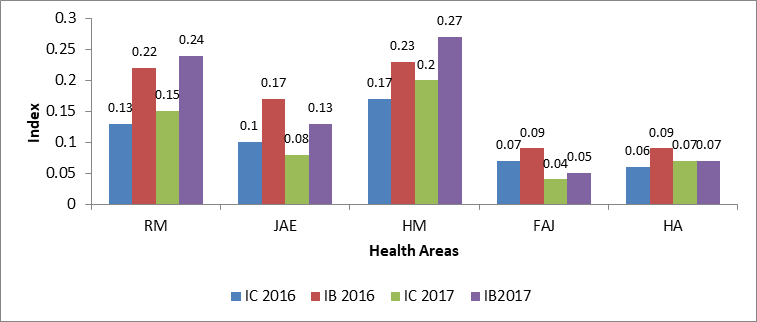
Legend: Ramón Martínez (RM), José Antonio Echeverría (JAM), Heroes of Moncada (HM)-framed in blue-, Antonio Piti Fajardo (FAJ), Humberto Álvarez (HA). Figure 1: House index (IH) and Breatau index (IB) of the 5 health areas corresponding to the Cárdenas municipality, Matanzas, Cuba in the years 2016-2017.
Statistical Analysis
Normality in the distribution of the data was explored using a Shapiro-Wilk test. The nonparametric Wilcoxn test for related samples was used for the comparison of the variables Home Index and Breteau Index, separated by semesters. The level of was set at p0.05. The statistical package SPSS, v21 for Macintosh was used.
Results
• Study of susceptibility and/or resistance to deltamethrin under laboratory conditions using the methodology of impregnated papers, pre-treatment phase When evaluating the susceptibility status in the Cardenas population and comparing it with the Rockefeller strain using paper impregnated with deltamethrin at 0.05%, it was observed that before the end of the hour of exposure, 100% of the individuals were knocked down.) At 24 hours, the total of the exposed individuals of the population showed 100% mortality, so that the population of Cardenas, according to WHO criteria, was susceptible. This result propitiated as a necessary condition for the continuity of the study in the field (Figure 2).
• Evaluation of the residual effect of K-Othrine Polyzone 62.5 SC using standardized cone methodology After the intervention with K-Othrine Polyzone 62.5 SC, the residual effect on different post-treatment treated surfaces was evaluated for 15 weeks. The residuality of tile followed by concrete and wood fluctuated from the first weeks, but remained high (> 80 %) until week 11 for tile, week 12 for concrete and week 13 for wood. As for mortality however on all surfaces it remained above 80 % until week 12. The highest mortalities occurred on plastic and metal during the 15 weeks of the evaluation. It is important to note that these materials make up the majority of water storage containers for human consumption.
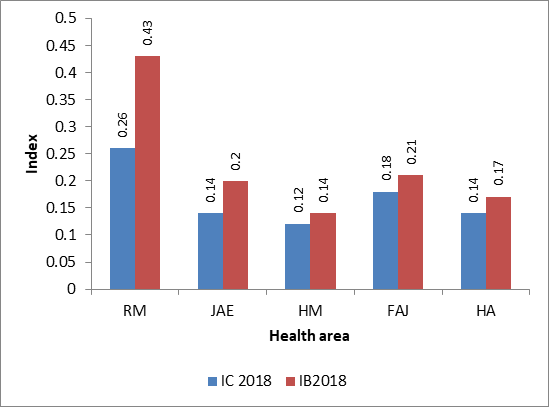
• Efficacy of K-Othrine Polyzone 62.5 SC as an indoor and outdoor residual treatment for the control of Ae. aegypti in the health area studied Figure 2 shows that one year after the treatment (2018), the greatest decrease in the house index and the Breteau index are in the Heroes of Moncada health area.
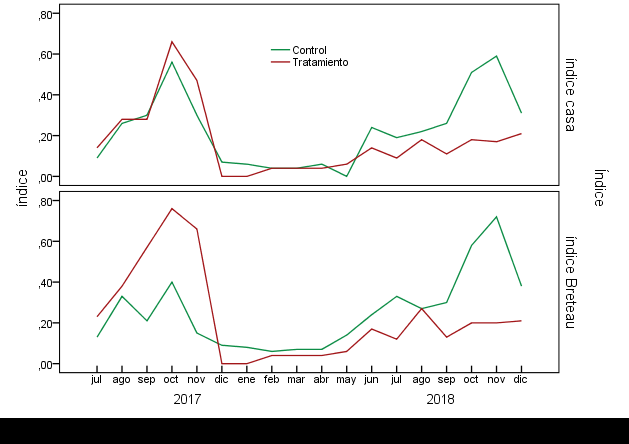
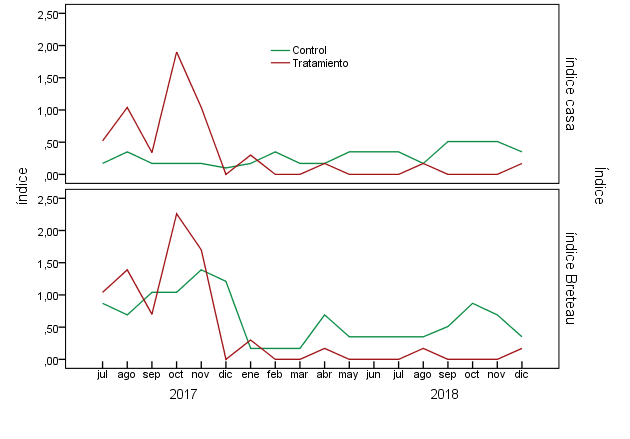
In Figure 3, when analyzing the impact of this intervention using the indexes established by the Aedes aegypti Control Program, we can state that in the pre-treatment period, a significant difference (p=0.042) was found between the blocks selected for treatment and the control blocks. In the post-intervention stage, a statistically significant difference (p=0.027) was found between the treated and control apples in both indexes, making evident the decrease in positivity to this vector in the study area. Figure 4 shows the result obtained in the apples that were applied intra and extradomiciliary, in which the calculated indexes decreased visibly and significantly in the analyzed semesters (January- July 2018 p=0.039; July-December 2018 p=0.018) more than the control apples. Both indices decreased more in these apples than those obtained in the apples treated only intradomiciliary.
• Susceptibility and/or resistance study to deltamethrin under laboratory conditions using the impregnated bottle and paper methodology (January 2019) When testing for susceptibility and/or resistance one and a half years after the application of the treatment, this time using two methodologies, we found that the Cardenas mosquito population was susceptible to deltamethrin both by impregnated papers and impregnated bottles at two doses.
Discussion
• Study of Susceptibility and/or Resistance to deltamethrin in laboratory conditions by means of the methodology of impregnated bottles and papers, pre and post intervention Deltamethrin is a pyrethroid that has not been regularly used in our country, except as perifocal treatment (TPF) with K-Othrine 250 WG, (i.a deltamethrin) in Camagüey and Santiago de Cuba [15] so there is no sustained application of this insecticide within the control policies in our National Vector Program.
Considering this background, we infer that the state of susceptibility to this insecticide of the Cardenas population before the intervention and after a year and a half post- treatment is attributable to this condition. Similar studies by Montada, et al. [18] estimated that the probable cause of susceptibility to deltamethrin in the population of Santiago de Cuba, could be manifested, in addition to the null application of this insecticide is in that locality, by the heterogeneity of the individuals used for the bioassay. This condition favors the susceptible response to an insecticide, which could also be a probable cause in our study.
The susceptibility found in our study allowed us to continue with the planned experimentation. The post- intervention evaluation, which corroborated susceptibility to deltamethrin, is justified because no new applications of this formulation were made in the area studied and thus no selection pressure occurred with this insecticide on this mosquito population in other country [16]. • Evaluation of the residual effect of K-Othrine Polyzone 62.5 SC over time using standardized cone methodology Residual treatment applications have been widespread in the Americas for triatomine bug control [17, 18]. In other areas of the planet they are used for the control of Malaria and Filaria [19, 20], highlighting a growing interest in the implementation and generalization of this methodology for the control of arbovirosis [21].
Indoor insecticide application can exert a more direct impact on resting adult mosquitoes [22]. This is particularly used during epidemics because it quickly knocks down adults that are presumably in flight. It is often the case that up to three applications are required to achieve maximum efficacy although the durability is reduced [23].
• Effectiveness of K-Othrine Polyzone 62.5 SC as a residual treatment inside and outside of the houses The Casa and Breteau indices calculated after the intervention for a year and a half were low when compared to the control blocks. During the 15 weeks (January-March) that the ovitraps remained in place, these indices were lower, even in some cases, than the ovitrap index. Our results are similar to those reported by other authors [24], for example, observed that the use of ovitrap indices proved to be more sensitive than the usual Breteau, house and container indices, even though these indicators decreased when compared to control dwellings. The authors argue that this minimizes the epidemiological risk and that these indices are not the most appropriate for determining the risk of infestation, since they consider a container with a high and low density of immature stages to be the same level of risk. Other authors however use it satisfactorily. Pinto, et al. [25] found reductions in the House and Breteau Indices, the Ovitrampa index and post- treatment adult resting catch when evaluating the use of Aqua K-Othrine® EW 20 (deltamethrin) for the control of Ae. aegypti. Paredes-Esquivel, et al. [16] argue in their study that pre-intervention infestation rates were moderate (IB =14.3, CI=8.9), which are significantly higher than those in our study, which decreased and remained low 16 weeks after deltamethrin spraying [26, 27, 28, 29, 30, 31].
There may be differences in the post-intervention evaluation criteria in the literature, as well as the need to implement other quantitative methods that allow us to evaluate the entire entomological universe of an area pre- and post-intervention. But we can affirm that the application of K-Othrine Polyzone 62.5 SC favored the decrease of positivity in the Heroes of Moncada health area.
Conclusions
The population of Cárdenas was susceptible to the insecticide deltamethrin, which made it possible to carry out the intervention with the formulated K-Othrine Polyzone 62.5 SC in the Heroes of Moncada health area, finding the greatest residuality of K-Othrine Polyzone 62.5 SC on metal and plastic surfaces (materials of which most of the breeding containers are made). A notable decrease in the focal point was achieved within the municipality of Cárdenas, to the point that the susceptibility status was maintained for a year and a half post-intervention, without the need for successive cycles of K-Othrine Polyzone 62.5 SC.
• Conflict of Interest Statement The authors declare that they have no conflict of interest.
• Contribution All the authors contributed substantially to the concrescence of the manuscript.
• Financing No funding was available.
References
-
Guzmán MG, Álvarez M, Rodríguez R, Rosario D, Vázquez S, et al. (1999) Fatal dengue hemorrhagic fever in Cuba, 1997. International Journal Infect Disease 3(3): 130-135.
-
Guzmán MG (2012) Treinta años después de la epidemia cubana de dengue hemorrágico en 1981. Revista Cubana Medicina Tropical pp: 64.
-
Guzmán MG (2016) Dengue. Ed. Ciencias Médicas. La Habana.
-
Bisset JA, Rodríguez MM, Hemingway J, Díaz C, Small J, et al. (1991) Malathion and pyrethroid resistance in Culex quinquefasciutus from Cuba: efficacy of pirimiphos- methyl in the presence of at least three resistance mechanisms. Medical and Veterinary Entomology 5: 223-228.
-
Bisset JA, Rodríguez MM, Soca A, Pasteur N, Raymond M (1997) Cross-Resistance to pyrethroid and organophosphorus insecticides in the southern house mosquito (Diptera: Culicidae) from Cuba. Journal of Medical Entomology 34(2): 244-246.
-
Castex M, Montada D, González I, Estévez S, San Blas O, et al. (2008) Efectividad del tratamiento perifocal con Ficam (Bendiocarb) 80 WP en el control de Aedes aegypti en Santa Clara, Cuba. Revista Cubana Medicina Tropical 60: 92-94.
-
Bisset JA, Rodríguez MM, Moya M, Ricardo Y, Montada D, et al. (2011) Efectividad de formulaciones de insecticidas para el control de adultos de Aedes aegypti en La Habana, Cuba. Revista Cubana Medicina Tropical pp: 63.
-
Montada D, Diéguez L, Llambias JJ, Bofill M, Codina A, et al. (2012) Tratamiento con K-Othrine WG250 (deltametrina) en un área con alta infestación de Aedes aegypti. Revista Cubana Medicina Tropical 64: 330-334.
-
González K (2015) Estrategias antivectoriales con deltametrina en Santiago de Cuba para el control de Aedes aegypti (Diptera: Culicidae). Costo-efectividad [Tesis en opción al grado científico de Máster en Entomología Médica y Control de Vectores], IPK, La Habana, Cuba.
-
WHO (2016) Monitoring and managing insecticide resistance in Aedes mosquito populations interim guidance for entomologists. WHO/ZIKV/VC/16.1.
-
WHO (2007) Manual for indoor residual spraying: application of residual sprays for vector control. Geneva: World Health Organization. Licence: CC BY-NC-SA 3.0 IGO.
-
WHO (2017) Evaluación de los depósitos de insecticidas en las paredes OMS / CDS / NTD / WHOPES / GCDPP / 2006.3.
-
WHO (2006a) Indoor residual spraying: Use of indoor residual spraying for scaling up global malaria control and elimination.
-
Rodríguez MM, Crespo A, Bisset JA, Hurtado D, Fuentes I (2017) Diagnostic doses of insecticides for adult Aedes aegypti to assess insecticide resistance in Cuba. Journal American Mosquito Control Association 33(2): 142-144
-
Montada D, Toledo ME, Castex M, Leyva M, González K, et al. (2018) The use of deltamethrin as a control strategy against Aedes aegypti (Culicidae) in Santiago de Cuba City. Journal of Pesticides and Biofertilizers 1: 10002.
-
Paredes-Esquivel C, Lenhart A, del Río R, Leza MM, Estrugo M, et al. (2016) The impact of indoor residual spraying of deltamethrin on dengue vector populations in the Peruvian Amazon. Acta Tropica 154: 139-144.
-
Palomino M, León W, Valencia P, Cárdenas F, Ancca J (2007) Evaluación de campo del efecto residual de la deltametrina sobre la mortalidad y knockdown en Triatoma infestans, según tipo de supeficie en Arequipa, Perú. Rev Perú Med Exp Salud Pública 24: 136-143.
-
Mougaboure-Cueto G, Picollo MI (2015) Insecticide resistance in vector Chagas disease: evolution, mechanisms and management. Acta Tropica 149: 70-85.
-
Dengela D, Seyoum A, Lucas B, Johns B, George K, et al. (2018) Multi-country assessment of residual bio- efficacy of insecticides used for indoor residual spraying in malaria control on different surface types: results from program monitoring in 17 PMI/USAID supported IRS countries. Parasites Vectors pp: 11.
-
Ibrahim KT, Popoola KO, Akure KO (2017) Laboratory evaluation of residual efficacy of Actellic 300 CS (Pirimiphos-Methyl) and K-Othrine WG 250 (Deltamethrin) on different indoor surfaces. International Journal of Insect Science 9: 1-7.
-
Ab Hamid N, Mohd Noor SN, Susubi J, Isa NR, Md Rodzay R, et al. (2020) Semi-field evaluation of the bio-efficacy of two different deltamethrin formulations against Aedes species in an outdoor residual spraying study. Heliyon 6: e03230.
-
Samuel M, Maoz D, Manrique P, Ward T, Runge- Ranzinger S, et al. (2017) Community effectiveness of indoor spraying as a dengue vector control method: A systematic review. PLoS Neglected Tropical Disease 11: e0005837.
-
Dunbar MW, Correa-Morales F, Dzul-Manzanilla F, Median-Barreiro A, Bibiano-Marín W, et al. (2019) Efficacy of novel indoor residual spraying methods targeting pyrethroid-resistant Aedes aegypti within experimental houses. PLoS Neglected Tropical Disease pp: 13.
-
Alarcón EP, Segura AM, Rúa-Uribe G, Parra-Henao G (2014) Evaluación de ovitrampas para vigilancia y control de Aedes aegypti en dos centros urbanos del Urabá antioqueño. Biomédica 34: 409-424.
-
Pinto NA (2017) Eficacia de Aqua K-Othrine® EW 20 para control de Aedes aegypti en San Joaquín, Cundinamarca - Colombia. Icosan, pp: 46-52.
-
Pérez Vigueras I (1956) Los Ixódidos y Culícidos de Cuba. Su historia natural y médica. Universidad de la Habana. Cuba, pp: 579.
-
PAHO (2016) Zika - Epidemiological Report Cuba. . Pan American Health Organization / World Health Organization. Washington, USA.
-
WHO (2020) Specifications and evaluations for public health pesticides: deltamethrin.
-
Guzmán MG, Kourí G, Martínez E (1988) Fiebre hemorrágica del dengue con síndrome de choque en niños cubanos. Bulletin of Sanitary Panamerican 104: 235-243.
-
Kourí G, Guzmán MG, Valdés L, Carbonell I, Rosario D, et al. (1998) Reemergence of dengue in Cuba: a 1997 epidemic in Santiago de Cuba. Emergy Infect Disease 1: 89-92.
-
CDC (2010) Guideline for evaluating insecticide resistance in vectors using the CDC Bottle Bioassay. In: Brogdon G, Chan BH (Eds.), Centers for Disease Control and Prevention pp: 1-28.
- California Red-Legged Frog and Non-Listed Amphibians Response to Non-Native Fish Removal
- Industrial Standardization of the Bio-OS: Algorithmic Codification of Resilience Engineering Guidelines and Version V8 Architecture
- Climate Variability and the Sustainability of Snail Farming in Nigeria: Past Trends, Present Challenges and Potential Outlook
- The Evaluation of the Surveillance System of Anthrax in Gilgit-Baltistan, Pakistan, 2018
- Natural Decline to Extinction of A New Zealand Rabbit Population
- Mitochondrial Bio-Logistics: Steering Co-Enzyme Q10 and Lycopene Synergies within the Science 4.0 Bio-OS Framework