
“Man-Peafowl Conflict”-An Assessment in the Cultivated Crop lands of Kumbakonam Region of Tamil Nadu, India
The Indian Peafowl Pavo cristatus also known as the Blue Peafowl was declared as the National bird of India during 1963 due to its ‘flagship’ value found on its glorious position in mythology and its widespread distribution and grandeur and comes in Schedule-I of the Indian Wild Life (Protection) Act, 1972. Many parts of India, the birds can be a nuisance to agriculture as they damage crops. The present study was made in the villages surrounded by Neelathanallur which is situated in the basin of Kollidam river. Line transect method were followed to estimate the population of the Indian Peafowl. The tree species used for roosting by peafowls were recorded and identified. The details of abundance and problems in selected cultivation areas were collected using questionnaire survey method. The study areas mostly dominated with crops cultivation and mainly cultivated by grains and vegetables. A total of 14 visits were made to the study sites of which a total of 50 sightings of peafowls were seen. About 26.25% of the observation shows the peafowls raid mainly on corn or maize plants followed by paddy field (23.11%), chilli (21.85%), cereals & grams (16.14%) respectively. The people living in the study sites does not have much impact due to peafowl. They are not doing any harm to the peafowl because they are worshipping the peacock as vehicle of Lord Subramania.
Introduction
Galliformes species are useful indicators of environmental quality and the assessment of their status is essential for management purposes [1]. The Indian Peafowl Pavo cristatus also known as the Blue Peafowl was declared as the National bird of India during 1963 due to its ‘flagship’ value found on its glorious position in mythology and its widespread distribution and grandeur and comes in Schedule-I of the Indian Wild Life (Protection) Act, 1972. The Indian Peafowl is a resident breeder across the Indian subcontinent and found mainly on the ground in dry, semi-desert areas, grasslands, scrublands, open and deciduous forests, roost in trees or other high places at night. They are omnivorous and feed on seeds, insects, fruits, small mammals and reptiles. They feed on small snakes but keep their distance from larger ones [2]. Around cultivated areas, peafowls feed on a wide range of crops such as groundnut, tomato, paddy, chilly and even bananas [3]. Like other pheasants, peafowls are adapted to a life of walking and forging on the ground as they search for the seeds, plants, insects and reptiles for its diet.
Many parts of India, the birds can be a nuisance to agriculture as they damage [4]. Its adverse effects on crops, however, seem to be offset by the beneficial role it plays by consuming prodigious quantities of pests such as grasshoppers. They can also be a problem in gardens and homes where they damage plants, attack their reflections breaking glass and mirrors, perch and scratch cars or leave their droppings. Many cities where they have been introduced and gone feral have peafowl management programmers. These include educating citizens on how to prevent the birds from causing damage while treating the birds humanely [5].
Poaching of peacocks for their meat and feathers and accidental poisoning by feeding on pesticide treated seeds are known threats to wild birds [6]. Methods to identify if feathers have been plucked or have been shed naturally have been developed as Indian law allows only the collection of feathers that have been shed [7]. In Tamil Nadu the peafowls can be seen in many parts both in wild and semi-wild condition. The present investigation was indented to study on Indian Peafowl with the following objectives in Kollidam river basin areas of Tamil Nadu.
The major objectives of the study were to find out the abundance of peafowl population in and around the study area, investigate the age sex classification of peafowl, find out the roosting tree preference and roosting behavior, estimate the time activity budget and study on conflict between peafowls and humans.
Methodology
The study was made in the villages surrounded by Neelathanallur which is situated in the basin of Kollidam river. Here most of the peoples were depending up their livelihoods for agricultural practice only. The major crops cultivated in this area was paddy, sugar cane, maize, ground nut, vegetables and cotton. The data were collected at 15 sites where the peafowl population is high in the cultivated areas. Line transect method were followed to estimate the population of the Indian Peafowl [8, 9, 10]. The cultivated areas were considered as the sampling unit and transects of 2 km length were walking across the cultivated fields. A total of 15 temporary transects were studied in all the 15 villages of the study area. In each transect were walked morning (6.00 am to 7.30 am and evening times (4.00 pm–6.30 pm) resulting in a sampling effort of 30 km in all the months during the study period. For each sighting of the peafowl species, detection time, group size, age and sex class, sighting angle and the sighting radial distance from the transect line were recorded. Sighting angles were recorded using a hand-held compass. Sighting distances were measured approximately.
Roosting of Peafowl
The roosting trees preference and roosting behavior of peafowl was recorded regularly. All the study areas were visited during dawn and dusk at 0600 hrs to 0700 hrs and 1600 hrs to 1900 hrs. The tree species used for roosting by peafowls were recorded and identified. Data were collected for the tree species utilized for roosting activity and height of the roosting tree branch by both male and females were maintained [11, 12, 13]. The number of males, females, sub- adults and chicks were counted separately in each roosting tree. All the direct observation with regard to the activity patterns such as feeding, resting, walking, preening, call and display were made using focal animal sampling method [14]. Questionnaire Survey Method The details of abundance and problems in selected cultivation areas were collected using questionnaire survey method. Interviews were conducted and discussion was made with the local peoples regarding the details of peafowl. Two sets of questionnaires were prepared and used for data collection, 1) “Precise and closed” sets of questions were prepared such as, Name of Respondent, peafowl presence and disturbance such as. This particular type of questions asked to the respondent to answer anything which is not relevant or otherwise this questionnaire was said as “one word answer” type. And not allowed the respondent to express his views freely, 2) The second set questionnaire is called as “Broad and open ended” where the questions were asked to the respondent to express his views freely without any hesitation or the answer would be descriptive type or one question may have multiple answers [5]. Diversity index of the data was analysed to find out the relative density (RD), standard deviation, standard error, etc. Percentage of questionnaire survey was used for comparison of the data.
Results
The study areas mostly dominated with crops cultivation and mainly cultivated by grains and vegetables. The different species of crops cultivated in the study area is given in the Table 1.
| Scientific Name | Common Name | Local Name | |
|---|---|---|---|
| 1 | Oryza sativa | Paddy | Nellu |
| 2 | Arachis hypogaea | Groundnut | Verkadalai |
| 3 | Cocous nusifera | Coconut | Thengai |
| 4 | Caspsicum annuum | Chilli | Milagai |
| 5 | Cassia auriculata | Cluster beans | Avarai |
| 6 | Curcuma longa | Turmeric | Manjal |
| 7 | Jasminum sambac | Jasmin | Malli |
| 8 | Kadia calycina | Ladies finger | Vendai kai |
| 9 | Lycoperiscon lycopersicum | Tomato | Thakkali |
| 10 | Musa paradisiaca | Plantain | Vazhai |
| 11 | Zea mays | Maize | Makka chollam |
| 12 | Mainihot utilissima | Tapioca | Maravalli |
| 13 | Vigna mungo | Black gram | Ulundhu |
| 14 | Sesamum indicum | Gingilli | Ellu |
| 15 | Phyllanthus emblica | Amla | Nelli kai |
| 16 | Solanam melogena | Brinjal | Kattari |
| 17 | Saccharum infortunatum | Sugar cane | Karumbu |
| 18 | Gossypium herbaceum | Cotton | Paruthi |
| 19 | Morus alba | Mulberry | Mulberry |
Table 1: Different types of crops cultivated in the study areas.
Abundance of Peafowls
A total of 14 visits were made to the study sites of which a total of 50 sightings of peafowls were seen. Of the 45 sightings consists of 119 birds. Adult female is the mostly sighted bird (64) with 23 sightings. Adult male has been sighted 12 times consists of 28 individuals. Sub adult male and chicks were sighted less in number (Table 2 & Figure 1). The sex ratio of adult male and adult female is 1:2.28. Whereas the adult female and chicks ratio is 1: 0.12.
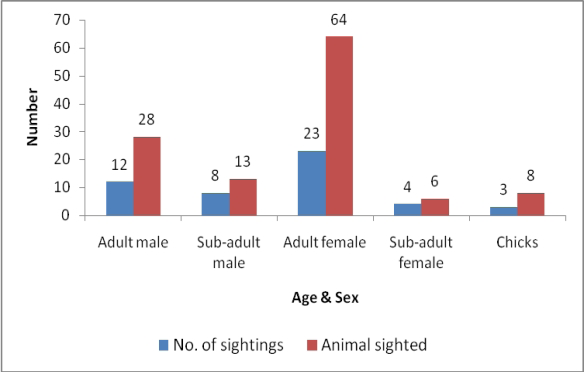
The encounter rate of adult male is 0.17 birds per kilometer. Whereas the female is 0.26, sub adult male is 1.62, sub adult female is 1.50 and chicks is 2.64 birds per kilometer (Table 2).
| Age& sex | No. of visit | No. of Sightings | Total | Encounter rate |
|---|---|---|---|---|
| Adult male | 14 | 12 | 28 | 0.17 |
| Sub-adult male | 14 | 8 | 13 | 1.62 |
| Adult female | 14 | 23 | 64 | 0.26 |
| Sub-adult female | 14 | 4 | 6 | 1.5 |
| Chicks | 14 | 3 | 8 | 2.67 |
| 50 | 119 | |||
| Diversity Index | A | B | t | |
| Shannon index (H) | 1.3638 | 1.248 | 0.30703 | |
| Variance | 0.0094 | 0.005 | ||
| Simpson index (D) | 0.3048 | 0.364 | ||
| Variance | 0.002 | 0.001 |
Table 2: Abundance of peafowls in the study area.
Roosting Behavior of Peafowl
The result of the roosting tree species selection was assessed and the peafowls mostly prefer Coconut tree (Cocos nusifer) (57.84%) for roosting during night hours.
The peafowls also roosted in other trees/clumps such as Bambusa arundinacae (13.85%), Borasus fabelliformes (8.9%) followed by Tamarindus indica and Azadiracta indica (9.7%) respectively (Table 4 & Figure 2).
| Tree species | No. of trees/ clumps | Average height (ft.) | No. of peafowl seen | Adult male | Adult female | Chicks | |
|---|---|---|---|---|---|---|---|
| 1 | Cocos nucifer | 12 | 26.2 | 38 | 23 | 10 | 2 |
| 2 | Bambusa arundinacae | 8 | 11.3 | 2 | 2 | 0 | 1 |
| 3 | Borassus fabelliformes | 4 | 17.5 | 4 | 1 | 3 | 1 |
| 4 | Tamarindus indica | 2 | 10.6 | 3 | 1 | 2 | 1 |
| 5 | Azadiracta indica | 2 | 9.89 | 3 | 2 | 1 | 0 |
| Total | 31 | 84.3 | 50 | 29 | 16 | 5 |
Table 3: Tree species selection for roosting in study area.
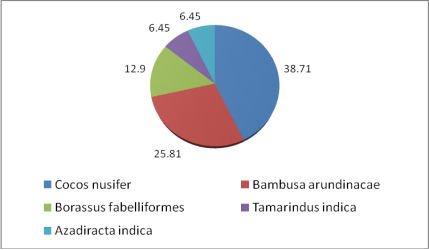
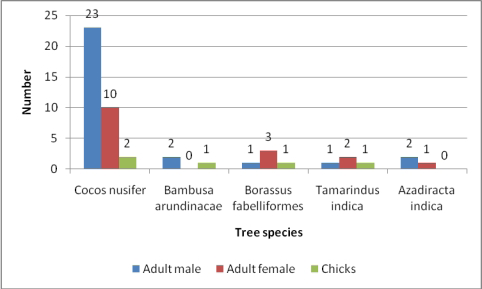
Likewise, 38 individuals of peafowls were roosting in Cocos nusifera tree followed by Bambusa arundinacae (8 individuals), Borasus fabelliformes (4 individuals), Tamarindus indica and Azadiracta indica (2 individuals each). Roosting tree preference by adult male (23) and adult female (10) were seen only Cocos nusifer tree than other species. The other species of trees were used for roosting is less (Figure 3).
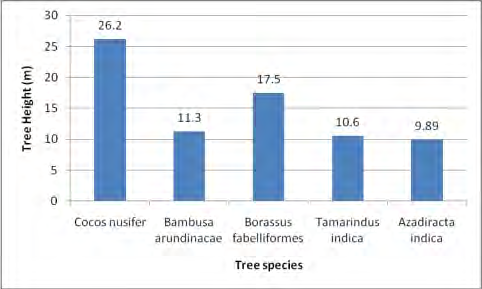
The peafowls prefer mainly the tree at the average height of 26.2 m in Cocos nusifer tree and the other tree species also almost the average height of roosting is upto 10 m (Figure 4).
Activity Budget
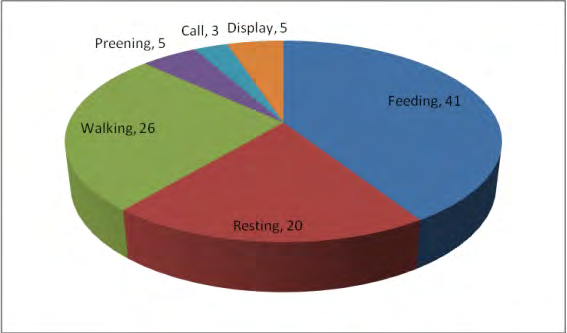
The activity budget of peafowl was taken using the focal animal sampling method shows that the peafowls mostly spent their time for feeding (41%) followed by Resting (20%), Walking (26%), Preening and Display (5%) and call (3%) (Figure 5).
Crop Raiding by Peafowls
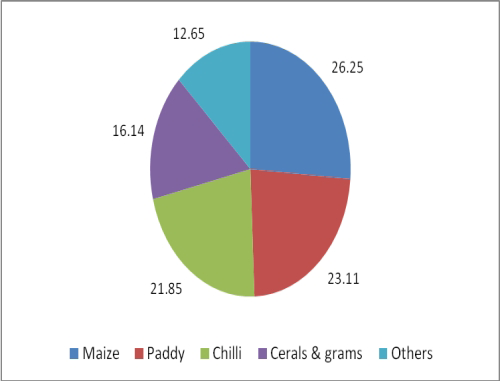
There is a problem of crop raiding by peafowls in the agricultural fields of the study area. About 26.25% of the observation shows the peafowls raid mainly on corn or maize plant followed by paddy field (23.11%), chilli (21.85%), cereals & grams (16.14%) respectively. The other crops such as cluster plantain and ground nut have been raided very less (Figure 6).
Questionnaire Survey
Questionnaire survey was made with the cultivators in different villages of the study areas. A total of 50 number of questionnaires were interviewed and the results are given below.
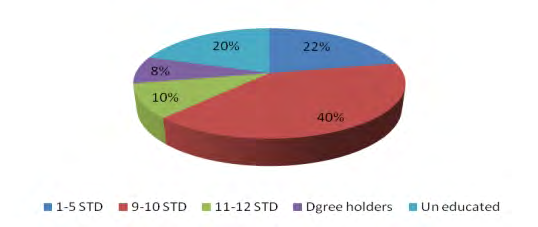
The education status of the people in the study area was assessed from the survey and the cultivators revealed that 20 of the people were studied from 6-10 Std, followed by 5 of them studied their high school and only 4 of them had finished their degree classes. On the contrary 20% of people (N=10) were uneducated (Figure 7).
The status of occupation of the people in the study area shows that 84% of them are farmers, followed by 10% of them are running business, 4% are drivers and 2% reveals they are working as coolie.
Area Holding
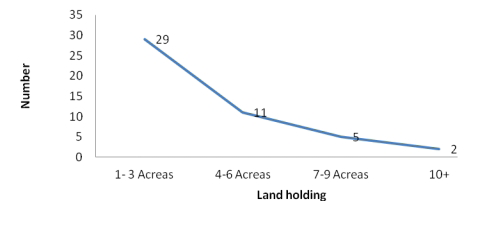
The questioner survey revealed that 58% people are holding 1-3 acres of cultivated land with them followed by 22% of them are holding 4-6 acres and 10% are having 7-9 acres. Only 4% of them are holding more than 10 acres of land (Figure 8).
Major Crop Cultivated
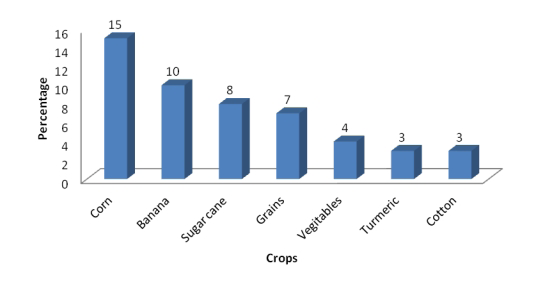
The farmers reveled that mostly they are cultivating corn (30%), followed by Banana 20%, sugar cane 16% and Grains 14%. They also cultivating vegetables 8%, Turmeric 6%, Cotton 6% in less area (Figure 9).
Crops Damaged by Peacock
The questioner survey with the farmers shows that 86% of them opined peacocks are causing damage to the cultivated crops, on the other hand 14% of them reveals that they are not having much problem with peafowls.
Roosting Behaviour
According to the farmers, they have opined that 74% says the peafowls roost on the trees, followed by 16% people says they roost at bushes and 10% of them told peafowls roost in the water body.
Roosting Tree Species Preference
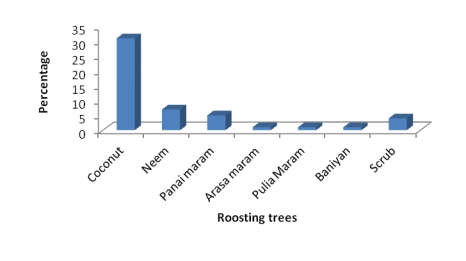
The farmers revealed that the peafowls roost in coconut trees (62%), followed by 14% of them told they roost at Neem tree. Very few of them (2%) told they have roosting at Peepal tree, Tamarind tree and Baniyan Tree (Figure 10).
Roosting Height, Time & Purpose
The roosting height of the tree by peafowls was asked to the farmers and 42% of them opined that they roost at the height of 15 to 25 ft. and 30 to 50 ft., followed by 16% of peoples were responded Peafowls roost on 60 to 100 ft heights of the trees. Seventy percent of the people say the peafowls leave the roost at 5 am to 6 am. Whereas 30% of them reveal that they leave at 6 am to 7 am. Similarly, 58% of them opined that the peafowls roost between 5 pm and 6 pm and 42% of them reveals they roost between 6 pm and 7 pm. The farmers were also asked for the reason for roosting in the trees at various heights. Fifty two percent of them say the peafowls roost in the tree top to escape from predators. But, 48% of them say they do not have any idea for the reason.
Feather Collection
The survey result revealed that 64% of people were opined that they collect the Peacock feathers from the field and 36% of people say they did not collect the feather. About 54% of them collect the feathers for the use of temple purpose and 10% says they collect for commercial purpose.
Food Preference of Peacock
The farmers were asked for the food preference of peafowl. Forty two percent of them opined that they eat all type of crops. In particular 22% of them say they feed mainly on vegetables and 36% of them say they eat insects.
Seasonal wise Abundance
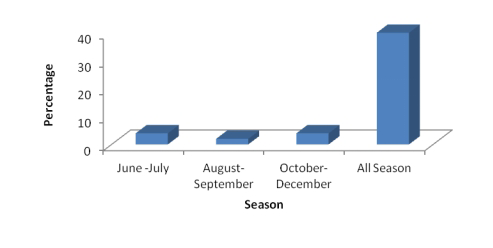
Majority of the people 80% opined that the peafowls can be seen all season in the cultivated lands. About 8% of them opined that they can be mostly seen during June-July season and October –November season. Only four percent of them says they can be seen during August-September season (Figure 11).
Opinion about Conservation for Peacock
The cultivators have been asked about their opinion on conservation of peafowls. Twenty eight percent of them say it has to be conserved and 24% of them opined need not to be conserved. There is no opinion (48%) about the conservation of the National bird.
Discussion
A total of 45 occasions of peafowl sighting consists of 119 birds. Adult female is the mostly sighted bird (64) with 23 sightings. Adult male has been sighted 12 times consists of 28 individuals. Sub adult male and chicks were sighted less in number. Similarly, the same observation of 713 birds were recorded in 429 occasions during the data collection period and the peafowl density estimated for Chilla Range of Rajaji National Park during the study was 88.24 birds per sq.km [15]. Veeramani, et al. [5] recorded 234 peafowls consists of 111 males, 105 females and 18 sub adults in Mudumalai Wildlife Sanctuary with the density of 2.86 birds per sq.km in scrub jungle forests where as it was 20.64 birds per sq.km. in dry deciduous habitat.
The present study of peafowls in Neelathanallur and surroundings of Kollidam river basin of Tamil Nadu shows that the sex ratio of adult male and adult female is 1:1.55. Whereas the adult female and chicks ratio is 1: 0.2. Das, et al. [15] estimated the male to female sex ratio of peafowl was estimated at 1: 1.44, which is near similar sex ratio reported from other parts of Northern India, in a sex ratio of 1: 1.24 [16]. Veeramani, et al. [5] estimated the sex ratio of adult male and adult females was 1: 0.95. In the polygynous peafowl harem-mating system was noticed as reported by Ali, et al. [17] but not by all adult males. Johnsingh, et al. [18] noted a sex ratio favouring apparent females, but admitted that, they may have mistaken immature females as males, which probably affected their estimates. Rajadurai [19] reported the sex ratio of Adult male and adult female peafowls in Viralimalai areas of Tamil Nadu is 1: 1.4.
In the study areas with semi wild condition the roosting tree species selection by the peafowls mostly prefer Coconut tree (Cocos nusifer) for roosting and it was rarely roost in other trees such as Bambusa arundinaceae followed by Borasus fabelliformes, Tamarindus indica and Azadiracta indica. Similar results have also been reported by Ward, et al. in case of other birds species. Dodia [20] has reported that among 14 trees species (Azadiracta indica, Ficus bengalensis, Eucalyptus, Cocos nucifera, Prosopsis juliflora, Mangifera indica, Ziziphus mauritina, Syzium cumini, Ficus teseila, Manikara haexandra, Terminalia catappa, Casuariana equisetafolia, Samanaea saman, Adansonnia digitate) peafowl roosted mainly on Azadiracta indica, Ficus bengalensis, Eucalyptus and Cocos nucifera in Gujarat state of India. In Mudumala Wildlife Sanctuary peafowls preferred 8 types of tree species for roosting such as Acacia sundra, Cordia oblique, Bombax malabaricum, Zizyphus jujube, Eleodendron glaucum, Odina wodier, Tamarindus indica and Dalbergia latifolia. The present study of roosting tree selection by peafowl shows that most of the birds select Cocos nucsifer tree followed by Bambusa arundinaceae, Borasus fabelliformes, Tamarindus indica and Azadiracta indica. Ali, et al. [17] have reported that large birds need tall trees and small birds need small trees for roosting. In the present study, peafowl, being the large bird, was found to prefer large trees for roosting. According to Bergmann J [21]; Johansgaurd [22], blue peafowl (Pavo cristatus) has been observed on the tall trees for roosting, and nesting under dense bushes with open areas having feeding grounds. Roosting of the peafowls was very closely related with the sunset but temperature had no relation with roosting [23].
Normally Pavo cristatus are both communal and solitary roosters [24]. The present study also showed the same result. One probable reason for the communal roosting habit of peacocks at may be their vulnerability for predation by feral dogs in that area. Communal roosting facilitates the birds to detect the predators easily. On trees with dense foliage, they preferred to roost on the highest branches. These observations resemble the findings of Yasmin S [25]. Hence, it could be attributed that the selection of roosting branch by peafowl depends on the clarity of vision it provides of the surroundings. Johnsingh, et al. [3] opined that some of the roost trees were traditional sites to which peafowl return every night. This coincided with the present findings, where in one adult peacock was observed to roost regularly on a coconut and palmyra tree throughout the study period. There is a problem of crop raiding by peafowls in the agricultural fields of the study areas. About 26.25% of the observation shows the peafowls raid mainly on corn or maize plant followed by paddy field (23.11%), chilli (21.85%), cerals & grams (16.14%) respectively. Similar observation was made in the Viralimalai region by Rathinasabapathy [26]; Rajadurai [19]. The activity budget of peafowl of the present study shows that the peafowls mostly spent their time for feeding followed by Resting, Walking, Preening and Display and call. The behavior of Indian peafowl was strongly influenced by age and sex. Adult males spent only about half as much time as females in feeding. This could be attributed to greater amount of time spent standing, displaying and preening by adult males than by females. Adult males spent significantly more time in preening than sub-adult males and females suggesting they incurred a ‘high maintenance handicap’ because of the elaborate ornamentation [27].
Subadult males, which lack the long train but possess the iridescent plumage similar to that of the adult males, were observed to spend about half the time spent by the adult males in preening [28, 29].
Conclusion
Questionnaire survey of the cultivators revealed the same result which derived from the field data including the population, roosting tree and roosting height preference, activity budget, food and feeding of peafowls in the study area. The people living in the study sites does not have much impact due to peafowl in the area. They are not doing any harm to the peafowl because they are worshipping the peacock as vehicle of Lord Subramania. Only very few incidents of poisoning happened in the recent past otherwise the peafowls are the pet of the people living around.
Acknowledgements
The authors are highly obliged to the Tamil Nadu State Council for Science and Technology (TNSCST) for providing financial assistant to conduct the study. The authors also thankful to the College Principal and staff members, Department of Zoology for their timely help during the study period.
References
-
The farmers revealed that the peafowls roost in coconut trees (62%), followed by 14% of them told they roost at Neem tree. Very few of them (2%) told they have roosting at Peepal tree, Tamarind tree and Baniyan Tree (Figure 10). [INLINE_FIGURE:7:0] Figure 10: Roosting tree used by peafowls.
- California Red-Legged Frog and Non-Listed Amphibians Response to Non-Native Fish Removal
- Industrial Standardization of the Bio-OS: Algorithmic Codification of Resilience Engineering Guidelines and Version V8 Architecture
- Climate Variability and the Sustainability of Snail Farming in Nigeria: Past Trends, Present Challenges and Potential Outlook
- The Evaluation of the Surveillance System of Anthrax in Gilgit-Baltistan, Pakistan, 2018
- Natural Decline to Extinction of A New Zealand Rabbit Population
- Mitochondrial Bio-Logistics: Steering Co-Enzyme Q10 and Lycopene Synergies within the Science 4.0 Bio-OS Framework