
Three-Year Perspective Study on American Kestrels (Falco sparverius) Received for Rehabilitation in a Facility in Southern Brazil
The American kestrel is a common bird of prey across Brazil and is abundant in many regions of the country. Kestrels are also found in urban areas, which predispose them to anthropogenic threats. Some threats that wild raptors face around the world include electrocution, barbed-wire lesions, shooting, collision with artificial structures, and vehicle-related accidents. Raptors are often brought to veterinary clinics with traumatic lesions arising from such threats. Infectious diseases are also a primary reason for raptors to be brought to veterinary facilities as well as nestlings and young those are found outside the nest or young. The aim of our study was to report the frequency and causes of injuries in American kestrels (F. sparverius) received at a rehabilitation facility in southern Brazil. We evaluated data collected from 2019 to 2021 for a total of 82 individuals, including 47 adults and 35 juveniles, which composed 57.3% and 35% of our dataset, respectively. We found that physical trauma was the main reason for admission (61% or 50/82 of all cases we examined). Traumatic injuries included bone fractures, traumatic brain injury, lacerations, and different kinds of lesions. Juveniles with no signs of trauma or diseases represented the second main cause of admission to the rehabilitation facility (28% or 23/82 individuals). Most individuals were admitted to the rehabilitation clinic in December (37.8%), followed by November (20.7%) and January (4.6%). We found that the outcomes of rehabilitation were generally positive. Of the 82 individuals received, 44 (53%) were released back to the wild, 20 (24%) were euthanized for humane reasons and 19 (23%) died as a result of their injuries or illness. Future work on the frequency of anthropogenically-induced injuries and illnesses will help shed more light on rehabilitation strategies that lead to successful outcomes for raptor species.
Introduction
The American kestrel is a common bird of prey in Brazil and is abundant in diverse habitats [1, 2] including open areas and both semi-desert and desert areas [2, 3]. Kestrels also frequent urban areas [4]. This species feeds mainly on invertebrates and occasionally on small vertebrates [5].
In the Southern hemisphere, kestrels breed during the Austral spring and summer (October to December) [6]. Their reproductive behavior occurs from June to October, with more intensity in September. Pairs nest in places such as tree hollows, high posts and artificial structures in buildings. Parents are often observed tending to their clutches in November, and chicks abandon the nest around 32 days after hatching [7]. As kestrels are widespread in Brazil and use human-modified habitats across the country for breeding and foraging, they are commonly exposed to anthropogenic threats that can cause debilitating injuries.
All around the world, wild raptors are brought to veterinary care facilities mainly because of traumatic lesions including electrocution, barbed-wire lesions, shooting, collisions with artificial structures, and accidents with vehicles. Infectious diseases are also a primary reason for raptors to be brought to veterinary facilities as well as nestlings and young that are found outside the nest [8, 9, 10, 11, 12, 13, 14, 15, 16, 17, 18].
Body of Paper
In this study, our aim was to assess the frequency and causes of admission of American kestrels (F. sparverius) to a rehabilitation facility in Rio Grande do Sul, Brazil. We evaluated data collected from 2019 to 2021 for a total of 82 individuals that were brought to the facility by citizens, environmental police authorities, and associated organizations. Birds were identified as adults or juveniles/ young upon arrival, and the kind of lesion or injury they presented was also documented in most cases. The results by age group are shown in Table 1.
| 2019 | 2020 | 2021 | Total | |
|---|---|---|---|---|
| Adults | 16 | 21 | 10 | 47 |
| Juvenile/young | 7 | 7 | 21 | 35 |
| Total | 23 | 28 | 31 | 82 |
Table 1: Total number of adult and juvenile American kestrels (_F. sparverius_) received by year in the facility in southern Braz
The majority of the birds that arrived at the facility were adults (47/82 or 57.3%), followed by juveniles (35/82 or 42,7%). Anthropogenic actions resulting from urbanization negatively impact the ecosystem, where interactions with avifauna are frequent [19]. In some cases, like vehicle collisions, these occurrences pose a threat to both humans and wildlife, causing loss of individuals and risks of injuries. In a facility in Ohio, United States, vehicle collisions caused admission of birds, showing more prevalence in species such as F. sparverius and Megascops asio [20].
In our study, physical trauma was the main reason for admission to the facility (61% of all birds, or 50/82). Such trauma included bone fractures, traumatic brain injury, lacerations, and different kinds of lesions. In some cases, it wasn’t possible to determine the cause of trauma, but in urban environments, window strikes and domestic animals predation should always be considered the major reasons for accidents involving birds (Figure 1). Glass collision casualties are considered one of major causes of death for these animals [21, 22]. In the United States, cat predation is considered a consistent cause of admission in rehabilitation facilities, since they have more access to wild life as a result of urbanization. Our results are consistent with several studies confirming that physical trauma is a main cause of injuries in raptors more broadly.
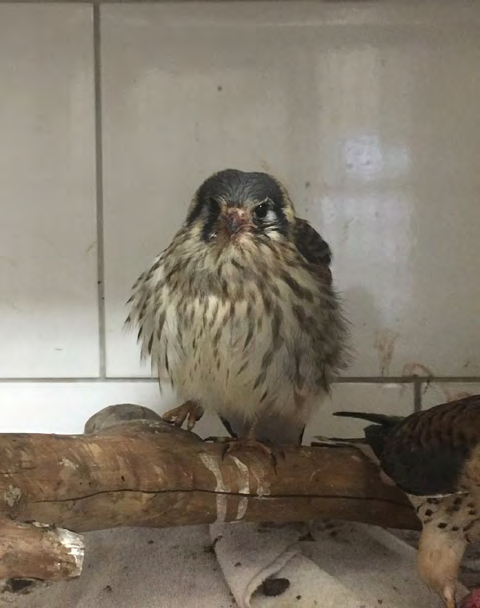
In the same facility, a retrospective study about frequency of radiographic findings in birds of prey admitted in the years 2020 and 2021 showed that 14/32 free range individual submitted to x-rays where presenting some kind of fractures in thoracic or pelvic limbs [23]. Study in Berlin evaluated data from a facility center during eleven years, and demonstrated that 317/724 did present clinical signs of limb fractures or luxations [24].
Even though electrocution is a frequent cause of death among birds of prey, previous study showed a higher prevalence in owls and hawks rather than falcons [25]. Also, the majority of carcasses found dead by electrocution in Mongolia belonged to bigger species, as saker falcons, leading researchers to conclude small birds like common kestrels and little owls were able to escape from electrical discharges in poles they landed [26]. The kestrels evaluated in the facility of our study didn’t present signs of this form of injury, such as burns and necrosis of wings and pelvic limbs [25].
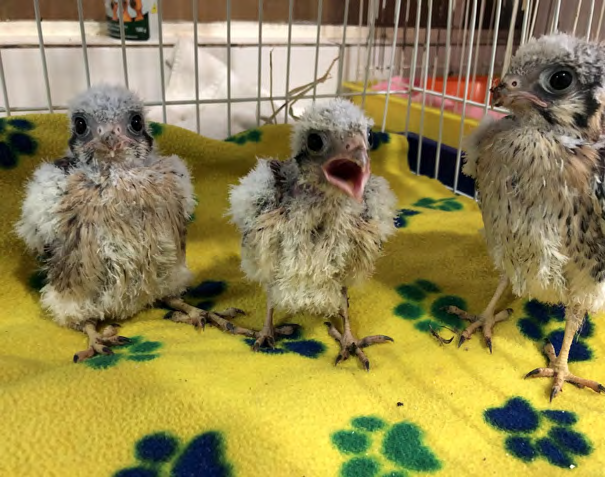
Birds highly adapted to urban areas are more prone to be found as orphan young, as shown in a retrospective study in Spain, where 32% of individuals of several species of birds of prey were included in this category. In that study, 591 from a total of 1295 Falco tinnunculus individuals were less than a year of age. F. tinnunculus is an european common kestrel [27], very similar to F. sparverius in size and habits. Those results are similar to ours, where juveniles with no signs of trauma or diseases represented the second main cause of admission in the facility, with 23/82 (28%) individuals (Figure 2). Most individuals arrived in December (31/37,8%), followed by November (17/20,7%) and January (12/4,6%). These months represent the final weeks of the Austral spring and beginning of the summer, indicating that the increased arrival of juvenile kestrels during these months is probably related to young individuals fledging.
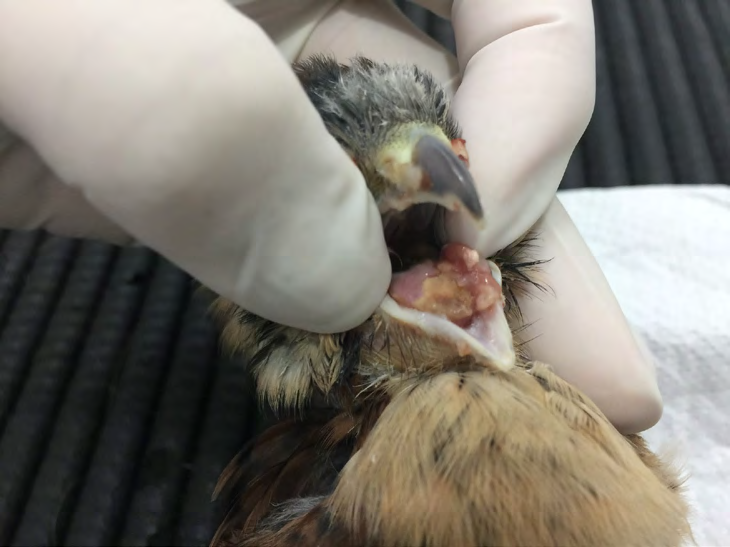
Birds with clinical signs of infectious diseases represented 11% (9/82) all individuals. Trichomonas sp. parasitic infections and Candida sp. fungal infections were common in our dataset. Both diseases can present white- yellowish lesions in the oral cavity causing dysphagia, difficulty swallowing, loss of weight or emaciation, and can lead to secondary bacterial/fungal infections and death, especially trichomoniasis [28, 29, 30] (Figure 3). In a study by Andery, et al. [11], F. sparverius was among the species received at a rehabilitation center in Belo Horizonte, Brazil, where Trichomonas sp. was prevalent in 9.1% of necropsied animals. Higher risk of pathognomonic lesions were observed in non-specific ornithophagous birds of prey as F. tinnunculus, and it’s related to some genotypic strains, as shown in a previous study in Spain. The characteristic of diet in F. sparverius is very similar to F.tinnunculus, and results presented in our study shows are close of those observed in Martinez-Herrero, et al. where 9,4% of common kestrels had gross lesions of trichomoniasis.
We also assessed rehabilitation outcomes in our dataset, and results are shown in figure 4. Of the 82 individuals received at the facility, 44 (53%) were able to be released back to the wild, 20 (24%) were euthanized for humane reasons and 19 (23%) died as a result of their injuries or condition. The percentage of birds released was lower than other studies in Spain, 57,7% [31] and in Jordan 55,8% [32] but higher that studies in South Africa, 48%, Canary Islands, 44,4%, Thailand, 40,5% [33], United States, 38% and in Czech Republic, 15,9% [34, 35, 36].
![Figure 4: Of the 82 individuals received at the facility, 44 (53%) were able to be released back to the wild, 20 (24%) were euthanized for humane reasons and 19 (23%) died as a result of their injuries or condition. The percentage of birds released was lower than other studies in Spain, 57,7% [31] and in Jordan 55,8% [32] but higher that studies in South Africa, 48%, Canary Islands, 44,4%, Thailand, 40,5% [33], United States, 38% and in Czech Republic, 15,9% [34-36].](/fulltextimages/9537/fig_4.png)
1 = Released individuals after admission 2 – Euthanized individuals 3 – Dead individuals. Figure 4: Graphic distribution of destination after admission in the facility center in south Brazil during years 2019 to 2021.
Our study showed a sad reality for raptors in Brazil, especially kestrels. More studies are necessary to comprehend the anthropogenic influence on the F. Sparverius life and to better understand how we are handling these species in captivity relating to the rehabilitation success.
Acknowledgements
We sincerely thank Grace-Smith Vidaurre and Daniel M. Brooks for their help with this article. Also, we thank non- governmental organization Voluntarios da Fauna in Porto Alegre, Rio Grande do Sul, Brazil, for providing access to data.
References
-
Belton W (1994) Aves do Rio Grande do Sul: Distribuição e Biologia. São Leopoldo, Editora UNISINOS.
-
Sick H (1997) Ornitologia Brasileira. Rio de Janeiro, Editora Nova Fronteira.
-
Del Hoyo J, Elliot A, Sargantal E (1994) The Handbook of Birds of The World. Volume 2: New Vultures to Guineafowl. Barcelona: Lynx Editions.
-
Efe MA, Mohr LV, Bugoni L (2001) Guia Ilustrado das Aves dos Parques de Porto Alegre. Porto Alegre, Proaves, Smam, Copesul, Cemave.
-
Zilio F (2006) Dieta de _Falco sparverius_ (Aves: Falconidae) e _Athene cunicularia_ (Aves: Strigidae) em uma região de dunas no sul do Brasil. Revista Brasileira de Ornitologia 14: 379-392.
-
Viana IR, Zocche JJ (2016) Biologia Reprodutiva de _Falco_ _sparverius_ nos Campos de Cima da Serra e Planalto Serrano, Sul do Brasil. Ornithologia 9: 4-11.
-
Menq W (2022) _Falco sparverius_. Aves de Rapina Brasil.
-
Morishita TY, Fullerton AT, Lowenstine LJ, Gardner I, Brooks DL (1998) Morbidity and mortality in free-living raptorial birds of Northern California: A retrospective study, 1983-1994. Journal of Avian Medicine and Surgery 12: 78-81.
-
Joppert AM (2007) Prospective study of the causes of death of free-living Falconiformes and Strigiformes in the city of São Paulo. Doctoral Thesis in Experimental and Comparative Pathology. Faculty of Veterinary Medicine and Animal Science, University of São Paulo.
-
Rodríguez B, Rodríguez A, Siverio F, Siverio M (2010) Causes of Raptor Admissions to a Wildlife Rehabilitation Center in Tenerife (Canary Islands). Journal of Raptor Research 44(1): 30-39.
-
Andery DA (2011) Perfil sanitário de rapinantes de cativeiro e recolhimento em um centro de triagem de animais silvestres, Belo Horizonte/MG.
-
Richard E, Zapata DC (2011) Raptor Mortality on Roads in Central and Northern Argentina: A Preliminary Analysis of the Problem. Spizaetus – Raptor Network Newsletter 11.
-
Katzner T, Winton JD, McMorris FA, Brauning D (2012) Dispersal, Band Encounters, and Causes of Death in a Reintroduced and Rapidly Growing Population of Peregrine Falcons. Journal of Raptor Research 46: 75-83.
-
Molina-López RA, Casal J, Darwich L (2013) Final Disposition and Quality Auditing of the Rehabilitation Process in Wild Raptors Admitted to a Wildlife Rehabilitation Centre in Catalonia, Spain, during a Twelve Year Period (1995–2007). Plos One 8(4): e60242.
-
Montesdeoca, N, Calabuig P, Corbera JA, Rocha J, Orós J (2017b) Final outcome of raptors admitted to the Tafira Wildlife Rehabilitation Center, Gran Canaria Island, Spain (2003–2013). Animal Biodiversity and Conservation 2: 211-220.
-
Hernandez CL (2018) Retrospective Study of Raptors Treated at the Southeastern Raptor Center in AUBURN, Alabama. Journal of Raptor Research 52: 379-388.
-
Inzani H, Williams DL (2018) Comparison of rehabilitation rates of birds of prey from a raptor rehabilitation centre ten years apart. International Journal of Avian & Wildlife Biology 3: 447-451.
-
Maphalala M, Monadjem A, Bildstein K, Hoffman B, Colleen D (2021) Causes of admission to a raptor rehabilitation centre and factors that can be used to predict the likelihood of release. African Journal of Ecology. 59(2): 510-517.
-
Vance JA, Smith WH, Smith GL (2018) Species composition and temporal patterns of wildlife–vehicle collisions in southwest Virginia, USA. Human–Wildlife Interactions 12(3): 417-426.
-
Burton DL, Doblar K (2004) Morbidity and mortality of urban wildlife in the midwestern United States. Proceedings 4th International Urban Wildlife Symposium pp: 171-181.
-
Klem Jr D (2008) Avian mortality in windows. Proceedings of the Fourth International Partners in Flight Conference: Tundra to Tropics pp: 244-251.
-
Loss SR, Lao S, Eckles JW, Anderson AW, Blair RB, et al. (2019) Factors influencing bird-building collisions in the downtown area of a major North American city. PLoS ONE 14(11): e0224164.
-
Prusch F, Morel AP, Anicet MZ, Scheibe AFS, Marsicano G (2022) Levantamento de aves de rapina atendidas em serviço de radiologia veterinária em Porto Alegre, RS, e sua relaçã o com ações antrópicas. Revista Multidisciplinar de Educaçã o e Meio Ambiente 2: 4-12.
-
Titze K (2016) Fractures and luxations in birds of prey and owls and the classification of fractures of the bird skeleton with the AO classification. Thesis. Mensch & Buch Publishers: Berlin, Germany, pp: 177.
-
Dwyer JF, Mannan WR (2007) Preventing raptor electrocutions in an urban environment. Journal of Raptor Research 41(4): 259-267.
-
Dixon A, Bold B, Tsolmonjav P, Galtbalt B, Batbayar N (2018) Efficacy of a mitigation method to reduce raptor electrocution at an electricity distribution line in Mongolia. Conservation Evidence 15: 50-53.
-
Nelson T (2008) Falco tinnunculus common kestrel. Animal Diversity Web.
-
Arent LR (2007) Raptors in Captivity, Guidelines for Care and Management. Hancock House, Surrey, Canada, pp: 301.
-
Muller MG (2009) Practical Handbook of Falcon Husbandry and Medicine. Nova Science Publishers, New York, USA, pp: 403.
-
Scott DE (2021) Raptor Medicine, Surgery and Rehabilitation. In: 3rd (Edn.), Cabi, Oxfordshire, pp: 340.
-
Montesdeoca N, Pascual C, Corbera J, Coooper J, Orós J (2017) Causes of morbidity and mortality, and rehabilitation outcomes of birds in Gran Canaria Island, Spain. Bird Study 64: 1-12.
-
Al Zoubi MY, Hamidan, NA, Baker AA, Amr Z (2020) Causes of Raptor Admissions to Rehabilitation in Jordan. Journal of Raptor Research 54(3): 273-278.
-
Kidsin K, Sanyathitisere P, Pothieng D, Wajjwalku W, Kasorndorkbua C (2012) A Retrospective Study of Morbidity and Mortality of Raptors in Kasetsart University Raptor Rehabilitation Unit, 2008-2011. Korean Journal of Ornithology 19: 87-92.
-
Lukesova G, Voslarova E, Vecerek V, Vucinic M (2021) Causes of admission, length of stay and outcomes for common kestrels in rehabilitation centres in the Czech Republic. Scientific Reports 11: 17269.
-
Pereira RJG (2008) Acompanhamento comportamental e endócrino da atividade reprodutiva anual de machos de falcões quiri-quiri (_Falco sparverius_) de vida livre. Doctorate Thesis Universidade Estadual Paulista, Faculdade de Ciências Agrárias e Veterinárias.
-
Wendell M, Sleeman J, Kratz G (2002) Retrospective study of morbidity and mortality of raptors admitted to Colorado State University Veterinary Teaching Hospital during 1995 to 1998. Journal of Wildlife Diseases 38: 101-106.
- California Red-Legged Frog and Non-Listed Amphibians Response to Non-Native Fish Removal
- Industrial Standardization of the Bio-OS: Algorithmic Codification of Resilience Engineering Guidelines and Version V8 Architecture
- Climate Variability and the Sustainability of Snail Farming in Nigeria: Past Trends, Present Challenges and Potential Outlook
- The Evaluation of the Surveillance System of Anthrax in Gilgit-Baltistan, Pakistan, 2018
- Natural Decline to Extinction of A New Zealand Rabbit Population
- Mitochondrial Bio-Logistics: Steering Co-Enzyme Q10 and Lycopene Synergies within the Science 4.0 Bio-OS Framework