
Invasive Species Drive Human Poisoning: The Case of the Silver Cheeked Pufferfish Lagocephalus sceleratus (Gmelin, 1789)
Since the opening of the Suez Canal in 1869, a phenomenon of biotic immigration, often reported as ‘Lessepsian migration’, took place from the Red Sea to the Mediterranean Sea. Besides causing huge ecological impacts, this massive invasion has resulted in the introduction of toxic species producing tetrodotoxin (TTX), with associated risks for human health. The subject of this review is the silver checked pufferfish Lagocephalus scelaratus, which has rapidly spread through the eastern Mediterranean and is currently expanding. The aim of this study is to provide a review of the current state of the art regarding the presence of L. sceleratus in the Mediterranean Sea and the related emerging problem of food poisoning risks to European consumers due to the tetrodotoxin contained in this species. In addition, the production of tetrodotoxin in pufferfish, its mechanism of action once ingested, and its potential lethality to humans is discussed. Here we listed 93 reported cases of intoxication and 12 deaths due to the consumption of this species in the Mediterranean Sea. It is clear from this review that the likelihood of catching L. sceleratus in the Mediterranean Sea is increasing and consequently the possibility of it accidentally ending up in the food chain. Possible solutions to this emerging issue are reported and discussed.
Introduction
Lessepsian migration is that phenomenon whereby species move from the Red Sea to The Mediterranean Sea through the Suez Canal. This human-made corridor, opened in 1869, enabled the unidirectional passage of entire Indo- Pacific complexes among mollusks, crustaceans, and algae as well as more than 100 species of fish [1]. This type of migration owes its name to the French engineer Ferdinand Marie de Lesseps who designed and supervised the building of the Suez Canal [2]. Lessepsian species cause ecological and financial damage not only on marine life but also by affecting the health of the Mediterranean Sea [3, 4, 5] and the number of these species continues to increase [6, 7, 8, 9]. A relevant impact is that of the Lessepsian poisonous fish species, included within the following families: Tetraodontidae, Siganidae, Dasyatidae, Scorpanidae, Plotosidae, Ostracionidae, and Ariidae [2]. The Tetraodontidae family is composed of 130 species and
19 genera, mainly marine and estuarine [10]. This family is well represented by at least eleven species: Lagocephalus guntheri, Lagocephalus spadiceus, Lagocephalus lagocephalus, Lagocephalus suezensis, Lagocephalus sceleratus, Torquigener flavimaculosus, Tylerius spinosissimus, Sphoeroides spengleri, Sphoeroides pachygaster, Sphoeroides marmoratus, and Ephippion guttiferum [11, 12].
The species of main concern is Lagocephalus sceleratus (Gmelin, 1789) that is considered among the most dangerous Lessepsian species in terms of toxicological, ecological, and economic impacts [13]. It has been blacklisted as one of the 18 worst invasive fish species by the International Union of Conservation of Nature (IUCN) [14]. The chronology of L. sceleratus invasion has been recently reviewed by Azzurro, et al. [15]. L. sceleratus was first recorded in the Mediterranean Sea in 2003 [16], then in the southern central Mediterranean [17] and later in Spain [10] and France [18], recently reaching the westernmost end of the Mediterranean Sea [19].
It is the most invasive species of the genus Lagocephalus in the Mediterranean Sea, rapidly spreading in the eastern basin and currently moving westwards, confirming its adaptability to different environmental conditions. Furthermore, it is considered one of the most rapidly expanding invasive species due to its high growth and reproduction rate, absence of natural predators, ability to exploit food resources and to tolerate different environmental conditions [20, 21].
Lagocephalus sceleratus is native to the Indo-Pacific region. It is 15-60 cm long and is characterized by two separate lateral lines, small spinules on the head and back that extend almost to the caudal fin and on the belly. It also has characteristic black spots of almost equal size on its back. It usually lives at a depth of 10-50 m and feeds mainly on benthic invertebrates on sandy bottoms. When threatened, it is able to inflate its body by rapidly engulfing water or air [2, 22]. L. sceleratus is known to carry high and variable concentrations of the dangerous tetrodotoxin (TTX) [23, 24, 25] and is therefore considered one of the most poisonous fish in the world [13].
Tetrodotoxin also accumulates in other Mediterranean species including several marine gastropods, oysters, mussels, parrot fish, toads of the genus Atelopus, several species of blue-ringed octopus of the genus Hapalochlaena, several starfish, an angelfish, a polycladic flatworm, several species of arrow worms, several ribbon worms, and many species of Xanthidae crabs [6, 26, 27, 28, 29]. However, the aspects listed above about L. sceleratus led us to the choice of the topic of this review. Indeed, given the increasing prevalence of this Lessepsian species and given its potential lethality we thought it would be useful to provide a review of the current state of the art regarding the presence of L. sceleratus in the Mediterranean Sea and the related emerging problem of food poisoning risks to European and Mediterranean consumers.
Tetrodotoxin in Lagocephalus sceleratus
L. sceleratus toxin is tetrodotoxin (TTX) (Figure 1), a strong marine neurotoxin. It is a guanidine heterocyclic compound of low molecular weight (319.1 g/M), not thermolabile, colorless, odorless, tasteless, and soluble in water, discovered in 1909 by the Japanese researcher Yoshizumi Tahara from ovaries of globefish [13, 26]. TTX shows maximum concentrations in the liver and ovaries, followed by intestines, muscles, and skin with regional and temporal variations [30, 31]. It is very dangerous to human health as it is responsible for paralysis of nerves and muscles, including the diaphragm and intercostal muscles, through selective blockade of voltage gated-sodium channels of the neuron cell membrane [32].
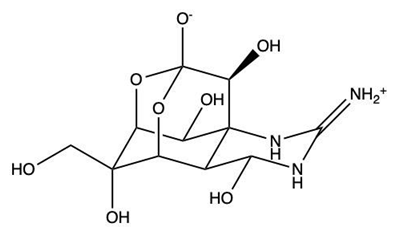
The production of tetrodotoxin in pufferfish is not endogenous but is produced by strains of symbiotic marine bacteria species belonging mainly of the genera Vibrio, Pseudomonas and Pseudoalteromonas [18]. In particular, the genus Vibrio is represented by about ten species and V. alginolyticus is the one most involved in the production of TTX. L. sceleratus use the toxin to defend themselves or as a weapon of predation and, as in other cases of animals or plants synthesizing toxins, show great resistance to the toxin itself through biological defense systems.
The level of TTX is not evenly distributed throughout the body of L. sceleratus and is also influenced by sex and seasonality In Lagocephalus sceleratus the gonads generally have a TTX level of more than 1000 MU/g, while the intestine has an average TTX level of 100-1000 MU/g and liver, skin, and muscles have an average TTX level of 10-100 MU/g [33]. The spawning season is another factor influencing toxicity: it generally occurs between late spring and summer, a period when the TTX levels are high, while they tend to decrease in the fall and winter seasons [34]. Other researchers, however, have not noticed such differences [35, 36, 37].
Tetrodotoxin is easily absorbed by the membranes of the small intestine, a factor that increases its speed of action after ingestion. Further studies have estimated that the minimum lethal dose (MLD) of TTX is 2 mg for a female of average weight (50 kg) [36]. This is equivalent to 10 MU of TTX per g of edible portion [38]. However, a number of cases have been reported indicating that acute poisoning can occur at doses of 0.28- 2.94 mg for a 70 kg adult [39]. Actual toxicity depends on several factors such as health, age, and individual sensitivity. TTX is one of the deadliest natural substances as its lethal dose (LD50) is 275 times lower than hydrogen cyanide and 50 times lower than curare and strychnine [40].
Tetrodotoxin acts by blocking voltage gated-sodium channels of peripheral motor and sensory nerves through which sodium ions flow during the ascending phase of the action potential [41, 42]. The toxin acts by binding extracellularly to receptor site-1 of Na+ channels occluding the outer pore [42] and inhibiting the generation and propagation of nerve and muscle action potentials, resulting in blockade of the neuron and muscle paralysis.
Clinical signs of tetrodotoxin poisoning usually appear within 10-45 minutes after ingestion of the toxin but may also be delayed up to 3 hours. Toxicity involves the neuromuscular, cardiovascular, pulmonary, central nervous, autonomic, peripheral sensorimotor, gastrointestinal, and dermatological systems. This poisoning is generally divided into four stages ranging from oral numbness to progressive loss of consciousness and death, which generally occurs within 6-24 h of consumption and is due to respiratory muscle paralysis or less frequently to profound hypotension. However, type and severity of the clinical manifestations depend on the amount of tetrodotoxin consumed and the individual’s health condition [43, 44, 45, 46, 47, 48, 49].
Currently, there is no effective antidote against tetrodotoxin. The only treatment is supportive therapy and is based on careful observation and continuous neurological assessments for early implementation of measures to maintain adequate breathing (mechanical ventilation) and circulation. Removal of the not-yet- absorbed toxin can be attempted with induced vomiting or gastric lavage with activated charcoal due to its binding action against TTX [50]. Some treatments still on trial include cholinesterase inhibitors (neostigmine), naloxone, cysteine, gastric lavage with sodium bicarbonate, antihistamines, and steroids [51, 52, 53]. Effective future treatments could also include monoclonal antibodies and 4-aminopyridine that have shown excellent results on mice poisoned with TTX [40, 54].
The toxic action of TTX, which blocks sodium channel activity, can play a very significant role in neurophysiology and other fields of research [33, 55] including the treatment of cardiac arrhythmias. Several studies have proved the analgesic activity of tetrodotoxin in cancer patients as well as the pain-relieving action has consistently proven useful in the treatment of migraines, neuralgia, rheumatism, and heroin withdrawal [56, 57, 58, 59].
Lagocephalus sceleratus as a Risky Food Item
Pufferfish meat, if cooked properly and carefully, is edible and considered a delicacy by some Japanese [60, 61]. Fugu is the traditional Japanese cuisine dish made from pufferfish and for its preparation as well as for any pufferfish recipe, it is necessary to have a special license issued by the National Health Authority. Fish preparation involves removing all those organs that accumulate TTX, namely the skin, viscera, gonads, and liver.
In 1952 the Japanese Ministry of Health published a report stating that 83% of poisonings occurred at home and 3% at restaurants, while the rest included hotels and other locations and this trend kept going on. In fact, from 1963 until 2007, 73% of poisonings happened at home and 15% at restaurants [62]. The frequency of poisonings related to pufferfish consumption prompted the Japanese Ministry of Health and Welfare to publish in 1983 a list of edible pufferfish that excluded Lagocephalus sceleratus. Then, in the 1990s, it banned the sale of pufferfish liver, but mortality from food poisoning continued [33].
Even in Malaysia, where pufferfish consumption is common, there is a ban on L. sceleratus [63]. Several cases of poisoning have also been recorded in the Mediterranean area [64], yet L. sceleratus is marketed regardless of the risk it poses to public health. Its large size may be one of the reasons behind the sale of this species; in Egypt it is illegally sold, consumed, and considered a delicacy despite a law prohibiting its marketing and edibility. Even in Turkey, where there is a prohibition, the fish is caught and consumed illegally [61]. In Lebanon, this species is consumed by some fishermen and a small number of consumers unaware of the health risks involved. Several cases of intoxication prompted the Lebanese government to ban fishing and consumption of all pufferfish species in the Mediterranean in 2011. Europe has issued a ban on the fishery, marketing, and consumption of L. sceleratus (Directive 91/493/CEE, 853/2004/EC and 854/2004/EC) and European countries, such Italy, ban the commercialization of all Tetraodontidae (Art. 5 DL n. 531/1992).
Guardone, et al. [65] conducted a retrospective study on human cases of tetrodotoxin intoxication from seafood eating with the aim of collecting scientific data to update the risk analysis related to the global consumption of fish products categories and geographical areas of origin. The
study displayed that more than half of the 3032 cases of intoxication are attributed to fishes followed by gastropods, arthropods, and cephalopods. Furthermore, European cases were caused by imported Asian products. However, recently, cases of poisoning caused by local fish have been reported in Spain, the Middle East, and North Africa, confirming the Lessepsian spread of pufferfish in the Mediterranean in areas previously marginally unaffected by this health risk. In particular, with regard to intoxication cases certainly due to L. sceleratus along the Mediterranean coasts, in Israel there have been reported 15 cases [2, 66], 2 in Lebanon [64, 66, 67], and 76 in Egypt of which 12 fatal [68].
Consumption of L. sceleratus can also be accidental. Its rapid expansion in the Mediterranean together with the danger of its ingestion to human health make L. sceleratus a serious emerging threat to food safety in Europe. However, specific monitoring plans have not yet been adopted, which underscores the importance of measuring its concentrations in Mediterranean species [13]. In any case, the probability of finding this species in Mediterranean catches is increasing as well as the chance of them accidentally ending up in the food chain, posing risks to consumers across Europe who may find themselves ingesting TTX-contaminated fish products. This is an emerging occupational safety issue, as even those who work in restaurant kitchens could find themselves unknowingly handling a puffer fish or otherwise tetrodotoxin-contaminated seafood product. To address this emerging issue, the solution could be the development of molecular markers that can quickly identify the presence of pufferfish in fresh and processed fish products to protect the health of consumers throughout Europe. Also important is the outreach campaign to educate fishermen and all those figures who, at different levels, frequent the Mediterranean Sea, so as to create a network that facilitates the detection of pufferfish and its distribution in real time [69]. Furthermore, raising awareness about the risks associated to the consumption of the silver-cheeked toadfish, is one of the key actions to prevent the impacts of this invasion [6].
Another interesting aspect is that pufferfish have been shown to be nontoxic when raised in environments where the bacterial strains responsible for TTX formation are not present. The diet is based on foods consisting of sardines and mackerel that are considered free of Vibrio usually found in their natural diet [70].
Conclusion
Currently, the presence of pufferfish in the Mediterranean is an established reality and keeps increasing. On the Mediterranean coast, the dominant species appears to be Lagocephalus sceleratus. This review made it clear that this Lessepsian species already represents an issue that needs to be addressed more harshly given its speed of spread and notes its extreme danger to consumer health. Official controls by health authorities and constant food training of personnel involved in catching and handling fishery products seem to have an effective preventive action against its biotoxin. It is important to continue control activities during the landing and marketing phase of seafood products and also monitor other species such as bivalve mollusks to ensure the safety and wholesomeness of seafood products. Moreover, a viable solution that can greatly decrease the absence of toxicological risks could be offered by the development of molecular markers to rapidly identify the presence of pufferfish in fresh and processed fish products.
Conflict of Interest
The authors declare having no conflict of interest.
References
-
Golani D, Azzurro E, Dulčić J, Massutí E, Orsi-Relini L (2021) Atlas of Exotic Fishes in the Mediterranean Sea. In: 2nd (Edn.), CIESM Publishers, Paris, Monaco.
-
Bentur Y, Ashkar J, Lurie Y, Levy Y, Azzam ZS, et al. (2008) Lessepsian migration and tetrodotoxin poisoning due to Lagocephalus sceleratus in the eastern Mediterranean. Toxicon 52(8): 964-968.
-
Coll M, Piroddi C, Steenbeek J, Kaschner K, Ben Rais Lasram F, et al. (2010) The biodiversity of the Mediterranean Sea: estimates, patterns, and threats. PLOS ONE 5(8): e11842.
-
Galil BS, Boero F, Campbell ML, Carlton JT, Cook E, et al. (2015) ‘Double trouble’: the expansion of the Suez Canal and marine bioinvasions in the Mediterranean Sea. Biological Invasions 17(4): 973-976.
-
Coro G, Vilas LG, Magliozzi C, Ellenbroek A, Scarponi P, et al. (2018) Forecasting the ongoing invasion of Lagocephalus sceleratus in the Mediterranean Sea. Ecological Modelling 371: 37-49.
-
Nader MR, Indary S, Boustany L (2012) The puffer fish Lagocephalus sceleratus (Gmelin, 1789) in the Eastern Mediterranean. EastMed Technical Documents (FAO) pp: 34.
-
Golani D, Appelbaum-Golani B (2010) First record of the Indo-Pacific fish the Jarbua terapon (Terapon jarbua) (Osteichthyes: Terapontidae) in the Mediterranean with remarks on the wide geographical distribution of this species. Scientia Marina 74(4): 717-720.
-
Zenetos A, Albano PG, Garcia EL, Stern N, Tsiamis K, et al. (2022) Established non-indigenous species increased by 40% in 11 years in the Mediterranean Sea. Mediterr Mar Sci 23(1).
-
Zenetos A, Tsiamis K, Galanidi M, Carvalho N, Bartilotti C, et al. (2022) Status and Trends in the Rate of Introduction of Marine Non-Indigenous Species in European Seas. Diversity 14(12): 1077.
-
Rambla-Alegre M, Reverté L, Del Río V, de la Iglesia P, Palacios O, et al. (2017) Evaluation of tetrodotoxins in puffer fish caught along the Mediterranean coast of Spain. Toxin profile of Lagocephalus sceleratus. Environmental research 158: 1-6.
-
Farrag M, El-Haweet AA, Moustafa MA (2016) Occurrence of puffer fishes (Tetraodontidae) in the eastern Mediterranean, Egyptian coast-filling in the gap. BioInvasions Record 5(1): 47-54.
-
Irmak E, Altinağaç U (2015) First Record Of An Invasive Lessepsian Migrant, Lagocephalus Sceleratus (Actinopterygii: Tetraodontiformes: Tetraodontidae), In The Sea Of Marmara. Acta Ichthyologica et Piscatoria 45(4): 433.
-
Hassoun AER, Ujević I, Jemaa S, Roje-Busatto R, Mahfouz C, et al. (2022) Concentrations of Tetrodotoxin (TTX) and Its Analogue 4, 9-Anhydro TTX in Different Tissues of the Silver-Cheeked Pufferfish (Lagocephalus sceleratus, Gmelin, 1789) Caught in the South-Eastern Mediterranean Sea, Lebanon. Toxins 14(2): 123.
-
Otero M, Cebrian E, Francour P, Galil B, Savini D (2013) Monitoring marine invasive species in Mediterranean marine protected areas (MPAs): a strategy and practical guide for managers. IUCN Centre for Mediterranean Cooperation, Malaga, Spain.
-
Azzurro E, Smeraldo S, D’Amen M (2022) Spatio‐temporal dynamics of exotic fish species in the Mediterranean Sea: Over a century of invasion reconstructed. Glob Change Biol 28(21): 6268-6279.
-
Akyol O, Ünal V, Ceyhan T, Bilecenoglu M (2005) First confirmed record of Lagocephalus sceleratus (Gmelin, 1789) in the Mediterranean Sea. Journal of fish biology 66(4): 1183-1186.
-
Jribi I, Bradai MN (2012) First record of the Lessepsian migrant species Lagocephalus sceleratus (Gmelin, 1789) (Actinopterygii: Tetraodontidae) in the Central Mediterranean. Bioinvasions records 1(1): 49-52.
-
Bédry R, de Haro L, Bentur Y, Senechal N, Galil B (2021) Toxicological risks on the human health of populations living around the Mediterranean Sea linked to the invasion of non-indigenous marine species from the Red Sea: A review. Toxicon 191: 69-82.
-
Azzurro E, Bariche M, Cerri J, Garrabou J (2020) The long reach of the Suez Canal: Lagocephalus sceleratus (Gmelin, 1789) an unwanted Indo-Pacific pest at the Atlantic gates. BioInvasions Rec 9(2): 204-208.
-
Peristeraki P, Lazarakis G, Skarvelis C, Georgiadis M, Tserpes G (2006) Additional records on the occurrence of alien fish species in the eastern Mediterranean Sea. Mediterranean Marine Science 7(2) 61- 66.
-
Yaglioglu D, Turan C, Erguden D, Gurlek M (2011) Range expansion of silverstripe blaasop, Lagocephalus sceleratus (Gmelin, 1789), to the northeastern Mediterranean Sea. Biharean Biologist 5(2): 159-161.
-
Golani D, Oztürk B, Başusta N (2006) Fishes of the eastern Mediterranean. Turkish Marine Research Foundation, Istanbul, Turkey 24: 259.
-
Bilecenoglu M, Kaya M, Akalin S (2006) Range expansion of silverstripe blaasop, Lagocephalus sceleratus (Gmelin, 1789), to the northern Aegean Sea. Aquatic Invasions 1(4): 289-291.
-
El-Ganainy A, Sabrah M, Zaky M (2006) Biology and toxicity of the pufferfish Lagocephalus sceleratus (Gmelin, 1789) from the Gulf of Suez. Egyptian Journal of Acquatic Research 32: 283-287.
-
Kasapidis P, Peristeraki P, Tserpes G, Magoulas A (2007) First record of the lessepsian migrant Lagocephalus sceleratus (Gmelin 1789)(Osteichthyes: Tetraodontidae) in the Cretan sea (Aegean, Greece). Aquatic invasions 2(1): 71-73.
-
Madejska A, Michalski M, Osek J (2019) Marine tetrodotoxin as a risk for human health. Journal of veterinary research 63(4): 579-586.
-
Kheifets J, Rozhavsky B, Girsh Solomonovich Z, Marianna R, Soroksky A (2012) Severe tetrodotoxin poisoning after consumption of Lagocephalus sceleratus (pufferfish, fugu) fished in Mediterranean Sea, treated with cholinesterase inhibitor. Case reports in critical care 2012: 782507.
-
Bane V, Lehane M, Dikshit M, O’Riordan A, Furey A (2014) Tetrodotoxin: Chemistry, toxicity, source, distribution and detection. Toxins 6(2): 693-755.
-
Bordin P, Dall’Ara S, Tartaglione L, Antonelli P, Calfapietra A, et al. (2021) First occurrence of tetrodotoxins in bivalve mollusks from Northern Adriatic Sea (Italy). Food control 120: 107510.
-
Katikou P, Vlamis A (2017) Tetrodotoxins: Recent advances in analysis methods and prevalence in European waters. Current Opinion in Food Science 18: 1-6.
-
Akbora HD, Kunter I, Erçeti̇n T, Elagöz AM, Çi̇çek BA (2020) Determination of tetrodotoxin (TTX) levels in various tissues of the silver cheeked puffer fish (Lagocephalus sceleratus (Gmelin, 1789)) in Northern Cyprus Sea (Eastern Mediterranean). Toxicon 175: 1-6.
-
Narahashi T (2001) Pharmacology of tetrodotoxin. Journal of Toxicology: Toxin Reviews 20(1): 67-84.
-
Noguchi T, Arakawa O (2008) Tetrodotoxin–distribution and accumulation in aquatic organisms, and cases of human intoxication. Marine drugs 6(2): 220-242.
-
Hwang DF, Noguchi T (2007) Tetrodotoxin poisoning. Advances in Food and Nutrition Research 52: 141-236.
-
Yu CF, Yu PHF (2002) The annual toxicological profiles of two common puffer fish, Takifugu niphobles (Jordan and Snyder) and Takifugu alboplumbeus (Richardson), collected along Hong Kong coastal waters. Toxicon 40(3): 313-316.
-
Katikou P, Georgantelis D, Sinouris N, Petsi A, Fotaras T (2009) First report on toxicity assessment of the Lessepsian migrant pufferfish Lagocephalus sceleratus (Gmelin, 1789) from European waters (Aegean Sea, Greece). Toxicon 54(1): 50-55.
-
Rodríguez P, Alfonso A, Otero P, Katikou P, Georgantelis D, et al. (2012) Liquid chromatography–mass spectrometry method to detect Tetrodotoxin and Its analogues in the puffer fish Lagocephalus sceleratus (Gmelin, 1789) from European waters. Food Chemistry 132(2): 1103-1111.
-
Miyazawa K, Noguchi T (2001) Distribution and origin of tetrodotoxin. Journal of Toxicology: Toxin Reviews 20(1): 11-33.
-
Chain EPoCitF, Knutsen HK, Alexander J, Barregård L, Bignami M, et al. (2017) Risks for public health related to the presence of tetrodotoxin (TTX) and TTX analogues in marine bivalves and gastropods. EFSA Journal 15(4): e04752.
-
Haque MA, Islam QT, Ekram AS (2008) Puffer fish poisoning. TAJ: Journal of Teachers Association 21(2): 199-202.
-
Kiernan MC, Isbister GK, Lin CSY, Burke D, Bostock H (2005) Acute tetrodotoxin‐induced neurotoxicity after ingestion of puffer fish. Annals of neurology 57(3): 339- 348.
-
Soong TW, Venkatesh B (2006) Adaptive evolution of tetrodotoxin resistance in animals. TRENDS in Genetics 22(11): 621-626.
-
Yang CC, Liao SC, Deng JF (1996) Tetrodotoxin poisoning in Taiwan: an analysis of poison center data. Veterinary and Human Toxicology 38(4): 282-286.
-
Halstead BW (1988) Poisonous and Venomous Marine Animals of the World. Darwin Press, Princeton, New Jersey, USA, pp: 1168.
-
Isbister GK, Son J, Ujma J, Smith B, Milder D, et al. (2002) Puffer fish poisoning: a potentially life‐ threatening condition. Medical Journal of Australia 177(11): 650- 653.
-
How CK, Chern CH, Huang YC, Wang LM, Lee CH (2003) Tetrodotoxin poisoning. The American journal of emergency medicine 21(1): 51-54.
-
Isbister GK, Kiernan MC (2005) Neurotoxic marine poisoning. The Lancet Neurology 4(4): 219-228.
-
Isbister G (2004) Marine envenomation and poisoning. In: Dart RC (Ed.), Medical toxicology 3rd (Edn.), Lippincott, Williams & Wilkins, Philadelphia PA, pp: 1621-1644.
-
Tunik M, Goldfrank L (2020) Food poisoning. In: Flomenbaum NE, Goldfrank LR, et al. (Eds.), Goldfrank’s Toxicologic Emergencies. 9th (Edn.), McGraw-Hill, New York, USA, pp: 668-681.
-
Leão JM, Lozano Leon A, Giráldez J, Vilariño Ó, Gago- Martínez A (2018) Preliminary results on the evaluation of the occurrence of tetrodotoxin associated to marine Vibrio spp. in bivalves from the Galician Rias (Northwest of Spain). Marine Drugs 16(3): 81.
-
Sims JK, Ostman DC (1986) Pufferfish poisoning: emergency diagnosis and management of mild human tetrodotoxication. Annals of emergency medicine 15(9): 1094-1098.
-
Rivera VR, Poli MA, Bignami GS (1995) Prophylaxis and treatment with a monoclonal antibody of tetrodotoxin poisoning in mice. Toxicon 33(9): 1231-1237.
-
Noguchi T, Ebesu JS (2001) Puffer poisoning: Epidemiology and treatment. Journal of Toxicology: Toxin Reviews 20(1): 1-10.
-
Yong Y, Quek L, Lim E, Ngo A (2013) A case report of puffer fish poisoning in Singapore. Case reports in medicine 2013: 206971.
-
Bhakuni D, Rawat D (2005) Bioactive marine toxins. In: Bhakuni DS, Rawat DS (Eds.), Bioactive marine natural products, Springer, New Dheli, India, pp: 151-207.
-
Matsumura K (1995) In vivo neutralization of tetrodotoxin by a monoclonal antibody. Toxicon 33(9): 1239-1241.
-
Schwartz DM, Fields HL, Duncan KG, Duncan JL, Jones MR (1998) Experimental study of tetrodotoxin, a long-acting topical anesthetic. American journal of ophthalmology 125(4): 481-487.
-
Dewick PM (2002) Medicinal natural products: a biosynthetic approach. In: 2nd (Edn.), Wiley, West sussex, England, New York, USA.
-
Hagen N, Fisher K, Lapointe B, du Souich P, Chary S, et al. (2007) An open-label, multi-dose efficacy and safety study of intramuscular tetrodotoxin in patients with severe cancer-related pain. Journal of Pain and Symptom Management 34: 171-182.
-
Torda T, Sinclair E, Ulyatt D (1973) Puffer Fish (Tetrodotoxin) Poisoning Clinical Record and Suggested Management. Medical Journal of Australia 1(12): 599- 602.
-
Aydin M (2011) Growth, reproduction and diet of pufferfish (Lagocephalus sceleratus Gmelin, 1789) from Turkey’s Mediterranean sea coast. Turkish Journal of Fisheries and Aquatic Sciences 11(4): 589- 596.
-
West MD (2009) Haley and the Blowfish. Washington University Global Studies Law Review 8: 427.
-
Monaliza M, Samsur M (2011) Toxicity and toxin properties study of puffer fish collected from sabah waters. Health and the Environment Journal 2(1): 14-17.
-
Chamandi SC, Kallab K, Mattar H, Nader E (2009) Human poisoning after ingestion of puffer fish caught from Mediterranean Sea. Middle East Journal of Anesthesiol 20: 285-288.
-
Guardone L, Maneschi A, Meucci V, Gasperetti L, Nucera D, et al. (2020) A global retrospective study on human cases of tetrodotoxin (TTX) poisoning after seafood consumption. Food Reviews International 36(7): 645- 667.
-
Uipinews (2016) A study on ‘alien’ puffer fish in our seas.
-
Arakawa O, Hwang DF, Taniyama S, Takatani T (2010) Toxins of pufferfish that cause human intoxications. Coastal Environmental and Ecosystem Issues of the East China Sea 227: 244.
-
Noguchi T, Narita H, Maruyama J, Hashimoto K (1982) Tetrodotoxin in the starfish Astropectenpolyacanthus, in association with toxification of a trumpet shell,“boshubora” Charonia sauliae. Nippon Suisan Gakkaishi 48(8): 1173-1177.
-
Vlamis A, Katikou P, Rodriguez I, Rey V, Alfonso A, et al. (2015) First detection of tetrodotoxin in Greek shellfish by UPLC-MS/MS potentially linked to the presence of the dinoflagellate Prorocentrum minimum. Toxins 7(5): 1779-1807.
-
Dell’Aversano C, Tartaglione L, Polito G, Dean K, Giacobbe M, et al. (2019) First detection of tetrodotoxin and high levels of paralytic shellfish poisoning toxins in shellfish from Sicily (Italy) by three different analytical methods. Chemosphere 215: 881-892.
- California Red-Legged Frog and Non-Listed Amphibians Response to Non-Native Fish Removal
- Industrial Standardization of the Bio-OS: Algorithmic Codification of Resilience Engineering Guidelines and Version V8 Architecture
- Climate Variability and the Sustainability of Snail Farming in Nigeria: Past Trends, Present Challenges and Potential Outlook
- The Evaluation of the Surveillance System of Anthrax in Gilgit-Baltistan, Pakistan, 2018
- Natural Decline to Extinction of A New Zealand Rabbit Population
- Mitochondrial Bio-Logistics: Steering Co-Enzyme Q10 and Lycopene Synergies within the Science 4.0 Bio-OS Framework