
New Perspectives on Isoglaridacris multivitellaria Amin, 1986 from the Lake Chubsucker Erimyzon sucetta (Lacépède) in Silver Lake, Wisconsin
Specimens of Isoglaridacris multivitellaria (Caryophyllidae) were described from the posterior-most region of a lake chubsucker Erimyzon sucetta (Lacépède) in the land-locked Silver Lake, Wisconsin in November, 1978. All 4 adult specimens were found in one individual host and have never been reported again since. Specimens are distinguished from all others of the genus Isoglaridacris by their extensive post-ovarian vitellaria, and long distance between its cirrus sac and ovary. The cirrus sac is with concentric rings and the ovary is also characteristically follicular. The original description was well documented and included 9-line drawings. We describe and measure additional structures and include microscope images from all 4 specimens that clarify many of the features not readily presented with line drawings. The relic distribution of worms maybe related to the disjunct post-glacial distribution of their primary and only host, E. sucetta. We propose that I. multivitellaria may be found in the same host species elsewhere within its normal range of distribution.
Omar M Amin* and Nataliya Yu Rubtsova
Introduction
Amin [1, 2, 3, 4] recognized 15 species in 8 families of caryophyllid cestodes mostly from suckers (Catostomidae) in lake and river systems in Arizona and Wisconsin. In Wisconsin, 13 species in 8 genera and 2 families (order Caryophyllidea Van Beneden, in Carus, 1863) were recovered from 3 catostomid and 1 cyprinid fish species in 2 southeastern Wisconsin lakes. The diversity of cestode species was considerably greater (11 species) in Tichigan Lake, connected to the larger Fox River, a tributary of the Mississippi River (the prevalence was, however, lower) than in the smaller land-locked Silver Lake (4 species including Isoglaridacris multivitellaria Amin, 1986). Conditions in Silver Lake appeared to “enhance denser populations of some species including Glaridacris catostomi Cooper, 1920, and Pseudoglaridacris laruei (Lamont, 1921) Oros, Uhrovič, Scholz, 2018 and the acceleration of sexual development and /or early elimination of gravid specimens of others, e.g., G. catostomi and Isoglaridacris agminis Williams and Rogers, 1972 [4]”. Isoglaridacris multivitellaria appears to have a high host specificity in E. sucetta and a highly specific distribution in Silver Lake, and its geographical distribution appears to be of limited and disjunct nature.
Materials, Collections and Methods
Collections
Four specimens of I. multivitellaria were collected from 1 of 116 lake chubsuckers, Erimyzon sucetta (Lacépède) examied in Silver Lake. The 4 specimens were found in the posterior-most intestinal region (C4) of a 20-cm long female chubsucker that was also infected with 2 specimens of I. agminis and 2 specimens of Neoechinorhynchus prolixoides Bullock, 1963 (Acanthocephala, Neoechinorhynchidae) in more anterior intestinal sites (C1 & C3, respectively) on November 26, 1978. A total of 42, 49, and 25 chubsuckers were examined during all seasons; in the autumn (late October, November), spring (April), and summer (June- early August), respectively between 1976 and 1984. The land-locked Silver Lake, Kenosha County, SE Wisconsin (42°32′58″N,88°10′9″W) is close to Tichigan Lake, a relatively large eutrophic impoundment on the Fox River which is a tributary of the Mississippi River in Racine County (42°48′20″N,88°13′00″W). Only two lake chubsuckers were captured in Tichigan Lake that harbored no parasites.
Methods
After capture and transfer to the laboratory in coolers on ice, the fish were dissected within a few hours after capture. Upon recovery, worms were placed at once in warm 70% ethanol then processed and stained with Semichon’s carmine. Worms were then processed in ascending concentrations of ethanol for dehydration reaching 100%. Worms were ultimately cleared in oil of winter green before whole mounting in Canada balsam. Measurements are in mm or micrometers as noted in Table 1; the range is followed by the mean values between parentheses. Width measurements represent maximum width. Microscope images were created using 10X and 40X objective lenses of a BH2 light Olympus microscope (Olympus Optical Co., Osachi- shibamiya, Okaya, Nagano, Japan) attached to an AmScope 1000 video camera (United Scope LLC, DBA AmScope, Irvine, California), linked to an ASUS lab top equipped with HDMI high-definition multimedia interface system (Taiwan- USA, Fremont, California). Images from the microscope were transferred from the lab top to a USB and stored for subsequent processing on a computer. We found microscope images to be considerably more informative than schematic line drawings as they depict the natural appearance of anatomical structures.
Results
Amin [4] gave the only morphological description of I. multivitellaria from the one known population of four specimens collected from one lake chubsuckers E. sucetta captured in Silver Lake, SE Wisconsin in November, 1978. This species has not been reported from E. sucetta or any other host since. He [4] included 9 suitable line drawings of whole or parts of worms (Figs. 5-13). We have restudied two specimens in our personal collection as well as the holotype and the allotype deposited in the Helminthological collection at the Department of Invertebrate Zoology of the National Museum of Natural history, Smithsonian Institution. We have complemented the original description with additional observations and provided microscope images of greater demonstrative value of more features. Table 1 summarizes all currently available measurements and ratios, old and new, and provides a descriptive account of internal anatomical structures. An outline of the updated description is provided below.
Revised Description of I. multivitellaria from E. sucetta in Silver Lake, Wisconsin
Based on 4 specimens. See Table 1 for measurements, ratios, and Figures 1-21 for microscope images. With characters of the genus Isoglaridacris. Worms of medium length, dorsoventrally flattened, widest at gonopore. Scolex fan-shaped with 3 pairs of very shallow loculi (Figs. 1,2). Neck of moderate size, with slight constriction (Fig. 3). Outer longitudinal muscles barely visible (Fig. 1). Testes medullary, usually spheroid but sometimes slightly longer than wide (Figs. 4-9), extending anteriorly about 23-28% of worm length from anterior tip and to near cirrus sac posteriorly. External seminal vesicle obvoid, dorsal, overlapping cirrus sac. Pre-ovarian vitellaria round-ovoid-laterally elongate, smaller than testes, in 2 primary lateral multilayered rows (Fig. 10) that irregularly extend and often merge medially (Figs. 5-9), beginning well anterior to testes anteriorly (Figs. 4, 6) with a distance of 12-21% of worm length. Posteriorly, they terminate medially at site of cirrus sac but decrease in number as they extend more posteriorly in an inverted V-pattern up to a short distance from anterior margin of ovarian arms (Figs. 11, 12). Cirrus sac distant anteriorly, far from ovary, at pit of inverted V-shaped posterior fork of pre- ovarian vitellaria, unarmed, round, large with clear external pattern of concentric rings (Figs. 11, 12). Ovary follicular with anterior arms occasionally unequal, much longer than posterior arms, with thick, commissure scarcely follicular (Figs. 13-17). Vagina straight (Fig. 12), curving just posterior to commissure, without seminal receptacle. Uterine coils between cirrus sac and posterior ovarian arms; indiscernible posterior to commissure. Utero-vaginal canal joins cirrus opening up on the surface as a single gonopore at a distance from posterior end of about 24-32% of worm length. Area between posterior ovarian arms and anterior margin of post-ovarian vitellaria (Figs. 18, 19) not visibly occupied by distinguishable structures except for possible posterior uterine coils. Post-ovarian vitellaria (Figs. 19-21) extensive, numbering 67-100, not continuous with pre-ovarian vitellaria, but usually close to posterior margin of posterior ovarian arms, covering an area of 1.05-1.50 X 0.47-0.70 mm. Eggs ovoid, smooth-shelled, with yolk cells.
| Locality | Silver Lake, Kenosha County |
|---|---|
| Specimens measured | 4 |
| Authority | Amin (1986) and this paper |
| Characters | |
| Body length (mm) | 7.68-11.00 (9.53) |
| Body width at gonopore (mm) | 0.56-0.96 (0.69) |
| Scolex | Fan-shaped |
| Scolex length (mm) | 0.35-0.42 (0.39) |
| Scolex width (mm) | 0.64-0.72 (0.68) |
| Neck | Intermediate in length |
| Neck length (mm) | 1.32-1.50 (1.41) |
| % Neck length to worm length | 14.0-18.5% (15.0%) |
| Neck width (mm) | 0.42-0.48 (0.45) |
| Pre-ovarian vitellaria | Ovoid to laterally elongate, medullary, in 2 lateral rows irregularly extending & often merging medially |
| Pre-ovarian vitellarium length (µm) | 104-208 (154) |
| Pre-ovarian vitellarium diameter (µm) | 56-182 (115) |
| First vitellarium to anterior tip (mm) | 1.20-1.87 (1.58) |
| % of worm length | 12-21% (14%) |
| Testes | Almost perfectly spheroid, larger than vitelline glands, in medullary field |
| Testes number | 25-50 (34) |
| Testis length (µm) | 125-187 (158) |
| Testis diameter (µm) | 102-176 (132) |
| First testis to ant. tip (mm) | 2.08-2.64 (2.34) |
| % of worm length | 23-28% (25%) |
| Post-gonopore distance (mm) | 2.28-3.32 (2.79) |
| % of worm length | 24-32% (29%) |
| External seminal vesicle | Dorsal, obvoid, overlapping cirrus sac |
| Ext. seminal vesicle length (µm) | 229-250 (240) |
| Ext. seminal vesicle width (µm) | 104-135 (120) |
| Cirrus sac | Distant from ovary, between posterior-most inner margins of pre-ovarian vitellaria, unarmed, round with many concentric rings |
| Cirrus sac diameter (µm) | 210-312 (254) |
| Post-ovarian vitellaria (POV) | Many, not connected to pre-ovarian vitellaria |
| No. post-ovarian vitellaria | 67-100 (88) |
| Triangular area covered by POV (mm) | 1.05-1.50 (1.18) X 0.47-0.70 (0.58) |
| Uterus | Coils from cirrus sac to ovary; not post-ovarian |
| Vagina | Straight, without seminal receptacle |
| Ovary shape | Follicular, H-shaped. Anterior arms much longer than posterior arms & occasionally unequal |
| Ovarian arms’ length (µm) | 420-925 (742) |
| Ovarian arms’ width (µm) | 208-312 (243) |
| Commissure | Thick, most robust centrally |
| Vagina | Straight anteriorly to common genital atrium, without seminal receptacle |
| Shape of posterior end | Bluntly pointed |
| Egg shape | Ovoid, with yolk cells |
| Egg length (µm) | 45-54 (49) |
| Egg diameter (µm) | 35-38 (37) |
Table 1: Morphometrics of adult Isoglaridacris multivitellaria from the posterior intestine of Erimyzon sucetta in Silver Lake, W
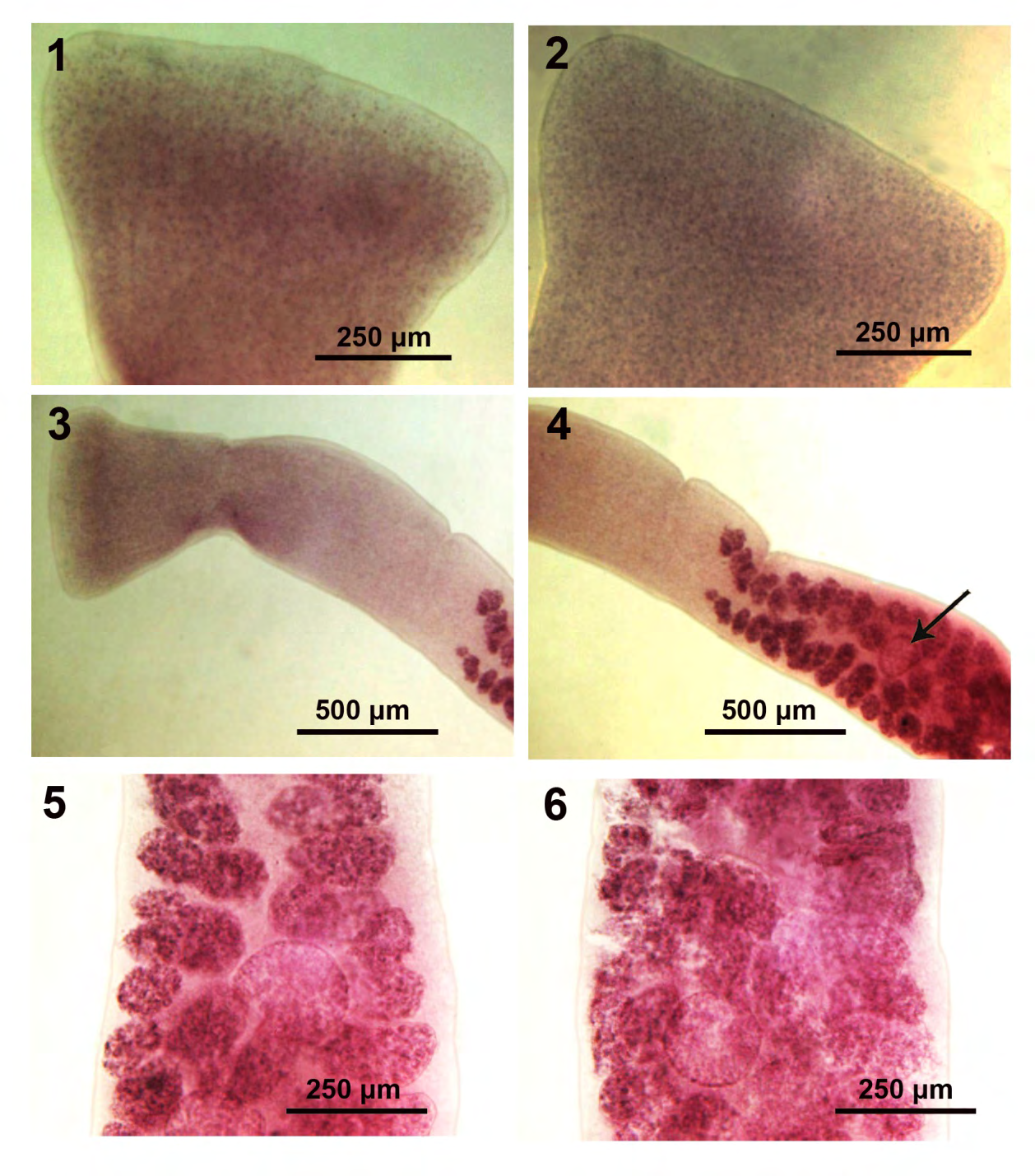
Figure 1-6: The anterior section of specimens of Isoglaridacris multivitellaria from Erimyzon sucetta in Silver Lake, SE Wisconsin. 1, 2. The scolexes of 2 individuals. 3, 4. Scolex, neck and anterior pre-ovarian vitellaria of the allotype specimen. Note the anterior-most testis in Fig. 4 (arrow) well posterior to first vitellaria. 5. Higher magnification of anterior-most testis of allotype specimen. Note the beginning of the medullary merging of lateral vitellaria. 6. High magnification of the allotype section just posterior to that shown in Fig. 5 showing more crowded vitellaria in the middle of the testicular field.
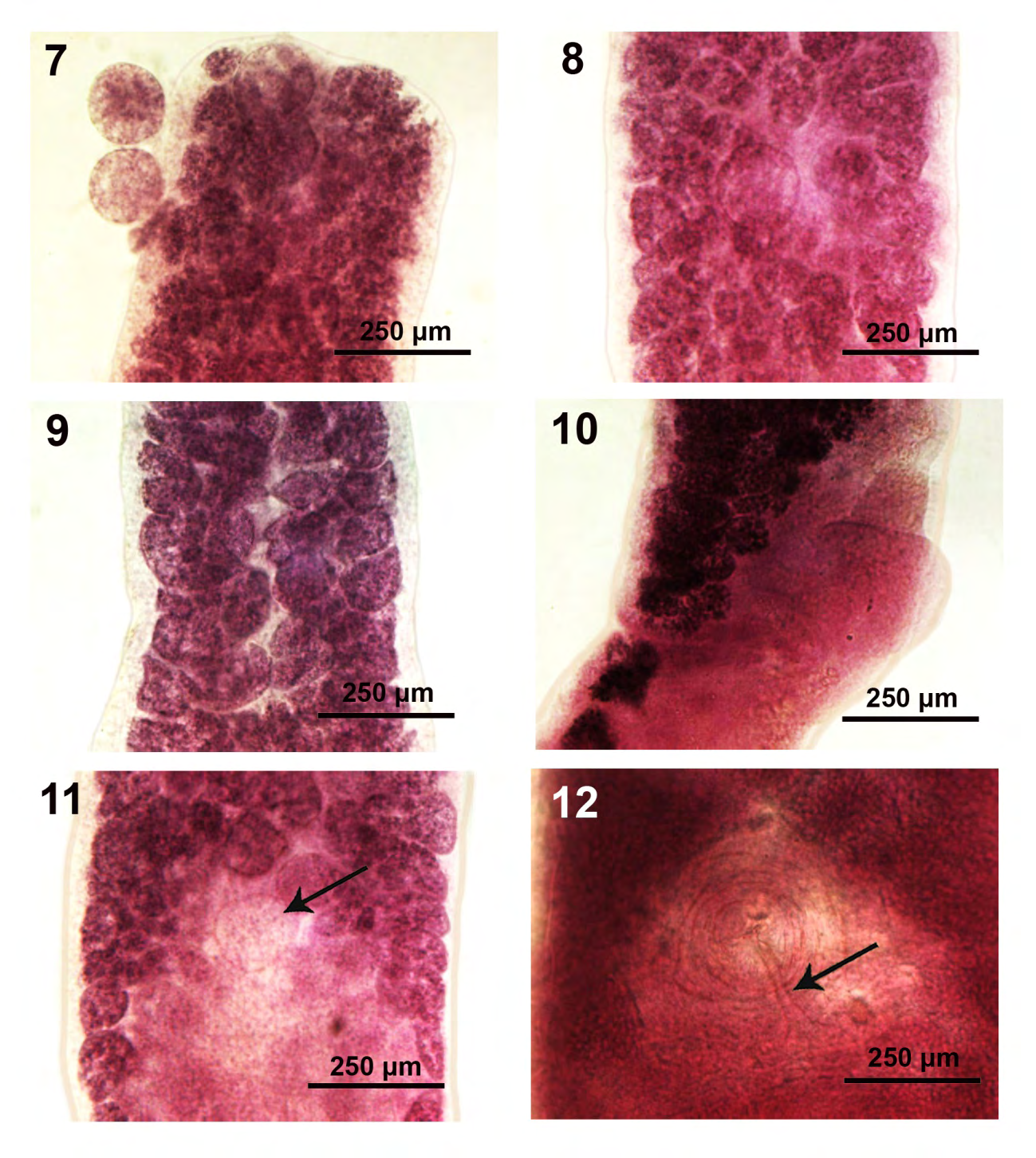
Figure 7-12: The mid-section of specimens of Isoglaridacris multivitellaria from Erimyzon sucetta in Silver Lake, SE Wisconsin. 7-9. Variations of the frequency of irregular extension of lateral vitellaria into the middle testicular field. In Fig. 9, they practically congest the whole middle section. 10. A lateral perspective of extruded cirrus sac across from multi-layered rows of pre-ovarian vitellaria dorsally (top). 11. The position of the cirrus sac (arrow) at the pit of the inverted V-shaped posterior margin of pre-ovarian vitellaria. 12. A high magnification of the cirrus sac showing its characteristic external concentric rings and the straight vagina (arrow).
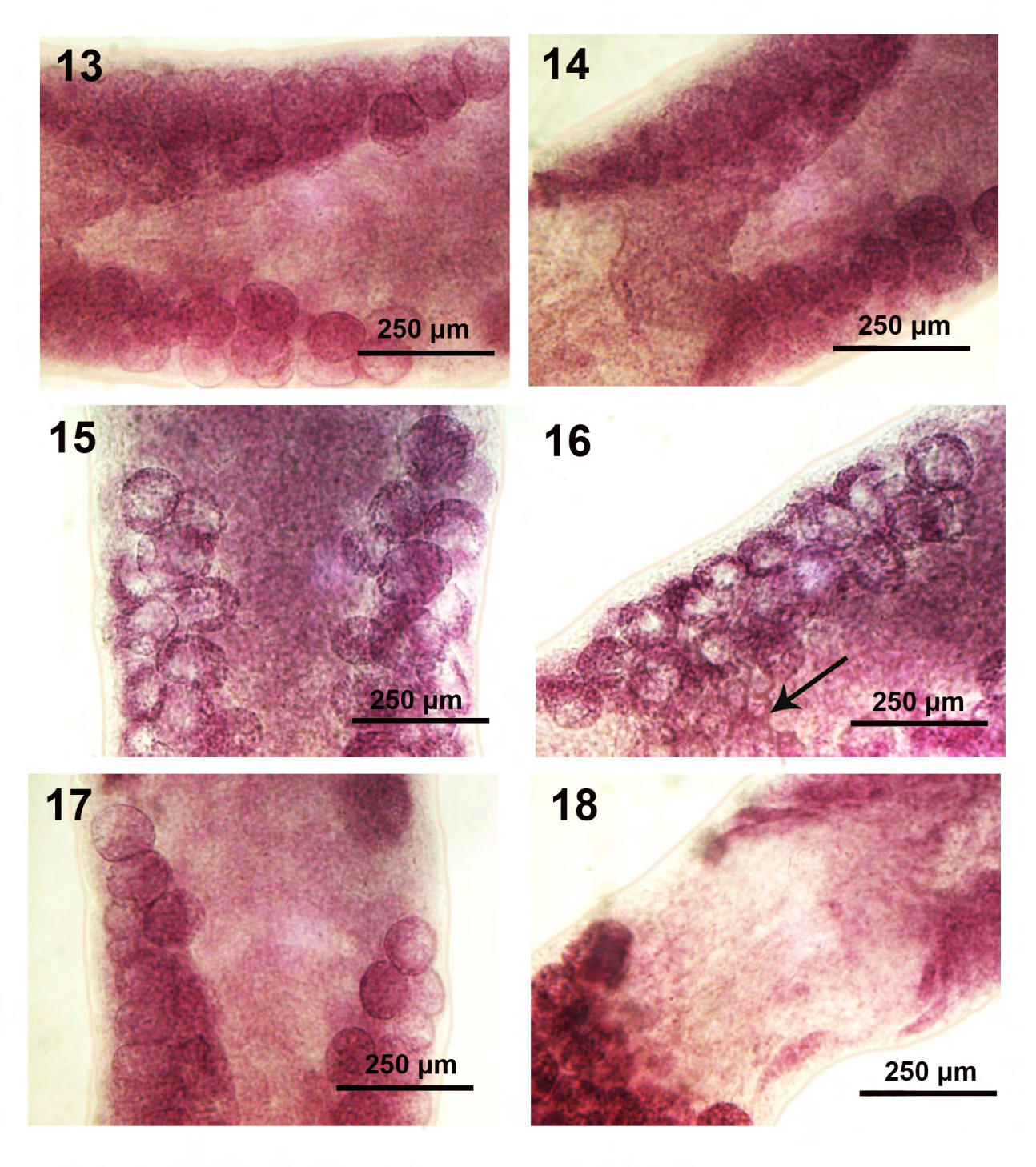
Figure 13-18: The ovarian structure of specimens of Isoglaridacris multivitellaria from Erimyzon sucetta in Silver Lake, SE Wisconsin. 13. The anterior unequal ovarian arms of the allotype. 14. The mid-section of the unequal ovarian arms of the allotype showing the robust V-shaped commissure. 15. The unequal anterior ovarian arm of another specimen. 16. Detail of one side of the ovary showing the long anterior arm, commissure (arrow), and the short posterior arm. 17. A clear view of the unequal ovarian arms of the allotype. 18. The space between the posterior margin of the ovary (right) and the anterior margin of the post-ovarian vitellaria (left) with no clear evidence of the presence of post-ovarian uterine coils.
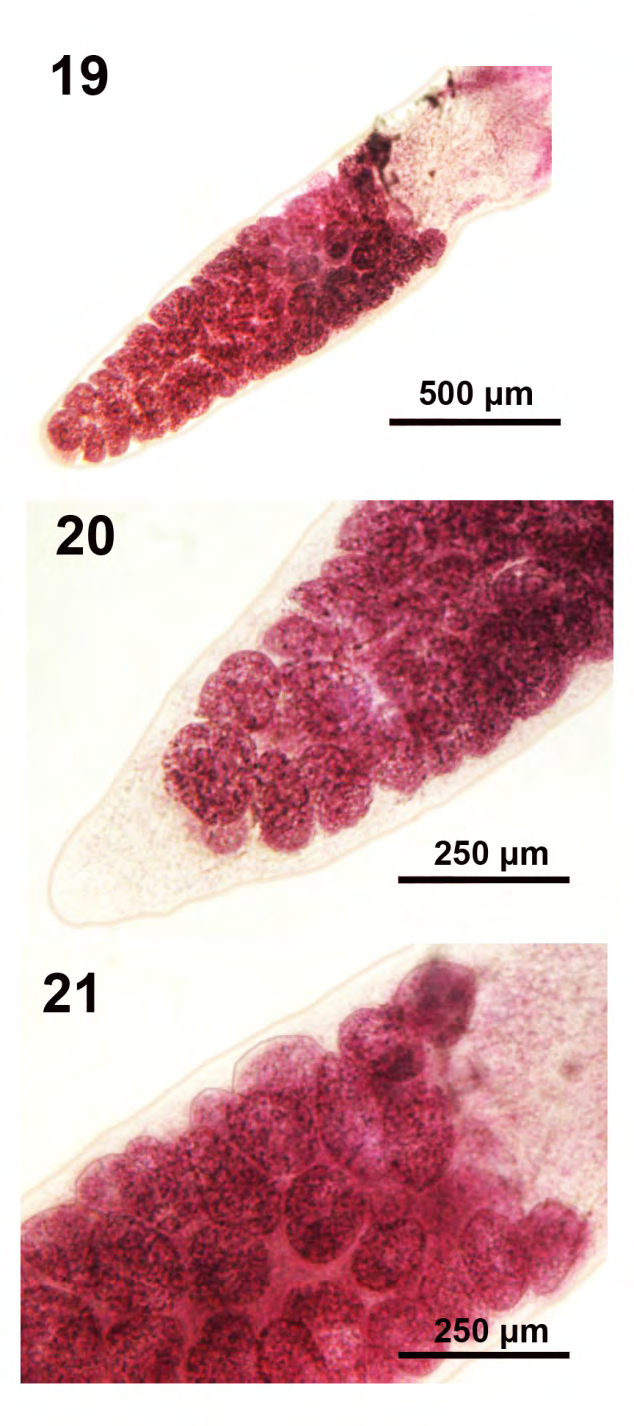
Figure 19-21: The post-ovarian vitellaria of the allotype of Isoglaridacris multivitellaria from Erimyzon sucetta in Silver Lake, SE Wisconsin. 19. A whole view of the posterior body segment enclosing the post-ovarian vitellaria. 20, 21. Higher magnification of the posterior and anterior post- ovarian vitellaria, respectively.
Taxonomic Summary
- Type specimens: Deposited at the Helminthological collection of the Department of Invertebrate Zoology, National Museum of Natural History, Smithsonian Institution nos. 78651 (holotype), 78652 (allotype).
- Other specimens: Two other specimens in the OMA collection.
- Type host: Erimyzon sucetta (Lacépède), Catostomidae.
- Type locality: Silver Lake, Kenosha County (42°32′58″N,88°10′9″W), Wisconsin.
- Other localities: None.
Remarks
Isoglaridacris multivitellaria is unique among all species of Isoglaridacris in having a large number of post- ovarian vitellaria (up to 100) and a cirrus sac with external concentric rings distant from the ovary, lodged at the pit of the medial inverted V-shaped posterior end of the pre- ovarian vitellaria. This extreme anterior displacement of the cirrus sac makes for unusually long distance between the gonopore and the posterior extremity of the worm making it between 24 and 32% of worm length. In the other 11 species of Isoglaridacris, the cirrus sac usually lies between the anterior arms of the ovary [4]. North American species of Isoglaridacris do not usually have more than 20 post- ovarian follicles with 2 species, I. jonesi Mackiewicz, 1972 and I. calentinei Mackiewicz, 1974 completely lacking such vitellaria [5]. The pre-ovarian vitellaria are basically in 2 multilayered lateral rows that usually extend medially to the point of often covering the whole medial field obscuring the testes. This condition is uncommon in other cestodes but has been rarely observed in such species as Biacetabulum macrocephalum McCrae, 1962 [6]. Variations include the presence of one medial and two lateral rows of pre-ovarian vitellaria in I. etowani Williams, 1975, I. chetekensis Williams, 1977, and I. wisconsinensis Williams, 1977 [4, 7].
Characteristically, I. multivitellaria has a few testes (25- 50), its uterine coils do not extend anterior to cirrus sac, and the pre-ovarian vitellaria do not extend anterior to first testis and are not connected to post-ovarian vitellaria. Most other species of Isoglaridacris have greater than 100 testes except for I. etowani (with 80-105 testes) [8] and I. agminis from Wisconsin (17-68) [9] and 28-40 from Alabama [10]. The body is usually, but not always, with parallel sides. Anterior ovarian arms are long and occasionally unequal. The scolex is fan-shaped, different from the usual wedge- or cuneiform- shaped. The shape of the scolex, however, is labile to limited variations depending on the pre-fixation methods.
Discussion
Despite the limitations of the small number of specimens available for this study, we have been able to shed considerably more light on the morphological features characterizing this unusual cestode. We have provided a more comprehensive morphological treatment of I. multivitellaria. Ecological factors add to the distinctiveness of this cestode. Only 4 worms were found in one individual lake chub sucker in one land-locked lake in Wisconsin when 116 lake chubsuckers were examined in the same lake between 1976 and 1984 [4]. It is clearly a rare cestode. This scarce occurrence has been similarly documented in at least two other incidences. The description of I. erraticus Williams, 1975 was based on 7 specimens recovered from one individual of Moxostoma sp. and that of I. etowani Williams, 1975 on 154 specimens from one (of 87) Hypentelium etowanum (Jordan) [8].
The ecological distribution of I. multivitellaria is comparable to that of Isoglaridacris agminis Williams and Rogers, 1972 in Wisconsin. In Wisconsin, both cestode species were collected only from E. sucetta in Silver Lake, SE Wisconsin. Williams, et al. [10] originally described I. agminis from E. sucetta in Alabama and since then it was reported mostly from the same host species in Arkansas, North Carolina, Mississippi, and Florida (Fig. 31 in Amin, et al. [9]). The sporadic distribution of I. agminis in independent waters in these states appear to be related to the disjunct distribution of E. sucetta in North America which was well documented by Mandrak, et al. [11]. See map (Fig. 31 in Amin, et al. [9]). Trautman [12] hypothesized that this “fragmentation was the result of northeastern range expansion during the warm Hypsithermal Period (ca. 7000 to 5000 years before present), and subsequent range contraction and fragmentation during the wane of this Period” (page 5). This fragmentation left residual pockets of suckers in isolated streams along with their parasites including I. multivitellaria. Figure 31 in Amin, et al. [9] shows the extension of E. sucetta into the SE third of Wisconsin including Kenosha County where the land-locked Silver Lake is located in the SE corner of the state. A similar pattern appears to occur in other species of fish parasites. For instance, Amin [13] demonstrated that the present distribution of 3 species of acanthocephalans of the genus Acanthocephalus Koelreuter 1771 in North America, especially Acanthocephauls dirus (Van Cleave, 1931) in the post-glacial streams of SE Wisconsin “formed after the withdrawal of the Lake Michigan lobe of the Wisconsin ice sheet from the area between 15,000 and 12,000 B.P. (page 216).” It is not unlikely that future research may produce new records of I. multivitellaria and of I. agminis, from E. sucetta in states within its range where infections in chubsuckers have not been reported, i.e., Georgia, Louisiana, or Michigan.
Acknowledgments
This project was supported by an Institutional Grant from the Parasitology Center, Inc. (PCI), Scottsdale, Arizona. We recognize the efforts by a number of former independent study students at the University of Wisconsin-Parkside, Kenosha for help with collecting and processing collections of fish parasites in lakes and streams of SE Wisconsin over the years, notably Pat Adams, Leslie Burns, Janet Burrows, Marsha Cowen, and Robert Bauer.
Declarations
Compliance with Ethical Standards
- Conflict of Interest: The authors declare no conflicts of interest or competing interests.
- Ethical Approval: The authors declare that they have observed all applicable ethical standards.
- Availability of Data: All presented and related data are available by contacting the senior author.
References
-
Amin OM (1968) Helminth fauna of Suckers (Catostomidae) of the Gila River System, Arizona. PhD Thes Ariz St Univ 202 pp (No 68-1644) Univ Microfilms. Ann Arbor, Michigan; Dissert Abstr 28: 3521.
-
Amin OM (1969) Helminth fauna of suckers (Catostomidae) of the Gila River System, Arizona. II. Five parasites from _Catostomus_ spp. Am Midland Nat 82: 429- 443.
-
Amin OM (1974) Intestinal helminths of the white sucker, _Catostomus commersoni_ (Lacépède), in SE Wisconsin. Proc Helminthol Soc Wash 41: 81-88.
-
Amin OM (1986) Caryophyllaiedae (Cestoda) from lake fishes in Wisconsin with a description of _Isoglaridacris multivitellaria_ sp. n. from _Erimyzon sucetta_ (Catostomidae). Pro Helminthol Soc Wash 53: 48-58.
-
Mackiewicz JS (1974) _Isoglaridacris calentinei_ n. sp. (Cestoidea, Caryophyllidea) from catostomid fish in western United States. Trans Amer Micros Soc 93: 143- 147.
-
Amin OM, Rubtsova NY (2023) Review and comparative assessment of _Biacetabulum macrocephalum_ McCrae, 1962 (Cestoda: Caryophyllidae) from _Catostomus_ _commersoni_ (Lacépède) in Wisconsin, USA. Int J Zoo Animal Biol 6(2): 000454.
-
Williams DD (1977) _Isoglaridacris chetekensis_ sp. n. and _I. wisconsinensis_ sp. n. (Cestoda: Caryophyllaeidae) from Cedar River, Wisconsin catostomid fishes. Proc Helminth Soc Wash 44: 91-95.
-
Williams EH, Jr (1975) Two new species of _Isoglaridacris_ (Cestoidea: Caryophyllaeidae) from Alabama. Trans. Am. Microsc Soc 94(3): 340-346.
-
Amin OM and Rubtsova NY (2023) The Finding and description of a diverse population of the southern cestode _Isoglaridacris agminis_ Williams and Rogers, 1972 (Caryophyllaidae) from lake chub sucker _Erimyzon_ _sucetta_ (Lacépède, 1802) in a northern land-locked lake in Wisconsin, with a special reference to its disjunct post-glacial distribution in North America. Int J Zoo Animal Biol 6(2): 000454.
-
Williams EH and Rogers WA (1972) _Isoglaridacris_ _agminis_ sp. n. (Cestoda: Caryophylleidae) from the lake chubsucker, _Erimyzon sucetta_ (Lacépède). J Parasitol 58: 1082-1084.
-
Mandrak NE, Cudmore B, and Crossman EJ (2008) COSEWIC assessment and update status report on the lake chubsucker _Erimyzon sucetta_ in Canada. Committee on the Status of Endangered Wildlife in Canada, Ottawa, pp: 1-29.
-
Trautman MB (1981) The fishes of Ohio. Ohio State University Press, Columbus, pp: 683.
-
Amin OM (1985) Hosts and geographic distribution of _Acanthocephalus_ (Acanthocephala: Echinorhynchidae) from North American freshwater fishes, with a discussion of species relationships. Proc Helminthol Soc Wash 52: 210-220.
- California Red-Legged Frog and Non-Listed Amphibians Response to Non-Native Fish Removal
- Industrial Standardization of the Bio-OS: Algorithmic Codification of Resilience Engineering Guidelines and Version V8 Architecture
- Climate Variability and the Sustainability of Snail Farming in Nigeria: Past Trends, Present Challenges and Potential Outlook
- The Evaluation of the Surveillance System of Anthrax in Gilgit-Baltistan, Pakistan, 2018
- Natural Decline to Extinction of A New Zealand Rabbit Population
- Mitochondrial Bio-Logistics: Steering Co-Enzyme Q10 and Lycopene Synergies within the Science 4.0 Bio-OS Framework