
Update of the Mosquito Fauna (Diptera: Culicidae) of Sancti Spíritus and Villa Clara Provinces, Cuba
Mosquito borne diseases constitute one of the priority health problems in most tropical countries, with emphasis on species with marked entomoepidemiological importance. The objective of this research was to update the mosquito entomofauna of Sancti Spíritus and Villa Clara provinces, Cuba. The research covered a period of 15 years (2007-2022). For the collection of the data used in the study, they were organized in the Excel application for Windows (years, months, municipalities and accumulated of both provinces), for which a database was created with all the documentary review of the records and statistical files existing in the Provincial Unit of Surveillance and Antivectorial Fight (UPVLA) of Sancti Spíritus and Villa Clara, as well as in the Provincial Departments of Health Statistics of both provinces, where all the entomological history of the work cycles conceived in the municipalities that make up both provinces is compiled. A total of 42 species of mosquitoes (59.15%) distributed in 12 genera were found in Sancti Spíritus province, while in Villa Clara, the figure amounted to 45 species (63.38%) distributed in 13 genera, all this, taking into account the 71 species of mosquitoes currently registered for Cuba. The most frequent and best represented species in both provinces were Anopheles albimanus, Aedes aegypti, Ae. albopictus, Culex quinquefasciatus, Cx. nigripalpus and Psorophora confinnis. The species Ae. vittatus was recorded in the two provinces under investigation, which is a highly invasive species. The results showed the great ecological plasticity of the entomofauna of culicidae in both provinces of Cuba.
Introduction
Humanity has suffered throughout history from the scourge of potentially fatal viral and parasitic diseases, including: Yellow Fever, Dengue, Zika, Chikungunya, Malaria, Chagas, Leishmaniosis, Onchocercosis, Angiostrongylosis, Fasciolosis, among many others, and most of them often involve a vector organism as a common factor [1, 2, 3]. These diseases are widespread in the tropics, with local variations in risk, so they are highly dependent on rainfall, temperature and rapid unplanned urbanization, among others [4, 5, 6].
To these problems, we can now add global warming and the intensification of extreme meteorological disturbances, which has brought about changes in the behavior of diseases and their transmissions, with the establishment of vector species in places never recorded before [7, 8, 9]. Climate change is considered one of the main environmental problems, and its effects undoubtedly have a negative impact on human health [7, 10, 11, 12]. There are several studies that relate climatic variables with the increase of infectious diseases, where arbovirosis has been one of the most studied, and it has been shown that there is a positive relationship between climate variation and the incidence of these infectious entities [13, 14, 15, 16, 17].
All vector-borne diseases in the world have very high incidence rates; for example, it is estimated that between 50- 100 million cases of Dengue fever occur each year [5, 18, 19]. This viral entity has been considered for many years as a public health problem in the world, especially in tropical countries where the influences of environmental variables favor the increase of cases each year [5, 19, 20].
However, the main health problem in terms of vectors continues to be Malaria, with 500 million reported cases and three million deaths each year, of which one million are children under five years of age [20, 21, 22, 23]; this entity causes the death of one person every 60 seconds [22, 24, 25, 26]. Cuba, due to its geographic location and climatological characteristics, has a wide fauna of culicidae with proven vectorial capacity, making them of great interest for human and other animal health [26, 27].
Efforts to control vector-borne diseases have been hampered in part by the development of drug-resistant etiologic agents, insecticide-resistant mosquitoes, environmental contamination, residual effect of chemicals, high prices of insecticides in the market and operational failures [21, 28, 29, 30, 31, 32].
Consequently, there is a growing need to develop and implement other strategies for the control of infectious entities and their vectors, which can complement existing methods in a more effective and efficient way [23, 33]. All of the above shows the urgent need for constant updating, both in the systematics and taxonomy of the entomofauna of culicidae, especially those of veterinary medical interest [32, 34, 35, 36].
The objective of the research was to identify the current fauna of culicidae existing in the provinces of Sancti Spíritus and Villa Clara, Cuba.
Materials and Methods
Study Area
The research covered two provinces in the center of the country (Sancti Spíritus and Villa Clara) (Figure 1). In the case of Sancti Spíritus, this province is made up of eight municipalities, its provincial capital being the municipality of Sancti Spíritus. It is bordered to the west by Villa Clara province, to the east by Ciego de Avila province, and to the south by Cienfuegos province. Its geographic coordinates are as follows (Latitude: 21°56’3’’ N, Longitude: 79º26’37’’ W).
The Villa Clara province, whose provincial capital is Santa Clara municipality and covered the 13 municipalities that comprise. This province is located in the central region of the island of Cuba (Latitude: 22º 29’40’’ N, Longitude: 79º28’30’’ W), and has the following geographical limits; to the west, with Matanzas province, to the east, with Sancti Spíritus province and to the south, with Cienfuegos province.
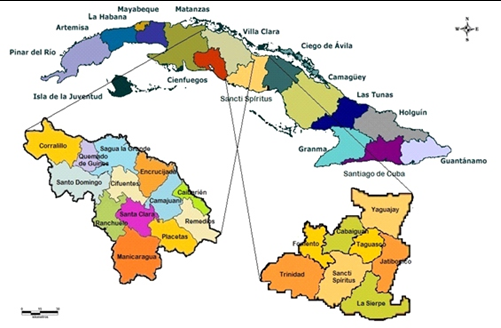
Source: Provincial Meteorological Center of Sancti Spíritus and Villa Clara, Cuba. Figure 1: Administrative map of the provinces of Sancti Spíritus and Villa Clara.
Regarding Data Collection
The data were organized in the excel application for windows, by years, months, municipalities and the accumulated of both provinces, for which a database was created with all the documentary review of the records and statistical files existing in the Provincial Unit of Surveillance and Antivectorial Fight (UPVLA) of Sancti Spíritus and Villa Clara, as well as the provincial departments of health statistics of both provinces, where the entire entomological history of the work cycles conceived in the municipalities that make up both provinces 8/Sancti Spíritus and 13/Villa Clara is compiled and periodically reported through statistical tables established for such purposes to the National Direction of Surveillance and Antivectorial Control (DNVLA) and the Department of Health Statistics of the Ministry of Public Health (MINSAP) of Cuba.
The information collected is based on the work cycles established for surveillance and vector control, aimed at focal work in the universe of dwellings and premises, both in urban and rural areas of each municipality in the provinces under study. The periodicity of the cycles is monthly for the urban universe and bimonthly for the rural universe. For this research, the period from 2007 to June 2022 was taken into account.
Collection and Identification of Mosquitoes
Fluvial ecosystems (rivers, streams, ditches, gullies, lagoons, marshes and marshes) were sampled, with emphasis on the banks, which constitute the mosquito oviposition and breeding sites (effective breeding area); In addition, for the collection of mosquito larvae, pupae and adults, the trees and bushes associated with the margins of the reservoirs (including bamboo) were taken into account, as well as disused artificial containers (cans, bottles, knobs, tires, among others) for the immature stages. We also consulted the records/passive archives and maps existing in the provincial units of both provinces, where we were able to obtain all the information on the mosquito species Aedes aegypti (Linnaeus, 1762), a species clearly circumscribed to urban ecosystems, as well as the results accumulated over the years on the capture of resting mosquitoes (adults). Mosquito larvae and pupae were collected by the ladle method [37], and were transferred to the respective laboratories in plastic bottles with a capacity of 250 mL, duly labeled, according to each breeding site.
The identification of the specimens collected was carried out according to dichotomous and pictorial keys for such purposes [38, 39, 40], and was performed in the Medical Entomology Laboratories of the Provincial Surveillance and Vector Control Units in Sancti Spíritus and Villa Clara, by specialists from both centers.
Results and Discussion
To date, 45 species of mosquitoes distributed in 13 genera have been identified in Villa Clara province, while in Sancti Spiritus, 42 species were identified, distributed in 13 genera, the same as in the former province of Sancti Spiritus (Table 1). Being the best represented and distributed species in both provinces were Anopheles albimanus, Aedes aegypti, Ae. albopictus, Culex quinquefasciatus, Cx. nigripalpus and Psorophora confinnis, for being present in all of the municipalities of the two provinces, followed by Cx. corniger, Ae. scapularis, Ae. mediovittatus and Ps ciliata.
| Species of mosquitoes | Sancti Spíritus | Villa Clara | ||||||||||||||||||||
|---|---|---|---|---|---|---|---|---|---|---|---|---|---|---|---|---|---|---|---|---|---|---|
| 1 | 2 | 3 | 4 | 5 | 6 | 7 | 8 | Total | 1 | 2 | 3 | 4 | 5 | 6 | 7 | 8 | 9 | 10 | 11 | 12 | 13 | |
| Aedeomyia squamipennis (Lynch- Arribálzaga,1878) | x | x | x | x | x | x | x | 7 | x | x | ||||||||||||
| Anopheles albimanus (Wiedemann,1821) | x | x | x | x | x | x | x | x | 8 | x | x | x | x | x | x | x | x | x | x | x | x | x |
| An. atropos (Dyar & Knab,1906) | x | x | x | x | x | 5 | x | x | ||||||||||||||
| An. grabhamii (Theobald,1901) | x | x | x | x | 4 | x | x | x | ||||||||||||||
| An. vestitipennis (Dyar & Knab,1906) | x | x | x | x | x | x | x | 7 | x | x | x | x | x | x | x | |||||||
| An. crucians (Wiedemann,1828) | x | x | x | x | x | x | x | x | 8 | x | x | x | ||||||||||
| Aedes aegypti (Linnaeus, 1762) | x | x | x | x | x | x | x | x | 8 | x | x | x | x | x | x | x | x | x | x | x | x | x |
| Ae. albopictus (Skuse, 1894) | x | x | x | x | x | x | x | x | 8 | x | x | x | x | x | x | x | x | x | x | x | x | x |
| Ae. mediovittatus (Coquillett,1906) | x | x | x | x | 4 | x | x | x | x | x | x | x | x | x | x | x | x | x | ||||
| Ae. scapularis (Rondan,1848) | x | x | x | x | x | x | 6 | x | x | x | x | x | x | x | x | x | x | x | x | x | ||
| Ae. serratus (Theobald,1901) | 0 | - | - | - | - | - | - | - | - | - | - | - | - | - | ||||||||
| Ae. sollicitans (Walker,1856) | x | x | x | x | x | 5 | x | x | x | x | x | x | x | x | x | |||||||
| Ae. taeniorhynchus (Wiedemann,1821) | x | x | x | x | x | 5 | x | x | x | x | x | x | x | x | x | |||||||
| Ae. tortilis (Theobald,1903) | x | x | x | x | 4 | x | x | x | x | x | ||||||||||||
| Coquillettidia nigricans (Coquillett, 1904) | x | x | x | x | 4 | x | x | |||||||||||||||
| Culex atratus (Theobald, 1901) | x | x | x | x | x | x | x | x | 8 | x | x | x | x | x | x | |||||||
| Cx. americanus (Neveu-Lemaire, 1902) | x | x | x | x | 4 | x | x | |||||||||||||||
| Cx. bahamensis (Dyar & Knab,1906) | x | x | x | 3 | x | x | ||||||||||||||||
| Cx. cancer (Theobald,1901) | x | x | x | x | 4 | x | x | x | ||||||||||||||
| Cx. chidesteri (Dyar,1921) | x | x | x | x | x | x | 6 | x | x | x | x | x | x | x | ||||||||
| Cx. corniger (Theobald,1903) | x | x | x | x | x | x | 6 | x | x | x | x | x | x | x | x | x | x | x | x | |||
| Cx. erraticus (Dyar & Knab,1906) | x | x | x | x | x | x | x | x | 8 | x | x | x | x | x | x | x | x | x | ||||
| Cx. iolambdis (Dyar,1918) | x | x | x | x | x | 5 | x | x | ||||||||||||||
| Cx. nigripalpus (Theobald,1901) | x | x | x | x | x | x | x | x | 8 | x | x | x | x | x | x | x | x | x | x | x | x | x |
| Cx. panocossa (Neveu Lemaire,1902) | x | 1 | ||||||||||||||||||||
| Cx. pilosus (Dyar & Knab,1906) | x | x | x | x | x | x | x | 7 | x | x | x | x | x | x | x | |||||||
| Cx. quinquefasciatus (Say,1823) | x | x | x | x | x | x | x | x | 8 | x | x | x | x | x | x | x | x | x | x | x | x | x |
| Cx. secutor (Theobald, 1901) | 0 | x | x | |||||||||||||||||||
| Cx. sphinx (Dyar & Knab, 1915) | 0 | x | ||||||||||||||||||||
| Howardina walkeri (Theobald, 1901) | 0 | x | x | x | x | |||||||||||||||||
| Limatus durhamii (Theobald, 1901) | 0 | x | x | x | ||||||||||||||||||
| Mansonia titillans (Walker,1848) | x | x | x | x | x | x | x | 7 | x | x | x | x | x | x | x | |||||||
| Orthopodomyia signifera (Coquillett, 1896) | x | x | x | 3 | x | x | ||||||||||||||||
| Psorophora ciliata (Fabricius,1794) | x | x | x | x | x | x | 6 | x | x | x | x | x | x | x | x | x | x | x | x | |||
| Ps. confinnis (Lynch Arribálzaga,1891) | x | x | x | x | x | x | x | x | 8 | x | x | x | x | x | x | x | x | x | x | x | x | x |
| Ps. ferox (Humboldt,1819) | x | x | x | x | x | x | 6 | x | x | |||||||||||||
| Ps. howardii (Coquillett,1901) | x | x | x | x | x | x | 6 | x | x | x | x | x | x | x | ||||||||
| Ps. infinis (Dyar & Knab, 1906) | x | x | x | x | x | x | x | x | 8 | x | x | |||||||||||
| Ps. insularia (Dyar y Knab, 1906) | 0 | x | ||||||||||||||||||||
| Ps. johnstonii (Grabham, 1905) | x | x | 2 | x | ||||||||||||||||||
| Ps. pygmaea (Theobald, 1903) | 0 | x | x | x | x | x | x | x | x | |||||||||||||
| Ps. santamarinai (González Broche, 2000) | x | 1 | x | x | ||||||||||||||||||
| Toxorhynchites portoricensis (von Röder, 1885) | x | x | x | 3 | x | x | ||||||||||||||||
| Uranotaenia lowii (Theobald,1901) | x | x | x | x | x | x | x | x | 8 | |||||||||||||
| Ur. sapphirina (Osten-Sacken,1868) | x | x | x | x | x | 5 | x | x | x | x | x | x | x | x | x | x | ||||||
| Wyeomyia aporonoma (Dyar & Knab,1906) | 0 | |||||||||||||||||||||
| Wy. mitchelli (Theobald,1905) | x | x | x | x | x | x | 6 | x | x | |||||||||||||
| Wy. nigritubus (Galindo, Carpenter & Trapido, 1951) | x | x | 2 | |||||||||||||||||||
| Wy. vanduzeei (Dyar & Knab,1906) | x | x | x | x | x | x | x | 7 | x | |||||||||||||
| * Aedes vittatus (Bigot, 1861) | x | x | 2 | x | x |
Table 1: ** Distribution of the mosquito fauna of Sancti Spíritus and Villa Clara provinces, Cuba.
Legend: municipalities of Sancti Spíritus province (1: Yaguajay, 2: Jatibonico, 3: Taguasco, 4: Cabaiguán, 5: Fomento, 6: Trinidad, 7: Sancti Spíritus, 8: La Sierpe). Municipalities of Villa Clara province: 1 Corralillo, 2 Quemado de Güines, 3 Sagua la Grande, 4 Encrucijada, 5 Camajuaní, 6 Caibarién, 7 Remedios, 8 Placetas, 9 Santa Clara, 10 Cifuentes, 11 Santo Domingo, 12 Ranchuelo and 13 Manicaragua. *(New report) Table 1: Distribution of the mosquito fauna of Sancti Spíritus and Villa Clara provinces, Cuba.
Of the 71 species of mosquitoes registered for Cuba [41], in Villa Clara, the number of identified species is 45/63.38%, while in Sancti Spíritus, 42 species were identified, equivalent to 59.15%. That species was collected in all the fluvial ecosystems sampled, as well as a wide range of deposits, which evidenced the great ecological plasticity of the entomofauna of culicidae existing in our country, in spite of being an archipelago, which corroborates the results obtained by García [42]; González [43].
The genera best represented and with a marked presence in the municipalities studied were Aedes, Anopheles, Culex and Psorophora, because they were distributed in almost all the ecosystems sampled, where they appeared in relatively high abundance, a fact that agrees with the results obtained by Marquetti [27], specifically for Cx. quinquefasciatus in the urban ecosystem; this result also confirms the criteria of Mattingly [44], Scorza [44] and Cruz, et al. [45] in relation to the extraordinary adaptive capacity and high ecological plasticity of Cx. quinquefasciatus in the most diverse and possible habitats provided by man.
The fact that Ae. aegypti and Ae. albopictus are gaining ground and space in Sancti Spíritus and Villa Clara provinces is notorious and relevant. These species are of high entomoepidemiological risk because of their involvement in several infectious entities [46, 47, 48, 49], among which Dengue, Yellow Fever, West Nile virus, Chikungunya and Zika virus stand out; but reality has shown us, that at present, these two species are practically present throughout the length and breadth of the national geography, expanding increasingly, colonizing an important number of breeding sites generated by human activity together with environmental variables [50], thus showing their high ecological plasticity and high capacity to adapt to the most dissimilar ecological niches [27, 50].
The association between temperature and population dynamics of culicidae has been investigated in many studies, particularly in tropical and sub-tropical areas. The results of this study are consistent with previous studies in other regions of the world [51, 52, 53, 54].
In relation to the analysis of climatological variables, there was concordance between the results of the study and others reviewed, in which temperature and relative humidity are variables with high correlation with the incidence of Dengue, Zika and Malaria [55, 56, 57, 58, 59].
The detection of the species Ae. vittatus (Bigot, 1861) in both provinces is noteworthy. This species was first identified as Culex vittatus. It was later placed in the genus Aedes, passing through several subgenera, such as Stegomyia and Aedimorphus, and is currently placed in a new subgenus described for the genus Aedes: (Fredwardsius) [60, 61, 62].
Regarding the history of detection, reporting and registration of Ae. vittatus in the Caribbean region, the first record of the species was made in the Dominican Republic [63], while in Cuba, the first detection of the species occurred outside the Guantánamo Naval Base (June 2019). The second detection was in Santiago de Cuba province, in January 2020 [35, 64]; by September of that year, the referred mosquito species had been detected in 31 localities in four municipalities of the province, where larval specimen collections were in a marked variety of reservoirs, with emphasis on low and elevated tanks, followed by artificial, puddles and other reservoirs. The third detection occurred in the rural locality “Isabel Hortensia”, Camagüey province [65], in the first days of December 2020 (34 larvae and 9 pupae), where specimens were collected in animal feeders, low tanks and disused tires, and in association with the species Ae. aegypti, Ae. albopictus, An. albimanus, Cx. coronator, Cx.
nigripalpus, Cx. quinquefasciatus and Culiseta inornata. The fourth detection occurred in the municipalities of Jatibonico, Sancti Spíritus and La Sierpe, belonging to the province of Sancti Spíritus (larvae, pupae and adults); collecting in buckets, low tanks and holes for construction of buildings, but always in rural ecosystems and framed within the rainy period (1st collection: December 2021, and then, specimens were collected in larval stage, and in greater quantity during the months of May-June 2022), something very similar also occurred in the province of Ciego de Avila (December 2021). Finally, and more recently, in the municipalities Encrucijada and Placetas belonging to Villa Clara province (June 2022), where larvae and pupae were also collected, which are pending taxonomic confirmation by IPK entomologists. The presence of Ae. vittatus in other provinces of the country is not ruled out, but has not yet been detected.
Everything seems to indicate that the movement of Ae. vittatus, from East to West is related to the geographical location of Cuba, within the northern portion of the tropical zone, very close to the limit between the tropical and subtropical zones, linked to the processes of intensification and weakening of the winds of the Northeast region, called Alisios, whose seasonal fluctuation is caused by the changes in the position and intensity of the North Atlantic Subtropical Anticyclone, where an important characteristic of this seasonal fluctuation is the decrease of the Atlantic anticyclonic influence over Cuba in winter. Such decrease allows the irruption of extratropical weather systems that impose a significant frequency of frontal events, cold air invasions and other events typical of higher latitudes, which considerably increase the seasonal contrast between climatic elements [66]. It is also accepted that changes in the frequency and characteristics of circulation patterns are the main cause of fluctuations in climatic elements [63, 64]. Consistent with the previous process, there is evidence of an increase in the baric gradients in the surroundings of Cuba that has caused increases in the intensity of the zonal current from the East linked to the trade wind regime over our area. Therefore, the regional atmospheric circulation (formed by the superposition, among other components, of cyclic signals of different frequencies), has allowed us to isolate a quasi- decadal signal and another one of 5 to 6 years of period, closely linked to the influence of the El Niño/Southern Oscillation (ENSO) event on the circulation systems in the vicinity of Cuba. In this sense, a clear variability of the ENSO influence on the region has been detected, with a significant tendency to increase its impact [67, 68].
Conclusion
The increase in the number of species in both provinces was considerable in relation to the study published in 2015; 42 against 34 for Sancti Spíritus province, and 45 against 43 for Villa Clara, with a highlight for the record of the species Ae. vittatus in both provinces, which corroborates the diversity and richness of culicid species in these two provinces. The marked representativeness and wide distribution of Ae. aegypti and Ae. albopictus in these two provinces, which raises the entomoepidemiological risk for the proliferation and transmission of arbovirosis in which the two species are involved.
Acknowledgments
To Lic. Carmen María Luna Rodríguez Gallo, who works as entomologist of the Provincial Unit of Surveillance and Antivectorial Fight (UPVLA) of Sancti Spíritus, for all the information provided in relation to the species Ae. vittatus in that province, and likewise, to Lic. Manuel Cancio Hernández, for the data provided on the collection of Ae. vittatus in the municipality of La Sierpe, Sancti Spíritus.
Conflict of Interest
The authors declare that they have no conflict of interest.
Contribution
All the authors contributed substantially to the concrescence of the manuscript.
Financing
No funding was available.
References
-
Guzmán MG, Kourí G (2002) Dengue: an update. Lancet Inf Dis 2(1): 33-42.
-
World Health Organization (WHO) (2019) Dengue and severe dengue. Descriptive note.
-
Ayala SY, Colos GP, Portal QE, Ibarra JL, Condor AR, et al. (2021) Quantitative biological response of two predators (Heteroptera: Notonectidae) in larval control of Aedes aegypti (Diptera: Culicidae). Revista Colombiana de Entomología 47(2): e10535.
-
Troyo A, Calderón AO, Fuller DO, Solano ME, Avedaño A, (2008) Seasonal profiles of Aedes aegypti (Diptera: Culicidae) larval habitats in an urban area of Costa Rica with a history of mosquito control. J Vector Ecol 33(1): 76-88.
-
Gould E, Pettersson J, Higgs S, Charrel R, de Lamballerie X (2017) Emerging arboviruses: why today?. One Health 4: 1-13.
-
Benavides MJA, Montenegro CMC, Rojas CJV, Lucero CNJ (2021) Sociodemographic and clinical characterization of patients diagnosed with dengue and chikungunya in Nariño, Colombia. Cuban Journal of Tropical Medicine 73(1): e451.
-
Gore A (2007) An inconvenient truth [videocinta]. Paramount Classic and Participant Productions, E.U.A.
-
Fajardo R, Valdelamar J, Arrieta D (2016) Prediction of the potential establishment of the Aedes aegypti mosquito in urban non-housing spaces in Colombia, using ecourban and landscape variables. Environmental Management 20(1): 10-19.
-
Real CJ (2017) Factors related to dengue dynamics in Guayaquil, based on historical trends. Faculty of Medicine 78(1): 37-41.
-
Ehelepola N, Ariyaratne K, Buddhadasa W, Ratnayake S, Wickramasinghe M (2015) A study of the correlation between dengue and weather in Kandy City, Sri Lanka (2003-2012) and lessons learned. Infectious Diseases of Poverty 4(42): 2-8.
-
Sharmin S, Glass K, Harley D (2015) Interaction of Mean Temperature and Daily Fluctuation Influences Dengue Incidence in Dhaka, Bangladesh. PLoS Negl Trop Dis 9(7): e0003901.
-
Márquez MK, Martínez E, Peña V, Monroy Á (2019) Influencia de la temperatura ambiental en el mosquito Aedes spp y la transmisión del virus del Dengue. CES medicina 33(1): 18-23.
-
García GS, Pérez BA, Fimia DR, Osés RR, Garín LG, et al. (2012) Influence of some climatological variables on larval densities in culicidae hatcheries. Pol Cap.
-
Osés RR, Fimia DR, Aldaz CJW, Iannacone OJ, Zaita FY, et al. (2017) Modelación matemática del cólera por medio de la Regresión Objetiva Regresiva y su relación con las variables climáticas. Caibarién, Villa Clara, Cuba. The Biologist (Lima) 15(1): 128.
-
Sánchez ÁML, Osés RR, Fimia DR, Gascón RBC, Iannacone J, et al. (2017) Objective Regressive Regression beyond white noise for viruses circulating in Villa Clara province, Cuba. The Biologist (Lima) 15(1): 127.
-
Osés RR, Fimia DR, Otero MM, Oses LC, Iannacone J, et al. (2018a) Incidencia del ritmo anual en algunas variables climáticas en poblaciones larvales de culícidos: pronóstico para la temporada ciclónica 2018 en Villa Clara, Cuba. The Biologist (Lima) 16(2).
-
Fimia DR, Osés RR, Alarcón EPM, Aldaz CJW, Roig BB, et al. (2020a) Mathematical modeling of the effect of atmospheric pressure on the population density of mosquitoes (Diptera: Culicidae) in Villa Clara, Cuba. Journal of the School of Medicine (Rev Fac Med) 68(4): 541-549.
-
Ortega LG (2001) Dengue: an ever-emerging problem. Epidemiology 14(2): 41-52.
-
Guzmán MG, Álvarez M, Halstead SB (2013) Secondary infection as a risk factor for dengue haemorrhagic fever/ dengue shock syndrome: an historical perspective and role of antibody-dependent enhancement of infection. Arch Virol 158: 1445-1459.
-
Service MW (1992) Importance of ecology in Aedes aegypti control. The Southeast Asian. Journal of Tropical Medicine and Public Health 23(4): 681-690.
-
Das PK, Amalraj DD (1997) Biological control of malaria vectors. Indian J Med Res 106: 174-197.
-
Dia I, Diop T, Rakotoarivony I, Kengne P, Fontenille D (2003) Bionomic of Anopheles gambiae Giles, An. arabiensis Patton, An. funestus Giles and An. nili (Theobald) (Diptera: Culicidae) and Transmission of Plasmodium falciparum in a Sudano-Guinean Zone (Nagari, Senegal). J Med Entomol 40(3): 279-283.
-
Castillo ALA, Lira PAA, Pedraza LC, Quijano MA, Bravo GME (2022) Effect of Malathion on the Development of Megaselia scalaris (Loew, 1866) (Diptera: Phoridae), a Forensically Important Fly. J Med Entomol 59(3): 826- 834.
-
Póvoa MM, Conn JE, Schlichting CD, Amaral JF, Nazaré MO, et al. (2003) Malaria Vector, Epidemiology and the Re-Emergence of Anopheles darlingi in Belén, Pará, Brazil. J Med Entomol 40(4): 379-386.
-
Beck Johnson LM, Nelson WA, Paaijmans KP, Read AF, Thomas MB, et al. (2013) The effect of temperature on Anopheles mosquito population dynamics and the potential for malaria transmission. PLoS One 8(11): e79276.
-
Fimia DR, Alarcón EPM, Osés RR, Argota PG, Iannacone OJ, et al. (2017) Modeling of Equivalent Effective Temperature and its possible incidence on larval density of Anopheles mosquitoes (Diptera: Culicidae) in Villa Clara province, Cuba. Revista de Biología Tropical 65(2): 565-573.
-
Marquetti FM (2006) Aspectos bioecológicos de importancia para el control de Aedes aegypti y otros culícidos en el ecosistema urbano [Tesis doctoral]. Ciudad de la Habana, Instituto de Medicina Tropical “Pedro Kourí, pp: 186.
-
Guzmán MG, Kourí G, Bravo J (1999) The emergence of dengue hemorrhagic fever in the Americas. Reemergence of dengue. Rev Cubana Med Trop 51(1): 5-13.
-
Ayala SYO, Ibarra JI, Grieco JP, Achee N, Mercado HR, et al. (2008) Behavioral response of Aedes aegypti (Linnaeus, 1762) to pyrethroid adulticides commonly used in public health. Peruvian Journal of Experimental Medicine and Public Health 25(1): 26-34.
-
Ngoagouni C, Kamgang B, Nakouné E, Paupy C, Kazanji M (2015) Invasion of Aedes albopictus (Diptera: Culicidae) into central Africa: what consequences for emerging diseases? Parasites & Vectors 8: 191-197.
-
Fimia DR, Aldaz CJ, Aldaz CN, Segura OJ, Cepero RO, et al. (2016) Mosquitoes (Diptera: Culicidae) and their control by means of biological agents in Villa Clara province, Cuba. International Journal of Current Research 8(12): 43114-43120.
-
Alarcón EPM, Paulino RR, Diéguez FL, Fimia DR, Guerrero KA, et al. (2017) Mosquito-borne arbovirosis (Diptera: Culicidae) in the Dominican Republic: a review. The Biologist (Lima) 15(1): 193-219.
-
Campos SCM, Guillén LLA, Del Valle LD, Acosta EI, Rodríguez HD, et al. (2022) Modeling and prediction of Dengue cases in the short and long term in Villa Clara, Cuba using climatic variables and Objective Regressive Regression. GSC Biological and Pharmaceutical Sciences 18(3): 35-45.
-
Aldersley A, Castor IJ (2019) Female resistance and harmonic convergence influence male mating success in Aedes aegypti. Scientific Reports 9(2145): 1-12.
-
Marquetti FM, Camacho AE, Bisset LJA, Leyva SM, Martínez LY, et al. (2021) Aedes vittatus (Bigot, 1861) amenaza de salud en la región del Caribe: revisión de su biología e importancia médica. Boletín Epidemiológico Semanal/BOLIPK 31(02): 10-15.
-
Alfonso PC, Osorio J, Agudelo J, Díaz S, Ramírez SLF, et al. (2022) More than sperm and egg: Male, female and environmental factor that influence reproduction of Aedes and Anopheles mosquitoes. Rev Colombiana Entomología 48(1): e11405.
-
González BR (2013) Descripción de una nueva especie de Culex (Diptera: Culicidae) de Cuba. Boletín de la Sociedad Entomológica Aragonesa (SEA) 52: 117-119.
-
Ibañez SB, Martínez CC (1994) Clave para la identificación de las larvas de mosquitos comunes en las áreas urbanas y suburbanas de la República Mexicana (Diptera: Culicidae). México 92: 43-73.
-
Forattini OP (1996) Culicidología Médica. Principios generales, morfología y glosario taxonómico. Universidad de Sau Paulo, Brasil 1: 1-549.
-
González BR (2006) Culícidos de Cuba. Editorial Científico Técnica, La Habana, pp: 184.
-
García AI (1977) Cuban fauna of mosquitoes and their typical breeding places. 1st (Edn.), Havana: Cuban Academy of Sciences.
-
González BR (1985) New reports on the tribe Sabethini (Diptera: Culicidae) for Cuba. POEYANA 298: 1-11.
-
Mattingly PF (1962) The urban mosquito hazard today. Bull World Health Organ 29: 135-139.
-
Scorza JV (1972) Bionomic observations on Culex pipiens fatigans Wiedemann, 1821 from Venezuela. University of Los Andes, Mérida, Spain, pp: 230.
-
Cruz CP, Cabrera MC (2006) Entomological-ecological characterization of cases and suspects of West Nile Virus in Sancti Spiritus province, Cuba. Cuban Rev Med Trop 58(3): 235-240.
-
Komar N (2003) West Nile virus: epidemiology and ecology in North America. Adv Virol Res 61: 185-234.
-
Mackenzie JS, Gubler DJ, Petersen LR (2005) Emerging Flavivirus: the spread and resurgence of Japanese encephalitis, West Nile and Dengue virus. J Am Mosq Control Assoc 21(1): 102-115.
-
Pupo AM, Cabrera V, Vázquez Y, Drebor M, Andonova M, et al. (2011) Serological study in localities with confirmed West Nile virus infections. Rev Cubana Med Trop 63(3): 227-230.
-
Bangs ML, Lavasati RP, Corwin AL, Wuryadi S (2006) Climatic factors associated with epidemic dengue in Palembang, Indonesia: Implications of short-term meteorological events on virus transmission. South Asian J Trop Med Public 37(6): 1103-1116.
-
Fimia DR, Marquetti FM, Iannacone J, Hernández CN, González MG, et al. (2015) Anthropogenic and environmental factors on culicid fauna (Diptera: Culicidae) of Sancti Spiritus province, Cuba. The Biologist (Lima) 13(1): 53-74.
-
Zhou G, Minakawa N, Githeko A, Yan G (2004) Association between climate variability and malaria epidemics in the East African highlands. Proc Natl Acad Sci USA 101: 2375-2380.
-
Adu Prah S, Kofi Tetteh E (2015) Spatiotemporal analysis of climate variability impacts on malaria prevalence in Ghana. Applied Geography 60: 266-273.
-
Zhang Y, Feng C, Ma C, Yang P, Tang S, et al. (2015) The impact of temperature and humidity measures on influenza A (H7 N9) outbreaks-evidence from China. International Journal Infectious Diseases 30: 122-124.
-
Alkhaldy I (2017) Modeling the association of dengue fever cases with temperature and relative humidity in Jeddah, Saudi Arabia-A generalized linear model with break-point analysis. Acta Tropica 168: 9-15.
-
Osés RR, Fimia DR, Marinice P, Castillo CJC, Pedraza MA, et al. (2018) Modeling of total larval and Anopheles mosquito density in Villa Clara, Cuba. Impact of atmospheric pressure. Redvet 19(6).
-
Machado VI, Hernández CL, Fimia DR, Pérez TBE, Santana RM, et al. (2018) The resident focal point: an alternative in the control of Aedes aegypti (Diptera: Culicidae) and the prevention of dengue in a health area of Santa Clara municipality, Villa Clara, Cuba. REDVET 19(6): 1-7.
-
Fimia DR, Machado VI, Osés R, Aldaz CJW, Armiñana GR, et al. (2019) Mathematical modeling of the population dynamics of the Aedes aegypti mosquito (Diptera: Culicidae) with some climatic variables in Villa Clara, Cuba 2007- 2017. The Biologist (Lima).
-
Fimia DR (2020b) Mathematical modeling of population dynamics of the Aedes aegypti (Diptera: Culicidae) mosquito with some climatic variables in Villa Clara, Cuba. International Journal of Zoology and Animal Biology (IZAB) 3(3): 1-3.
-
Fimia DR, Osés RR, del Valle LD, Yee D (2022) Mathematical modeling and climate: incidence and impact on communicable entities and vector organisms. Himalayan Journal of Applied Medical Sciences and Research 3(4): 52-65.
-
Ribeiro H, Da Cunha RH (1973) Research on the mosquitoes of Angola. VIII--The genus Aedes Meijen, 1818 (Diptera. Culicidae). Check-list with new records, keys to females and larvae, distribution and taxonomic and bioecological notes. Separata dos Anais do Instituto de Higiene e Medicina Tropical 1(1-4): 107-138.
-
Reinert J (2000) New classification for the composite genus Aedes (Diptera: Culicidae: Aedini), elevation of subgenus Ochlerotatus to generic rank, reclassification of the other subgenera, and notes on certain subgenera and species. J Am Mosq Control Assoc 16(3): 175-188.
-
Melero AR (2006) The pupae of Spanish Culicinae II: Aedes vittatus Bigot, 1861 (Diptera: Culicidae). European Mosq Bull 21: 19-22.
-
Alarcón EPM, Rodríguez SMA, Newman BC, Sutton WB (2020) The First Record of Aedes vittatus (Diptera: Culicidae) in the Dominican Republic: Public Health Implications of a Potential Invasive Mosquito Species in the Americas. Journal Medical Entomology 57(6): 2016- 2021.
-
Pérez MM, Alfonso HY, Castillo QRM, Silva PS (2020) First record of Aedes vittatus (Bigot, 1861) in Cuba. Rev Médica de Santiago de Cuba 5.
-
Díaz MI, Diéguez FL, Santana ÁB, Atiénzar PEM, Ruiz DD, Alarcón EPM (2021) New introduction of Aedes vittatus (Diptera: Culicidae) into the East-Central region of Cuba: ecological characterization and medical relevance. Interamerican J Medicine and Health 4(181): 1-6.
-
Díaz HF (1986) An analysis of Twentyth Century Climate fluctuations in Northern North America. J App Met 25(11): 1625-1657.
-
Rodríguez M, Centella A (1996) Variaciones internauales de los campos meteorológicos sobre el Caribe y el Golfo de México. Parte I: presión al nivel medio del mar y altura en 500 hPa 20.
-
Rodríguez M, Ballester M (1985) Cronología de los “Sures” que han afectado la mitad occidental de Cuba desde la temporada de 1916-17 hasta 1977-78. Reporte de Investigación del Instituto de Meteorología 10(7).
- California Red-Legged Frog and Non-Listed Amphibians Response to Non-Native Fish Removal
- Industrial Standardization of the Bio-OS: Algorithmic Codification of Resilience Engineering Guidelines and Version V8 Architecture
- Climate Variability and the Sustainability of Snail Farming in Nigeria: Past Trends, Present Challenges and Potential Outlook
- The Evaluation of the Surveillance System of Anthrax in Gilgit-Baltistan, Pakistan, 2018
- Natural Decline to Extinction of A New Zealand Rabbit Population
- Mitochondrial Bio-Logistics: Steering Co-Enzyme Q10 and Lycopene Synergies within the Science 4.0 Bio-OS Framework