
History of the Taxonomic Studies of Marine Isopoda (Crustacea: Peracarida) from Argentina
The order Isopoda is one of the most speciose and morphologically diverse order within the Crustacea worldwide, and the Southwest Atlantic is not the exception. The knowledge of the marine isopod fauna in the Argentine Continental Shelf and Slope spans almost two centuries. It began during the 19th century and the first half of the 20th century, when European and North American scientists directed their research to this part of world. Subsequently, some Argentine researchers continued the taxonomic studies on the Isopoda, focused mainly on intertidal and shallow waters species of the continental shelf. Currently, the taxonomic knowledge of Isopoda has significantly expanded due to the access to deep-sea environments. In the present contribution, the history of the taxonomic studies of Isopoda from Argentina is reviewed.
Order Isopoda
Isopoda with more than 10600 described species is the most diverse order within the Peracarida crustaceans [1]. The isopods are an ancient group; the most ancient fossil record belong to the Middle Pennsylvanian Period [2] and it is hypothesized that ancestral isopods living in the Devonian [3]. This long evolutionary history of the Isopoda might explain the great diversity of morphotypes observed among all the suborders. Moreover, isopods display a high variety of morphological adaptations that could be an important factor in their ability to colonize different environments. Of the total described species, more than 6200 inhabit marine or estuarine waters, and are distributed from the intertidal to the abyssal zone, all over the world [4]. Currently, within the order Isopoda 11 suborders are recognized, viz.: Asellota, Calabazoida, Cymothoida, Limoniriidea, Microcerberidea, Oniscidea, Phoratopidea, Phreatoicidea, Sphaeromatidea, Tainisopidea and Valvifera [5].
Taxonomic Studies
The Beginning with International Researchers
The researches on the marine isopod fauna from the Argentine Sea spans nearly 200 years. The initial studies documenting species from the Argentine Continental Shelf were published in the 19th century. These early descriptions were conducted by two European carcinologists. In 1843, Adam White described a species of Sphaeromatidae based on several specimens housed in the British Museum, which were collected in the Malvinas Islands [6]. In the same year, Félix Guérin-Méneville [7] described two species (one Sphaeromatidae and one Valvifera), also collected in the Malvinas Islands, using specimens provided by Baron Cuvier. Subsequently, the North American naturalist James Dana studied the isopods collected during the United States Exploring Expedition (1838–1842). Through this survey, Dana reported new findings and described many new species from Patagonia and Tierra del Fuego [8, 9].
Following that, Danish zoology Christian Lütken, and British carcinologists Robert Cunningham and Edward Miers investigated the isopod fauna from the Magellan Strait and the surrounding area. In 1858, Lütken [10] described the serolid Acanthoserolis schythei; Cunningham [11] examined material collected by the H.M.S. Nassau during 1866–1869, while Miers [12] studied material collected by the H.M.S. Alert during 1878–1879. Their work resulted in the documentation of several species and new records in the area. In 1874, Swiss marine biologist Théophile Studer published his findings on the Isopoda collected by the German S.M.S. Gazelle during the expedition from 1874 to 1876. Studer’s work included the description of the valviferan species Pseudidothea miersii, collected off the coast of Patagonia (ca. 47°S 63°W) [13]. In 1884 and 1886, British carcinologist Frank Beddard published two papers reporting isopods and tanaids collected during the H.M.S. Challenger Expedition from 1876 to 1878. As a result, Beddard described four species (two spp. in each suborder of Asellota and Valvifera, respectively) based on the specimens collected at stations 320 (ca. 37°S 53°W) and 313 (ca. 52°S 67°W) [14, 15]. Some years later, Georg Pfeffer described a total of six species (three Asellota spp. and three Sphaeromatidea spp.) collected during the Deutschen Polarstation 1882–1883 Expedition to the South Georgia Islands [16].
In the early 20th century, Timothy Stebbing reported new records for nine species from the Malvinas Islands [17, 18, 19]. In 1901, Swedish zoologist Axel Ohlin described eight species belonging to the Valvifera suborder, collected during two surveys to Tierra del Fuego and Patagonia during 1892–1893 and 1895–1896 [20]. Among the North American researchers, it is worth to mention the carcinologist Harriet Richardson, who described two species (one sp. in the Asellota and Valvifera suborders each) based on specimens obtained from the RV Albatross during a survey in 1888 [21, 22]. Finally, Åke Nordenstam in a monographic work recorded many isopods and described 12 species from the subantarctic waters around the Malvinas Islands, Beagle Channel, and South Georgia Islands based on materials collected during the Swedish Antarctic Expedition carried out between 1901 and 1903 [23]; while Edith Sheppard described four species of Serolidae, two species of Valvifera, and reported eight new records based on materials collected by the British R.R.S. William Scoresby during 1927–1931 [24, 25].
In the latter half of the 20th century, international expeditions focused on the deep waters off the coast of Argentina. These surveys significantly contributed to the understanding of isopod fauna in the Argentine Continental Slope and Argentine Basin. Notable researchers, such as Robert Menzies, reported three new records and described eleven species collected during the RV Vema expeditions [26]. Additionally, Russian scientist Oleg Kussakin described several isopod species collected during Cruise III of the Soviet Antarctic Expedition aboard the RV Ob [27] and RV Akademik Kurchatov [28, 29, 30, 31]. Since then, numerous species of isopods have been described. For a comprehensive compilation of the deep-sea isopod fauna off Argentina, see Doti, et al. [32].
The Advent of Argentine Researchers
Taxonomic studies focusing on marine Isopoda in the Argentine Sea, conducted by Argentine researchers, are scattered across numerous publications. The first researcher to study this fauna was Deidamia Giambiagi, whose initial work in 1922 described three isopod species found in the collection of the Museo Argentino de Ciencias Naturales “Bernardino Rivadavia” [33]. In 1925, Giambiagi described two species and reported 14 new findings based on material collected in the intertidal zone of Tierra del Fuego during the first national expedition in 1921 [34].
In later years, taxonomic studies on marine isopods focused primarily on Valvifera and Serolidae from the intertidal and shallow waters of Buenos Aires Province. Bastida and Torti [35, 36] and Torti and Bastida [37] described three valviferan species of the family Chaetiliidae. Additionally, Bastida and Torti [38, 39, 40] studied the Serolidae, describing two new species and providing an identification key. In 1970, Bastida and Torti [41] conducted a monographic work on Serolidae collected by the RV Calypso along the Atlantic coast of South America. Towards the end of the 20th century, Roux and Bastida [42] reported the presence of the exotic species Sphaeroma serratum in the Mar del Plata harbor for the first time. More recently, Rumboldt, et al. [43] and Meloni, et al. [44] recorded two additional non- native species Dynamene edwarsi and Paracerceis sculpta, respectively, from the Mar del Plata harbor (Buenos Aires Province).
In the early 21st century, Argentine researchers focused mainly on the taxonomy and biogeography of Asellota isopods. The examination of just a few benthic samples collected in the Beagle Channel allowed to Doti, et al. [45] to present several new records of asellote species. This work highlighted that the asellote fauna from the Argentine Sea was poorly studied, probably as a consequence of their small size. This preliminary result encouraged the study of the Asellota along the shallow waters of the Argentine Continental Shelf, spanning from Buenos Aires to the Beagle Channel. As a result, new species of paramunnids were described by Doti
and Roccatagliata [46, 47, 48, 49]; Doti et al. [50] presented new records and biogeographical analyses for asellote isopods.
Furthermore, several studies examined the biology of parasitic isopods in the families Cryptoniscidae and Bopyridae. Lovrich, et al. [51] and Peresan and Roccatagliata [52] provided information on hyperparasitism by the cryptoniscid Liriopsis pygmaea. Roccatagliata and Lovrich [53] and Miranda-Vargas and Roccatagliata [54] studied the infestation of Pseudione tuberculata (now Eremitione tuberculata) on two lithodid species in the Beagle Channel. Roccatagliata and Torrés-Jordá [55], Torres-Jordá and Roccatagliata [56], and Diaz and Roccatagliata [57] investigated the infestation of Leidya distorta and Anathelges cf. hyptius on different host species. More recently, Pereira et al. [58] described a new bopyrid species, Pseudione chiesai, infesting the squat lobster Munida spinosa (now Curtonida spinosa) in the Mar del Plata submarine canyon.
With regards to the suborder Valvifera, Doti et al. [59] reported new records for Pseudidothea miersii and described its commensal relationship with the sea urchin Austrocidaris canaliculata. One year later, Poore et al. [60] described the species Macrochiridothea estuariae from the Río de la Plata and redefined the genus Chiriscus.
Since 2009, with the acquisition of the RV Puerto Deseado by the National Research Council (CONICET), several national expeditions have been conducted in the Argentine Continental Shelf, Mar del Plata submarine canyon, and Marine Protected Areas (MPAs) Namuncurá/ Banco Burdwood I and II. As a result of these expeditions many benthic samples collected along the Argentine coast, taken in depths ranging from 25 to 3300 meters are being study by the laboratory of “Systematics and Biogeography of Crustaceans Peracarida”, headed by Dr. Daniel Roccatagliata (IBBEA, CONICET-UBA).
The collected material includes thousands of isopod specimens, with the suborders Asellota and Valvifera being the most diverse and abundant. Based on this material, Doti [61] described the asellotes Pentaceration pleonarietis, Neasellus argentinensis and N. bicarinatus. Whereas many other species of Asellota, most of them from the Mar del Plata submarine canyon, are still awaiting formal description (B. Doti, pers. comm.). Regarding the Valvifera, studies focused on the taxonomy of Ideoteidae and Antarcturidae from the Mar del Plata submarine canyon. Pereira and Doti [62] described Edotia abyssalis, the finding of this species at 3282 m represent the deepest record for the family Idoteidae. Later, Pereira et al. [63] erected the genus Xiphoarcturus with two new species, X. kussakini and X. carinatus, and performed the first phylogenetic analysis based on morphological characters for Antarcturidae. More recently, Pereira et al. [64] also described Fissarcturus argentinensis and the male of Fissarcturus patagonicus, providing additional morphological information since its original description by Ohlin [20]. Among the samples collected in the Mar del Plata submarine canyon, at least other nine new species of Valvifera were recorded (E. pereira, unpub. data).
Regarding the MPA Namuncurá/Banco Burdwood I, Doti et al. [65] updated the list of isopods and cumaceans from this area. This work increased the number of recorded isopod species to a total of 56, including the records of seven new species of Asellota. More recently, Calderón López et al. [66] includes the fully description of two new species of the sphaeromatid genus Moruloidea, collected in the deep waters surrounding the Burdwood Bank.
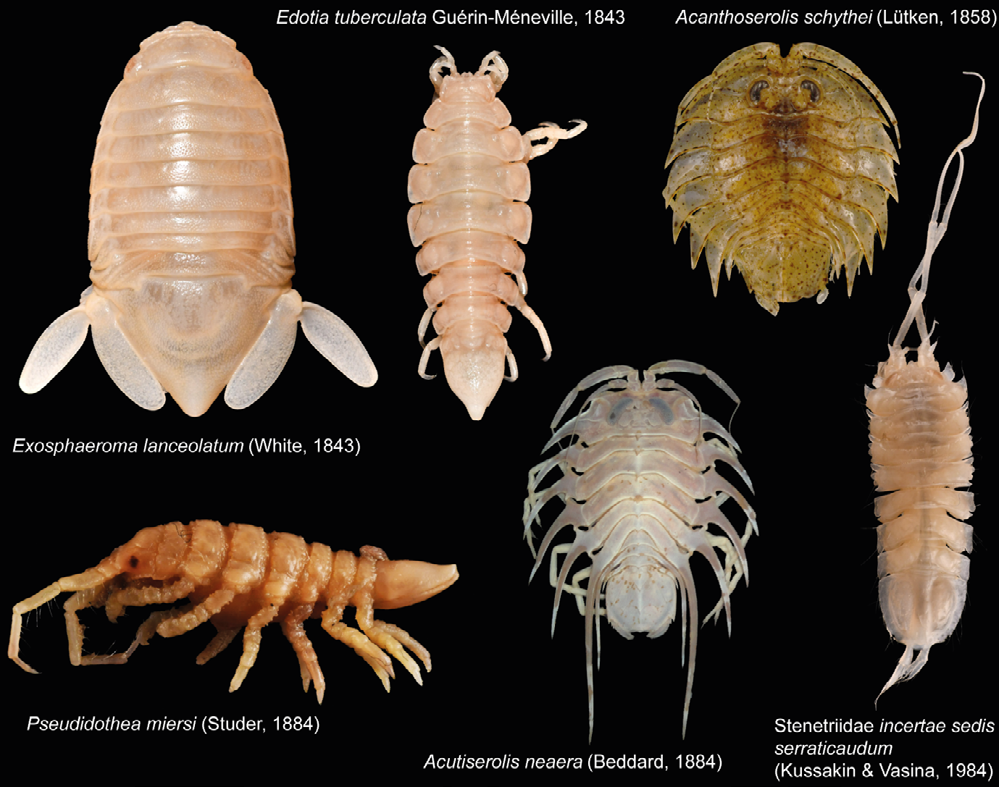
In Figure 1 are illustrated some of the first described species of isopod by international researchers. In Table 1 are listed all the species of isopods described by Argentine researchers, and their references.
ASELLOTA Paramunnidae Abyssianira acutilobi [47] Abyssianira lingula [47] Advenogonium fuegiae [46] Meridiosignum undulatum [48] Meridiosignum disparitergum [48] Munogonium quequensis [49] Munogonium diplonychia [49] Neasellus argentinensis [61] Neasellus bicarinatus [61] Pentaceration pleonarietis [61] CYMOTHOIDA Bopyridae Pseudione chiesai [58] Cirolanidae Natatolana pastorei [34] SPHAEROMATIDEA Serolidae Brazilserolis foresti [41] Cristaserolis marplatensis [41] Leptoserolis bonaerensis [38] Leptoserolis sheppardae [39] Sphaeromatidae Pseudosphaeroma platense [33] Tholozodium rhombofrontalis [33] VALVIFERA Antarcturidae Fissarcturus argentinensis [64] Xiphoarcturus carinatus [63] Xiphoarcturus kussakini [63] Chaetiliidae Chaetilia argentina [36] Chiriscus giambiagiae [60] Macrochiridothea estuariae [60] Macrochiridothea robusta [35] Idoteidae Edotia abyssalis [62] Edotia doellojuradoi [34] Synidotea marplatensis [33]
- Funding
Table 1: Isopod species from the Southwest Atlantic Ocean
Conclusions
The investigation of marine isopods in the Argentine Continental Shelf and Slope has a lengthy background. Nonetheless, numerous areas, particularly in the Argentine Continental Slope, remain unexplored. Consequently, our knowledge of the taxonomy of marine Isopoda will continue to expand in the coming years.
Conflicts of Interest
The author has no conflicts of interest to declare.
Acknowledgements
I am very grateful to Brenda Doti (IBBEA) and an anonymous reviewer, for their valuable comments that improve the original version of this work.
This research was funded by the CONICET (PIP 11220200102070CO).
References
-
Boyko CB, Bruce NL, Hadfield KA, Merrin KL, Ota Y, et al. (2020) World Marine, Freshwater and Terrestrial Isopod Crustaceans database. Isopoda. Accessed through: World Register of Marine Species.
-
Schram FR (1970) Isopods from the Pennsylvanian of Illinois. Science 169(3948): 854-855.
-
Schram FR (1974) Paleozoic Peracarida of North America. Fieldiana Geol 33(6): 95-124.
-
Poore GC, Bruce NL (2012) Global diversity of marine isopods (except Asellota and crustacean symbionts). PLOS one 7(8): e43529.
-
Brandt A, Poore GCB (2003) Higher classification of the flabelliferan and related Isopoda based on a reappraisal of relationships. Invertebr Syst 17(6): 893-923.
-
White A (1843) XLIII.-Descriptions of apparently new species and varieties of Insects and other Annulosa, principally from the collection in the British Museum. J Nat Hist 12(78): 342-346.
-
Guérin-Méneville FE (1843) Crustaces. In: Cuvier G (Ed.), Iconographie du Regne animal de G Cuvier, ou representation d’apres nature de l’une des especes les plus remarquable et souvent non encore figurees de chaque genre d’animaux. Paris, France, pp: 1-48.
-
Dana JD (1849) Conspectus crustaceorum quae in orbis terrarum circumnavigatione, Carolo Wilkes e classe Reipublicae, Foederate Duce, lexit et descripsit (continued.). Am J Sci Art 8: 424-428.
-
Dana JD (1853) Crustacea. Part II. United States exploring expedition during the years 1838, 1839, 1840, 1841, 1842, under the command of Charles Wilkes, USN. Sherman, Philadelphia, United States, pp: 691-1618.
-
Lütken CF (1858) Beskrivelse af en ny Serolis-Art, Serolis Schythei Ltk.,. Vidensk Meddel Natuirist Foren Kjobenhavn 1858: 98-104.
-
Cunningham RO (1871) Notes on the Reptiles, Amphibia, Fishes, Mollusca, and Crustacea obtained during the voyage of H.M.S. ‘Nassau’ in the years 1866-1869. Trans Linn Soc Lond 27(4): 465-502.
-
Miers EJ (1881) Account of Crustacea of the Zoological Collections made during the survey of H.M.S. ‘Alert’ in the Straits of Magellan and on the coasts of Patagonia. Proc Zool Soc Lond pp: 61-79.
-
Studer T (1884) Isopoden, gesammelt während der reise SMS Gazelle um die erde 1874-76. Bearb, pp: 1-28.
-
Beddard FE (1884) Report on the Isopoda collected by H.M.S. Challenger durin the years 1873-76. Part I. The genus Serolis. Challenger Rep Zool 11: 1-85.
-
Beddard FE (1886) Report on the isopoda collected by H.M.S. Challenger during the years 1873-76. Part II. Challenger Rep Zool 17: 1-175.
-
Pfeffer G (1887) Die Krebse von Süd-Georgien nach der Ausbeute der Deutschen Station 1882-83. 1. Teil. Jahrb Hamburg Wiss Aus Hamburg 4: 1-110.
-
Stebbing TRR (1900) On some crustaceans from the Falkland Islands, collected by Mr. Rupert Vallentin. Proc Zool Soc Lond 1900: 517-568.
-
Stebbing TRR (1914) Crustacea from the Falkland Islands collected by Mr. Rupert Vallentin, F.L.S.—Part II. Proc Zool Soc Lond 84(2): 341-378.
-
Stebbing TRR (1919) Crustacca from the Falkland Islands collected by Mr. Rupert Vallentin, F.L.S. — Part III. Proc Zool Soc Lond 89(3-4): 327-340.
-
Ohlin A (1901) Isopoda from Tierra del Fuego and Patagonia. Svenska Expeditionen Till Magellansländerna 2(11): 261-306.
-
Richardson H (1910) Description of a new isopod of the genus Notasellus from the east coast of Patagonia. Proc US Natl Mus 37(1720): 649-650.
-
Richardson H (1911) Descriptions of a new genus and species of isopod crustacean of the family Idotheidae from the mouth of the Río de la Plata, Argentina, South America. Proc US Natl Mus 40: 169-171.
-
Nordenstam Å (1933) Marine Isopoda of the families Serolidae, Idotheidae, Pseudidotheidae, Arcturidae, Parasellidae and Stenetriidae mainly from the South Atlantic. Further Zool Res Swed Antarct Exped 1091- 1903 3: 1-284.
-
Sheppard EM (1933) Isopod Crustacea. Part I: The family Serolidae. Discov Rep 7: 253-361.
-
Sheppard EM (1957) Isopod Crustacea Part II. The suborder Valvifera. Families: Idoteidae, Pseudidotheidae and Xenarcturidae fam. n. With a supplement to Isopod Crustacea, Part 1. The family Serolidae. Discov Rep 29: 141-197.
-
Menzies RJ (1962) The isopods of abyssal depths in the Atlantic Ocean. In: Ewing M (Ed.), Abyssal Crustacea. Columbia University Press, New York, United States, pp: 79-206.
-
Kussakin OG (1967) Fauna of Isopoda and Tanaidacea in the coastal zones of the Antarctic and subantarctic water. Biol Rep Soviet Antarct Exped (1955-1958) 3: 220-389.
-
Vasina GS, Kussakin OG (1982) Four new species of isopod crustaceans of the genus Acanthaspidia (Crustacea: Isopoda, Janiridae) from the Antarctic. In: Kafanov AN, Kussakin OG (Eds.), Fauna and distribution of Crustaceans from the Southern and Antarctic Waters. Academy of Sciences of the USSR, Far East Science Center, Vladivostok, pp: 62-72.
-
Kussakin OG, Vasina GS (1984) Deep-sea lower asellotes from the Scotia Sea and South Sandwich Trench. Biol Morya (Vladivost) 6: 9-17.
-
Kussakin OG, Vasina GS (1998) New bathyal and abyssal arcturids from the western Antarctic and Subantarctic (Crustacea: Isopoda: Arcturidae). Zoosyst Rossica 7(1): 55-75.
-
Kussakin OG, Vasina GS (2001) Supplements for the Fauna of Arcturid Isopods of the Genus Dolichiscus (Crustacea, Isopoda, Valvifera) of the Antarctic and Subantarctic. Russ J Mar Biol 27(4): 208-217.
-
Doti BL, Chiesa IL, Roccatagliata D (2020) Biodiversity of the Deep-Sea Isopods, Cumaceans, and Amphipods (Crustacea: Peracarida) Recorded off the Argentine Coast. In: Hendrickx ME (Ed.), Deep-Sea Pycnogonids and Crustaceans of the Americas. Springer Nature, Cham, Switzerland, pp: 157-191.
-
Giambiagi D (1922) Cuatro nuevos isópodos de la Argentina. Physis 5(20): 230-244.
-
Giambiagi D (1925) Resultados de la primera expedicíon a Tierra del Fuego (1921). Crustáceos Isópodos. An Soc Cient Argent 1925: 1-20.
-
Bastida R, Torti MR (1969) Un nuevo isopódo del género Macrochiridothea de las costas Argentinas (Valvifera, Idoteidae). Neotropica 15(47): 65-72.
-
Bastida R, Torti MR (1970) Chaetilia argentina sp. nov: un nuevo aporte al conocimiento de la isopodofauna Sudamericana. Bull Mus Natl Hist Nat (2 Ser) 42(2): 392- 400.
-
Torti MR, Bastida R (1972) Presencia del género Macrochiridothea Ohlin, 1901 en Uruguay y Brasil: M. giambiagiae sp. nov. (Crustacea, Isopoda). Neotropica 18: 16-22.
-
Bastida R, Torti MR (1967) Una nueva especies de Isopoda Serolidae para las costas de la provincia de Buenos Aires (Argentina). Bull Mus Natl Hist Nat (2 Ser) 39(3): 573-582.
-
Bastida R, Torti MR (1969) Una nueva especie de Serolis de las costas argentinas. Neotropica 15(46): 33-39.
-
Bastida R, Torti MR (1973) Los isopodos Serolidae de la Argentina. Clave para su reconocimiento. Physis 32(84): 19-46.
-
Bastida R, Torti MR (1970) Crustaceos Isopodos: Serolidae. Résultats Scientifiques des Campagnes de la “Calypso” 9: 62-105.
-
Roux AM, Bastida R (1990) The occurrence of Sphaeroma serratum (Fabricius, 1787) in the Western South Atlantic (Crustacea, Isopoda). Proc Biol Soc Wash 103(2): 350- 352.
-
Rumbold C, Meloni M, Doti B, Correa N, Albano M, et al. (2018) Two new nonindigenous isopods in the Southwestern Atlantic: Simultaneous assessment of population status and shipping transport vector. J Sea Res 138: 1-7.
-
Meloni M, Correa N, Pitombo FB, Chiesa IL, Doti B, et al. (2020) In-water and dry-dock hull fouling assessments reveal high risk for regional translocation of nonindigenous species in the southwestern Atlantic. Hydrobiologia 848(9): 1981-1996.
-
Doti BL, Roccatagliata D, Zelaya DG (2005) The shallow- water Asellota (Crustacea: Isopoda) from the Beagle Channel: Preliminary taxonomic and zoogeographical results. Sci Mar 69(S2): 159-166.
-
Doti BL, Roccatagliata D (2005) On two paramunnid species from the Beagle Channel, Argentina (Crustacea : Isopoda : Asellota). Proc Biol Soc Wash 118(3): 509-521.
-
Doti BL, Roccatagliata D (2006) On the Atlantic species of the genus Abyssianira Menzies, 1956 (Isopoda: Asellota: Paramunnidae). Zootaxa 1252: 1-35.
-
Doti BL, Roccatagliata D (2009) On the South American species of the genus Meridiosignum (Crustacea: Isopoda: Asellota: Paramunnidae). J Nat Hist 43(17-18): 1115- 1138.
-
Doti BL, Roccatagliata D (2013) Two new species of the genus Munnogonium (Isopoda: Asellota: Paramunnidae) from Argentina. Zootaxa 3717(3): 301-319.
-
Doti BL, Roccatagliata D, López Gappa J (2014) An inverse latitudinal biodiversity pattern in asellote isopods (Crustacea, Peracarida) from the Southwest Atlantic between 35° and 56°S. Mar Biodivers 44(1): 115-125.
-
Lovrich GA, Roccatagliata D, Peresan L (2004) Hyperparasitism of the cryptoniscid isopod Liriopsis pygmaea on the lithodid Paralomis granulosa from the Beagle Channel, Argentina. Dis Aquat Org 58(1): 71-77.
-
Peresan L, Roccatagliata D (2005) First record of the hyperparasite Liriopsis pygmaea (Cryptoniscidae, Isopoda) from a rhizocephalan parasite of the false king crab Paralomis granulosa from the Beagle Channel (Argentina), with a redescription. J Nat Hist 39(4): 311- 324.
-
Roccatagliata D, Lovrich GA (1999) Infestation of the false king crab Paralomis granulosa (Decapoda: Lithodidae) by Pseudione tuberculata (Isopoda: Bopyridae) in the Beagle Channel, Argentina. J Crust Biol 19(4): 720-729.
-
Miranda-Vargas P, Roccatagliata D (2004) A redescription and new host record for the parasitic isopod Pseudione tuberculata Richardson, 1904 (Epicaridea: Bopyridae) from the Beagle Channel, Argentina. Cah Biol Mar 45(2): 157-166.
-
Roccatagliata D, Torres Jordá M (2002) Infestation of the fiddler crab Uca uruguayensis by Leidya distorta (Isopoda, Bopyridae) from the Rio de la Plata Estuary, Argentina. J Crust Biol 22(1): 69-82.
-
Torres Jordá M, Roccatagliata D (2002) Population dynamics of Leidya distorta (Isopoda: Bopyridae) infesting the fiddler crab Uca uruguayensis at the Río de la Plata estuary, Argentina. J Crust Biol 22(4): 719-727.
-
Diaz MV, Roccatagliata D (2006) Remarks on the genus Anathelges (Isopoda: Bopyridae), with a new record from the Beagle Channel, Argentina. J Crust Biol 28(3): 331-340.
-
Pereira E, Doti BL, Roccatagliata D (2021) A new species of Pseudione sensu lato (Isopoda: Bopyridae) on a squat lobster host from the deep South-West Atlantic. Zootaxa 4996(2): 363-373.
-
Doti BL, Roccatagliata D, Scarabino F (2008) Range extension of Pseudidothea miersii (Studer, 1884) (Isopoda, Valvifera) and new evidence of its likely commensal relationship with a sea urchin. Crustaceana 81(7): 883-888.
-
Poore GCB, Ramirez F, Schiaritti A (2009) A new species of Chaetiliidae (Crustacea: Isopoda: Valvifera) from the Río de la Plata estuary, Argentina-Uruguay, and reconsideration of Macrochiridothea and Chiriscus. Zootaxa 2119: 51-65.
-
Doti BL (2017) Three new paramunnids (Isopoda: Asellota: Paramunnidae) from the Argentine Sea, South- west Atlantic. J Mar Biolog Assoc UK 97(8): 1695-1709.
-
Pereira E, Doti B (2017) Edotia abyssalis n. sp. from the Southwest Atlantic Ocean, first record of the genus (Isopoda, Valvifera, Idoteidae) in the deep sea. Zool Anz 268: 19-31.
-
Pereira E, Roccatagliata D, Doti BL (2019) Xiphoarcturus-a new genus and two new species of the family Antarcturidae (Isopoda: Valvifera) from the Mar del Plata submarine canyon and its phylogenetic relationships. Arthropod Syst Phylog 77(2): 303-323.
-
Pereira E, Roccatagliata D, Doti BL (2020) On the antarcturid genus Fissarcturus (Isopoda: Valvifera): Description of Fissarcturus argentinensis n. sp., first description of the male of Fissarcturus patagonicus (Ohlin, 1901), and biogeographic remarks on the genus. Zool Anz 288: 168-189.
-
Doti BL, Chiesa IL, Roccatagliata D (2020) Biodiversity of Isopoda and Cumacea (Peracarida, Crustacea) from the Marine Protected Area Namuncurá-Burdwood Bank, South-West Atlantic. Polar Biol 43(10): 1519-1534.
-
Calderón López S, Pereira E, Roccatagliata D, Doti BL (2022) Dos nuevas especies del género Moruloidea (Crustacea: Isopoda: Sphaeromatidae) del Área Marina Protegida Namuncurá-Banco Burdwood II. XI Jornadas Nacionales de Ciencias del Mar. Argentina.
- California Red-Legged Frog and Non-Listed Amphibians Response to Non-Native Fish Removal
- Industrial Standardization of the Bio-OS: Algorithmic Codification of Resilience Engineering Guidelines and Version V8 Architecture
- Climate Variability and the Sustainability of Snail Farming in Nigeria: Past Trends, Present Challenges and Potential Outlook
- The Evaluation of the Surveillance System of Anthrax in Gilgit-Baltistan, Pakistan, 2018
- Natural Decline to Extinction of A New Zealand Rabbit Population
- Mitochondrial Bio-Logistics: Steering Co-Enzyme Q10 and Lycopene Synergies within the Science 4.0 Bio-OS Framework