
Cystic Endometrial Hyperplasia (CEH) in a Common Marmoset (Callithrix jacchus) kept in Zoo
Cystic endometrial hyperplasia is a neoplasm that affects the reproductive system of uncastrated females. The main causes that lead to the appearance of this disease are the accumulation of exudate and uterine inflammation that, when evolving, can cause sepsis in the animal, increasing the chances of leading to death. Clinical signs of cystic endometrial hyperplasia include anorexia, vomiting, diarrhea, depression, polydipsia and polyuria, in addition to purulent vaginal discharge. A common marmoset female arrived at a zoo as a result of illegal trafficking. His history was unknown, but he showed signs of osteodystrophy, which was promptly treated and the case improved. After a few months, the animal showed signs of cystitis, including hematuria and vulvar licking, which was treated with antibiotics and the treatment was successful. However, after being diagnosed again with cystitis, antibiotic therapy was not effective, which led to the indication of an ultrasound examination that indicated the presence of hyperechogenic cysts in the right ovary and uterine enlargement. In view of this, therapeutic castration was chosen, since the zoo was not interested in reproducing the species. Thus, the procedure was successfully performed and the changes indicated in the ultrasound were confirmed. The animal underwent a satisfactory recovery and since then has not had any of the signs it had previously shown. After evaluating all possible treatments, it was concluded that the best option for this case was surgical therapy. However, it is possible that the patient will experience hormonal changes in the future. In view of this, it is extremely important to carry out the correct diagnosis so that the problem is treated as early as possible
Introduction
Callithrix jacchus, popularly known as Common Marmoset, is a primate that belongs to the Callitrichidae family. The marmoset, considered a New World primate, is small in stature and weighs less than 1 kg. Their diet is based on fruits, insects, flowers, eggs and plant exudate such as sap and gum [1]. Thus, marmosets are considered generalist animals, being carnivores, herbivores, gumiferans and insectivores [2]. At this moment, the common marmoset is considered a least concern species by IUCN [3].
The common marmoset is one of the main primate species studied for reproductive purposes. Female primates have a single-cavity uterus, two functional ovaries, a pair of fallopian tubes, clitoris, vagina, and labia [4]. In addition, the placenta is hemochorial and bi-diskoidal, that is, there is direct contact between maternal and fetal blood [4].
The ovarian cycle of C. jacchus presents characteristics of the estrous cycle and the menstrual cycle, being classified as a mixed cycle. Despite not menstruating, this primate species exhibits copulation in any phase of the cycle, but there are times when the frequency is higher, such as in periovulatory periods [4]. The reproductive system of female primates is frequently affected by diseases that can compromise the health of the animal and, in case of pregnancy, also the fetal evolution. The main conditions that interfere with reproduction in primates include spontaneous abortion, which can occur early in pregnancy and go unidentified, tumors, placental displacement, hormonal disruption, anatomical defects, infectious conditions, and uterine neoplasms [5].
Cystic endometrial hyperplasia (CEH), is one of the factors that predispose to pyometra, it is caused by uterine inflammation and accumulation of exudate, which affects mostly middle-aged and non-castrated females, and can lead to sepsis [6, 7]. The occurrence of CEH may be associated with an exaggerated uterine response to progesterone during the luteal phase of the estrous cycle, this accumulation of fluid favors bacterial growth [6].
Some of the clinical signs are: anorexia, vomiting, diarrhea, depression, polydipsia and polyuria, in addition to purulent vaginal secretion [6]. The diagnosis is clinical and by physical examination, in addition to ultrasonography, radiography, blood count and biochemistry as complementary tests. Its treatment is based on ovariohysterectomy, which consists of removing the uterus and ovaries [7].
CEH has been described in a few primates: cynomolgus monkey (Macaca fascicularis) and rhesus monkey (Macaca mulatta) [8, 9, 10]. Despite the fact that C. jacchus are also used in laboratory research [11, 12], only a few cases are reported about reproductive issues, mainly being dystocia [13, 14, 15] and one case of uterine rupture [16]. Endometritis has been reported in Callithriquids with 5,4% prevalence [17].
Body of Paper
In this case report, the common marmoset female, age and history unknown, has an illegal trade origin and arrived at the zoo four years ago with signs of osteodystrophia. It was treated accordingly and got better. The female lives alone in an enclosure with visual contact with other females and one neutered male.
After a few months displayed signs of cystitis (hematuria and licking of the vulva) that was treated with antibiotics with success. This time, after an unsuccessful antibiotic therapy and with the adding of vaginal discharge, it was decided to perform an abdominal ultrasound. The exam showed an enlarged uterus and hypoechogenic cysts at the right ovary (Figures 1 & 2).
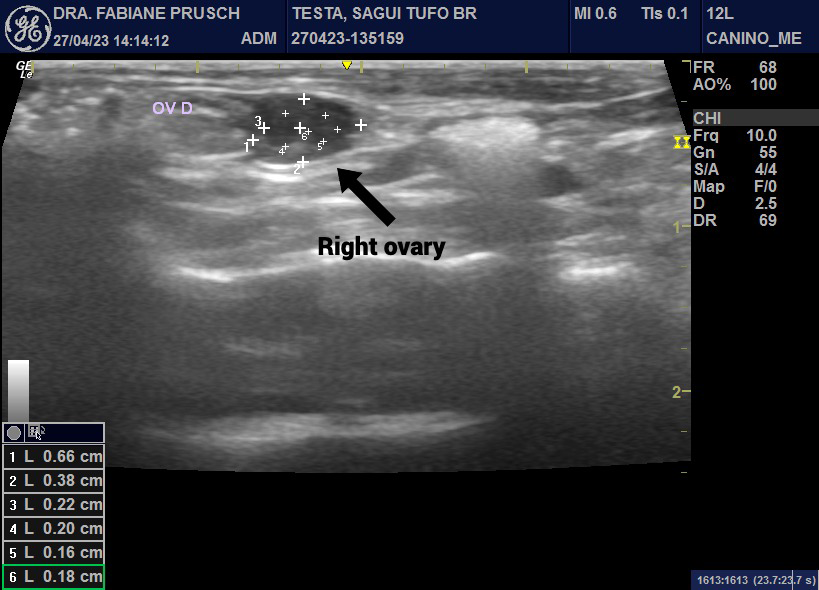
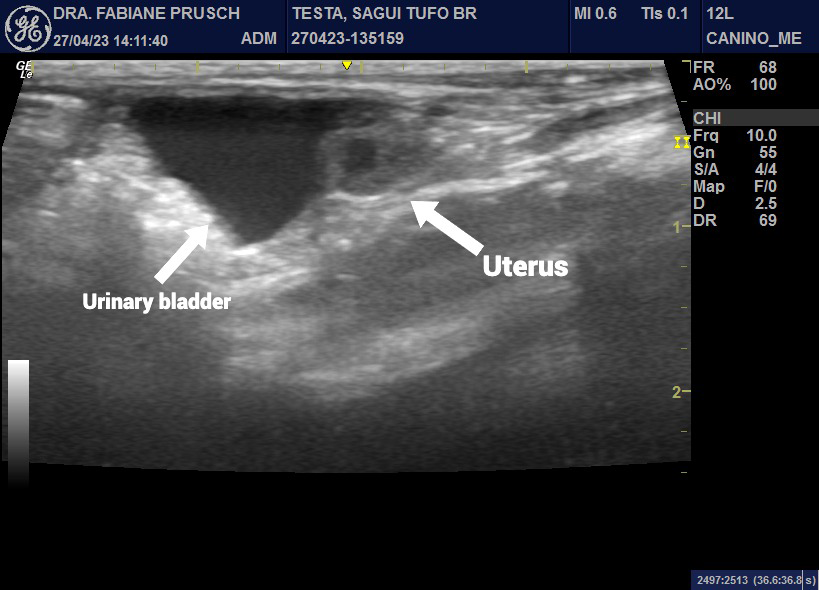
Since the zoo doesn’t have interest in reproducing the species it was decided for a therapeutic spaying, since both ovaries and uterus showed abnormalities. The procedure was successful and the alterations saw at the ultrasound have been confirmed (Figures 3 & 4).
The animal recovered fine and has not shown any of the previous signs since then.
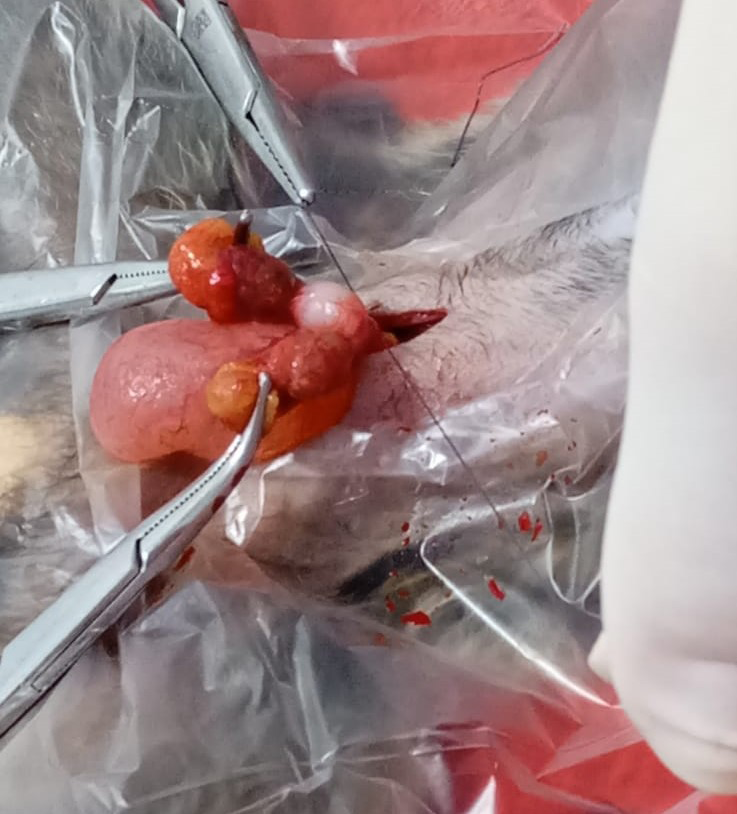
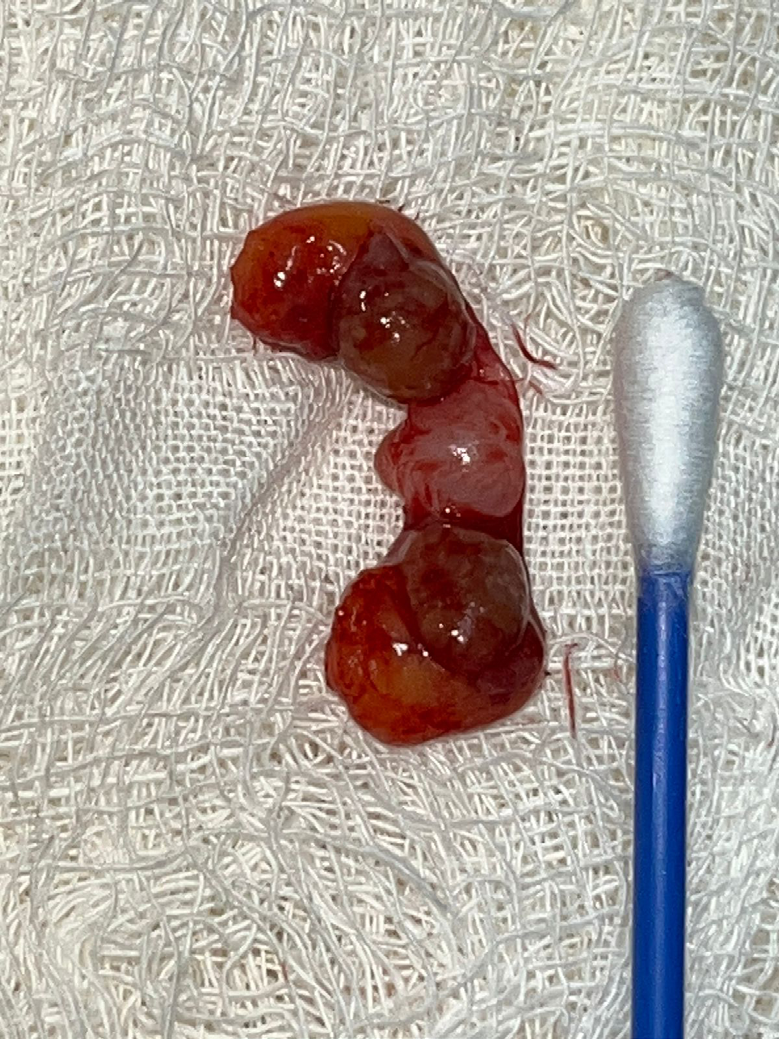
The anatomical specimens were sent to a pathology laboratory in order to identify macro and microscopically the causes of clinical signs.
Macroscopically, the uterus showed a slightly conical shape, measuring 0.6 cm in diameter. The ovaries had a solid appearance with a smooth surface and measuring 0.5 cm in diameter and 0.3 cm in height.
Microscopy findings in the ovaries include the presence of persistent corpora lutea composed of solid clusters of granulosa cells, containing ample eosinophilic cytoplasm and a central round nucleus surrounded by small theca cells. In the ovarian periphery, the presence of ovarian follicles in different stages of maturation was identified.
The uterus showed endometrial glands with multiple dilations of varying sizes. The center of the glands indicated clear spaces, red blood cells or small amounts of eosinophilic fluid. Furthermore, the presence of fibrosis in the submucosal region was identified.
After histopathological analysis, it was concluded that the animal had persistent corpora lutea and endometrial hyperplasia associated with hemometer.
Conclusion
We concluded that the surgical therapy was the better choice in this case despite possible hormonal alterations in the future. Also, the correct diagnosis could lead to an early treatment of the issue.
References
-
Evandro Chagas Institute. National Primate Center. Pará, Brazil, CENP.
-
Parker SP, Grzimek B (1990) Grzimek’s Encyclopedia of Mammals. Volume 1: Monotremata, Marsupialia, Insectivora, Macroscelidea, Chiroptera, Dermoptera. Ann Arbor, Michigan. McGraw-Hill. pp: 648.
-
IUCN Red List. Common Marmoset (Callithrix jacchus).
-
Guimarães MADBV (2014) Reproduction in neotropical primates. In: Cubas ZS, Silva JCR, et al. (Eds.), Tratado de animais selvagens: Medicina Veterinária. 2nd (Edn.), São Paulo: Editora GEN/Roca, pp: 2270-2275.
-
Santana JS (2021) Reproductive aspects and surgical resolution of dystocia in non-human primates. Pubvet 15(1): 1-11.
-
Barni BDS (2012) Cystic endometrial hyperplasia in bitches and cats. Universidade Federal do Rio Grande do Sul, Porto Alegre, Brasil.
-
Santos RDL, Alessi AC (2023) Patologia Veterinária. 3rd (Edn.), Rio de Janeiro: Guanabara Kogan. Grupo GEN, pp: 1008.
-
Arifin E, Shively CA, Register TC, Cline JM (2008) Polycystic ovary syndrome with endometrial hyperplasia in a cynomolgus monkey (Macaca fascicularis). Vet Pathol 45(4): 512-515.
-
Baskin GB, Smith SM, Marx PA (2002) Endometrial hyperplasia, polyps, and adenomyosis associated with unopposed estrogen in rhesus monkeys (Macaca mulatta). Vet Pathol 39(5): 572-575.
-
Cline JM, Söderqvist G, Register TC, Williams JK, Adams MR, et al. (2001) Assessment of hormonally active agents in the reproductive tract of female nonhuman primates. Toxicol Pathol 29(1): 84-90.
-
Kishi N, Sato K, Sasaki E, Okano H (2014) Common marmoset as a new model for neuroscience research and genome-editing technology. Dev Growth Differ 56: 53-62.
-
Mansfield K (2003) Marmoset models commonly used in biomedical research. Comp Med 53: 383-392.
-
Susanne R, Ann-Kathrin O (2007) Husbandry and Management of New World Species: Marmosets and Tamarins. The Laboratory Primate 2005: 145-162.
-
Prestes NC, Ferreira JC, Ferraz MC, Garofalo NA, Simões CR, (2014) Cesarean sections in marmosets: white-tufted marmoset (Callithrix jacchus). Veterinária e Zootecnia 21(1): 92-97.
-
Gomes SL, Macêdo DCS de, Costa RC, Coelho TG, LélisI CN, et al. (2014) Distocia em sagui do tufo branco (Callithrix jacchus, Linnaeus 1758) por traumatismo automobilístico. Revista de Educação Continuada em Medicina Veterinária e Zootecnia do CRMV-SP 12(2): 87- 87.
-
Divincenti L, Miller AD, Knoedl DJ, Mitchell JF (2016) Uterine Rupture in a Common Marmoset (Callithrix jacchus). Comp Med 66(3): 254-258.
-
Moresco A, Feltrer-Rambaud Y, Wolfman D, Agnew DW (2022) Reproductive one health in primates. Am J Primatol 84(4-5): e23325.
- California Red-Legged Frog and Non-Listed Amphibians Response to Non-Native Fish Removal
- Industrial Standardization of the Bio-OS: Algorithmic Codification of Resilience Engineering Guidelines and Version V8 Architecture
- Climate Variability and the Sustainability of Snail Farming in Nigeria: Past Trends, Present Challenges and Potential Outlook
- The Evaluation of the Surveillance System of Anthrax in Gilgit-Baltistan, Pakistan, 2018
- Natural Decline to Extinction of A New Zealand Rabbit Population
- Mitochondrial Bio-Logistics: Steering Co-Enzyme Q10 and Lycopene Synergies within the Science 4.0 Bio-OS Framework