
Description of Neoechinorhynchus pikensis n. sp. (Acanthocephala: Neoechinorhynchidae) from Catostomus commersoni (Lacépède) in Wisconsin, USA
Neoechinorhynchus pikensis n. sp. is described from one whole-mounted male specimen that was collected a few decades ago but went missing. It was collected from an individual white sucker, Catostomus commersoni (Lacépède) captured in the Pike River, Kenosha County and has never been found subsequently despite the examination of many collections of white suckers since. It is distinguished from other species of Neoechinorhynchus Stiles and Hassall, 1905 by a combination of the following diagnostic characters: Trunk small, straight anteriorly but slightly curled ventrad posteriorly; body wall with similar thickness dorso-ventrally; cuticle of proboscis and neck conjoined as one sheet of thick, dark chitin-like layer; proboscis wider than long with long anterior hooks with short round roots; hooks in second and third circles much smaller and rootless; receptacle three times as long as proboscis with a triangular cephalic ganglion at its base; lemnisci relatively long and equal, not reaching anterior testis; all male reproductive structures contiguous in posterior two thirds of trunk; testes pre-equatorial; anterior testis larger than posterior testis; large syncytial cement gland with 10 giant nuclei; cement reservoir prominent branching in 2 long cement ducts surrounding Saefftigen’s pouch. Comparisons with worldwide and North American related species that have partially similar features are made. It is proposed that the holotype may be part of a larger population in southwest Lake Michigan where the Pike River flows and where a continuous population of C. commersoni survives.
Introduction
With his description of Neoechinorhynchus robertbaueri Amin, 1985 from Erimyzon sucetta (Lacépède) in Wisconsin, Amin [1] provided a key to the 20 species of Neoechinorhynchus known in North American freshwater fish then. Amin [2] revised the genus Neoechinorhynchus Stiles and Hassall, 1905 and provided keys to 88 species in two subgenera, Neoechinorhynchus Stiles and Hassall, 1905 and Hebesoma Van Cleave, 1928. Of 26 species in 10 families of fish examined from two adjacent river systems in Racine and Kenosha counties, SE Wisconsin (the Root and Pike rivers), 15 species of fishes in 8 families were infected with helminth parasites between 1976 and 1984 [3, 4]. During the same period, we also examined 3,386 fishes in 10 families from two adjacent lakes (Silver and Tichigan lakes) from which we recovered specimens of Neoechinorhynchus cylindratus (Van Cleave, 1913) in 142 and 25 fishes, respectively, along with specimens of 4 other species of Neoechinorhynchus [4]. In the Pike River, 231 individuals of the white sucker Catostomus commersoni (Lacépède) were captured and examined for parasites [3] with additional and more recent collections that were not recorded. Only 1 sucker that was examined in a 1983 class project contained a unique male specimen of Neoechinorhynchus that was considered new then but has not been examined further since. This single whole mounted specimen is being resurrected and described herein. Line drawings and microscope images were generated but this limited sample size of one whole-mount prohibits the production of SEM images, molecular or EDXA (Energy Dispersive x-ray analysis) studies.
Materials and Methods
Collection
Hundreds of fish, especially white suckers, were infected with specimens of 5 species of acanthocephalans genus Neoechinorhynchus between 1976 and 1984 in SE Wisconsin waterways in Racine and Kenosha counties [3, 4]. The white suckers were most heavily sampled in the Pike River, Kenosha County (42°38′40″N,87°51′09″W). Only one individual sucker was found infected with the described male acanthocephalan specimen on June 27, 1983 in the Pike River, site alpha 6 on the grounds of the University of Wisconsin-Parkside campus, Kenosha County. This collection was part of a parasitology class project; no other information was kept.
Methods for Microscopical Studies
The Worm was punctured with a fine needle and subsequently stained in Mayer’s acid carmine, destained in 4% hydrochloric acid in 70% ethanol, dehydrated in ascending concentrations of ethanol (24 hr each), and cleared in 100% xylene then in 50% Canada balsam and 50% xylene (24 hr each). The whole worm was then mounted in Canada balsam. Measurements are in micrometers, unless otherwise noted; the range is followed by the mean values between parentheses. Width measurements represent maximum width. Trunk length does not include proboscis, neck, or bursa.
Line Drawings
Line drawings were created by using a Ken-A-Vision micro projector (Ward’s Biological Supply Co., Rochester, N.Y.) which uses cool quartz iodine 150W illumination. Images of the stained whole mounted specimen were projected vertically on 300 series Bristol draft paper (Starthmore, Westfield, Massachusetts), then traced and inked with India ink. The completed line drawings are subsequently scanned at 600 pixels on a USB and subsequently downloaded on a computer.
Optical Microscope Images
Optical microscope images were acquired using a BH2 light Olympus microscope (Olympus Optical Co., Osachi- shibamiya, Okaya, Nagano, Japan) attached to an AmScope 1000 video camera (United Scope LLC, dba AmScope, Irvine, California), linked to an ASUS laptop equipped with HDMI high-definition multimedia interface system (Taiwan- USA, Fremont, California). Images from the microscope are transferred from the laptop to a USB and stored for subsequent processing on a computer.
Results
Neoechinorhynchus pikensis n. sp.
Description of holotype male: With characters of the genus Neoechinorhynchus Stiles and Hassall, 1905 as revised by Amin (2002). Trunk cylindrical, small, 5.12 mm long by 0.45mm wide at its widest point anterior to testes; straight anteriorly but slightly curled ventrad posteriorly. Body wall not dorso-ventrally differentiated (Fig. 1). Cuticle of proboscis and neck conjoined together as one sheet of thick, dark chitin-like layer distinct from cuticular layers of trunk (Fig. 5). Proboscis 125 long and 182 wide anteriorly with prominent apical organ measuring 105 by 35 (Fig. 6, arrow) and 90-100 long anterior hooks with moderate size laterally slender obovoid roots (Figs. 3, 6) measuring 42-50 long. Hooks in second and third circles much smaller and rootless, 37 and 30 long, respectively (Figs. 3,7). Receptacle three times as long as proboscis, 468 long by 198 wide, with a triangular cephalic ganglion measuring 83 long and 62 wide at its base (Figs. 2,5). Lemnisci equal, with two and one giant nuclei each, much longer than receptacle, 1.30 mm long by 0.11 wide at middle, not reaching anterior testis. All male reproductive structures contiguous in posterior two thirds of trunk. Testes rectangular, pre-equatorial. Anterior testis (Figs. 1,8) 600 by 325, larger than posterior testis 450 by 300 (Figs. 1,9). Large syncytial cement gland (Figs. 1,4,10) 1.05 mm long by 0.0.22 wide with 10 round but variable giant nuclei measuring 62-73 in diameter. Cement reservoir prominent and thick measuring 333 long by 213 wide branching in two 655 long cement ducts (Figs. 1,4,11, arrow). Saefftigen’s pouch between cement ducts, 600 long by 75 wide anteriorly (Fig. 11, arrow). Bursa partially retracted (Fig. 12).
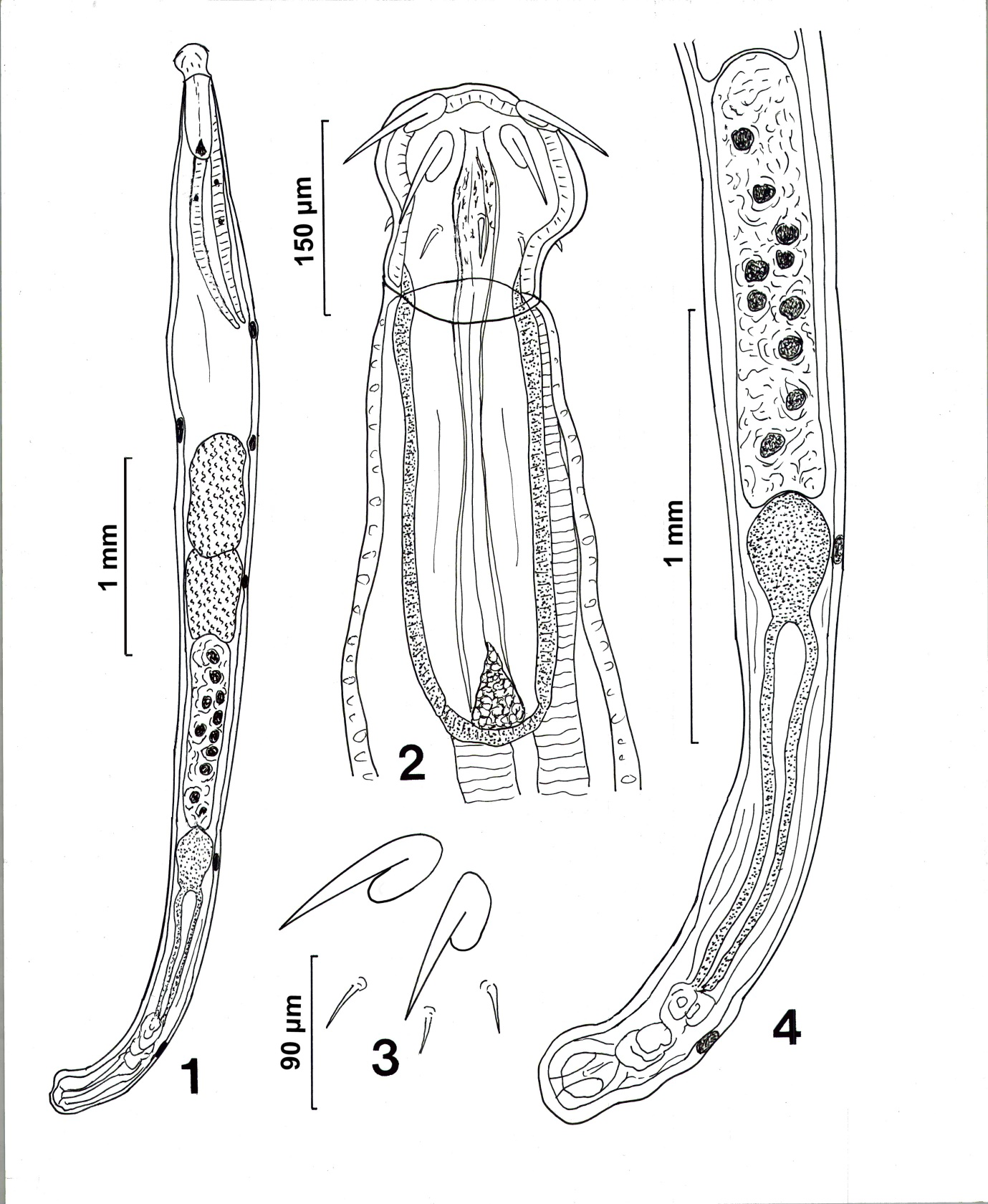
Figures 1-4: Line drawings of Neoechinorhynchus pikensis from Catostomus commersoni in the Pike River, SE Wisconsin.
- Whole worm.
- Praesoma showing proboscis with cephalic ganglion and apical organ.
- Rooted anterior hooks and rootless middle and posterior hooks.
- Posterior portion of reproductive system showing cement gland, cement reservoir and cement ducts surrounding Saefftogen’s pouch reaching retracted bursa.
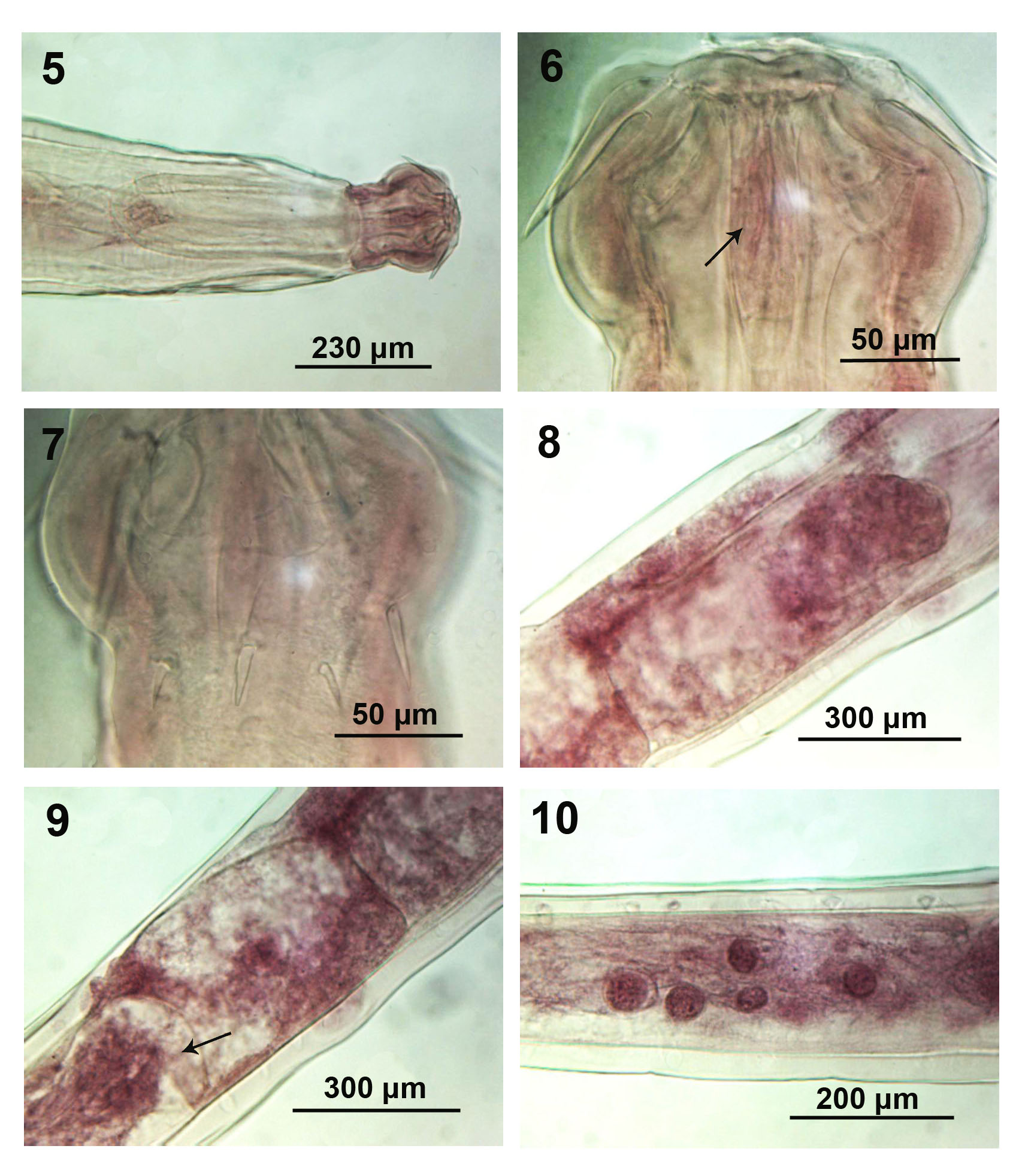
Figures 5-10: Microscope images of Neoechinorhynchus pikensis from Catostomus commersoni in the Pike River, SE Wisconsin. 5. Praesoma showing the distinction between the chitin-like cuticular covering of the proboscis-neck complex compared to the usual body wall layers. The position and shape of the cephalic ganglion is apparent. 6. A higher magnification of the of the proboscis showing the long apical hooks and their obovoid roots in lateral perspective. Note the cephalic ganglion at center (arrow). 7. Another perspective of the posterior part of the proboscis showing the rootless middle and posterior hooks. 8. Middle trunk featuring the anterior testis. 9. The posterior testis contiguous with anterior testis anteriorly and with the beginning of the cement gland posteriorly (arrow). 10. A large portion of the cement gland showing variations in size and shape of the giant nuclei.
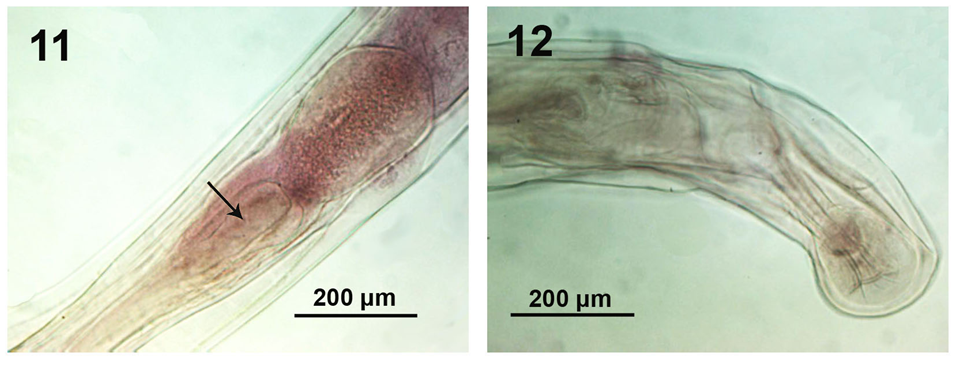
Figures 11,12: Microscope images of Neoechinorhynchus pikensis from Catostomus commersoni in the Pike River, SE Wisconsin. 11. The cement reservoir branching into two cement ducts surrounding Saefftigen’s pouch (arrow). 12. The posterior portion of the reproductive system with the retracted bursa.
Taxonomic Summary
Type host: Catostomus commersoni (Lacépède) Type locality: Pike River, Kenosha County (42°38′40″N,87°51′09″W); site alpha 6 on the grounds of the University of Wisconsin-Parkside campus, Kenosha County, Wisconsin Site of infection: Intestine Specimen: One holotype male in the Harold W. Manter Laboratory (HWML) parasite collection, accessioned (P- 2023-027) and cataloged (HWML-216995), University of Nebraska State Museum, Lincoln. Etymology: The new species is named for the Pike River from which it was collected. ZooBank LSID#E974DDB3-0263-47EE-A0B8- 816B076ACC6B
Remarks
As of 1985 and 1999, there are 20 species of Neoechinorhynchus that are known from North American freshwater fishes [1, 5] and a few others described since. Amin [6] listed 114 species in two subgenera and species without subgeneric assignment worldwide. Neoechinorhynchus pikensis n. sp. is unique among other species of Neoechinorhynchus in having a combination of the following characters, among others (1) a dark chitin-like proboscis- neck complex in combination with (2) body wall with similar thickness dorso-ventrally, (3) short obovoid roots of apical hooks, (4) lemnisci relatively long and equal, not reaching anterior testis, (5) large syncytial cement gland with 10 giant nuclei, and (6) prominent and thick cement reservoir branching in 2 long cement ducts surrounding Saefftigen’s pouch and feeding into the bursa. We ran this male specimen Worldwide Acanthocephalans except North America: A few species were found to have one or two of the above noted combination of characters characteristic of N. pikensis n. sp. For instance, Neoechinorhynchus (Neoechinorhynchus) arminiacus Mikailov, 1975 from freshwater fish in Armenia has similar organization of lemnisci and testes but it is a much larger worm with proboscis longer than wide and shorter anterior hooks. Neoechinorhynchus (Neoechinorhynchus) prochilodorum Nickol and Thatcher 1971 also has a similar organization of lemnisci and testes but it has a much smaller proboscis with relatively smaller apical hooks and round testes, constricted cement gland, crested dorsal body wall, and is found in Prochilodus reticulatus Valenciennes in Colombia. Neoechinorhynchus (Neoechinorhynchus) saurogobi Yu Yi and Wu, 1989 also has similar equal lemnisci distant from anterior testis and contiguous male reproductive structures but the lemnisci and the more elongate proboscis are markedly smaller with barely different hook sizes in all circles. It is found in Saurogobio dabryi Bleeker in the Yangtze River, China. Neoechinorhynchus (Neoechinorhynchus) roseus Salgado Maldonado, 1978 from the flatfish Achirus mazatlanus (Steindachner) in Mexico has short equal lemnisci distant from anterior testis and compact contiguous reproductive structures; it has, however, a much smaller proboscis with very small apical hooks. Two short equal lemnisci and a very distant compact contiguous reproductive system secluded at the posterior-most end of the trunk characterize Neoechinorhynchus (Neoechinorhynchus) wuyiensis Wang, 1981 from Crossostoma davidi Sauvage in China; it has no hypodermal giant nuclei, a longer than wide proboscis with very small apical hooks and small receptacle, testes and cement gland. Also, Neoechinorhynchus (Neoechinorhynchus) villoldoi Vizcaino, 1992 from Corydoras paleatus (Jenyns) in Argentina has a comparable body plan to N. pikensis except that it has a proboscis longer than wide with very small apical hooks equal to middle hooks in length (all hooks rooted), among other differences. As with N. villoldoi, Neoechinorhynchus (Neoechinorhynchus) rigidus Van Cleave, 1928 from Schizothorax spp. in India (Kashmir) and Afghanistan has a comparable body plan to N. pikensis except that it has 10 dorsal and 4 ventral hypodermal giant nuclei, a proboscis longer than wide with smaller apical and larger and nearly equal middle and posterior hooks (all rooted), almost equal lemnisci reaching anterior testis. Neoechinorhynchus (Neoechinorhynchus) chilkaensis Podder, 1937 from Mugil cephalus Linn. in India bore similarities to N. pikensis including longer, nearly equal lemnisci not reaching anterior testis but has 5-8 dorsal and 3-5 ventral hypodermal giant nuclei, globular proboscis with shorter apical hooks and its contiguous reproductive structures are distantly confined to posterior trunk extremity. The body of Neoechinorhynchus golvani Salgado Maldonado, 1978 from many fish species in Mexican streams has a similar plan to that of N. pikensis but it is a very small acanthocephalan with correspondingly much smaller trunk, globular proboscis, hooks (middle and posterior hooks equal), receptacle, testes and cement gland. Similarly, the larger Neoechinorhynchus coiliae Yamaguti, 1939, a marine acanthocephalan from Coilia mystus (Linn.) in Japan has a similar plan with its equal lemnisci not reaching anterior testis, but it’s much smaller rectangular proboscis has very small apical hooks equal in length to the middle hooks (all hooks are rooted). The larger specimens of Neoechinorhynchus oreini Fotedar, 1968 from Oreinu_s (=_Schizothorax) sinuatus Heckel in Kashmir is most similar to N. pikensis in body form and organization of lemnisci and contiguous reproductive system. It (N. oreini), however, has a proboscis longer than wide with smaller apical hooks of similar size to middle hooks and with very small roots, and 5-7 and 2 giant hypodermal nuclei dorsally and ventrally, respectively. The cement gland is smaller and the lemnisci are nearly subequal not reaching anterior testis. Neoechinorhynchus zacconis Yamaguti, 1935 from Zacco platypus Temminck and Schlegel in Japan is a very small acanthocephalan with equal lemnisci and contiguous reproductive system that has correspondingly very small proboscis, hooks, receptacle, lemnisci, testes, and cement gland; the lemnisci overlap anterior testis and the testes overlap each other. The larger Neoechinorhynchus karachiensis Bilqees, 1972 from Mugil sp. (=M. spegieleri?) off the Karachi coast in Pakistan is a marine worm with a similar body organization to N. pikensis but differs in having a globular proboscis with very small apical hooks, the equal lemnisci overlap anterior testis, and the testes and cement glands are larger. The larger marine acanthocephalan Neoechinorhynchus nigeriensis Farooqi, 1981 from Galeoides decadactylus (Bloch) in Nigeria is similar to the marine N. coiliae from Japan except that the equal lemnisci are distant from anterior testis, the testes and cement glands are larger, and the apical hooks are much smaller with all hooks rooted. A comparable plan in another marine acanthocephalan from Australia very similar to that of N. nigeriensis is exhibited by Neoechinorhynchus aldrichettae Edmonds, 1971 from Aldrichetta forsteri (Valenciennes) in Australia except for its very long equal lemnisci being distant from anterior testis, globular proboscis with smaller apical hooks, contiguous testes and cement glands displaced to posterior trunk, and 8 giant hypodermal nuclei, 6 ventral and 2 dorsal. Neoechinorhynchus ningalooensis Pichelin and Cribb 2001 from Scarrus spp., another marine acanthocephalan from Australia, is practically identical to N. aldrichettae except for having much shorter and equal lemnisci, larger testes, and 5 giant hypodermal nuclei (4 + 1). Neoechinorhynchus elongatus Tripathi, 1959 from Mugil spp. in India is similar to the latter two species of Neoechinorhynchus from Australia in the general plan except that the nearly equal lemnisci do reach anterior testis, the proboscis is slightly longer than wide, and the anterior hooks and cement gland are small. Like N. pikensis, Neoechinorhynchus afghanus Moravec and Amin (1978) from Labeo dero (Hamilton) in Afghanistan is a small worm that has a proboscis longer than wide with very small apical hooks (all hooks rooted), receptacle, and lemnisci, round testes contiguous with the rest of the reproductive system, and two giant hypodermal nuclei, one dorsal and one ventral.
In North America: See Hoffman [5] and Arai [7] for additional host and distributional records in the US and Canada, respectively. Neoechinorhynchus (Neoechinorhynchus) tumidus Van Cleave and Bangham, 1949 has comparable proboscis, lemnisci and testes plan but its longer lemnisci are nearly subequal and may reach posterior testis, proboscis is globular with middle and posterior hooks not much smaller than anterior hooks, and with markedly larger testes and cement gland; it is found in whitefish, smelt and cisco (lake herring). Neoechinorhynchus (Neoechinorhynchus) strigosus Van Cleave, 1919 which is also found in C. commersoni, among other species of fish including buffalo fish, bears some similarities to N. pikensis such as equal lemnisci that however, reach anterior testis, similar organization of testes that are, however, not contiguous with cement gland, and with a globular smaller proboscis without much difference in size of anterior compared to other hooks. Neoechinorhynchus (Neoechinorhynchus) salmonis Ching, 1984 shares some features with N. pikensis such as the lemnisci that do not reach anterior testis and the organization of the reproductive system with contiguous testes and cement gland and cement reservoir and duct. The roots of the apical hooks are similar. While N. salmonis was originally described from salmonid fishes in British Columbia, we have subsequently found it in the Pike River, Kenosha County, Wisconsin in green sunfish, Lepomis cyanellus Raf.; see Amin (1975, 1986). It does differ from N. pikensis in having slightly subequal lemnisci, much smaller apical hooks, larger testes, ovoid cement gland overlapping posterior testis and a smaller cement reservoir overlapping cement gland. Neoechinorhynchus (Neoechinorhynchus) crassus Van Cleave, 1919 also from the intestine of C. commersoni similarly has almost equal lemnisci and comparable contiguous reproductive structures but the proboscis is longer than wide with much longer hooks in second and third circles and the lemnisci are much longer reaching posterior testis. The circumpolar Neoechinorhynchus (Neoechinorhynchus) rutili (Müller, 1780) Stiles and Hassall, 1905 is a Holarctic acanthocephalan which also infects C. commersoni, among other species of fish, has similar but slightly subequal lemnisci not reaching the anterior testis and all reproductive structures are contiguous; the proboscis is, however, globular with considerably smaller apical hooks, the testes are larger and the cement gland and reservoir are smaller than in N. pikensis. Neoechinorhynchus saginatus Van Cleave and Bangham, 1949 from Semotilus atromaculatus (Mitchill) in Wisconsin is very similar to N. rutili except that the proboscis is more globular with middle and posterior hooks being about equal in length. One of the more recently described species of the genus in North America is Neoechinorhynchus bullocki Doolin and Reyda, 2018 from C. commersoni in New York which is readily distinguishable from N. pikensis by having markedly unequal lemnisci distant from anterior testis, dorsal body wall being much thicker than ventral, much smaller anterior hooks, and smaller cement gland. The most prevalent species of Neoechinorhynchus in North America is probably N. cylindratus (Van Cleave, 1913) Van Cleave, 1919 which has been commonly collected in southeast Wisconsin, ex., 4,158 specimens from 142 of 807 examined fish of 12 species from Silver Lake alone between 1976 and 1984 [4]; other examples from elsewhere in Wisconsin [8] but not in the Pike River. Compared to N. pikensis, N. cylindratus is a larger worm with unequal lemnisci not reaching anterior testis and subspherical proboscis with markedly smaller apical hooks, among other differences.
Discussion
Distinguishing characteristics of N. pikensis n. sp. include the shape and size of the dark chitin-like proboscis-neck complex, body wall with similar thickness dorso-ventrally, long apical hooks with short obovoid roots, much smaller middle and rootless posterior hooks, lemnisci relatively long and equal, not reaching anterior testis, large syncytial cement gland with 10 giant nuclei, contiguous reproductive organs in posterior two thirds of trunk, and prominent and thick cement reservoir branching in 2 long cement ducts surrounding Saefftigen’s pouch reaching bursa. The combination of these characters, and a few more such as the number of giant hypodermal nuclei (5 + 1), size of male reproductive organs, shape of proboscis and hook roots could not be found in any species of the many worldwide acanthocephalans of the genus Neoechinorhynchus, including those known in North America.
We have demonstrated the validity of Neoechinorhynchus pikensis n. sp. by comparing some of its major diagnostic features with those of other species of Neoechinorhychus worldwide. Neoechinorhynchus pikensis appears to be a rare species found only once in one individual of C. commersoni in the Pike River from which we have previously examined hundreds of individuals. The scarcity of N. pikensis may be interpreted as a spillover from a larger population in southwest Lake Michigan in which the Pike River flows not too far from our usual collecting sites in the Pike River. The white sucker populates Lake Michigan, especially its SW region, and it is commonly infected there with Acanthocephalus dirus (Van Cleave, 1931) Van Cleave and Townsend, 1936 [9] which has been collected in large numbers and described from C. commersoni in the Pike River, its type locality [10].
We could only provide line drawings and microscope images but no SEM, molecular or metal analysis could be made as we have only one whole mounted male specimen to work with.
Acknowledgements
This project was supported by an institutional grant from the Parasitology Center, Inc. (PCI), Scottsdale, Arizona. We are extremely fortunate to have had the technical skills and the talents of Dr. Nataliya Yu. Rubtsova of PCI who put together the images in such an artistic way.
References
-
Amin OM (1985) Acanthocephala from lake fishes in Wisconsin: _Neoechinorhynchus roberbaueri_ n. sp. from _Erimyzon sucetta_ (Lacepede), with a key to species of genus _Neoechinorhynchus_ Hamann, 1892 from North American freshwater fishes. J Parasitol 71: 312-318.
-
Amin OM (2002) Revision of _Neoechinorhynchus_ Stiles and Hassall, 1905 (Acanthocephala: Neoechinorhynchidae) with keys to 88 species in two subgenera. Syst Parasitol 53(1): 1-18.
-
Amin OM (1977a) Distribution of fish parasites from two southeast Wisconsin streams. Trans Wis Acad Sci, Arts, Lett 65: 225-230.
-
Amin OM (1986) Acanthocephala from lake fishes in Wisconsin: Host and seasonal distribution of species of the genus _Neoechinohynchus_ Hamann, 1892. J Parasitol 73(2): 111-118.
-
Hoffman G L (1999) Parasites of North American freshwater fishes. Second Ed. Comstock Publish. Assoc., Cornell Univ Press, pp: 539.
-
Amin OM (2013) Classification of the Acanthocephala. Folia Parasitol 60: 271-305.
-
Arai HP (1989) Acanthocephala, Part III. In: Margolis L, Kabata Z (Eds.), Guide to the parasites of fishes of Canada. Fisheries and Oceans, Ottawa, Canada, pp: 95.
-
Amin OM, Dickey CA, Spallato AR (1993) The impact of chemical rehabilitation on the parasitic fauna of fish in a Wisconsin lake. Trans Wisconsin Acad Sci Arts Lett 81: 1-6.
-
Amin OM (1977b) Helminth parasites of some southwestern Lake Michigan fishes. Proc Helminthol Soc Wash 44: 210-217.
-
Amin OM (1975) _Acanthocephalus parksidei_ sp. n. (Acanthocephala: Echinorhynchidae) from Wisconsin fishes. J Parasitol 61: 301-306.
- Mitochondrial Bio-Logistics: Steering Co-Enzyme Q10 and Lycopene Synergies within the Science 4.0 Bio-OS Framework
- Hymenoptera Specimens from the Caño Negro Wetland, of the National Museum Collection, Costa Rica
- Science 4.0: Comprehensive Architecture of the Biological Operating System (Bio-OS) A Framework for Systemic Resilience and Industrialized Bio-Governance
- Rabbit on, or Hare Back? Understanding Climate Change
- Clinical Validation of Science 4.0: Flow Steering and Epigenetic Drift Inversion on a 76-Year-Old Hybrid System
- Seeds Planted by another Mind