
Enriching Lives in Captivity: A Case Study on Stress Reduction in Leptailurus serval through Environmental Enrichment
This case report describes the application of environmental enrichment in a Leptailurus serval with the aim of reducing stress and stereotypic behaviors observed in the animal. The study was conducted on a private property in São Paulo, Brazil, for a period of four months. The feline was housed in an enclosure measuring 46.4 m2, which included sand substrate, grassy area, trees, a pond, a bed, a den, and platforms. Prior to the study, both normal behaviors and stress-related behaviors were observed. Environmental enrichment actions were planned, involving olfactory, physical, and feeding stimuli. Natural odors such as catnip, chamomile, mint, lemon balm, anise, and high-quality hay were used. These odors were presented to the animal through sachets, toys, and structures scattered throughout the enclosure. Portions of raw chicken were hidden to stimulate hunting behavior. The results showed different levels of interaction between the animal and the environmental enrichment stimuli. There was greater interest and interaction with catnip, chamomile, and mint, while lemon balm and anise resulted in low interaction. High-quality hay generated intense interaction. In conclusion, environmental enrichment provided sensory, physical, and feeding stimuli to the Leptailurus serval, contributing to its well-being, reducing stress, and minimizing stereotypic behaviors. These practices simulated aspects of the animal's natural environment, enriching its life in captivity and promoting its physical and mental health.
Introduction
The practice of environmental enrichment is a scientific approach that aims to create and simulate environments that are complex and interactive, allowing the expression of behaviors characteristic of the animal’s nature. Its main objective is to stimulate the specific behaviors of each species, supplying their psychological and physical needs. The success of environmental enrichment is measured when the animal is able to perform all the behaviors it would demonstrate in its natural habitat, including running, hiding, feeding, hydrating, and performing its physiological needs without stress, enabling it to make choices [1, 2, 3, 4].
The objectives of environmental enrichment are diverse and include assisting in the conservation of endangered species, improving reproductive success and optimizing the interaction of social groups (in the case of animals that live in groups); improve physical and cognitive development and facilitate the expression of typical free-life behaviors; promote well-being and increase the diversity of positive behaviors by reducing or eliminating behaviors considered abnormal or negative for the species, such as pacing (stereotypical gait), aggressiveness and hair pulling; and, in the case of zoos, to enable visitors to observe and understand the natural behaviour and habits of the animals residing there [5, 6].
In the context of felines, the application of environmental enrichment requires a more in-depth study of the behaviors observed in the free life of these animals. Being carnivores, they have a foraging hunting behavior and occupy a wide territorial area. Therefore, when kept in small enclosures with little diversity of environmental complexity, they can manifest stress-related behaviors, such as pacing, which is a compulsive and stereotyped walk [2, 5].
By understanding these specific needs of felines and applying appropriate environmental enrichment strategies, it is possible to significantly improve the welfare of these animals in captivity, allowing them to express natural behaviors, reducing stress and promoting a quality of life closer to that which they would have in their natural habitat [7].
In this sense, the objective of this case report is to demonstrate how the environmental enrichment process applied in a Leptailurus serval reduced stress and stereotyped behaviors.
Case Report
The study was conducted between February 2022 and June 2022 on a private property in the city of São Paulo, SP, Brazil. The specimen studied was a 9-year-old female of the species Leptailurus serval, reared on the property since the age of 2 as can be seen in Figure 1. The animal had a body weight of 12.3 kg, length of 79 cm, of these, 27 cm were tail and was housed in an enclosure with a total area of 46.4 m2 and height of 3 m.
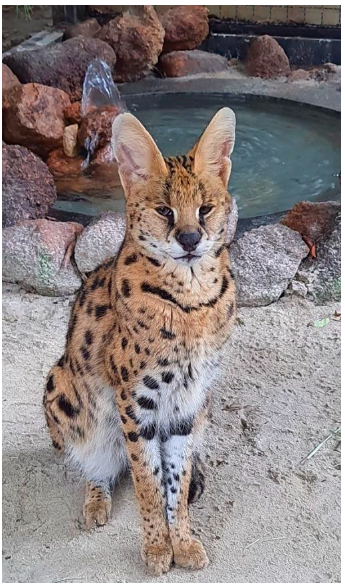
Source: Personal archive. Figure 1: Serval (Leptailurus serval) used in the study of environmental enrichment.
The enclosure consisted of sand substrate, a small grassy area and a few small trees. There was also a pond with fountain, a bed with a metal frame and two mattresses, and a cubic MDF burrow lined with fabric, which was occasionally used as shelter. In addition, the enclosure had wooden platforms on one of the walls and artificial lighting that was active in the period that comprised 5:30 p.m. to 8:00 p.m.
Part of the ceiling was covered by glass plates for protection against rain or wind. The enclosure had two changing areas, one for humans and one for animals. The animal exchange consisted of two corridors with a width of 1.2 m and a height of 0.8 m, with different lengths: a corridor of 12.9 m and another of 10.2 m, as shown in Figure 2.
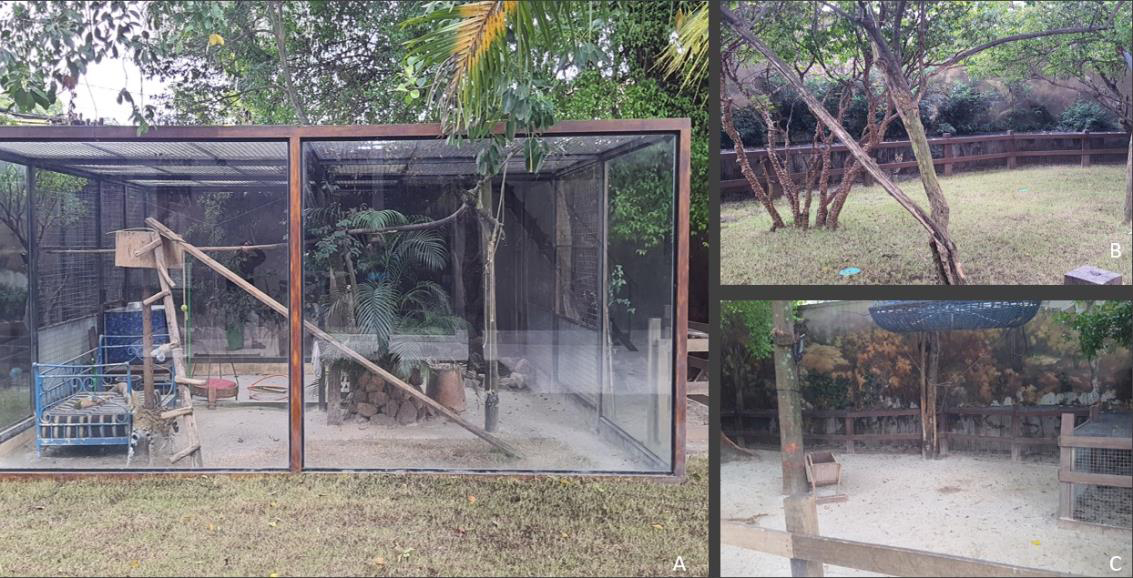
Source: Personal archive. Figure 2: View of the enclosure being respectively, frontal view of the enclosure (A); left animal exchange (B); right animal exchange (C).
Feed was provided twice a day, consisting of portions of raw chicken and super premium feed for adult cats, available at will. The maintenance of the enclosure, including food replenishment, cleaning of the substrate and water source, was carried out by three employees of the property.
Before the beginning of the study, observations of the animal’s behavior in its normal routine for two days were performed. During this observation, behaviors that indicated stress and stereotyping were identified. The animal presented an exacerbated pacing behavior, walking with stereotypy from one side to the other in the enclosure, imitating foraging behaviors in free life. In addition, there was a lack of interest in the interaction with caregivers and the search for food. These behaviors can be attributed to the high movement of people on the property, the presence of other animals nearby, and environmental noises such as the sound of cars, motorcycles, and buildings.
After the observation period, different types of actions aimed at environmental enrichment were planned to be applied in the enclosure. The choice of these actions was based on literature reviews on environmental enrichment practices in wild cats. The types of actions and modifications chosen were focused on olfactory, physical and food stimuli. Second [8], sensory stimuli, which includes the olfactory stimulus, are important for felines since they use their sense of smell to hunt, demarcate territory, and interact with other members of their species.
The stimuli that culminated in the enrichment were performed twice a week, over four months, from February to June. The visits for the application of the enrichment did not follow a fixed schedule, in order not to generate adaptation or habituation [9, 10, 11, 12].
Several odors were used as olfactory stimuli, including natural herbs such as chamomile (Matricaria chamomila), lemon balm (Melissa officinalis), fennel (_Pimpinella anisium), _mint (_Mentha spicata), catnip (Nepeta cataria) and high- _quality type A hay. Each herb was offered on different days through sachets made with fabric and toys. The sachets were hung in less explored areas of the enclosure to increase interest and interaction in those areas. Toys, such as tennis balls, were stuffed with herbs and scattered around the enclosure. Bamboo wands with rope or ribbon were tied to sachets at the tip as shown in Figure 3.
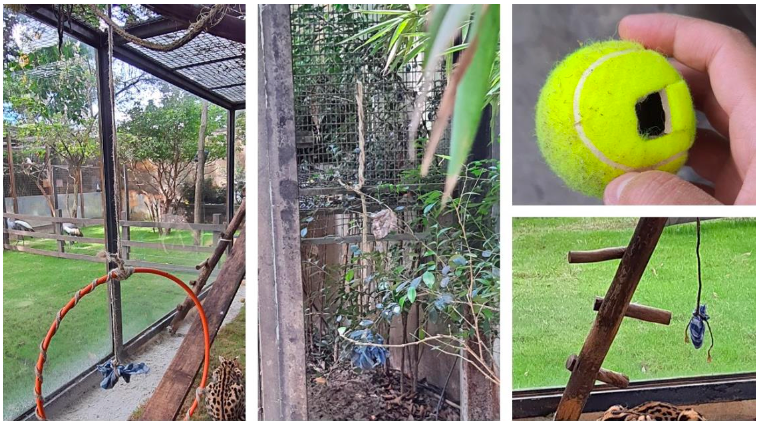
Source: Personal archive Figure 3: Sachets and toys made for olfactory enrichment.
In addition, the sachets were fixed in hula hoops hanging around the enclosure. Hay was used to create beds of different sizes scattered around the enclosure. They were also hidden in stuffed animals already present in the enclosure and tied in hula hoops as shown in Figure 4.
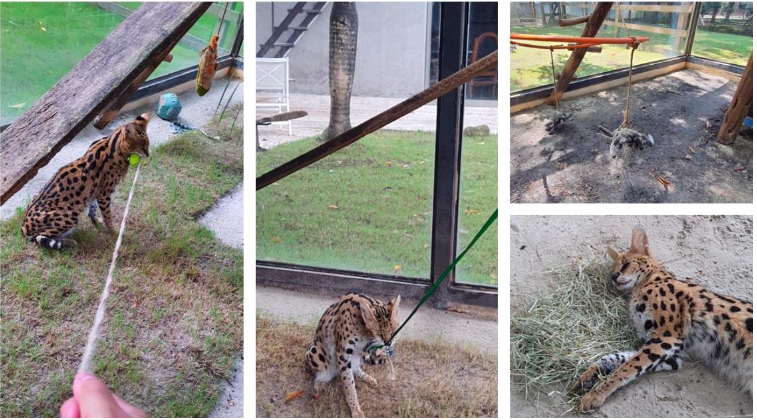
Source: Personal archive Figure 4: Interaction with hay bed, tennis ball, sachet in tape and demonstration of the use of stuffed animals.
Physical and food stimuli were related to sensory stimuli. Second [13], to stimulate hunting behavior, it is necessary to stimulate the sense of smell. For food enrichment, portions of raw chicken were hidden in boxes scattered around the enclosure. Pieces of chicken were wrapped in hay inside a volleyball “carcass,” and pieces of chicken were placed on platforms or tied into ropes to stimulate physical activity.
To encourage the search for food, the liquid resulting from thawing the chicken was collected and used to create tracks that the animal could sniff out during the search for food. In addition, toys were made with sisal rope and tennis balls, a sisal rope scratcher, and tug-of-war and accompanied walking activities were made as complementary physical stimuli, as shown in Figure 5.
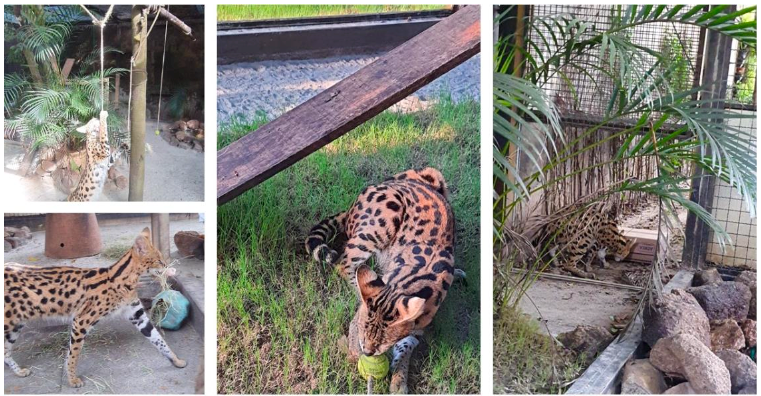
Source: Personal archive Figure 5: Feline seeking and capturing hidden prey; interaction with ball and rope toy.
With the implementation of these environmental enrichments, it was envisaged to provide the animal with sensory, physical and food stimuli in order to promote well- being, reduce stress and minimize stereotyped behaviors. These practices aim to simulate, as far as possible, aspects of the animal’s natural environment, enriching its life in captivity and contributing to its physical and mental health.
Results and Discussion
Among the environmental enrichment stimuli applied, different response patterns were observed. As the study involved only one individual, the interactions were evaluated through categories, which were: “No interaction”, “Low interaction”, “Median interaction”, “High interaction” and “Intense interaction”.
On the first day of assembling the sachets and toys, the feline presented itself reserved, lying in a grassy corner and exhibiting behavior of showing its teeth and “blowing”. As the assembly proceeded, the feline was curious, observing the assembled structures and occasionally smelling them.
The aromas were introduced separately in the enclosure to evaluate the interaction of the feline studied. The first aroma introduced was catnip (Nepeta cataria), known to cause relaxation in domestic felines. The technique of olfactory enrichment with catnip for the reduction of repetitive behaviors has been previously reported by Tucker AO, et al. [14], showing a significant increase in exploratory behaviors. The results of Tucker AO, et al. [14] showed that every time the catnip (Nepeta cataria) was presented to Serval, the same exhibited behaviors of rolling, rubbing, chewing the sachet and, in an isolated case, urinating.
When exposed to chamomile (Matricaria chamomila), there was a median interaction, in which the feline showed interest in the aroma, but without behaviors considered exacerbated or agitated. This can be attributed to the calming effect of chamomile (Matricaria chamomila), which, according to Wells DL, et al. [15], assists in the reduction of repetitive behaviors.
A study of Moss M, et al. [16] showed that the use of mint (Mentha spicata) generates an effect of improved memory and alertness in felines, in addition to the known benefits, such as relief of respiratory symptoms, itching and skin irritations. Our observation was that the Serval had a moderate interaction with the mint, with the animal sniffing, rubbing and chewing the sachet. However, when mint was placed on toys such as tennis balls or sprinkled on plushies, there was no interaction.
Lemon balm (Melissa officinalis) and fennel (Pimpinella anisium) showed low interaction, although both are known for their benefits related to relaxation, anxiety and stress relief. Regarding exposure to type A hay, the interaction was immediate and intense, with behaviors of excessive brushing, chewing and construction of a “bed”.
The interaction with the different odors was categorized into five levels, taking into account the level of interaction with each herb, relating them to stress reduction and repetitive behaviors. These levels of interaction were classified from 1 to 5, being 1-No interaction; 2-Low interaction; 3-Median interaction; 4 - High interaction and 5-Intense interaction.
These levels of interaction can be seen in Graph 1.
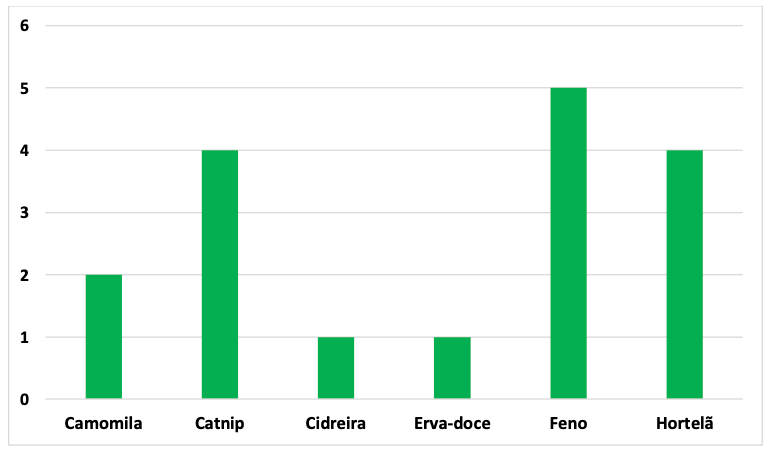
Graph 1: Graph representing the level of interaction of serval (Leptailurus serval) with each herb.
In addition, hay was used as food enrichment, being rolled into chicken portions and hidden in boxes or in a volleyball carcass. Second [17] and [18], the use of “puzzles” to search for food stimulates the foraging and hunting behavior of felines. Because felines are carnivorous and hunter-gatherer animals, the introduction of these activities stimulates their natural behavior, reducing stress levels and compulsive behaviors.
Considering physical enrichment, according to Hoy JM, et al. [8], applications range from the structure of the environment in which the animal inhabits to the introduction of items for interaction. Toys were made using tennis balls, sisal rope, satin ribbon, hula hoops and plushies. Chicken pieces were also offered at different heights to stimulate the behavior of jumping, capturing and manipulating the prey, encouraging the use of the claws for food manipulation. After four months of observation and application of environmental enrichment activities, a decrease in the behavior of pacing After two months and at the end of the four months of the study, this behavior was no longer observed. It was also observed a decrease in reactivity in relation to the presence of the caregivers inside the enclosure and an improvement in the hygiene habit after the stimuli.
Therefore, the results indicate that the introduction of environmental enrichment stimuli, such as different aromas, toys and physical activities, can promote appropriate interactions and behaviors in the studied feline, reducing stress and repetitive behaviors. These interventions can contribute to the welfare and quality of life of the animal in captivity.
The results suggest that the implementation of environmental enrichment stimuli had positive effects on the behavior of the feline studied. The introduction of different aromas, such as catnip, chamomile, mint, lemon balm and fennel, resulted in distinct patterns of interaction. Catnip was shown to be especially effective, promoting behaviors of rolling, rubbing, chewing the sachet and, in one isolated case, urinating. This is in line with previous studies highlighting the relaxing effects of catnip on felines.
Chamomile, known for its calming properties, showed a medium interaction, arousing interest in the feline, but without triggering excitatory behaviors. This effect may be related to the relaxation provided by chamomile, which, according to Wells DL [15], contributes to the reduction of pacing.
Mint, although it has been studied for its possible benefits on memory and alertness, has not resulted in meaningful interaction when placed on toys or plushies. However, the feline demonstrated behaviors of sniffing, rubbing, and chewing the mint sachet, indicating some degree of interest in this herb.
On the other hand, lemon balm and fennel, despite being recognized for their relaxing effects, did not arouse interest in the feline studied. However, when exposed to type A hay, there was an immediate and intense interaction, with behaviors of excessive brushing, chewing and “bed” construction. This suggests that hay may be a highly attractive stimulus for the feline, providing it with comfort and satisfaction.
Regarding physical enrichment, the availability of toys made with tennis balls, sisal rope, satin ribbon, hula hoops and plushies, as well as the offer of chicken pieces at different times, stimulated the natural behavior of the feline, such as jumping, capture and manipulation of prey. These physical activities contributed to the decrease in pacing behavior throughout the study, indicating that physical enrichment was effective in promoting more appropriate behaviors and reducing stress.
The results indicate that the combination of environmental enrichment stimuli, both olfactory and physical, had a positive impact on the behavior of the feline studied. The introduction of different aromas and the availability of toys and stimulating physical activities provided appropriate interactions and more natural behaviors, contributing to the well-being and quality of life of the animal in captivity. These findings underscore the importance of environmental enrichment as an effective strategy in promoting the well-being of cats kept in captivity.
Conclusion
Based on the results and discussion presented, it is concluded that the appropriate application of environmental enrichment stimuli, taking into account the natural behaviors of the serval (Leptailurus serval) and aiming at its well-being, proved to be effective in reducing stress and stereotyped behaviors, such as pacing. The use of different aromas and the availability of toys and stimulating physical activities promoted appropriate interactions and more natural behaviors in the feline studied.
Environmental enrichment has proven to be an indispensable tool for cats kept in captivity, providing significant benefits in terms of animal welfare. By exploring the behavioral and sensory needs of felines, environmental enrichment contributes to the promotion of a more enriching environment by reducing the stress associated with stimulus deprivation and confinement.
These findings highlight the importance of implementing environmental enrichment strategies in captive cat management programs, seeking to offer conditions that stimulate natural behaviors, reduce stress and improve the quality of life of these animals. The application of appropriate stimuli, both olfactory and physical, can be an effective approach to meet behavioral needs and provide well-being to felines kept in captivity.
However, it is important to note that each individual may respond differently to enrichment stimuli, so it is necessary to consider individual characteristics and adjust the stimuli according to the specific needs of each animal. In addition, additional studies are needed to assess the long-term effects of environmental enrichment and identify even more effective strategies to promote the well-being of captive cats.
In short, the results of this study highlight the relevance of environmental enrichment as a fundamental approach in the management of cats in captivity, demonstrating its effectiveness in reducing stress and stereotyped behaviors. The implementation of appropriate and personalized environmental enrichment practices is essential to provide an enriching environment, promoting the welfare and quality of life of these animals.
References
-
Claxton AM (2011) The potential of the human–animal relationship as an environmental enrichment for the welfare of zoo-housed animals. Applied Animal Behaviour Science 133(1): 1-10.
-
da Silva TBB, de Abreu JB, Godoy AC, Carpi LCFG (2014) Environmental enrichment for cats in captivity. Environmental Health Minutes-ASA 2(3): 44-52.
-
Azevedo CS, Barçante L (2018) Environmental enrichment in zoos: in search of animal welfare. Brazilian Journal of Zoosciences 19(2).
-
Bashaw MJ, Kelling AS, Bloomsmith MA, Maple TL (2007) Environmental effects on the behavior of zoo- housed lions and tigers, with a case study of the effects of a visual barrier on pacing. Appl J Anim Welf Sci 10(2): 95-109.
-
Ricci GD, White CH, Sousa RT, Titto CG (2018) Effect Of Different Environmental Enrichment Techniques In Captivity Of Cougars (Puma Concolor). Ciênc anim bras 19(0).
-
Fukushima AR, Ricci EL, Queiroz AES, Bueno LL, Bernardi MMS, et al. (2019) Comparative analysis of the behavior of the maned wolf (chrysocyon brachyurus) in captiveiro: a proposal for environmental enrichment 12(2): 32-32.
-
Radical A, Norman S, Ponzio P, Bono L, Macchi E (2023) The effects of the addition of two environmental enrichments on the behavior and fecal cortisol levels of three small felids species (Caracal caracal, Leptailurus serval, Leopardus pardalis) in captivity. Journal of Veterinary Behavior 60: 56-64.
-
Hoy JM, Murray PJ, Tribe A (2010) Thirty years later: enrichment practices for captive mammals. Biol Zoo 29(3): 303-316.
-
Damasceno J (2018) Environmental Enrichment for Cats in Captivity: Classification of Techniques, Challenges, and Future Directions. Brazilian Journal of Zoosciences 19(2).
-
Hashimoto CY (2008) Behavior in captivity and testing of the effectiveness of environmental enrichment techniques (physical and feeding) for ocelots (Leopardus pardalis) University of São Paulo.
-
(2023) Aline Zanini Carpes.
-
Veloso ACG (2020) Environmental Enrichment in Captive Animals.
-
Camargo JRP, Nascimento ÉL, Santos-Prezoto HH (2014) Techniques of environmental enrichment of bush cat leopardus guttulus (schreber, 1775), in captivity: a case study. CES Magazine 28(1): 169-179.
-
Tucker AO, Tucker SS (1988) Catnip and the catnip response. Econ Bot 42(2): 214-231.
-
Wells DL (2009) Sensory stimulation as environmental enrichment for captive animals: A review. Applied Animal Behaviour Science 118(1-2): 1-11.
-
Moss M, Hewitt S, Moss L, Wesnes K (2008) Modulation of cognitive performance and mood by aromas of peppermint and ylang-ylang. Int J Neurosci 118(1): 59- 77.
-
Resende L de S, Pedretti Gomes KC, Andriolo A, Genaro G, Remy GL (2011) Influence of cinnamon and catnip on the stereotypical pacing of oncilla cats (Leopardus tigrinus) in captivity. J Appl Anim Welf Sci 14(3): 247-254.
-
Jenny S, Schmid H (2002) Effect of feeding boxes on the behavior of stereotyping Amur tigers (Panthera tigris altaica) in the Zurich Zoo, Zurich, Switzerland. Zoo biology 21(6): 573-584.
- Mitochondrial Bio-Logistics: Steering Co-Enzyme Q10 and Lycopene Synergies within the Science 4.0 Bio-OS Framework
- Hymenoptera Specimens from the Caño Negro Wetland, of the National Museum Collection, Costa Rica
- Science 4.0: Comprehensive Architecture of the Biological Operating System (Bio-OS) A Framework for Systemic Resilience and Industrialized Bio-Governance
- Rabbit on, or Hare Back? Understanding Climate Change
- Clinical Validation of Science 4.0: Flow Steering and Epigenetic Drift Inversion on a 76-Year-Old Hybrid System
- Seeds Planted by another Mind