
First Observation of an Albino Crested Porcupine Hystrix cristata Linnaeus, 1758 (Mammalia: Rodentia) in Algeria
In the Northwest of Algeria a specimen of the crested porcupine Hystrix cristata Linnaeus, 1758 (Mammalia Rodentia) was observed, captured and photographed in the forest of Toumiet department of Sidi Bel Abbes. The specimen was completely albinos and this is the first time we see this phenomenon in a porcupine in Algeria.
Introduction
Albinism is the congenital absence of melanin in an animal or plant resulting in white hair, feathers, scales and skin and pink or blue eyes. People with the disease are called albinos. [1]. Among mammals it has been described in squirrels (Sciurus carolinensis) and Jeffery [2] claimed that squirrels are the only known albino mammal to survive successfully in the wild. Mahabal A, et al. [3] researching albino mammals in India reported that there were several records including tiger, lesser mouse-tailed bat, chital, common palm civet, northern palm squirrel, five-banded palm squirrel, and wild boar.
The crested porcupine is native to regions of northern Africa as well as southern Europe and areas of the Mediterranean. There is only one species of porcupine in the old world [4]. It is present in Africa: South Sahara, Great Lakes regions (East Africa) and North Africa [5], it is also found in Europe (Southern Italy, Sicily). Indeed the crested porcupine populations exist in Algeria, Benin, Burkina Faso, Cameroon, Chad, Ivory Coast, Eritrea, Ethiopia, Gambia, Ghana, Guinea- Bessau, Kenya, Liberia, Libya, Mali, Mauritania, Morocco, Namidia, Niger, Nigeria, Rwanda, Senegal, Sierra Leone, Somalia, Sudan, Tanzania, Togo, Tunisia, Italy, Iraq, Israel, Jordan. On the other hand, it may be extinct in Egypt and an uncertain presence in the Central African Republic, Congo, Democratic Republic of Congo [6, 7, 8, 9, 10].
It is a largest rodent, the hind part of its back is covered with long sharp spines white at their tips and banded with black colour. The adult animal weight is about 18kg and has few natural predators [11, 12, 13]. The structure of the rattle quills in its short tail is shaken to frighten enemies and may be in social communication, which produces a loud rattling sound so they strike against each other [14]. It is a nocturnal land animal, which takes refuge during the day in deep burrows or hollows in the rocks where it raises its offspring.
It looks for its food alone and can cover great distances for this purpose, occasionally helping itself in the fields. Its diet is indeed herbivorous, based on roots and tubers, supplemented with bark and fallen fruit and it can live more than 21 years in captivity.
In Algeria the porcupine inhabits the whole northern belt from the seaside to the Saharan Atlas and Aures in the south. In the west its range extends further to the south along the Moroccan border, reaching in Bechar. He does not live in the true desert [15].
For Barthelmess EL [16] cited in the Hystrix africae australis, was the first to mention the albinism on porcupine in the territory of Ex-Rhodesia (today Zimbawe). More recently, the first reported sighting of an albino porcupine was made in Quebec in the county of Rawdon (Canada ) in 2015 where Julie Caillard made a video posted on the facebook page Sentier Chasse-peche (https://www.facebook. com/magazine.sentier).
In 2017 Grano M [17] report the discovery of some white quills belonging to the crested porcupine Hystrix cristata from Sabini Mountains (Central Italy) and they hypothesize the leucism or albinism of the individual.
In 2020 also in Canada, Radio Canada reported that a couple traveling on the Alaska Highway near Morley River in the Yukon saw an albino porcupine [18]. Holly Palmer, the person who observed it, she saw many porcupines all brown or black and this is the first time she has seen a cream-colored porcupine. And in 2022, the Northern Lights Wildlife Society, an animal sanctuary in Smithers about 370 kilometers northwest of Prince George, British Columbia rescued a rare baby albino porcupine. It was the first time that an albino porcupine has been taken in by this refuge since it’s commissioning in 1989 and for [18] the probability that a mammal such as a porcupine develops the Albinism is extremely low, ranging from one in 20,000 to one in a million. The latter author also distinguishes albinism from color polymorphism, a genetic phenomenon where melanin is deposited in the animal’s skin and eyes, but not in its fur.
Material and Methods
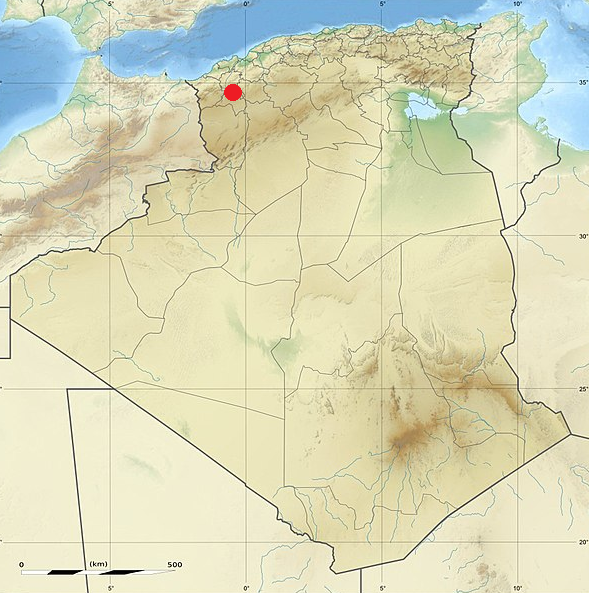
Sidi bel abbes is a department located at 441 kilometers west of Algiers in Algeria, it is an agro-sylvo-pastoral region and there are forests of Aleppo pine (Pinus halepensis) with a dense undergrowth of Heather (Erica arborea), steppe (Stippa tenansissima). In 2023 by doing fieldwork with foresters in the forest of Toumiet situated in the south of the canton of Teniet Tag dependent on the commune of Telagh (34.74342° N – 0.596513° W) and at an altitude of 1014 meters, we encountered an albino specimen of crested porcupine, and Habibellah Benhamou took pictures with his Camera (Canon D200 - Zoom 18-75). We examined the individual and released him.
Results and Conclusion
The specimen of porcupine captured was a female adult, for the first time in Algeria and north Africa. She was a healthy adult female and she was albino and not leucistic. His eyes were pink and his whole body was white and the quills were white from end to end.
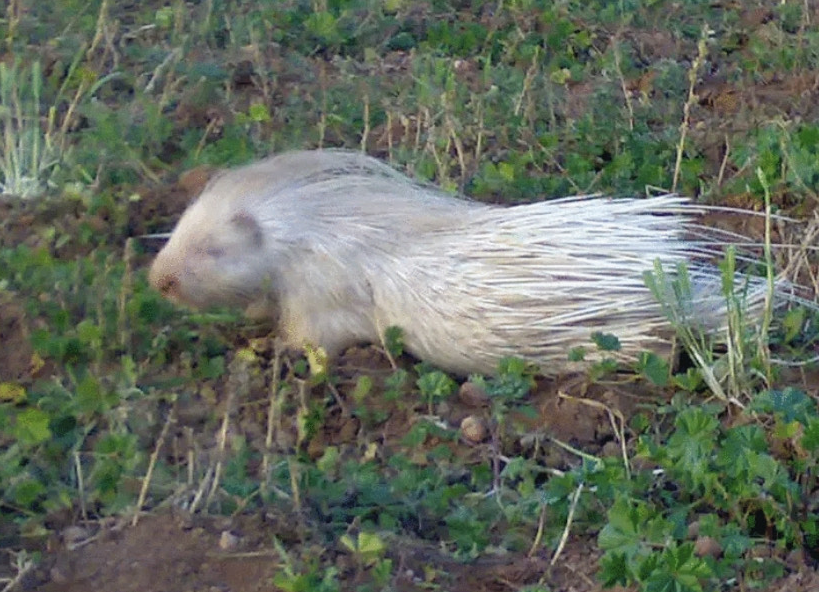
Albinism in mammals is a known and fairly common phenomenon [17, 19, 20] . In the case of Hystrix cristata there are no observations of albino or leucistic individuals in nature apart from the citation relating to the Hystrix africae australis [16] in the territory of Ex-Rhodesia (today Zimbabwe), captured close to Chiredzi River, and kept at the National Museum of Bulawayo [21]. The only known albino individuals of H. cristata are bred in captivity by private breeders and / or by the Olmen Zoo in Belgium. Obviously, albino individuals are unfavorably selected and their life expectancy in nature would seem very low, either by low vitality, great sensibility to sunlight, difficulty in intraspecific interactions, or by a clear disadvantage respect to predators [22]. The specimens suffering from leucism, which can be considered as a low level of partial albinism, don’t have red eyes, and the individual is neither weak nor particularly sensitive to sunlight and heat [22].
Our observation, considered rare, encourages us to do more prospecting work on the porcupine and to know if there are other albino individuals and this will allow us to undertake more investigations on albinism in rodents and especially in porcupine which is currently threatened in Algeria by hunting and poisoning by farmers.
Acknowledgements
We would like to thank everyone who helped to write this manuscript and especially those who corrected the English (Susanne Chapelle).This work has not been funded and has not received any funds.
References
-
Oetting WS, Adams D (2018) Albinisme: Génétique. John Wiley & Sons, Ltd.
-
Jeffery G (1998) Reduced retinal deficits in an albino mammal with a cone rich retina: A study of the ganglion cell layer at the area centralis of pigmented and albino grey squirrels. Vision Research 38 (6): 937-940.
-
Mahabal A, Rane PD, Sask P (2012) Un cas d’albinisme total chez le Bonnet Macaque Macaca radiata (Geoffroy) de Goa. Journal imprimé des zoos 27(12): 22.
-
Mohamed WF (2011) The crested porcupine, Hystrix cristata (Linnaeus, 1758) in Misurata, Libya. Journal of Ecology and the Natural Environment 3(7): 228-231.
-
Mouzoun S (2018) Ecologie et connaissances ethnozoologiques du porc-épic à crete ( Hystrix cristata Linnaeus, 1758 ) dans les reserves de biosphere de la Pendjari et du W du Benian. Zoologie des Vertebrés. Université d’Abomey-Calavi (Benin).
-
Osborn DJ, Helmy I (1980) The contemporary mammals of Egypt (Including Sinai). Fieldiana Zoology. Museum of Natural History, Bethseda, Maryland, USA, pp: 579.
-
Amori G, Angelici FM (1999) Distribution of the crested porcupine Hystrix cristata L.,1758 in peninsular Italy and Sicily. Boll Mus Reg Sci Torino 16: 83-88.
-
Cuzin F (2003) Les grands mammiferes du Maroc méridional (Haut Atlas, Anti Atlas et Sahara) : Distribution, Ecologie et Conservation. PhD Thesis. Laboratoire de Biogeographie et Ecologie des Vertebrés. Ecole Pratique des Hautes Etudes. Université de Montpellier II pp: 347.
-
Grubb P, Amori G, De Smet K, Bertolino S (2008) Hystrix cristata. In IUCN.2012.Liste Rouge de l’UICN des especes menacées. www.uicnredlist.org.
-
Amori G, De Smet K (2016) Hystrix cristata. The IUCN Red List of Threatned Species, pp: 9.
-
Walker EP (1999) Walker’s Mammals of the World. 6th edition, edited by Ronald M. Nowak. John Hopkins University Press, Baltimore pp: 1004-1009.
-
Hufnagl E (1972) Libyan mammals. The Oleander Press, England, UK, pp: 85.
-
Macdonald DW (2006) The Encyclopedia of Mammals. In: 2nd (Edn.), Oxford University Press, pp: 930.
-
Santini L (1980) The habits and influence on the environment of the old world porcupine Hystrix cristata L. in the northernmost part of its range. Vertebrate Pest Conference Proceedings Collection, Proceedings of the 9th Vertebrate Pest Conference pp: 149-153.
-
Kowalski K, Rzebick-Kowalska B (1991) Mammals of Algeria. Polish Academy of Sciences.Institute of Systematics and Evolution of Animals pp: 353.
-
Barthelmess, EL (2006) Hystrix africaeaustralis. Mammalian Species 2006(788): 1-7.
-
Grano M, Angelici FM (2017) Discovery of some white quills of the crested porcupine Hystrix cristata (Linnaeus, 1758) (Mammalia Rodentia). Biodiversity Journal 8(4): 885-887.
-
Otter K (2022) Albino porcupine rescued in northwest British Colombie (Canada). University of the north of British Colombie.
-
Jones SVH (1920) Color variations in wild animals. Journal of Mammalogy 4: 172-177.
-
Caro T (2005) The adaptive significance of coloration in mammals. Bioscience 55: 125-136.
-
Mohr E (1965) Altweltliche Stachelschweine. A. Ziemsen Verlag, Wittenberg Lutherstadt pp: 164.
-
McCardle H (2012) Albinism in wild vertebrates. Master Thesis, Texas State University-San Marcos, pp: 82.
- Mitochondrial Bio-Logistics: Steering Co-Enzyme Q10 and Lycopene Synergies within the Science 4.0 Bio-OS Framework
- Hymenoptera Specimens from the Caño Negro Wetland, of the National Museum Collection, Costa Rica
- Science 4.0: Comprehensive Architecture of the Biological Operating System (Bio-OS) A Framework for Systemic Resilience and Industrialized Bio-Governance
- Rabbit on, or Hare Back? Understanding Climate Change
- Clinical Validation of Science 4.0: Flow Steering and Epigenetic Drift Inversion on a 76-Year-Old Hybrid System
- Seeds Planted by another Mind