
Further Information about the Nest, Eggs and Nestlings of the Copper-Rumped Hummingbird Saucerottia tobaci from Venezuela
The Copper-rumped Hummingbird Saucerottia tobaci is a polyphyletic hummingbird with seven recognized subspecies. Nonetheless, the most information on its nesting behavior come from the island race S. t. erythronotos. This study aims to describe a nesting event of S. t. feliciae, the most widespread mainland subspecies, in order to provide detailed information on its nest structure, eggs and nestling development, as well as report information related to the nesting success (survival strategies, potential threats), based on observations carried out from August to October 2021 in northern Venezuela. Features of nest (composition, form, dimensions), eggs (appearance, dimensions, mass) and nestling development data from hatching to fledging time (body length, bill, wings, tail, and body mass) were all recorded in detail. The nest was an open saddle-type, cream in color, built of silky vegetable down, silky fibers of moth cocoon, mossy stuffs, pieces of lichen and spider’s web. Nest dimensions (mm): outer-cup depth: 40.7; inner-cup depth: 18.0; base-bed: 22.7; cup-rim thickness: 10.0–12.0; cup-rim length: 40.4; cup-rim wide: 18.4. Two oval-shaped eggs were laid inside, white in color, without spots or blots, smooth in texture, and non-glossy. Egg mass (0.6 ± 0 g; n = 2), egg length (13.95 ± 0.07 mm; n = 2), egg width (9.4 ± 0.14 mm; n = 2). Both eggs were incubated during 16 days. Nestlings were born almost completely naked, dark skin above, reddish beige below; bill yellow with the tip red and blunt; eyes closed. Nestling body mass at hatching (0.6 ± 0 g, n = 2), fledgling period (23 days). First feather barbs (day 10), eyes open (day 10), nestling totally feathered (day 16), and nestling body mass at fledging (4.7 g, n = 1). Survival strategies were nest camouflage, roof protection, female motionlessness, distraction displays and mobbing behavior. The nest was also close to a bumblebee nest and an artificial feeder. Potential threats included nest predators and heavy rains. This study introduces novel information on nesting behavior of a mainland subspecies and suggests that S. t. feliciae resembles S. t. erythronotos with slight differences in terms of nest construction, and eggs mass and length. Data on other nests, including those of other Venezuelan subspecies, are necessary to fully categorize the nesting behavior of this hummingbird in order to identify critical subspecific elements (e. g. nest materials, nestling´s food, human impact, additional nest predators and parasites) needed for its conservation in future.
Introduction
The Copper-rumped Hummingbird Saucerottia tobaci is a typical glossy green hummingbird characterized by the lower back and rumped bronzy brown (=copper); under tail coverts reddish brown to cinnamon rufous; tail forked, very dark shinning blue; upper mandible dusky and the lower mandible flesh colored with dark tip [1]. With seven subspecies distributed between Trinidad (S. t. erythronotos), Tobago (S. t. tobaci) and Venezuela (S. t. feliciae, S. t. monticola, S. t. caudata, S. t. aliciae and S. t. caurensis) [1, 2, 3], this hummingbird mainly dwells in tropical and lower subtropical zones of continental Venezuela from sea level up to 1,800m where it inhabits fairly dry to humid zones almost anywhere there are suitable flowers including thorny scrub, deciduous forest, humid forests (rainy, cloud, gallery), forest edges, second growth, llanos and other savannas with scattered trees, as well as highly perturbed areas such as urban zones, parks, gardens, shadow (coffee, cacao) and sunny (citrus, peach) plantations [1, 4, 5, 6]. Regarding to nesting behavior, the foremost information come from Trinidad and Tobago where the nest, eggs and nestling development of the S. t. erythronotos subspecies have been described exhaustively [7, 8, 9, 10, 11]. According to Herklots GAC [10], the nest is a saddle-type usually situated in the fork of a small tree or scrub, built of silky vegetable down ornamented with large pieces of lichen and spider’s web. Other materials including coconut fiber, scales of young fern leaves, downy seeds of Asclepias (Apocynaceae), moss, and dead moss-like matter probably Selaginella (Selaginellaceae) [7, 8]. Inside, the nest is lined with cotton and some loose fern-frond scales at the bottom [7]. There, the female laid two white eggs 13.0 x 8.5 millimeters [9, 10, 11] of 7.5 grains (=0,49 g) [8]. Additional information [2, 7, 8, 11] indicates the nest is built 1–3 meters above ground, sometimes up to six meters, and occasionally found on wires and clothes-lines. Also, the incubation takes 16–19 days, fledging period 19–23 days, with 2–3 broods/ season at intervals of one week to one month [2, 11].
In spite of the widespread distribution in Venezuela, detailed information about the nesting behavior of the Copper-rumped Hummingbird is poorly known in mainland races [2]. Indeed, the nest has been barely described in the country as a downy cup saddled on a branch [12] or twig, usually not too high. In addition, Robinson W, et al. [12] inform that S. t. feliciae robs portions of the nest’s lining belonging to a Phaethornis hummingbird to build its own. In this sense, this study aims to describe a nesting event of S. t. feliciae, the most widespread mainland subspecies, in order to: a) provide detailed information about its nest (composition, form, dimensions) and eggs (appearance, dimensions, mass); b) to describe the nestling development in terms of biometric and body mass data, as well as plumage development from hatching to fledging time; c) to report information associated to the nesting success, such as survival strategies and potential threats.
Methods
The Copper-rumped Hummingbird nest was located in Los Naranjos farm, a disturbed area on the Coastal Mountain Range, southeastern suburbs of Caracas, El Hatillo County, Miranda state, northern Venezuela (10°26’’ North, 66°47’ West; ±900 m a.s.l.). This locality was previously described by Verea C [13] as a pastureland with scattered fruit trees (citrus, banana, and avocado) and few resident houses. A little creek (Quebrada Santa Rosa) runs close from the nest site (less than 25 m) where trees of Fabaceae, Burseraceae, and Cecropiaceae reach up to 30 m tall. Also, shrubbery plants of Asteraceae, Caricaceae, and Heliconiaceae are present. According to taxonomic and distribution literature [1, 14] the subspecies studied correspond to S. t. feliciae.
Eggs and nest dimensions (outer-cup depth; base-bed; cup-rims thickness; cup-rim length; cup-rim wide) were taken with a plastic dial caliper Spi 31-415-3 model (0.1 mm readability), whereas the inner-cup depth with a metallic rule (1.0 mm readability). The mass of the eggs and nestlings were taken with an electronic precision balance Acculab EC- 211 model (0.1 g readability). Detailed notes on the nestlings’ development were collected on a daily basis. Eggs and naked nestling were removed from the nest with a metal spoon, previously sterilized with 100% ethylic alcohol. Once the nestlings were feathered, with eyes open, they were removed by hand. Notes were taken at 08:30 h every morning, including body mass and nestlings’ anatomy dimensions (total length, bill, wings, and tail). Total length was the distance between the bill tip and tail, feathered or not; bill length between the base and the bill tip (culmen); and tail length between the base and tail tip of the two central feathers. Notes on particular events of the nestlings’ development were recorded, including days when the pterylae were noticeable, the feather papillae opened, the eyes opened, among others. A photographic sequence of nestling development was also recorded. In addition, survival strategies (e. g. nest camouflage) and potential threats (e. g. nest predator, heavy rain) were documented. Most survival strategies derived from hummingbird-observer interactions. I took notes on the female behavior when I was approaching the nest or handling the nestlings. Advantages associated to nest location (e. g. food resource proximity, protection structures for sunlight/rain, camouflage, others) were also recorded. In addition, I spent 45 minutes after nest/nestling data collecting (08:45–09:30 h), and 45 minutes at afternoon hours (17:00–17:45 h) recording potential predators that explored the nest´s tree, or marauded 10 m from the nest. Records by chance were not discarded. Potential predators were based on personal knowledge or previously reported in literature [15, 16]. Records of rain were taken randomly, and only when its intensity and winds were capable to move the branch that held the nest. The information obtained was compared with previous data from Trinidad [8, 9, 11] in order to establish potential differences with the island subspecies S. t. erythronotos. Most literature associated to the Copper- rumped Hummingbird nesting was provided by Matta-Pereira M, et al. [18].
Results
On 31 August 2021, an incomplete nest was discovered while the female was decorating with lichen the outer walls. The nest was an open saddle-type located on the ending fork of an avocado Persea americana tree, 1.8 m above the ground, built of silky vegetable down, silky fibers of moth cocoon, cream in color, with a few intermixed black mossy stuffs, and externally camouflaged with large pieces of flat greenish lichen and spider’s web. Over the nest, an assemblage of seven avocado leaves was working as a natural roof protecting the nest against sunlight and rain, and hid it from potential predators (Figure 1). Nest dimensions were (mm): outer-cup depth: 40.7; inner-cup depth: 18.0; base-bed: 22.7; cup-rim thickness: 10.0–12.1; cup-rim length: 40.4; cup-rim wide: 18.4 (Figures 1a,b). Once the nest was finished, one egg appeared 48 h later (02 Sep 2021), and a second one was laid 48 h afterwards (04 Sep) (Figures 2a,b). Both eggs were oval-shaped, white in color, without spots or blots, smooth in texture, and non-glossy. The eggs were weighed and measured on the day of lying. Egg dimensions were (mm): 13.9 x 9.3 and 14.0 x 9.5; with a mass of 0.6 g each. Between the laying of the first egg and the second one, the female never laid to incubate. The first 48 hours after lying, the female behave restless and any sound or immediate movement quickly scares her out of the nest. Both eggs hatched on 20 September 2021, after 16 days of incubation; the newly- hatched nestlings had body mass of 0.6 g each, and left the nest 23 days later, on 12 October. They were born almost completely naked, with only a cuff of hair-like neossoptiles on back; dark skin above, reddish beige below; bill yellow with the tip red and blunt, and eyes were completely closed (Figure 3a). They show an innate natural reflex that strongly keeps their toes curled, securing the nestlings to the silky cotton-like threads of the nest bottom. The female feed the nestlings from hatching day and brooded them the firsts nine days only. From day 13 they were difficult re-entry in the nest. On the 17th day at afternoon time, one of the nestlings was missing. Because of this, I decided collect data only two additional days (20 and 22) to avoid the loss of the remain nestling. The last two days in the nest (22, 23), the nestling became restless, alert on each surroundings event (sounds, human movements). It also flapped continuously the wings and preened its feathers. On the 23rd day, early morning (08:00 h), the nestling was perched on the nest´s border, flapping continuously the wings. Suddenly, it left the nest at 10:00 h with a heavy flight, landing at the base of a shrub six meters away. It was nervously followed by the female. After that, I never saw them again. Table 1 shows a dataset on the nest, egg and nestling of the S. t. feliciae of Venezuela compared with S. t. erythronotos from Trinidad. Most data of S. t. feliciae match with those previously recognized for S. t. erythronotos, but the inner-cup in the nest studied was less deep. Also, eggs of S. t. feliciae were slightly larger and heavier than S. t. erythronotos.
| S. t. feliciae(Present study) | S. t. erythronotos(Muir and Butler 1925) | S. t. erythronotos(Williams 1922) | S. t. erythronotos(Belcher and Smoker 1936) | S. t. erythronotos(ffrench 1991) | |
|---|---|---|---|---|---|
| Outer-cup depth (mm) | 40.7 | 42 | 44.5 | 40 | - |
| Cup-rim length (mm) | 40.5 | 46 | 44.5 | - | - |
| Cup-rim wide (mm) | 28.4 | 29 | 25.4 | 24 | - |
| Cup-rim thickness (mm) | 10.4–12.1 | 17.0* | 19.1* | - | - |
| Inner-cup depth (mm) | 18 | 30 | 25.4 | - | - |
| High from ground (m) | 1.8 | 1.35 | - | - | 1.0–3.0 (odd 6.0) |
| Support plant | Avocado | Rose-tree | Bamboo | - | - |
| Egg dimension (mm) | 13.9 x 9.3; 14.0 x 9.5 | - | - | 13.0 x 8.5 | 13.0 x 8.5 |
| Egg mass (g) | 0.6 g (n=2) | 0.49 g (n=1) | - | - | - |
| Nestling mass (g) | 0.6 g | 0.49 g; 0.46 g | - | - | - |
| Time between laying (h) | 48 | 48 | - | - | - |
| Incubation period (days) | 16 | 19 | - | - | 16–17 |
| First feather report (days) | 8 | 7 | - | - | - |
| Eyes ligthly open (days) | 9 | 8 | - | - | - |
| Eyes open (days) | 10 | 10 | - | - | - |
| Fledgling period (days) | 23 | 22 | - | - | 19–23 |
Table 1: ** General data on nest, egg and nestling of the Saucerottia tobaci feliciae collected in Venezuela compared with simila
* Cup-rim thickness = Cup-rim length - Cup-rim wide. ( - ) Information not provided. Table 1: General data on nest, egg and nestling of the Saucerottia tobaci feliciae collected in Venezuela compared with similar information observed by other authors on S. t. erythronotos from Trinidad and Tobago.
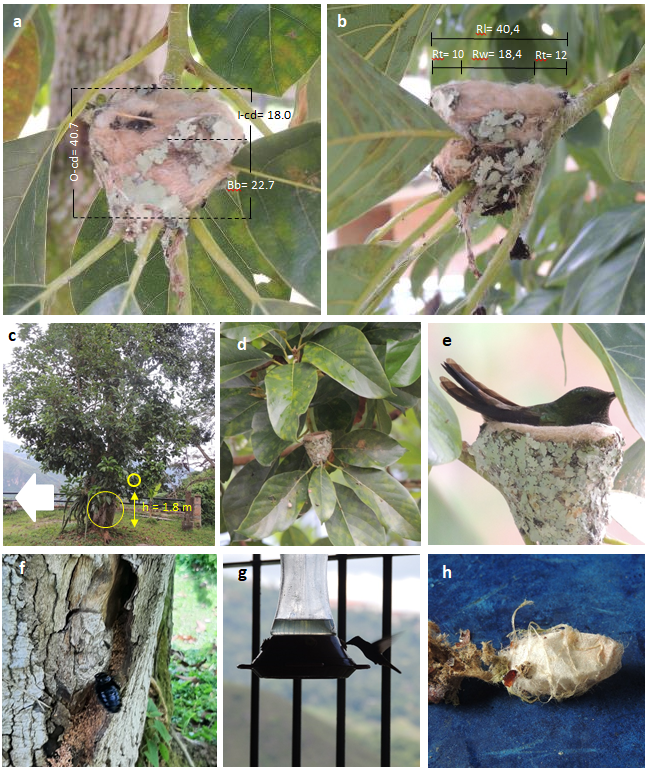
Figure 1: Copper-rumped Hummingbird Saucerottia tobaci feliciae nest measures (mm): a, front view; b, back view. Nomenclature: Outer-cup depth (O-cd); Inner-cup depth (I-cd); Base-bed (Bb); Cup-rims thickness (Rt); Cup-rim length (Rl); Cup-rim wide (Rw); c, nest support plant, an avocado tree Persea americana. The small circle indicates the hummingbird´s nest site (h =height from the ground) whereas large circle the bumblebee nest position, 1.5 m apart. The white arrow shows the route direction toward the artificial feeder, 10 m apart; d, the nest under an arrangement of leaves (roof); e, motionless female incubating hidden under the roof; f, the bumblebee nest entrance with an insect arriving; g, female feeding at the artificial feeder; h, remains of the moth cocoon used by the hummingbird as material to build its nest. Photos: C. Verea.
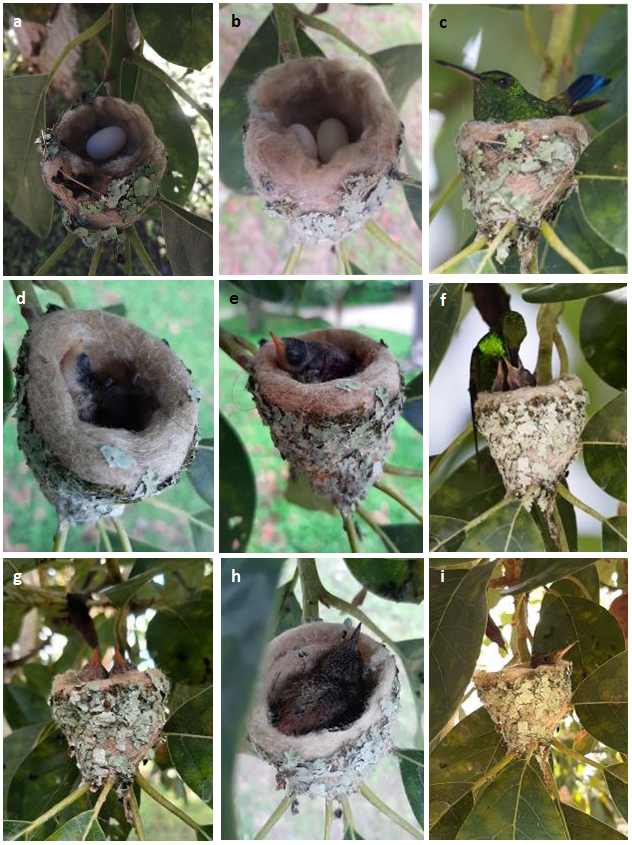
Figure 2: Copper-rumped Hummingbird Saucerottia tobaci feliciae nesting sequence: a, first egg 02 September 2021; b, second egg 04 September 2021; c, female incubating; d, hatching day 20 September 2021; e, nestlings on the 9th day; f, female feeding the nestlings (day 12); g, nestlings on the 14th day; h, one nestling remains in nest (day18); i, nestling on the 21st day, two days before left the nest. Photos: C, O. Hernández; F, E. Pescador; others, C. Verea.
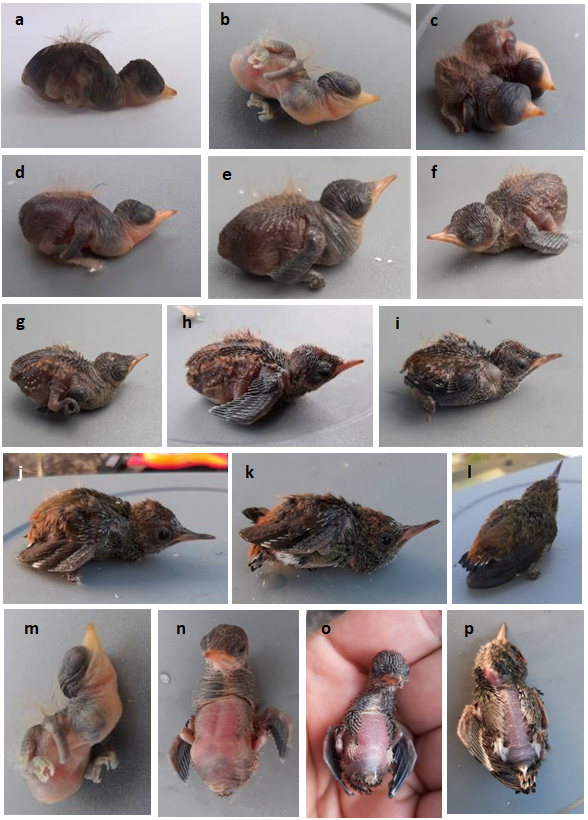
Figure 3: Copper-rumped Hummingbird Saucerottia tobaci feliciae nestling development sequence. Dorsal view: a–c, first nestling days (1–3 respectively): naked, eyes closed, bill yellow with red tip, skin dark above, reddish beige below; a cuff of brown neossoptiles on back; d, dorsal pterylae appear (day 5); e, feather papillae acuminate (day 8); f, eyes half-closed (day 9); g, most dorsal papillae acuminate (day 10); h, most dorsal papillae brush-like aspect and wing papillae enlarged (day 11); i, dorsal papillae slightly green with movement (day 13); j, nestling totally feathered (day 16); k, cooper rump appear (day 18); l, wing feathers fully developed (day 20). Ventral view: m, skin totally naked (days 1–5); n, pterylae appear (day 8); o, ventral papillae enlarged and acuminate (day 10); p, only natural ventral apteria visible, nestlings fully feathered; tail feathers brush- like aspect. Photos: C. Verea.
Besides nest camouflage and roof protection, other survival strategies included female motionlessness, distraction display and mobbing behavior. Also, the nest was located 1.5 m from a bumblebee Xylocopa (Apidae) nest on same avocado tree and 10 m from an artificial feeder (Figure 1).
Potential threats included three nest predators: Squirrel Cuckoo Piaya cayana, Great Kiskadee Pitangus sulphuratus and Crested Oropendola Psarocolius decumanus; and four heavy rains were documented: 08/09/2021 (22 minutes), 20/09/2021 (35 minutes), 22/09/2021 (40 minutes) and 24/09/2021 (20 minutes).
Discussion
With the exceptions of the Blue-tailed Emerald Chlorostilbon mellisugus [19], the Sooty-capped Hermit Phaethornis augusti [13] and the present study, no other Trochilidae species has a complete and detailed information on the nest, eggs, and nestling development in Venezuela. Likewise, the insufficient information on the nests in other Saucerottia species, such as S. viridigaster [20] and S. saucerottei [21], become the Copper-rumped Hummingbird the species better understood in terms of nest and nesting behavior into its genre.
Even though the nest of S. t. feliciae resulted similar from those of S. t. erythronotos described by several authors in Trinidad and Tobago [7, 8, 9, 10, 11], the external appearance better matches with that described by Belcher C, et al. [9] according to color (cream) and decoration (intermixed dark stuff and externally covered with flat lichen). Compared with S. t. erythronotos, the nest studied resulted similar in size but the inner-cup less deep, and without other material inside more than downy cotton-like fiber. Aveledo-Hostos R [22] also reports feathers in the nest of S. t. feliciae from Venezuela. My observations included silk fibers of moth cocoon, a nest material not previously informed. I observed the female to collect it from two different cocoons to then add it to the nest. A similar material, silk fibers of spider cocoon, is considered an important component in bird nests, including Trochilidae species [23].
The nesting behavior of S. t. feliciae differed in some aspects from S. t. erythronotos. Contrary to my observations, Muir A, et al. [8] reported the eggs´ lying before the adding of the external decoration of lichen to the nest. But it was probably a coincidence. The female studied applied pieces of lichens to the exterior of the nest before and after the eggs’ lying. Some of them were even moved continuously from one place to other throughout the five initial days of incubation. Thomas BT [19] observed similar behavior on the Blue- tailed Emerald. Due to lichen flakes are important for nest camouflage [21], lichen movements might be interpreted as an adjustment of the nest’s cover-up.
Eggs of S. t. feliciae were slightly larger and heavier than S. t. erythronotos. These eggs resemble those of Sooty-capped Hermit with 0.6 g and 14.0 mm length [13]. Since this hermit is larger and heavy (130 mm; 6.0 g) than Copper-rumped Hummingbird (80 mm; 4.7 g) [1], we can consider that S. t. feliciae lays eggs relatively large. Although Aveledo-Hostos R [22] informs about the egg dimensions of the Copper-rumped Hummingbird in Venezuela, the metric information provided seems to be taken from Belcher C [9]. Same information is presented by Herklots GAC [10] and ffrench R [11] as well.
Once the nestlings were born, the female brooded them for the initial nine days only. Because at day 10 most back papillae open (Table 2), (Figure 3g), the new forming feathers probably had a thermal effect on nestlings, and female care was no longer necessary. Verea C [13] found a similar result in the Sooty-capped Hermit. However, the increase in thermal mass as result of nestling grow allows the young birds be functionally homeothermic as a unit a few days after hatching [24, 25]. In S. t. feliciae, the nestlings reached the average body mass (3.3 g) of an adult (Verea C, et al.) [26] on day 10, so we can expect a better development of the nestling’s thermoregulation system at that moment. Once eggs hatch, nestlings are brooded by the parents until thermogenic capacity is sufficient [27].
| Day | Observations | Mass | x | Total | x | Bill | x | Wing | x | Tail | x |
|---|---|---|---|---|---|---|---|---|---|---|---|
| 1 | Naked; eyes closed, bill yellow with red tip, blunt; skin dusky above, reddish beige bellow including wings and feet; a cuff of brown neossoptiles on back; back and head bumpy | 0.6–0.6 | 0.6 | 22.5–23.3 | 22.9 | 3.5–3.8 | 3.7 | - | - | - | - |
| 2 | 0.7–1.0 | 0.9 | 23.5–24.7 | 24.1 | 3.5–3.9 | 3.7 | - | - | - | - | |
| 3 | 0.8–1.0 | 0.9 | 24.8–27.0 | 25.9 | 3.8–4.3 | 4.1 | - | - | - | - | |
| 4 | 1.1–1.2 | 1.2 | 26.0–28.2 | 27.1 | 3.9–4.5 | 4.2 | - | - | - | - | |
| 5 | Dorsal pterylae slightly evident; neossoptiles remain. | 1.2–1.4 | 1.3 | 27.4–29.6 | 28.5 | 4.1–4.6 | 4.4 | - | - | - | - |
| 6 | As above. | 1.5–1.9 | 1.7 | 29.0–30.0 | 29.5 | 5.0–5.2 | 5.1 | - | - | - | - |
| 7 | Dorsal pterylae wrinkled and bumpy; neossoptiles remain. | 1.8–2.3 | 2.1 | 30.9–32.1 | 31.5 | 5.2–5.4 | 5.3 | - | - | ||
| 8 | Pterylae (dorsal, wings) with feather papillae acuminate; dorsal papillae white tipped; wing papillae grey tipped; bill reddish-yellow with fuscous tip; neossoptiles remain. | 2.4–2.5 | 2.5 | 33.9–34.9 | 34.4 | 5.4–5.7 | 5.6 | - | - | - | - |
| 9 | Well-developed feather papillae on head, dorsal area, and wings: imminent opening; eyes half-closed; neossoptiles remain. | 2.6–2.6 | 2.6 | 35.7–36.8 | 36.3 | 5.7–5.8 | 5.8 | 9.1–11.4 | 10.3 | - | - |
| 10 | Eyes open; contour papillae open, first barbs dark cinnamon, brush-like aspect; wing and ventral papillae enlarged and acuminate; neossoptiles remain. | 3.2–3.6 | 3.3 | 38.9–40.5 | 39.7 | 5.9–6.1 | 6 | 11.0– 12.5 | 11.8 | - | - |
| 11 | Most dorsal papillae brush-like aspect; more developed barbs light cinnamon; wing papillae enlarged and white tipped: imminent opening; ventral papillae open, first barbs black and white (sternal) and white (abdominal); neossoptiles remain. | 3.5–3.6 | 3.6 | 38.9–40.7 | 39.8 | 6.5–7.0 | 6.8 | 13.0– 15.6 | 14.3 | - | - |
| 12 | Ventral papillae brush-like aspect; wing papillae open, first barbs black; tail papillae appear; neossoptiles remain. | 3.6–3.7 | 3.7 | 39.2–42.3 | 40.9 | 6.7–7.1 | 6.9 | 15.8– 17.9 | 16.9 | 1.0–1.3 | 1.2 |
| 13 | Dorsal feathers green shinning; wing papillae brush-like aspect; tail papillae acuminate; few neossoptiles remain (4–5). | 3.7–4.2 | 4 | 42.1–42.3 | 42.2 | 7.2–7.5 | 7.4 | 18.0– 19.1 | 18.6 | 1.2–2.0 | 1.6 |
| 14 | Feathers grow more developed in general; tail papillae acuminate and white tipped: imminent opening; neossoptiles almost disappear (3). | 3.7–4.0 | 3.9 | 43.0–43.9 | 43.5 | 7.6–7.9 | 7.8 | 19.3– 20.3 | 19.8 | 2.3–2.9 | 2.6 |
| 15 | Tail papillae open, first barbs black; neossoptiles disappear. | 3.8–4.2 | 4 | 44.3–45.7 | 45 | 8.1–8.2 | 8.2 | 21.1– 22.2 | 21.7 | 3.5–3.8 | 3.7 |
| 16 | Except natural ventral apteria (bare areas without feathers) both individuals were fully feathered. | 3.8–4.0 | 3.9 | 46.9–48.0 | 47.5 | 8.4–8.5 | 8.5 | 24.0– 24,8 | 24.4 | 3.9–4.5 | 4.2 |
| 17 | As above; forehead and wing covert papillae acuminate and white tipped: imminent opening tail papillae brush-like aspect; bill color turned to fuscous. | 3.9–4.0 | 4 | 49.3–50.5 | 49.9 | 8.6–8.8 | 8.7 | 27.3– 27.6 | 27.5 | 4.7–5.0 | 4.9 |
| 18 | - | - | - | - | - | - | - | - | - | - | |
| 19 | - | - | - | - | - | - | - | - | - | - | |
| 20 | Wing feathers fully developed. | 4.6 | - | 55.6 | - | 10.5 | - | 30.5 | - | 8.8 | - |
| 21 | Nestling perched on the nest border, flapping the wings and preening its feathers. | - | - | - | - | - | - | - | - | - | - |
| 22 | 4.7 | - | 59.3 | - | 11.2 | - | 32.0 | - | 10.1 | - | |
| 23 | Nest empty (10:00 h) | - | - | - | - | - | - | - | - | - | - |
Table 2: Body masses, biometry data (total length, bill, and tail) and daily growth notes collected on a couple Copper-rumped Hum
Table 2: Body masses, biometry data (total length, bill, and tail) and daily growth notes collected on a couple Copper-rumped Hummingbird Saucerottia tobaci feliciae nestlings studied in northern Venezuela. Day 1: 20/09/2021; Day 23: 12/10/2021. Body mass in grams; biometry data in millimeters (mm). x ̅: average. Dash (-) symbol: datum not collected.
According to Muir A, et al. [8], the female of S. t. erythronotos protect the nestlings from sunlight up to an advance state of development (day 11). But that nest was built on a rose-tree exposed directly to the sunlight without natural protection, a condition opposite to this study. Same authors point out that wind and the rain are two climatic issues that threat the development of eggs and nestlings of the Copper-rumped Hummingbird in Trinidad. On my observations, only the rain threatened the nest and nestlings’ survival. But built the nest under a roof of leaves was important to keep them safe.
Predator’s influence is a recognized feature on nest site selection [28, 29], the reason because the nest studied was likely built near to a bumblebee nest, a strategy to deter nest raiders . Certainly, several bird species build their nests near colonies of wasps, ants, and bees as a symbiotic behavior to avoid nest predation (Haemig 2001). In Trinidad, Muir A, et al. [8] found the nest of S. t. erythronotos built on a rose-tree, a plant armed with sharp thorns, another strategy to deter predators. Likewise, Williams CB [7] reported a nest built over a water surface, a place inaccessible to predators as well. Further, the nest of S. t. feliciae was built close to an artificial feeder in order to secure a food supply. Same strategy was followed by the Sooty-capped Hermit in Venezuela [13]. Similarly, Thomas BT [19] reported a nest of the Blue-tailed Emerald built on a plant just beginning to flower. Thus, the Copper-rumped Hummingbird seems to plan the nest construction taking into account both safety and food supply.
The Squirrel Cuckoo, the Great Kiskadee, and the Crested Oropendola are documented bird and nest predators [15, 16, 17]. Nonetheless, no one was preventive attacked by this tiny hummingbird in despite of its aggressive attitude against marauders and recognized mobbing behavior [30]. Contrary, the female always preferred to remain motionless inside the nest unnoticed likely because to leave the nest could expose its position. In fact, I found the nest when the female suddenly abandoned it. However, she tried to distract me when I got within two meters or less from nest. For this, the female was flying in front of me to draw my attention and suddenly changed the course inviting me to follow her. Likewise, she strongly mobbed me with darting flights and squeaky voices when I touched the nest and eggs to take my notes the first two days of data collection. Then, she used to the routine. Though mobbing behavior is known in the Cooper-rumped Hummingbird [1, 30] motionlessness and distraction display were never reported in this species before.
One nestling was missing on day 17. Although nest predators surrounded the hummingbird’s nest, I do not think they would take only a single nestling. A soil search did not reveal the presence of the missing nestling either. Since from day 13 the nestlings were difficult to re-entry into the nest, the handling for data collection likely motivated the drop of it.
Although most data of S. t. feliciae nesting resembles those previously recognized for S. t. erythronotos, the recorded information improves the prior knowledge on the nesting behavior in the Cooper-rumped Hummingbird complex. Data on other nests, including those of other Venezuelan subspecies, are necessary to fully categorize the nesting behavior in this polyphyletic hummingbird in order to identify critical subspecific elements (e. g. nest materials, nestling´s food, human impact, additional nest predators and parasites) needed for its conservation in future.
Acknowledgements
The author wishes to thank Oswaldo Hernández and Enma Pescador by their photographs.
References
-
Meyer de Schauensee R, Phelps WH (1978) A Guide to the Birds of Venezuela.: Princeton University Press, Princeton, USA.
-
Weller A (1999) Cooper-rumped Hummingbird Saucerottia tobaci. In: del Hoyo J (Ed.), Handbook of the Birds of the World. Lynx editions, Barcelona, Spain, pp: 605.
-
Kenefick M, Restall R, Hayes F (2007) Field Guide to the Birds of Trinidad & Tobago. Christopher Helm, London, UK, pp: 288.
-
Schäfer E, Phelps WH (1954) The birds of the “Henri Pittier” National Park (Rancho Grande) and their ecological functions. Bol Soc Venez.Cienc Nat 16: 3-167.
-
Verea C, Solórzano A, Díaz M, Parra L, Araujo MA, et al. (2009) Registros de actividad reproductora y muda en algunas aves del norte de Venezuela. Ornitol Neotrop 20(2): 181-201.
-
Verea C, Serva U, Solórzano A (2013) Avifauna asociada a un duraznero de la Colonia Tovar: estudio comparativo con un bosque nublado natural del Monumento Natural Pico Codazzi. Rev Venez Ornitol 3: 4-20.
-
Williams CB (1922) Notes on the food and habits of some Trinidad birds. Bull Dep Agr Trinidad and Tobago 20: 123-185.
-
Muir A, Butler AL (1925) The nesting of the Emerald Hummingbird (Saucerottia tobaci erythronota) in Trinidad. Ibis 67: 648-654.
-
Belcher C, Smooker GD (1936) Birds of the colony of Trinidad and Tobago Part III. Ibis 78(1): 1-35.
-
Herklots GAC (1961) The Birds of Trinidad and Tobago. Charles T Collins, London, UK.
-
ffrench R (1991) A Guide to the Birds of Trinidad and Tobago. In: 3rd(Edn.), Comstock, Ithaca, USA.
-
Robinson W, Richmond CW (1902) An annotated list of birds collected in the vicinity of La Guaira, Venezuela. Proc U S Natl Mus 24(1247): 163-178.
-
Verea C (2016) Nest and nestling development of the Sooty-capped Hermit (Phaethornis augusti) from Venezuela. Rev Bras Ornitol 24: 338-343.
-
Phelps WH, Phelps WH (1958) Lista de las aves de Venezuela con su distribución: No-Passeriformes. Bol Soc Venez Cienc Nat 19: 1-317.
-
Komar O, Thurber WA (2003) Predation on birds by a Cuckoo (Cuculidae), Mockingbird (Mimidae), and Saltator (Cardinalidae). Willson Bull 115(2): 205-208.
-
Reidy JL (2009) Nest predators of Lance‐tailed Manakins on Isla Boca Brava, Panamá. J Field Ornithol 80(2): 115- 118.
-
Machado SF, Fernandes AMF, Riera F, Gianni R, Rodríguez FA, et al. (2019) Monitoreo del Conoto Negro Psarocolius decumanus en un ecosistema urbano: una iniciativa de ciencia ciudadana en Caracas, Venezuela. Rev Venez Ornitol 9: 4-14.
-
Matta PM, Lentino M, Lentino L, Angelozzi G, Piñero J, et al. (2021) Recuento bibliográfico sobre los nidos de las aves de Venezuela. Rev Venez Ornitol 11: 4-185.
-
Thomas BT (1994) Blue-tailed Emerald Hummingbird (Chlorostilbon mellisugus) nesting and nestling development. Ornitol Neotrop 5(1): 57-60.
-
Snow BK, Snow DW (1974) Breeding of the Green-bellied Hummingbird. Auk 91(3): 626.
-
Feinsinger P (1977) Notes on the hummingbirds of Monteverde, Cordillera de Tilaran, Costa Rica. Wilson Bull 89(1): 159-164.
-
Aveledo HR (1962) Doce aves venezolanas. El Farol 23: 9-26.
-
Hansell M (1996) The function of lichen flakes and white spider cocoons on the outer surface of bird’s nest. J Nat Hist 30(2): 303-311.
-
Węgrzyn E (2013) Resource allocation between growth and endothermy allows rapid nestling development at low feeding rates in a species under high nest predation. J Avian Biol 44: 383-389.
-
Andreasson F, Nord A, Nilsson JA (2016) Brood size constrains the development of endothermy in blue tits. J Exp Biol 219: 2212-2219.
-
Verea C, Solórzano A, Fernández BA (1999) Pesos y distribución de aves del sotobosque del Parque Nacional Henri Pittier en el norte de Venezuela. Ornitol Neotrop 10: 217-231.
-
Nord A, Giroud S (2020) Lifelong effects of thermal challenges during development in birds and mammals. Front Physiol 11: 419.
-
Hansell M (2000) Bird nests and construction behavior. Cambridge University Press, Cambridge, UK, pp: 280.
-
Mainwaring MC, Hartley IR, Lambrechts MM, Deeming DC (2014) The design and function of birds’ nest. Ecol Evol 4(20): 3909-3928.
-
Verea C (2023) Records of mobbing behavior in Venezuelan wild birds. Ornitol Neotrop 34(1): 49-61.
-
Deméré T, Hollingsworth BD, Unitt P (2002) Nests and nest-building animals. Field Notes 2002: 13-15.
-
Haemig PD (2001) Symbiotic nesting of birds with formidable animals: a review with applications to biodiversity conservation. Biodivers. Conserv 10: 527- 540.
-
Verea C, Araujo MA, Parra L, Solórzano A (2009) Estructura de la comunidad de aves de un monocultivo frutícola (naranjo) y su valor de conservación para la avifauna: estudio comparativo con un cultivo agroforestal cacao. Memoria Fund La Salle Cienc Nat 172: 51-68.
- Mitochondrial Bio-Logistics: Steering Co-Enzyme Q10 and Lycopene Synergies within the Science 4.0 Bio-OS Framework
- Hymenoptera Specimens from the Caño Negro Wetland, of the National Museum Collection, Costa Rica
- Science 4.0: Comprehensive Architecture of the Biological Operating System (Bio-OS) A Framework for Systemic Resilience and Industrialized Bio-Governance
- Rabbit on, or Hare Back? Understanding Climate Change
- Clinical Validation of Science 4.0: Flow Steering and Epigenetic Drift Inversion on a 76-Year-Old Hybrid System
- Seeds Planted by another Mind