
The Unlucky and Ordinate Distribution of Actiniaria (Cnidaria, Hexacoralla) and Rugosa (= Tetracoralla+)
This short communication had compared distribution through times between two taxa: Actiniaria and Rugosa. This analysis can to see distribution larval is unlucky when planulae larvae swimming to find out a substratum and this distribution disappeared when juvenile settled to substratum.
Introduction
The sea anemones (Actiniaria) and the corals fossil Rugosa have same distribution, meanwhile the first one are littoral and the last one are sublittoral.
The unlucky distribution is owing to planula larvae, because it swimming the plankton loocking for an adequate substratum and when it is found, the same larvae settle and begin her own growing in high and size. During this growing made the mouth, tentacles, gastric cavity, mesenteries and cnidocysts for sea anemone meanwhile for fossil coral made mouth, calcified mesenteries, gastric cavity, small tentacles and cnidocysts and the association (symbiosis) between the coral and algae too.
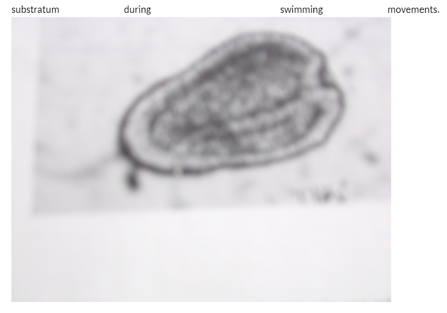
The behavior swimming larval is made by the cilium and the apical tuft of flagellum toward head and during this movement the apical tuft touch different substratum for selection and when found it the planulae larvae fixed and the growing begin; the planulae larvae selective different types of substratum during swimming movement (Figure 1).
Results
The mentioned in Inroduction can see on the next diagram: porous substratum---------attached larval---------- metamorphosis smooth substratum--------temporal attached------swimming movements [1].
Once planulae larvae is fixed another larvae have similar behavior and they fixed near too, so this unluky distribution finished and will begin another distribution more or less ordinate, where adults specimens are closed between them.
This phenomena is equal for sea anemones and fossil corals, so the nearest between specimens make a local current of movement of sea water where the specimens can to get food; the movement of water is make by tentacles .These tentacles have cnydocists and through it can catch different organisms from zooplankton and benthos too.
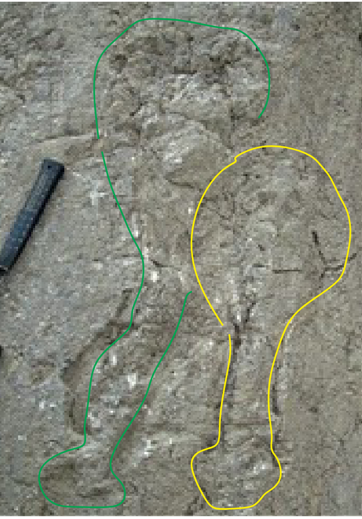
This types of distribution is curious because it was noticed in two zoological groups with interval of times so great; meanwhile sea anemones is an actually group, coral fossils (Rugosa) had his distribution in Ordovisic Period (500- 600 MY), so this group is far away to Edicarian period for more 100 MY; this taxa was found in “ Formación Volcán” (Jujuy Province, Argentina) edicarian aged 630-542 MY.
Moreover this distribution is and was held through the time because is a strategy beneficious for both of them.
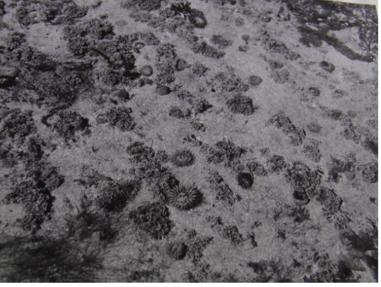
The sea anemones are close between them (Figure 2) and their oral disc are addressed to water current and through the tentacular crown can to catch something near; the tentacular crown is a true arm for catching zooplankton (micro and medium), small crustacean are swimming nearest, aquatic insects, small molusc, small and great crustaceans; so sea anemones are voracious predactor because they have a polyphagus diet, of course they are called polyphagous opportunistic [2].
The coral fossils, when they are joined by junction of their calcic walls make a propicious area where their superficial of oral disc lets them to catch solar energy through their symbiotic algae; this association is beneficious for both of them because the algae catch excrement metabolic like ammonium from coral and it catch from algae elements like sodium, calcium and nitrogen
Why these Distributions are Held along Time?
The unlucky distribution begin when spawing of adults specimens of sea anemone and fossil coral have place in the sea; this spawing is similar to a cloud where there are spermatocytes or ovules such as from male or female. The spermatocytes by chimiotactis movements swims to ovules and both of them fussioned and from here begin formation of planulae larvae. This larvae as was mentioned above, begin to swing for loocking a suitable substratum.
The suitable substratum is unlucky, so the larvae can loocking for on differents places, but this substratum must be adequated and to sure to it resources for food; another larvae have equal condition, so this situation go to repeat again.
Conclusion
This unluky distribution is exitous because lets to most larvae settlement near every one and when this larvae growing in size and heigh built an area where develop a great superficies for catching prey, and the local movements of water with abundance of oxygen lets every larvae gaseous interchange.
When this larvae changed to adult, this distribution finish because all adults specimens are localized in the original places where were settled the respective larvae. From here the new distribution is ordinated because all individuals are closed from one to one and this type of distribution will repeat again when the larval stated begin again (Figure 3).
For this reason the sequences of this distribution could be: Step larval (planulae larvae)-----------------unlucky distribution Adult (sea anemone/fossil coral)-----------ordinated distribution Through of times both distribution are beneficious for species, so the evolution of each one is exitous and lets every one survival for a long time [3].
References
-
Zamponi MO (1990) La larva de Olindias sambaquiensis Muller, 1861 (Cnidaria: Limnomedusae): comportamiento natatorio y selección del substrato. Physis (Buenos Aires), Secc A, 48(114-115): 21-24.
-
Acuña FH, Zamponi MO (1995) Feeding ecology of intertidal sea anemones (Cnidaria, Actiniaria): food sources and trophic parameters. Biociéncias, Porto Alegre, Brazil 3(2): 73-84.
-
Zamponi MO (2006) Historia paleontológica y tendencias evolutivas en el phylum Cnidaria. Rev. Real Acad. Galega de Ciencias (España) 25: 131-157.
- Mitochondrial Bio-Logistics: Steering Co-Enzyme Q10 and Lycopene Synergies within the Science 4.0 Bio-OS Framework
- Hymenoptera Specimens from the Caño Negro Wetland, of the National Museum Collection, Costa Rica
- Science 4.0: Comprehensive Architecture of the Biological Operating System (Bio-OS) A Framework for Systemic Resilience and Industrialized Bio-Governance
- Rabbit on, or Hare Back? Understanding Climate Change
- Clinical Validation of Science 4.0: Flow Steering and Epigenetic Drift Inversion on a 76-Year-Old Hybrid System
- Seeds Planted by another Mind