
Key for Identification of Bumblebee Queens from Costa Rica (Apidae: Apinae: Bombini)
In Costa Rica, five species of bumblebees of the Bombus genus are reported, however, two of these species have practically identical coloration, which makes it difficult to distinguish between populations that reside in the same site. A dichotomous key was generated to identify the bombus queens, and it is determined that the species B. ephippiatus and B. digressus can only be identified by observing their jaw characteristics. On the other hand, it is concluded that the distribution of the species B. weisi, B. digressus and B. mexicanus present more restricted distributions than those of B. pullatus, B. ephippiatus and B. volucelloides, of the latter it is also concluded that it had been confused with B. melaleucus, which is determined to be a species restricted to South America for the moment, although it is not ruled out that it can be collected in the southern part of the country, on the Pacific slope, especially in the La Amistad International Park and the Corcovado National Park.
Introduction
Bumblebees are essential for the pollination of plant species whose floral structures are too narrow for the bees to enter to collect pollen directly, but require a strong vibration that detaches the pollen and makes it go outside [1]. The reproduction of these bees depends on the fertilized queens, which, once they have mated with the males, will separate from the colony to found a new one on their own, using nests of mice or small rodents, and the flight ranges of bumblebees are highly variable, ranging from 500m to almost 10km in European species [2], and in South American species B. atratus between 1 and 1.5 km [3].
In areas with well-defined seasons, bombus colonies normally must start from scratch after each winter because only fertilized females survive [4], but some studies reveal that the worker species such as B. terrestris remain active together with the queens during the winter [4, 5].
Por otro lado, en las zonas los nidos permanecen activos durante todo el año, y si bien la mayoría de las especies se distribuyen en las zonas de mayor altitud, las especies del subgénero Fervidobombus abarcan altitudes medias y bajas, siendo la B. pullatus la más abundante de las zonas bajas de todo centroamérica [6].
Six species of the Bombus genus are reported in Costa Rica, namely: B. pullatus, B. ephippiatus, B. digressus, B. mexicanus, B. weisi and B. volucelloides, all of them represented in the scientific collection of the National Museum of Costa Rica (MNCR). The present study provides an identification key for the queens of these species.
Methodology
Identification Key
The key was structured in a simple way, using the general coloration of the species and some jaw features that separate the most similar species.
Specimens from the MNCR collection were used to compare the species of B. digressus and B. ephipiatus, in order to confirm the characters established as diagnostic by Hofstede, et al. [7].
A review was also carried out on the possible distribution of the species in the national territory (Figure 1), and a brief compilation of the known data on their biology.
Collection Specimens
The MNCR collection has a total of 2,599 specimens of the genus Bombus, belonging to the six species reported for the country, which were reviewed for the preparation of the key and the determination of the possible distribution in the country: Bombus digressus: 3 queens, 23 workers, 23 males. Bombus ephippiatus: 333 queens, 520 workers and 165 males. Bombus mexicanus: 2 queens, 89 workers, 13 males. Bombus pullatus: 176 queens, 724 workers, 140 males. Bombus volucelloides: 108 queens, 222 workers, 52 males. Bombus weisi: 5 workers and a queen report: field observation [8].
Results
Identification Key for Queens
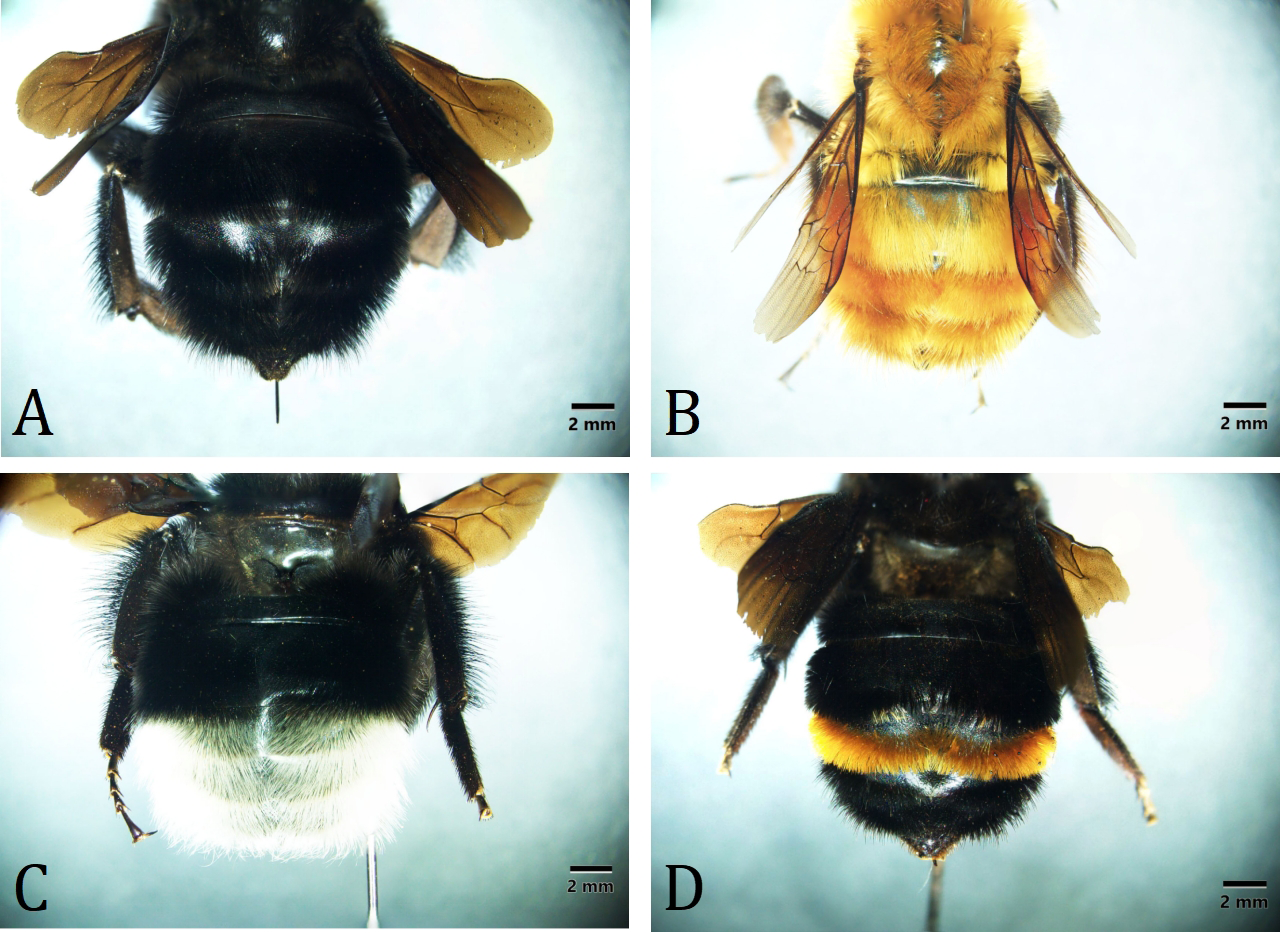
1 Body completely black, without setae of other color (Figure 1A)_________B. pullatus 1’ Body with setae of other colors _______2 2 Body mostly covered by black setae, with only some sections in another color_____3 2’ Abdomen completely covered with yellow and orange setae (Figure 1B)________5 3 Last abdominal segments covered dorsally by long white setae (Figure 1C)__B. volucelloides 3’ Last abdominal segments do not present white setae_______________4 4 Body completely covered by long, only yellow setae, with the exception of the dorsal area of the thorax and the last abdominal segments, which are covered by black setae [8]____B. weisi 4’ Completely black body with a single yellow stripe on the abdomen (Figure 1D)____B. mexicanus
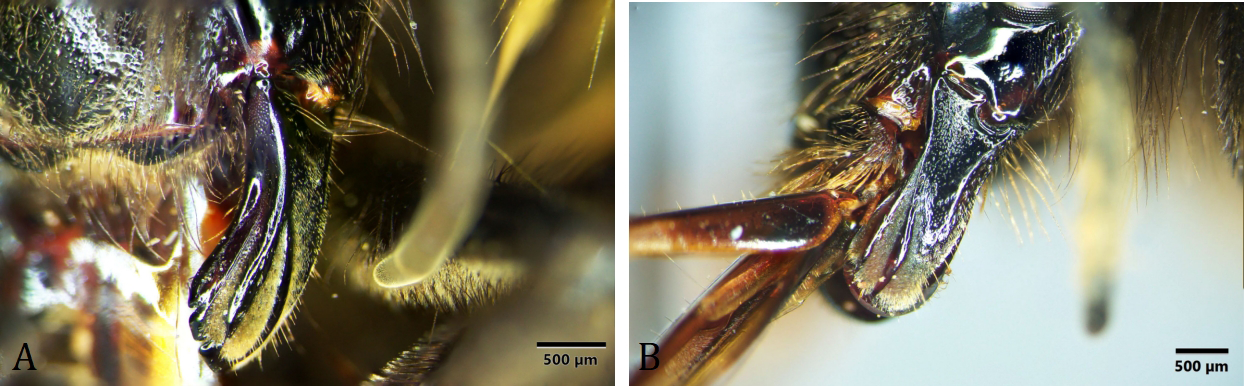
5 Distal edge of mandible with 2 well-defined clefts, wide malar zone, curved mandible (Figure 2A) _______ _______________________ ___B. digressus 5’ Distal edge of mandible without clefts, malar area short, mandible almost straight (Figure 2B) ________ _______________________ _B. ephippiatus
Distribution of Bombus in Costa Rica
Bombus (Fervidobombus) digressus Milliron, 1962 It is reported from 1300 masl to 2900 masl, it is distributed in the province of Alajuela only in the district of San Rafael; in the province of Cartago in the Orosí, San Rafael and San Francisco districts; in the province of Heredia in the districts of Vara Blanca and San José de la Montaña; in the province of Limón only in the district of Bratsi; in the province of Puntarenas in the districts of Pitier and Potrero Grande, and in the province of San José in the districts of Rivas, San Jerónimo and San Isidro. It is expected to be present within the Braulio Carrillo, Poas Volcano, Irazú Volcano, Tapantí and Quetzales National Parks, as well as the biological corridors that connect these areas.
Bombus (Fervidobombus) mexicanus Cresson, 1878 It is found from 200 masl to 2000 masl, it is distributed in the province of Alajuela in the Dos Ríos district, in the province of Cartago in the Cachí district, in the province of Guanacaste in the districts of La Cruz, La Garita, Mayorca, Santa Elena and Santa Cecilia, in the province of Heredia in the La Virgen district, in the province of Puntarenas in the Guacimal, Monteverde and San Vito districts, and in the province of San José in the Catedral, Guaitil, San Pedro, San Antonio and Sabanilla. It is expected to be found throughout the Greater Metropolitan Area (GAM), the Huetar Norte zone, and the highlands of the province of Puntarenas.
Bombus (Fervidobombus) pullatus Franklin, 1913 It has been reported from 0 masl to 3400 masl, making it the most abundant species in the country, present throughout the territory.
Bombus (Fervidobombus) weisi Friese, 1903 There are only five individuals captured and other recorded [7] between 1400 masl and 2750 masl, four collected in the district of San Antonio de Escazú in the province of San José and one from the district of San Nicolás in the province of Cartago. It is considered a rare species due to the small number of individuals, however this may be due to the fact that no sampling effort has been made for the species, so it cannot be ruled out that it may be in the peri- urban and rural areas of the GAM in which provinces of San José and Cartago.
Bombus (Pyrobombus) ephippiatus Say, 1837 It is the second most abundant species in the country, present throughout the territory from 300 masl to 3650 masl.
Bombus (Robustobombus) volucelloides Gribodo, 1892 It is another of the most abundant species distributed throughout the country, from 100 masl to 3400 masl.
Discussion
All six species are relatively easy to identify with the naked eye, with the exception of B. digressus and B. ephippiatus for which it is necessary to observe their jaws closely. Outside of these two species, the greatest conflict had been related to the presence of B. melaleucus and B. volucelloides in Costa Rica, since both species are reported for Costa Rica [9]; however, after verifying the material, it was determined that B. melaleucus still does not have specimens deposited in the official collections that corroborate its presence in the national territory, since all the specimens correspond to B. volucelloides, delimiting B. melaleucus to South America for the moment. However, it is not ruled out that specimens may appear in the upper areas of La Amistad International Park.
On the other hand, the biology of B. ephippiatus has been the most studied, since both B. pullatus have been considered as an alternative to other Bombus for commercial use such as B. terrestris and B. impatienes, which are exotic species in Central America and very invasive with the local populations of bumblebees [6, 10, 11]. However, B. ephippiatus is easy to confuse with B. digressus, because although the literature mentions that the latter are more robust [7], the truth is that intraspecific variation affects both the color pattern and the size of specimens, which can vary greatly depending on environmental and dietary factors, which is reflected in the specimens of the collection.
Conclusions
- It is concluded that the only certain way to differentiate B. ephippiatus and B. digressus is through the structure of the mandible, where the mandible of the latter is longer, presents a very marked curvature and two incisions on the distal margin. .
- It is determined that B. melaleucus is a South American species that does not present specimens in collections that corroborate its presence, but it is not ruled out that it can be reported in the southern part of the country, or that there are even specimens of this species in international collections. species that have been collected in Costa Rica.
- It is concluded that B. weisi may not really be a rare species as previously estimated, but that its distribution may complicate its collection, especially in urban areas of the GAM, and in private farms adjacent to National Parks Irazu and Turrialba Volcanos.
References
-
Dardón MJ, Yurrita, CL, Landaverde-González P, Vásquez M, Ayala R (2020) Rediscovering the Diversity of Guatemalan Bumble Bees (Hymenoptera: Apoidea: Bombus Latreille, 1802). International Journal of Scientific Research in Biological Sciences 7(2): 1-14.
-
Goulson D, Stout J (2001) Homing Ability of the Bumblebee Bombus Terrestris (Hymenoptera: Apidae). Apidologie 32: 105111.
-
Pardo L, Jiménez L (2006) Observation of Flight Ranges of Bombus Atratus Hymenoptera: Apidae) in Urban Environments. Acta Biológica Colombiana 11(2): 1-7.
-
Stelzer RJ, Chittka L, Carlton M, Thomas C (2010) Winter Active Bumblebees (Bombus terrestris) Achieve High Foraging Rates in Urban Britain. PLoS ONE 5(3): e9559.
-
Michener CD (2000) The bees of the world. The John Hopkins University Press, Baltimore.
-
Hines HM, Cameron SA, Deans AR (2007) Nest Architecture and Foraging Behavior in Bombus pullatus (Hymenoptera: Apidae), with Comparisons to Other Tropical Bumble Bees. Journal of the Kansas Entomological Society 80(1): 1-15.
-
Hofstede FE, Van Det ME, Van Asperen de Boer JRJ, Ortiz A, Sommeijer MJ (2001) A note on Bombus (Fervidobombus) digressus (Hymenoptera: Apidae) in Costa Rica, with a description of the queen. Entomologische berichten 61: 120-125.
-
Sanchez-Ocampo M (2023) Reina de Bombus (Fervidobombus) weisi Friese, pp: 190.
-
Abrahamovich AH, Díaz NB, Morrone JJ (2004) Distributional patterns of the neotropical and Andean species of the genus Bombus (Hymenoptera: Apidae). Acta zoológica mexicana 20(1): 99-117.
-
Torres-Ruiz A, Jones RW (2012) Comparison of the Efficiency of the Bumble Bees Bombus impatiens and Bombus ephippiatus (Hymenoptera: Apidae) as Pollinators of Tomato in Greenhouses. Journal of Economic Entomology 105(6): 1871-1877.
-
Dafni A, Kevan P, Gross CL, Goka K (2010) Bombus terrestris, pollinator, invasive and pest: An assessment of problems associated with its widespread introductions for commercial purposes. Applied Entomology and Zoology 45(1): 101-113.
- Mitochondrial Bio-Logistics: Steering Co-Enzyme Q10 and Lycopene Synergies within the Science 4.0 Bio-OS Framework
- Hymenoptera Specimens from the Caño Negro Wetland, of the National Museum Collection, Costa Rica
- Science 4.0: Comprehensive Architecture of the Biological Operating System (Bio-OS) A Framework for Systemic Resilience and Industrialized Bio-Governance
- Rabbit on, or Hare Back? Understanding Climate Change
- Clinical Validation of Science 4.0: Flow Steering and Epigenetic Drift Inversion on a 76-Year-Old Hybrid System
- Seeds Planted by another Mind