
A Mini Review on Diversity and Distribution of Ixodidae Tick among Cattle and Wild Fauna of West Bengal Region, India
Indian subtropical climates provide a suitable niche for the diversity of Ixodidae ticks on various host. Very limited taxonomic information exists in literature about the diversity and distribution of tick both within and outside of West Bengal. In the current review, species and hosts diversity and geographical distribution of ticks present in the state have been reviewed based on taxonomic data in the literature from 1926-2022. More than 109 tick species were recorded in India, among which 88 genera belongs to the Ixodidae group. West Bengal's hot and humid environment makes it a hotspot for tick diversity, accounting for 30% of the overall Indian tick fauna. According to this study, 9 genera and 32 species were detected in West Bengal, with Rhipicephalus sp. being the most infectious in cattle, followed by Hyalomma and Haemaphysalis species. While, Haemaphysalis with 13 species is the most diverse genus reported in West Bengal, the most prevalent species detected in all seventeen districts were H. bispinosa and Boophilus microplus. To understand the variety and distribution pattern of tick species, the study reveals their presence and infestation in different classes and orders of their conspecific host.
Introduction
Next to mosquitoes, ticks are most important group of arthropods for medical and veterinary purposes that pose a threat to both humans and animals [1]. Ticks are obligate hematophagous ectoparasites that can induce a variety of clinical symptoms when feeding on their vertebrate hosts, including tissue damage, physical paralysis, and occasionally anemia during intense infestations [2]. According to Anderson JF, et al. [3] tick can also spread a variety of infections that can infect and kill wildlife, domestic animals, and humans. Ticks are divided into two major categories: Ixodidae (hard tick) and Argasidae (soft ticks). Apart from these a small group called Nuttalliellidae also exist, which is only reported from Africa [4]. Ixodes, which has 217 species, is the largest genus among hard ticks. Dermacentor, Haemaphysalis, Rhipicephalus (which now contains the genus synonym Boophilus), Hyalomma, and Amblyomma (genus synonym Aponomma) are further genera of relevance to veterinarians [5]. Many tick species are now recognized as reservoirs and vectors of a variety of infections that cause major morbidity and mortality in both humans and animals. This knowledge dates back to the turn of the nineteenth century when the first description of a tick-transmitted infection was published.
Although their habitat is distributed throughout the world, but tropical and subtropical regions act as hotspot for their diversity [2]. Lyme Disease (LD), Kyasanur Forest Disease (KFD), Crimean-Congo Hemorrhagic Fever (CCHF), Q Fever (also known as coxiellosis), and Rickettsial infections are some of the tick-borne diseases in India. Other tick-borne illnesses like Babesiosis, Ganjam Virus (GANV), and Bhanja Virus (BHAV) infections have also been documented in India in recent years [6]. The identification of the tick-borne virus disease known as Kyasanur Forest Disease (KFD) in India in 1957 which was spread by Haemaphysalis sp. in the Western Ghats, was a turning point in the field of tick research [7]. Before the report of KFD, just 50 species had been identified within the country. India, one of the 12 countries with the highest biodiversity, and its two largest biodiversity hotspots are the western ghat and northeastern India, contribute greatly to the world’s flora and wildlife [8]. In India, the Ixodidae and Argasidae families contain 106 species divided among 12 genera [9]. This data represents more than one- eighth of the approximately 820 tick species from 19 genera and 3 families that are known to exist globally [9]. The two most widely distributed species among the 106 tick species that have been identified in India are Rhipicephalus microplus and Hyalomma anatolicum, which have a significant negative economic impact on the cattle production system by lowering productivity and profitability in the livestock sector [10, 11, 12].
Tick infestation affects these animals throughout the entire year, resulting in both direct and indirect losses. According to Minjauw, et al. [13] the projected yearly control cost of TBDs (Tick-Borne Diseases) in India is 498.7 million USD. West Bengal (22.9868° N, 87.8550° E), is a state located in the eastern part of India, is a hot and humid zone that provide lucid habitat to show diversification of the species of ticks among cattle as well as in other mammal, birds and reptiles. From West Bengal, 32 species belonging to 9 genera have been recorded from 17 districts which is 30 % of total Indian tick population [14]. 1758 Linnaeus was the pathfinder of tick research in India and in West Bengal, Rudow, first initiated the study in 1870 [15]. This brief research highlights the variety, distribution, and prevalence of tick species from several districts in West Bengal, showing their existence and infection in different classes and orders of conspecific host.
Identifying Characteristics of Ixodidae Family and Feeding Mechanism
A flattened, oval-shaped body part called the idiosoma and a capitulum, or head, makes up the tick’s body. The dorsal surface of hard ticks has a hardened plate known as a scutum (Figure 1). This scutum, which covers around one- third of the dorsal surface of female ticks, can help identify various tick species. The scutum prevents a male’s capacity for food intake by covering the entire dorsal area. Chelicerae and hypostome (Figure 1) the tick’s mouthparts, are found on the capitulum and are used to pierce and attach the tick to its host [16]. Their mouthparts extend out in front, and they frequently have eyes that are visible on the dorsal side. There are several sizes of Ixodidae ticks. Amblyomma and Hyalomma are two genera of ixodid ticks that are as big as 6-7mm. They have big eyes and long mouthparts that extend to the front of the body. The majority of the leg segments in these two taxa, both features pale rings. Boophilus and Haemaphysalis, two small-sized ticks (less than 3mm) with anterior and short mouthparts and small or nonexistent eyes, respectively. While, Rhipicephalus is Medium-sized ticks (3-5mm) with short eyes and mouthparts. The anal grove extends to the anterior of the anus in the genus Ixodes. The anal groove passes posterior to the anus (Figure 1) or is absent in all other genera of ixodid ticks [17].
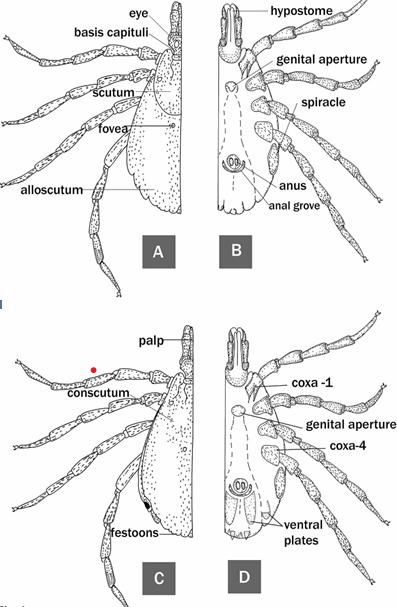
The external body surface of host is the site of mating for the hard ticks. While the female is feeding on host, male ticks will stay on them and make many attempts to mate with females and deliver a sperm sac or spermatheca [18]. Before they are ready to fully engorge with blood, the females only mate once. Two thousand to twenty thousand eggs are laid by female hard ticks in a single batch [19]. Larvae never have a genital opening and always have three pairs of legs whereas nymphs are four-legged and lack a vaginal opening [18]. Females have a big vaginal opening and a male’s genital opening is located in the same location as a female. A hard plate known as a scutum is present on the dorsal surface of all ixodid ticks. Male ticks are fully covered with scutum (Figure 1) and in case of female and juvenile stage like larvae and nymph, scutum covers the dorsal surface partially [19].
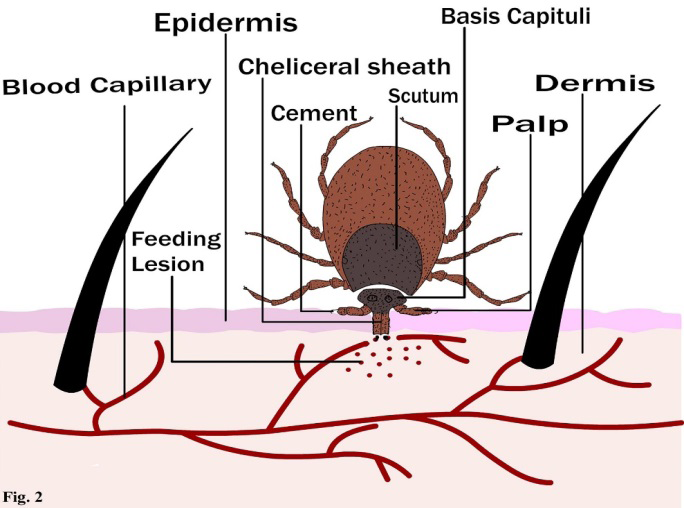
Unlike lice, ticks are less host-specific [20]. Ticks can have one, two, or three hosts, depending on whether they molt on the host between the larval and nymphal phases [21]. Ticks body segment comprises of cephalothorax and abdomen with a projection of hypostome and palps present in the mouthparts. All feedings of ticks at each stage of the life cycle are parasitic. At every step of their life cycles, ticks feed exclusively on their vertebrate host and purely consume their hosts’ blood as food [22]. Ticks use their mouthparts to cling to their host’s skin after crawling there which is made up of the palps, hypostome, and chelicerae. The skin of the host is penetrated via a tube formed by the chelicerae and hypostome. The chelicerae are made up of flexible rods with pointed claws at each end. These create a feeding lesion by puncturing the dermis and rupturing capillary blood vessels that are extremely near the skin’s surface (Figure 2) [17]. Depending on the criteria, like life stage, host type, and tick species, hard ticks can feed on their hosts for several days to several weeks at a time. Hard ticks’ outer layer, or cuticle, actually thickens to handle the massive amount of blood they consume, which, in adults, can be 200–600 times their unfed body weight [23].
Diversity of Ixodidae Tick in West Bengal
It was after Rudow, et al. numerous researchers examined the state’s tick taxonomy, from West Bengal, which is the home to about 9 genera and 32 species of the Ixodidae family of ticks (Table 1) [15]. No Argasid ticks were found in the state. Based on a vast array of collections of various hard tick species found from this state and the specimens collected by Zoological Survey of India [15], a chapter was created on the fauna of ixodid ticks in West Bengal. Five major tick genera were found in India among which Rhipicephalus sp. is the most infectious in West Bengal followed by Hyalomma sp. And Haemaphysalis sp [24].
| Amblyomma Koch | Aponomma Neumann | Boophilus Curtice | Derma centor Koch | Haema physalis Koch | Hyalomma Koch | Ixodes Latreille | Nosomma Schulze | Rhipicephalus Koch |
|---|---|---|---|---|---|---|---|---|
| A.helvolum Koch | A.gervaisi (Lucas) | B. microplus (Canestrini) | D.auratus Supino | H. aborensis Warburton | H. anatolicum anatolicum Koch | I. acutitarsus Karsch | N. monstrosum Nuttall and Warburton | R. haema physaloides Supino |
| A. javanense (Supino) | A. lucas Warburten | H. aponommoides Warburton | H. marginalum isaaci Sharif | I. granulatus Supino | R. sanguineus Latreille | |||
| A. supinoi Neumann | H. birmaniae Supino | H. brevipunctata Sharif | I. ovatus Neumann | R. turanicus Pomerantzev | ||||
| A. testudinarium Koch | H. bispinosa Neumann | H. Hussaini Sharif | ||||||
| H. cornigera Shimoga Trapido and Hoogstraal | ||||||||
| H. himalaya Hoogstraal | ||||||||
| H. hystricis Supino | ||||||||
| H. indica Warburton | ||||||||
| H. montgomery Nuttall | ||||||||
| H. obesa Larrousse | ||||||||
| H. ramachandrai Dhanda, Hoogstraal and Bhat | ||||||||
| H. spinigera Neumann | ||||||||
| H .darjeeling Hoogstraal and Dhanda |
Identifying Features of the Genus Recorded from the State
Following the most recent checklists [25] the identifying characters of the tick species are mentioned in this review. Amblyomma: One of the biggest tick species in the world. The most obvious features of this species are their enormous mouthparts and elaborate scutum, which are present in both male and female species. Additionally, they feature banded legs, flat or beady eyes, and festoons in all stages Alan, et al. Unfed ticks measure between 6 and 7 mm in length, including the mouthparts. Lack of lateral suture. The lateral border of the basis capituli is straight. Legs typically have light rings. Both males and females have festoons, however it is not clear when females are fed. Ventral plates in males are ill developed [9]. Aponomma: Aponomma genera often have a single host and exclusively consume on reptilian blood. Male ticks have a dorsoventral flattened body and dorsally wider. The mouth parts are supported by rectangular-shaped basic capitulum, which is not clear from the dorsal aspect. In contrast to males, basic capituli in female bear two porose regions, each of which is interrupted by numerous tiny pores. The lateral wall of the genital organ is striated, has a few grooves, and has a few small spines. Male genital orifices are roughly oval in form and lack appendages [26]. Boophilus: The palpi of ticks in the Boophilus group are compressed, and articles II and III have transverse sides on their dorsal and lateral surfaces. No festoons are visible. Males have elongated, posteriorly pointed adanal shields. The majority of Boophilus ticks only bite one host [27]. Unfed ticks are only 2 to 3 millimetres in size. Lack of lateral suture. The texture of the integument is striated. The mouth parts are located in front. Lateral borders of basis capituli are angular. Legs lack light rings. Females have scutums, whereas males have conscutums. Both males and females lack festoons. Only males possess ventral plates. The anal groove is barely visible [9]. Dermacentor: The mouthparts of Dermacentor are relatively short. The dorsal surface of female has wide, oval, and porous sites, while the base of the head (basis capituli) is rectangular. Dermacentor has a distinctive, decorative, and pale-colored marble pattern on its dorsal shield (scutum). The eyes are lateral to the back, roughly at the same height as the second set of legs. Festoons resemble pie crusts and define the posterior margin. There are typically 11 festoons. The female is 3.8–4.2 mm long and can grow up to 15 mm following a blood meal. The male is equally large, measuring 4.2–4.8 mm [28]. Haemaphysalis: Ticks in the genus Haemaphysalis are tiny and have short mouthparts. The second segment of the palps in some species exhibits lateral extending posterolateral angles, giving the palps a triangular appearance. The following traits make them easily distinguishable from the other genera, viz., lack of eyes, and presence of festoons in all life stages, rectangular base capituli, and absence of adanal plates on the males. Only a small number of species infect domestic livestock and are significant commercially. Hyalomma: Unfed ticks are huge (5 to 6mm), including the mouthparts. Lack of lateral suture. The texture of the integument has striations. The lateral borders of basis capituli are moderately angular. Legs typically have light rings. The female has scutum, while the male has a conscutum, both are brown in color. Males have festoons, as do females (though it’s not apparent when females are fed). Only males have ventral plates, which often come in three different pairs. The anus is posterior to the anal groove [9]. Ixodes: Unfed ticks’ range in size from medium (3 to 4 mm) to large (though keep in mind that males of this genus are often smaller than females), Lack of lateral suture. The texture of the integument has striations. Articles 1 and 3 are shorter than Article 2 of the Palp. The lateral borders of basis capituli are straight. Pale rings are absent on legs. The female has a scutum whereas the male has a conscptum. Only males have ventral plates, which are characterized by massive, flat plates that cover much of the ventral surface. In some species the anal groove creates a circle around the anus rather creating an anterior loop [9]. Nosomma: The distinctive features of Nosomma include small to large and deep punctures, long internal and external spurs on coxae I in both males and females, and long thick hairs on palpal segments, 1-3 of females and segments 1 and 2 of males, with fewer on segment 3 of males. Male spiracular plates are comma shaped, whereas those of females are subtriangular with a slightly truncated dorsal angle. Males have three enlarged finger-like projections on their subanal plates, which are especially prominent in individuals that are actively feeding [29, 30]. Rhipicephalus: The hexagonal shape of the basic capituli distinguishes the ticks of the genus Rhipicephalus [31]. Unfed ticks range in size from 3 to 5 mm, including the mouthparts. Lack of lateral suture. The texture of the integument has striations. The mouth parts are in front. The lateral borders of basis capituli are clearly angular, giving them a hexagonal form overall. Legs lack light rings. The female has a scutum whereas the male has a conscutum. There are eyeballs, which range from being flat to slightly convex. Males have festoons, as do females (though it’s not apparent when females are fed). The anus is posterior to the anal groove [9].
| Sl No. | Name of the Districts | Number of species found | Name of the species |
|---|---|---|---|
| 1 | Darjeeling | 18 | Amblyomma testudinarium, B. microplus, Dermacentor auratus, Haemaphysalis aborensis, H. aponommoides, H. birmaniae, H. bispinosa, H. darjeeling, H. himalaya, H. hystricis, H. montgomeryi, H. ramchandrai, H. spinigera, Hyalomma anatolicum anatolicum, Ixodes acutitarsus, I. granulatus, I. ovatus, and Rhipicephalus haemaphysaloides |
| 2 | Jalpaiguri | 13 | A. Javanense, A. supinoi, A. testudinarium, B. microplus, Demacentor auratus, Haemaphysalis aborensis, H. bispinosa, H. cornigera shimoga, H. hystricis, H. obesa, H. ramchandrai, H. spinigera and Rhipicephalus haemaphysaloides. |
| 3 | Cooch Bihar | 3 | B. microplus and H. bispinosa |
| 4 | Dinajpur | 3 | B. microplus, Hyalomma anatolicum anatolicum and H. bispinosa |
| 5 | Malda | 2 | B. microplus and H. bispinosa |
| 6 | Bankura | 4 | B. microplus and H. bispinosa |
| 7 | Birbhum | 3 | B. microplus and H. bispinosa |
| 8 | Bardhhaman | 4 | B. microplus and H. bispinosa |
| 9 | Purulia | 6 | B. microplus, H. bispinosa, H. marginatum isaaci, Hyalomma anatolicum anatolicum,R. sanguineus and R. turanicus |
| 10 | Medinipur | 7 | H. marginatum isaaci, H. brevipunctata, Nosomma monstrosum, R. sanguineus, B. microplus, H. bispinosa and H. anatolicum anatolicum |
| 11 | Murshidabad | 2 | B. microplus and H. bispinosa |
| 12 | Nadia | 3 | B. microplus, H. turanicus and H. bispinosa |
| 13 | Howrah | 3 | B. microplus, Hyalomma anatolicum anatolicum and H. bispinosa |
| 14 | Hooghly | 5 | B. microplus, H. indica, H. bispinosa, R. turanicus,Hyalomma anatolicum anatolicum |
| 15 | Kolkata | 11 | Amblyomma helvolum, A. javanense, Aponomma gervaisi, A. lucasi, Dermacentor auratus, H. apommoides, H. indica, R. sanguineus, R. turanicus, B. microplus and H. bispinosa |
| 16 | North 24 -Parganas | 6 | A. testudinarium, Dermacentor auratus, H. hussaini, B. microplus, H. bispinosa and Hyalomma anatolicum anatolum |
| 17 | South 24-Parganas | 3 | B. microplus, H. bispinosa and Rhipicephalus haemaphysaloides |
District Wise Distribution of Ixodidae Tick in West Bengal
Table 2 describes Tick genus and species diversity and distribution which were recorded from 17 districts of West Bengal. Among which Boophilus microplus and Haemaphysalis bispinosa were reported from all the 17 districts. The entire 09 genera and 32 species of ticks known from the state were represented by the Darjeeling district alone, with 77.8 % of genera and 56.3 % of species distribution, placing it in first place among other districts (Figure 3). Except genera Nosomma and Amblyomma, all other genera have been recorded from this district that included Amblyomma testudinarium, B. microplus, Dermacentor auratus, Haemaphysalis aborensis, H. aponommoides, H. birmaniae, H. bispinosa, H. darjeeling, H. himalaya, H. hystricis, H. montgomeryi, H. ramchandrai, H. spinigera, Hyalomma anatolicum anatolicum, Ixodes acutitarsus, I. granulatus, I. ovatus, and Rhipicephalus haemaphysaloides, Total seven genera with eighteen species have been reported from Darjeeling district. While, Jalpaiguri district was in second place with a species diversity of 40.8 %, followed by Kolkata. Species recorded from Jalpaiguri district included A. Javanense, A. supinoi, A. testudinarium, B. microplus, Demacentor auratus, Haemaphysalis aborensis, H. bispinosa, H. cornigera shimoga, H. hystricis, H. obesa, H. ramchandrai, H. spinigera and Rhipicephalus haemaphysaloides. With eleven recorded species, Amblyomma helvolum, A. javanense, Aponomma gervaisi, A. lucasi, Dermacentor auratus, H. apommoides, H. indica, R. sanguineus, R. turanicus, B. microplus and H. bispinosa, Kolkata was placed at third position.
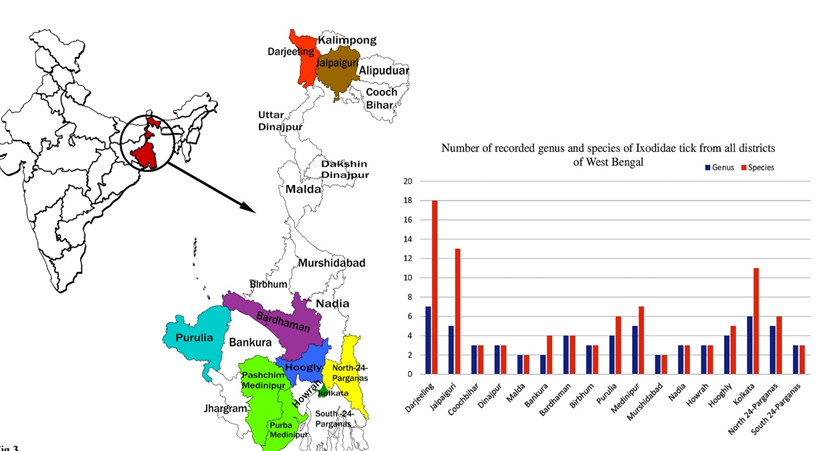
Amblyomma helvolum and Aponomma gervaisi are the only reported species from Kolkata. Next highest number of species diversity was recorded from Midnapur district and H. marginatum isaaci, H. brevipunctata, Nosomma monstrosum, R. sanguineus, B. microplus, H. bispinosa and H. anatolicum anatolicum were reported from that district. Furthermore, A. testudinarium, Dermacentor auratus, H. hussaini, B. microplus, H. bispinosa and Hyalomma anatolicum anatolum from North 24-Parganas and B. microplus, H. bispinosa and Rhipicephalus haemaphysaloides were recorded from South 24-Parganas. Along with B. microplus and H. bispinosa, additionally, Hyalomma anatolicum anatolicum were reported from Howrah and Dinajpur, H. turanicus from Nadia, H. indica, R. turanicus and Hyalomma anatolicum anatolicum from Hoogly, H. marginatum isaaci, R. sanguineus, R. turanicus and Hyalomma anatolicum anatolicum were recorded from Purulia. From Malda and Mursidabaad only B. microplus and H. bispinosa were recorded [15].
Seasonal, Age and Sex Wise Distribution among Cattle in West Bengal
The capacity of different species of ticks to live in a given place is strongly influenced by the local temperature, precipitation, and percent humidity. It is helpful to categorize a tick’s spread by both geographic region and climate type [32]. Early survey found that the monsoon season had the highest overall incidence of ixodid ticks with 59.25 %, followed by the summer season with 55.44 %, and the winter season with 27.09 % species infestation rate. The highest levels of Haemaphysalis sp. (9.25 %) were noted during the monsoon. While Rhipicephalus sp. is the most common prevalent species during summer, Haemaphysalis and Hyalomma infestation rates are higher in monsoon and winter than they are in the summer [24]. According to study by Debbarma A, et al. [24] on the seasonal prevalence of several haemoparasitic illnesses in cattle, the summer season had the statistically highest prevalence (45.54 %), followed by the monsoon (40.74 %), and the winter season had the significantly lowest (25.8 %) infestation rate. Monsoon season shows the highest prevalence of tick transmitted parasites viz., Theileria sp. (25.92 %) and Babesia sp. (14.81 %). While, Anaplasma sp (24.75%) had the highest prevalence in summer season. Theileria sp., Babesia sp., and Anaplasma sp. had the lowest prevalence ever seen during winter [24]. Among all states in India, Uttar Pradesh has been reported to show highest tick diversity with about 43 different species. Another study showed that the infection rate of ticks is lowest during winter season (47.96 %) and highest in the rainy season (69.46 %), followed by summer (62.55 %) [33].
Even though the animals were constantly plagued with ticks, the severity of the infection increased after rainfall. So, according to Vasya S, et al. [34] rainfall (humidity) seems to be a key macroclimatic factor driving seasonal variation in tick infestation. Due to low temperature (13.02 oC), infestation rates, during the harsh winter months of December to February, decreased. Ticks attempt to defend themselves by going into diapauses at low temperatures, which causes delayed morphogenesis and decreased behavioural activity [32, 35]. Changes in the macroclimate, which is necessary for tick breeding, may be the cause of the haemoprotozoan disease’s significant seasonal variance in the cattle. The winters, however, are cold and dry, which makes it difficult for ticks to survive. As a result, they spend the season lurking in cracks and crevices as engorged females, nymphs, larvae, and unfed adults [14]. Therefore, decreased levels of tick infestation in cattle during the winter could account for the lowest occurrence of Tick-Borne Diseases (TBD).
Subsequently, age is also a crucial factor in determining an animal’s ability to resist sickness and parasite infections. Study by Debbarma A, et al. [24] showed that highest tick infestations were found in young calves of one year of age (65.00 %), followed by cattle older than three years (36.8 %), and cattle younger than three years of age (35.63 %). In comparison to 1-3 years and > 3 years age groups of cattle, the prevalence of Rhipicephalus (Boophilus) sp. (45 %), Hyalomma sp. (28.33 %), and Haemaphysalis sp. (8.33 %), ticks were found to be substantially higher in 1- year calves. Additionally, it was noted that no cattle in the 1-year-old age group had Babesia sp infection [24]. Prior studies also revealed similar findings [13] Babesiosis and anaplasmosis were shown to be more prevalent in adults than in young calves, according to Debbarma A, et al [24]. Similar findings were made by Perez, et al. [36] who noted that older animals had a higher prevalence of blood protozoa. This “Inverse age resistance” phenomena in the case of babesiosis in animals was supported by many studies [37].
Furthermore, female cattle have higher infection rate (44 %) than the male cattle (36 %). According to Blikis, et al. women (33.47 %) had a much greater prevalence rate than men (14.28%). This greater incidence of infection rate in female cattle could be brought about by hormonal changes. According to Lloyd those who have high levels of the hormones like prolactin and progesterone, are more vulnerable to infections. Additionally, due to pregnancy, lactation, and production, female cattle experience more stress than male cattle, which increases their susceptibility to infection.
| Class of the host species | Name of the host species | Order of the host species | Tick species recorded from the adjacent Host |
|---|---|---|---|
| Reptilia | Varanus sp., | Squamata | Amblyomma helvolum Koch |
| Reptilia | Varanus bengalensis | Squamata | Aponomma gervaisi (Lucas) |
| Reptilia | Varanus salvator, Varanus nebulosus | Squamata | Aponomma varanensis (Supino) |
| Reptilia | Naa tripudians, (Indian Cobra) | Squamata | Aponomma gervaisi (Lucas) |
| Aponomma varanensis (Supino) | |||
| Reptilia | Python molurus | Squamata | Aponomma varanensis (Supino) |
| Reptilia | Python reticulatus | Squamata | Aponomma varanensis (Supino) |
| Reptilia | Zamensis mucosus | Squamata | Aponomma varanensis (Supino) |
| Reptilia | Naja naja | Squamata | Amblyomma helvolum Koch |
| Reptilia | Nicoria tricarinata (The tricarinate hill turtle) | Testudines | Amblyomma javanense (Supino) |
| Reptilia | Testudo elongata, (Elongated tortoise) | Testudines | Amblyomma supinoi (Neumann) |
| Reptilia | Geomyda spinosa | Testudines | Amblyomma supinoi (Neumann) |
| Mammalia | Ovis nayaur (Hodgson,1833) Blue sheep | Artiodactyla Sub family caprini | Aponomma varanensis (Supino) |
| Mammalia | Deer | Artiodactyla Sub family caprini cervinae | Dermacentor auratus (Supino) |
| Mammalia | Rusa unicolor(Sambar) | Artiodactyla Sub family cervinae | Haemaphysalis cornigera shimoga Trapido and Hoogstra |
| Hyalomma brevipunctata Sharif | |||
| Nosomma monstrosum(Nuttall and Warburton) | |||
| Mammalia | Susscrofa cristatusOr Indian boar | Artiodactyla Sub family suidae | Haemophysalis aborensis Warburton, Haemaphysalis darjeeling Hoogstraal and Dhanda |
| Mammalia | Muntiacus muntzak | Artiodactyla | Haemaphysalis ‘birmaniae’ Supino, Haemaphysalis darjeeling Hoogstraal and Dhand |
| Mammalia | Antelope cervicapra(Blackbuck) | Artiodactyla | Haemaphysalis ‘birmaniae’ Supino |
| Capricornis sumatraensis thar or Himalayan serow | Artiodactyla | Haemaphysalis ‘birmaniae’ Supino, Haemaphysalis darjeeling Hoogstraal and Dhanda, | |
| Rhipicephalus haemaphysaloides Supino | |||
| Mammalia | Capra hircus Domestic goat | Artiodactyla Sub family caprini | Haemaphysalis Montgomery,Nuttall, Hyalomma marginatum isaaci, Sharif |
| Mammalia | Muntiacus vaginalis (Barking deer) | Artiodactyla | Haemophysalis aborensis Warburton, Haemaphysalis himalaya Hoogstral, |
| Rhipicephalus haemaphysaloides Supino | |||
| Mammalia | Rattus rattus | Rodentia | Ixodes granulatus Supino |
| Rhipicephalus turanicus Pomerantzev | |||
| Mammalia | Bandicota bengalensis | Rodentia | Rhipicephalus turanicus Pomerantzev |
| Mammalia | Mus musculus | Rodentia | Rhipicephalus turanicus Pomerantzev |
| Mammalia | Suncus murimus | Rodentia | Rhipicephalus turanicus Pomerantzev |
| Mammalia | Tiger Cheeta | Carnivora | Amblyomma |
| testudinarium Koch, | |||
| Haemaphysalis bispinosa Neumann, Hyalomma brevipunctata Sharif, | |||
| Mammalia | Indian native dog | Carnivora | Haemaphysalis bispinosa Neumann, Haemaphysalis indica Warburton, |
| Rhipicephalus sanguineus (Latrielle), | |||
| Rhipicephalus turanicus Pomerantzev | |||
| Mammalia | Bengal fox Jackle | Carnivora | Haemaphysalis indica Warburton |
| Mammalia | Manis pentadactyla | Pholidota | Amblyomma javanense (Supino) |
| Mammalia | Buffalo | Artiodactyla Subfamily: Bovinae | Amblyomma testudinarium Koch |
| Mammalia | Bos frontalis Drung ox | Artiodactyla Subfamily:Bovinae | Aponomma varanensis |
| Mammalia | Bullock | Artiodactyla Subfamily:Bovinae | Rhipicephalus sanguineus (Latrielle) |
| Mammalia | Cattle | Artiodactyla Subfamily:Bovinae | Boophilus microplus (Canestrini) |
| Haemaphysalis aponommoides Warburton, Haemaphysalis bispinosa Neumann, Haemaphysalis obesa Larrousse | |||
| Haemaphysalis ramachandrai Dhanda, Hoogstraal and Bhat, Haemaphysalis spinigera Neumann | |||
| Hyalomma anatolicum anatolicum Koch, Hyalomma marginatum isaaci Sharif, | |||
| Hyalomma hussaini Sharif, Rhipicephalus haemaphysaloides Supino | |||
| Mammalia | Homo sapiens sapiens | Primates | Dermacentor auratus, |
| Haemaphysalis aponommoides Warburton, | |||
| Ixodes acutitarsus (Karsch) | |||
| Birds | Parus monticolus (The green -backed tit) | Passeriformes | Haemophysalis aborensis Warburton |
| Birds | Gallus gallus murgha | Galliformes | Haemophysalis aborensis Warburton |
Distribution of Tick Species among Wild Fauna of West Bengal
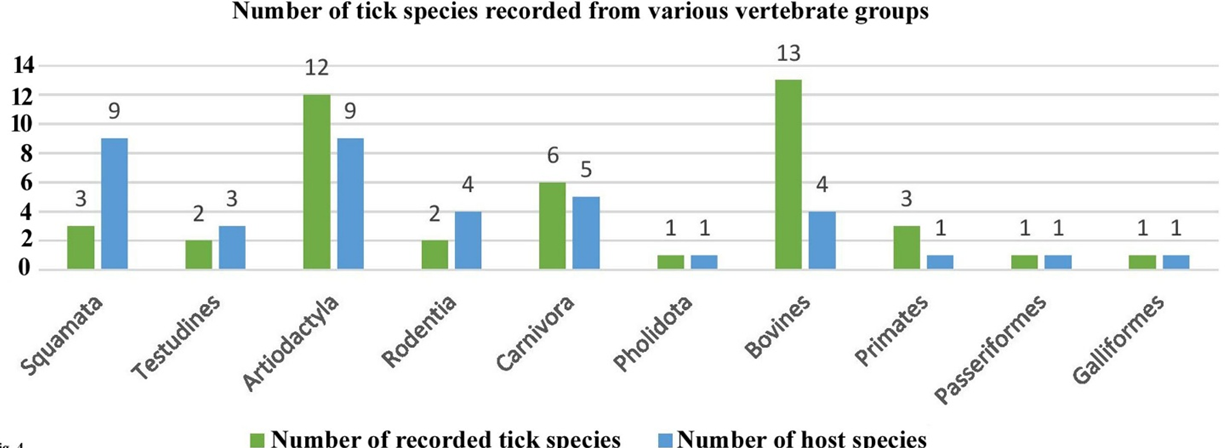
Distribution of Ixodidae tick species according to the class and order of their vertebrate host animals of West Bengal has been depicted in Table 3. In this study it has been revealed that all 32 tick species recorded from West Bengal are distributed as ectoparasites throughout 10 orders/ families of their conspecific vertebrate’s host including reptilian, mammalian and avian group (Figure 4). The diversity of reptile ticks is important for understanding how different infectious disorders are transmitted [38].
Amblyomma helvolum, Aponomma gervaisi and Aponomma varanensis are the prevalent species of tick found from the host of order Squamata distributed among 8 major host species under the class reptilia from West Bengal, India. From Zoological Garden in Calcutta, one male species A. helvolum from Geomyda grandis was recorded [39]. Later in a detailed study on snake, adult male and female tick of Ixodidae family, Amblyomma gervaisi Lucas, et al. (Syn.: Aponomma gervaisi) and A. helvolum Koch, et al. were identified from 15 species of snakes belonging to 12 genera from both natural and captive habitats from six different districts (Hoogly, Bankura, N. 24 Parganas, Nadia, Bardwan and Midnapur) of West Bengal [25].
From Zoological Garden, Kolkata, Robinson (1926) first identified Ambylomma javanense [1], from Manis pentadactyla under the order Pholidata from Mammalia
group. Amblyomma testudinarium was first reported in West Bengal in Darjeeling from unidentified host and in Naihati (North 24-Parganas) from tiger as reported by Sharif M [39]. From the mammalian host under order Arictodactyla, 12 species of Ixodidae were recorded under which Haemaphysalis sp. the most prevalent group was distributed among the deer family. According to Hoogstraal H [40], Haemaphysalis aponommoides was thought to be the source of infection for Himalayan haemorrhagic sickness. Haemaphysalis cornigera recorded for first time in India from West Bengal. Haemaphysalis darjeeling (Hoogstraal and Dhanda) is distributed among cattle and many other group of host species like Capricornis sumatraensis, Sus scrofa cristatus and Muntiacus muntzac vaginalis. Hoogstraal and El. Kammah, 1970 identified Haemaphysalis himalaya from the host, Indian muntjac, in Darjeeling, which is located at an elevation of 3200 feet. Nuttall and Warburton, 1915 from Assam first recorded Haemaphysalis hystricis from India. The species was later documented by Sharif, 1928 in Darjeeling, Assam, and Arunachal Pradesh. Apart from the hill region of North Bengal, recently Haemaphysalis darjeeling were documented from the body of Jersey cow from North 24 Pargana district of West Bengal [41].
In West Bengal, Ixodes granulatus Supino and Dermacentor auratus Supino have both been found on the bodies of deer and human, as reported by Sanyal AK, et al. [15], According to Hoogstraal H [42], these species are the transmitter of the virus that causes Langat encephalitis in small ground-dwelling and arboreal mammals from Southeast Asia to Eastern India. Ixodes ovatus was recorded for first time in India from Ghoombhanjan area of nursery forest in Darjeeling district.
From order Rodentia, Ixodes granulatus (Supino) and Rhipicephalus turanicus (Pomerantzev) were recorded, among which Rhipicephalus was the prevalent one. According to Sharif M [39], Rhipicephalus haemaphysaloides may contribute in some way to the spread of tick typhus fever in India. Rhipicephalus turanicus was first time recorded in India from West Bengal by Mitchell.
From host order carnivora, two species of Haemaphysalis, two species of Rhipicephalus and one species each of Hyalomma and Ambylomma species were recorded from Tiger, Cheeta, Indian Native dog, Bengal Fox and jackle. The ectoparasites of animals in the Neora Valley National Park (NVNP), West Bengal, India, were investigated in a preliminary faunistic study. On the bodies of domestic animals that frequently graze in the national park, several ectoparasites were found where Ixodes granulatus, and Dermacentor auratus [1] were two more significant species recorded. The study also showed that domestic animals and human inhabitants in NVNP are exposed to many ectoparasite species that are significant from a medical and veterinary standpoint [43] Hyalomma marginalum isaaci was first time reported in West Bengal. The Crimean haemorrhagic fever virus was isolated by Grobov, et al. [15] from the nymphs of this species. Dermacentor auratus, Haemaphysalis aponommoides (Warburton) and Ixodes acutitarsus (Karsch) are three species from Ixodidae family that were recorded from Human host. The species _Dermacentor auratu_s that was found from deer and man in West Bengal was first noted by Sharif M [39].
Apart from the above reptilian and mammalian host species, Haemophysalis aborensi_s (Warburton), were recorded from avian species, _Parus monticolus and Gallus gallus murgha, from the order Passeriformes and Galliformes, respectively. For a long time, the status of the taxon, Haemaphysalis aborensis (Warburton) was unknown [44, 45, 46, 47, 48]. Later, Haemaphysalis aborensis (Warburton) was briefly described and sketched from a single female (Holotype) taken while sweeping grass, in Yambung, Siang division of North East Frontier Agency, at 1,100 ft height, India, in 1912, and deposited in Indian Museum, Calcutta (1251) [48, 49, 50].
Conclusion
Ticks are highly specialized obligate hematophagous ectoparasites of mammals, birds and reptiles that are found all over the world. Because of the direct harm they bring to their hosts and the fact that they act as vectors for a wide range of human and animal infections, ticks have significant medical and veterinary significance. Their large range of potential hosts and propensity to feed on several hosts during their life cycles offer plenty of opportunities to infect and spread infections. Similar to the tick distribution, the data on host-wise distribution focused primarily on farm animals including bovines, while there were a few instances of tick infestations reported on wild species also. The data provides a preliminary insight into how host selection affects the diversity of tick species and their establishment in various vertebrate orders and classes among wild fauna besides their bovine host from different districts of West Bengal. Further studies with an interest in tick research need to pay attention to the vast information gap on the subject.
Acknowledgement
Corresponding author, KB, is grateful to Department of Science & Technology-Uzbek (INT/UZBEK/P-09, 2021-2024) for the financial support. AM received financial assistance from UGC, Govt. of India. PRG, University of Kalyani & DST- PURSE 2023-24 are also acknowledged for partial financial support.
Author’s Contribution
KB (corresponding author) conceived the idea, supervised the work and designed the write-up of the review. AM analyzed the data and prepared all figures and tables contributed to the final manuscript.
Competing Interests
No competing financial interests exist. The authors declare no conflict of interest.
References
-
Che Lah EF, Yaakop S, Ahamad M, George E, Nor SM (2016) Preciseidentification of different stages of a tick, Ixodes granulatus Supino, 1897 (Acari: Ixodidae). Asian Pacific Journal of Tropical Biomedicine 6 (7): 597-604.
-
Hurtado OJB, Giraldo Ríos C (2019) Economic and Health Impact of the Ticks in Production Animals. In Ticks and Tick-Borne Pathogens. IntechOpen.
-
Anderson JF, Magnarelli LA (2008) Biology of Ticks. In Infectious Disease Clinics of North America 22(2): 195- 215.
-
Jongejan F, Uilenberg G (2004) The global importance of ticks. In Parasitology 129: S3-S14.
-
Taylor M, Coop R, Wall R (2016) Veterinary Parasitology. Wiley-Blackwell pp: 161-258.
-
Negi T, Kandari LS, Arunachalam K (2021) Update on prevalence and distribution pattern of tick-borne diseases among humans in India: a review. In Parasitology Research 120(5): 1523-1539.
-
Mourya DT, Yadav PD, Mehla R, Barde PV, Yergolkar PN, et al. (2012) Diagnosis of Kyasanur Forest disease by nested RT‐PCR, real‐time RT‐PCR and IgM capture ELISA. Journal of Virological Methods 186(1-2): 49-54.
-
Gupta S (2015) Tick diversity in India and its impact on livestock production system.
-
Geevarghese G, Fernandes S, Kulkarni SM (2013) A checklist of Indian ticks (Acari: Ixodoidea). The Indian Journal of Animal Sciences 67(7).
-
Ghosh S, Nagar G (2014) Problem of ticks and tick-borne diseases in India with special emphasis on progress in tick control research: a review. J Vector Borne Dis 51(4): 259-270.
-
Balasubramanian R, Yadav PD, Sahina S, Arathy Nadh V (2019) Distribution and prevalence of ticks on livestock population in endemic area of Kyasanur forest disease in Western Ghats of Kerala, South India. J Parasite 43(2): 256-262.
-
Ananda KJ, D’Souza PE, Puttalakshmamma GC (2009) Prevalence of haemoprotozoan diseases in crossbred cattle in Bangalore north. Vet World 2(1): 15-16.
-
Singh NK, Rath SS (2013) Epidemiology of ixodid ticks in cattle population of various agro-climatic zones of Punjab, India. In Asian Pacific Journal of Tropical Medicine 6(12): 947-995.
-
Sanyal AK, De SK (1992) Ixodid ticks (Acari: Ixodidae). State Fauna Series 3: Fauna of West Bengal part 3. pp: 17-60.
-
Barker S, Walker AR (2014) Ticks of Australia. The species that infest domestic animals and humans. Zootaxa 3816: 1-144.
-
Walker AK, Bouattour A, Camicas JL, Estrada Peña A, Horak IG, et al. (2003) Ticks of Domestic Animals in Africa: a guide to identification of species. Bioscience Reports, Edinburgh.
-
Coons LB, Rothschild M (2004) Ticks. Encyclopedia of Entomology pp: 2240-2262.
-
Sonenshine DE (2009) Ticks. Encyclopedia of Insects Elsevier: pp: 1003-1011.
-
Sudhindra P (2018) Tick-Borne Infections of the Central Nervous System. In The Microbiology of Central Nervous System Infections pp: 173-195.
-
Institute of Medicine (US) Committee on Lyme Disease and Other Tick-Borne Diseases: The State of the Science (2011) Critical Needs and Gaps in Understanding Prevention, Amelioration, and Resolution of Lyme and Other Tick-Borne Diseases: The Short-Term and Long- Term Outcomes: Workshop Report. Washington (DC): National Academies Press (US).
-
Tahir D, Meyer L, Fourie J, Jongejan F, Mather T, et al. (2020) Interrupted Blood Feeding in Ticks: Causes and Consequences. Microorganisms 8(6): 910.
-
Sonenshine DE, Roe RM (1991) Biology of Ticks. In: 2nd (Edn.), Oxford University Press, New York, USA, pp: 1.
-
Debbarma A, Pandit S, Jas R, Baidya S, Mandal SC, et al. (2017) Prevalence of hard tick infestations in cattle of West Bengal, India. In Biological Rhythm Research 49(5): 655-662.
-
Ghosh HS, Sanyal AK, Misra KK (2021) Survey for snake- tick (Ixodida) association in some districts of West Bengal, India. Persian Journal of Acarology 10(1): 55-67.
-
Patra G, Borthakur SK, Rajkumari SD, Lalrinkima H, Lalliankimi H (2016) Surface ultra structural Studies of an ectoparasiteAponomma varanense, of Indian King Cobra. Jounal of Entomology and Zoology Studies.
-
Geevarghese G, Mishra AC (2011) Haemaphysalis Ticks of India. In: 1st (Edn.), Agricultural and biological sciences.
-
Saari S, Nikander S, Nikander S (2018) Canine Parasites and Parasitic Diseases. In: 1st (Edn.), Microbiology and virology.
-
Aiman O, Ullah S, Chitimia-Dobler L, Nijhof AM, Ali A (2022) First report of Nosomma monstrosum ticks infesting Asian water buffaloes (Bubalus bubalis) in Pakistan. Ticks and Tick-borne Diseases 13(2): 101899.
-
Barker SC, Murrell A (2004) Systematics and evolution of ticks with a list of valid genus and species names. Parasitology 129: 15-36.
-
William L, Nicholson Richard NB (2019) Medical and Veterinary Entomology.
-
Gray JS, Dautel H, Estrada-Peña A, Kahl O, Lindgren E (2009) Effects of Climate Change on Ticks and Tick-Borne Diseases in Europe. In Interdisciplinary Perspectives on Infectious Diseases 2009: 593232.
-
Patel G, Shanker D, Jaiswal AK, Sudan V, Verma SK (2012) Prevalence and seasonal variation in ixodid ticks on cattle of Mathura district, Uttar Pradesh. In Journal of Parasitic Diseases 37(2): 173-176.
-
Vatsya S, Yadav CL, Kumar RR, Garg R (2007) Seasonal activity of Boophilus microplus on large ruminants at an organised livestock farm. J Vet Parasitol 21(2): 125-128.
-
Delinger D (1985) Hormonal control of diapause. In: Kerkutt GA, Gilbert LI, et al. (Eds.), Comprehensive insect physiology biochemistry and pharmacology. Pergamon Press, New York, USA, pp: 335-412.
-
Perez E, Herrero MV, Jimenez C, Hird G, Buening GB (1994) Effect of management and host factors on seroprevalence of bovine anaplasmosis and Babesiosis in Costa Rica. Prev Vet Med 20(1-2):33-46.
-
Urquhart GM, Armour J, Duncan JL, Dum AM, Jennings FW (1996) Veterinary Parasitology. In: 2nd (Edn.), Blackwell Science Ltd, London, UK, pp: 242-243.
-
Goodman JL, Dennis DT, Sonenshine DE (2005) Tick borne diseases of humans. American Society for Microbiology pp: 40.
-
Sharif M (1928) A revision of the Indian Ixodidae, with special reference to the collection in the Indian Museum. Rec.lndian Mus 30(3): 217-344.
-
Hoogstraal H (1967) Ticks in relation to human diseases caused by Rickettsia species. Ann Rev Ent 12: 377-420.
-
Mirzaeva AU, Chakraborti U, Tukhtaev Kh R, Akramova FD, Azimov DA, et al. (2022) Acaricidal efficacy of bitter almond against two tick species, Argas persicus and Haemaphysalis darjeeling – an in vitro study. In International Journal of Acarology 48(6): 450-456.
-
Hoogstraal H, Trapido H, Kohls GM (1966) Studies on Southeast Asian Haemaphysalis ticks (Ixodoidea, Ixodidae). Speciation in the H. (Kaiseriana) obesa group: H. semermis Neumann, H. obesa Larrousse, H. roubaudi Toumanoff, H. montgomery; Nuttall and H. hirsuta sp.n. J Parasit 52(1): 169-191.
-
Hajra A, Sinha SK, Mahato S (2022) A preliminary survey of ectoparasites in Neora Valley National Park, West Bengal. In Indian Journal of Entomology 85(2): 1-3.
-
Hoogstraal H (1970) Identity, distribution, and hosts of Haemaphysalis (Rhipistoma) indica Warbunon (Resurrected) (Ixodoidea: Ixodidae), a carnivore parasite of the Indian subregion. J Parasit 6(5): 1013-1022.
-
Ajith Kumar KG, Ravindran R, Johns J, Chandy G, Rajagopal K, et al. (2018) Ixodid Tick Vectors of Wild Mammals and Reptiles of Southern India. J Arthropod Borne Dis 12(3): 276-285.
-
Bilkis M, Mondal M, Rony S, Islam M, Begum N (2013) Host Determinant Based Prevalence of Ticks and Lice in Cattle (<i>Bos indicus</i>) at Bogra District of Bangladesh. In Progressive Agriculture 22(1-2): 65-73.
-
Front Matter (1971) The Journal of Parasitology. Allen Press, pp: 2.
-
Hoogsttaal H, Dhanda V (1970) Haemaphysalis (H.) darjeeling sp.n. a member of the H. (fl.J birmaniae group (Ixodoidea, Ixodidae) parasitizing artiodactyl mammals in Himalayan forests of India, and in Bunna and Thailand. J Parasit 56(1): 169-174.
-
Marchiondo AA, Cruthers LR, Fourie JJ (2019) Parasiticide Screening: In Vitro and In Vivo Tests with Relevant Parasite Rearing and Host Infection/Infestation Methods. Academic Press 1: 1155.
-
(1992) Stale Fauna Series 3: Fauna of West Bengal, India, pp: 17- 60.
-
Singh NK, Gelot IS, Jyoti Bhat SA, Singh H, Singh V (2013) Detection of acaricidal resistance in Hyalomma anatolicum anatolicum from Banaskantha district, Gujarat. In Journal of Parasitic Diseases 39(3):563-566.
- California Red-Legged Frog and Non-Listed Amphibians Response to Non-Native Fish Removal
- Industrial Standardization of the Bio-OS: Algorithmic Codification of Resilience Engineering Guidelines and Version V8 Architecture
- Climate Variability and the Sustainability of Snail Farming in Nigeria: Past Trends, Present Challenges and Potential Outlook
- The Evaluation of the Surveillance System of Anthrax in Gilgit-Baltistan, Pakistan, 2018
- Natural Decline to Extinction of A New Zealand Rabbit Population
- Mitochondrial Bio-Logistics: Steering Co-Enzyme Q10 and Lycopene Synergies within the Science 4.0 Bio-OS Framework