
How to Eat Spiny Food? Predation by Bird of Prey on Thin-Spined Porcupine, Chaetomys subspinosus (Olfers, 1818)
Chaetomys subspinosus is an arboreal, cryptic, medium-sized porcupine. This species has the body densely covered by spines thinner and softer than those of other genera of Neotropical porcupines. Its known natural predators are big cats and harpy eagle, while other mammalian carnivores and large birds of prey in general are cited as potential predators. Here I report a new event of predation by bird of prey on Chaetomys subspinosus in the northern Espírito Santo state, southeastern Atlantic Forest. The predator removed the stomach and intestine of the prey, as well as the spines of its head and the ventral portion of the body. Although it was not possible to identify the predator precisely, it was a medium to large-sized bird of prey, probably a hawk or a hawk-eagle (Family Accipitridae). The presented data contributes information to the natural history of Chaetomys subspinosus, representing one of the first records of predation on this porcupine species by a bird of prey.
Introduction
The Thin-spined Porcupine, Chaetomys subspinosus (Olfers, 1818), is a rodent species of the monotypic Subfamily Chaetomyinae, Family Erethizontidae [1]. It’s a medium- sized porcupine species (~1.3 kg) and has the body densely covered by cylindrical spines [2] thinner and softer than those of other genera of Neotropical porcupines [3]. The spines are shorter and pointed on the head, neck and shoulders. The other parts of the body are covered by longer, blunt, and soft spines [2, 3, 4]. Chaetomys subspinosus has solitary lifestyle [5] and is an arboreal cryptic species, difficult to observe in nature. It’s nocturnally active, spending most of the time resting [5, 6, 7], and individuals use daily roosts mostly located on masses of vine and liana tangles in the vegetation [7, 8].
The species is folivorous [6], feeding exclusively on the leaves of woody trees and is highly selective in food choice [9]. However, the consumption of flowers and fruits may usually occur opportunistically, mainly during the rainy season [10]. Due to its relatively small size and folivorous diet, this species has the smallest home range already recorded for the Neotropical porcupines [7].
Chaetomys subspinosus in endemic to Brazil, occurring from the northern part of the state of Rio de Janeiro to the southern part of Sergipe, but the northernmost limit of its original range is not known [3]. Recent records of the species are restricted to a narrow section of the coastal Atlantic Forest, between Espírito Santo and south of Sergipe [11]. This porcupine is still poorly studied and only few field studies in a few localities have been conducted with this rodent species thus far [5, 6, 7, 8, 9, 10]. Because of the lack of information, even some basic aspects of this specie’s natural history remain poorly know. One of the knowledge gaps is related to information on predator-prey interactions. The known natural predators of Chaetomys subspinosus are big cats, both Jaguar [Panthera onca (Linnaeus, 1758)] [12] and Puma [Puma concolor (Linnaeus, 1771)] [13], and Harpy eagle [Harpia harpyja (Linnaeus, 1758)] [14], while other mammalian carnivores and large birds of prey in general are cited only as potential predators of this porcupine [8]. Here I report a new event of predation by bird of prey on Chaetomys subspinosus in the northern Espírito Santo state, southeastern Atlantic Forest, and provide information on how the predator dealt with a spiny prey from post-capture to the initiation of feeding.
Material and Methods
The record was obtained in the Vale Natural Reserve
(Reserva Natural Vale - RNV: 22,711 ha; 19°06’ S, 39°45’ W and 19°18’ S, 40°19’ W), located in the municipality of Linhares (Figure 1). The RNV, together with the Sooretama Biological Reserve (Reserva Biológica de Sooretama - RBS: 24,250 ha) and other two smaller private protected areas (Recanto das Antas Natural Heritage Private Reserve: 2,212 ha; and the Mutum Preto Natural Heritage Private Reserve: 379 ha), form a single remnant of native vegetation, the Linhares-Sooretama Forest Block (Bloco Florestal Linhares-Sooretama - BLS; ~53 thousand hectares; Figure 1). This area corresponds to about 11% of the remaining area covered by forests in the entire state. This great forest remnant represents one of the last large fragments of “Mata de Tabuleiro” (lowland forest), one of the more threatened vegetation types from Atlantic Forest. And is the richest area in mammalian species known in the biome, demonstrating their biological importance and high priority for conservation [15]. The BLS is surrounded mostly by pastures and crops, especially fruit and coffee cultivations, and Eucalyptus plantations.
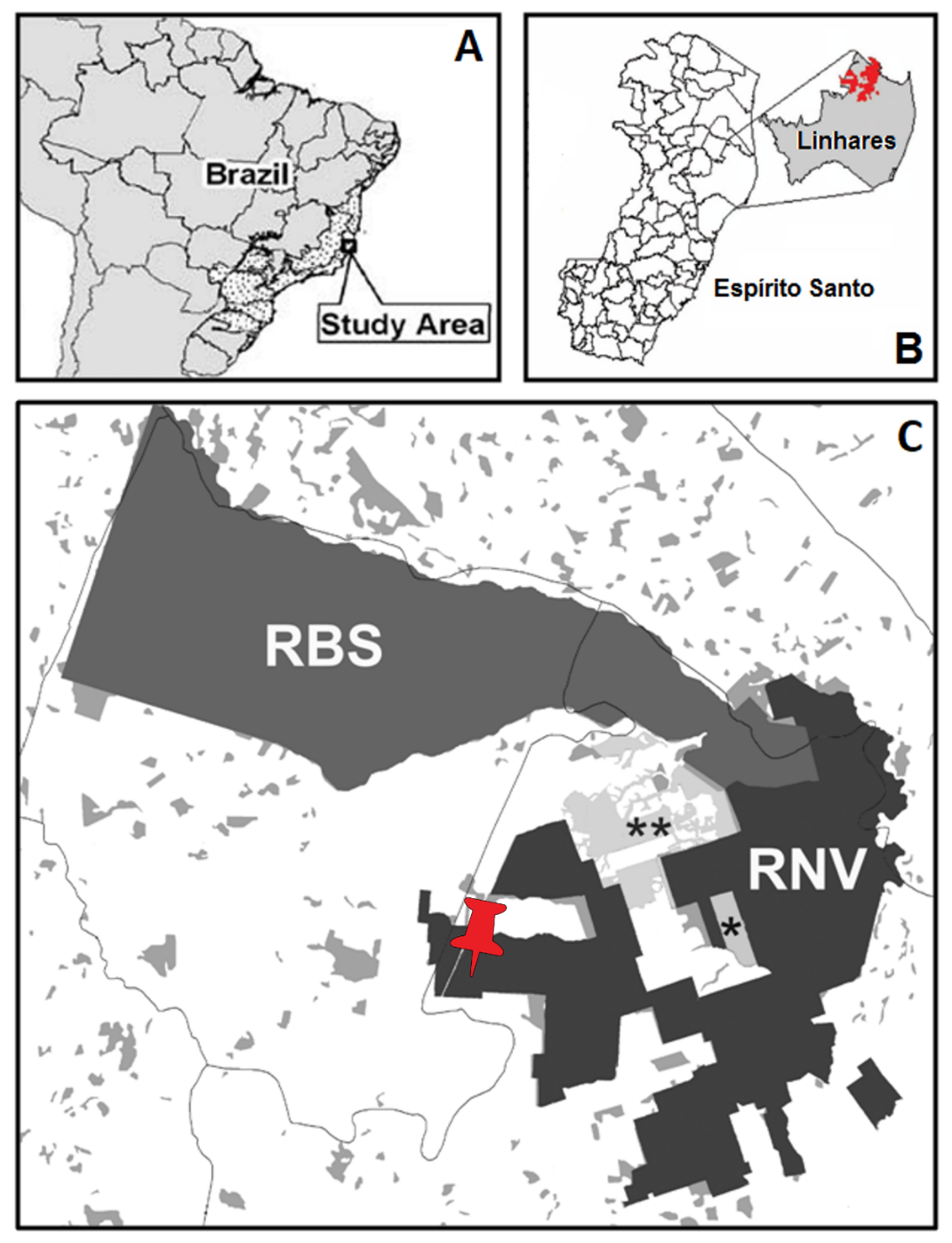
Figure 1: Location of the record of the Thin-spined Porcupine (Chaetomys subspinosus) preyed by a bird of prey in Vale Natural Reserve (RNV), in the northern Espírito Santo state, southeastern Brazilian Atlantic Forest (A,B). The Sooretama Biological Reserve (RBS), Mutum Preto Natural Heritage Private Reserve (*), Recanto das Antas Natural Heritage Private Reserve (**) and surrounding Atlantic Forest remnants (light gray polygons) are also shown (C).
The carcass of a recently slaughtered mammal was found on 13 January 2009 at 08:15h on the visiting trail located in the RNV public use area (19°09’15’’ S, 40°04’12’’ W; Figure 1). The carcass was being consumed by a bird of prey at the time of the recording.
Results and Discussion
The fresh carcass was identified as being a Chaetomys subspinosus. Although Chaetomys subspinosus has similarities with the genus Coendou, this species differs on its general morphology (mainly the shape of the head, muzzle and ears, and tail features), having spines not stiff as the other Neotropical porcupine species [2, 3].
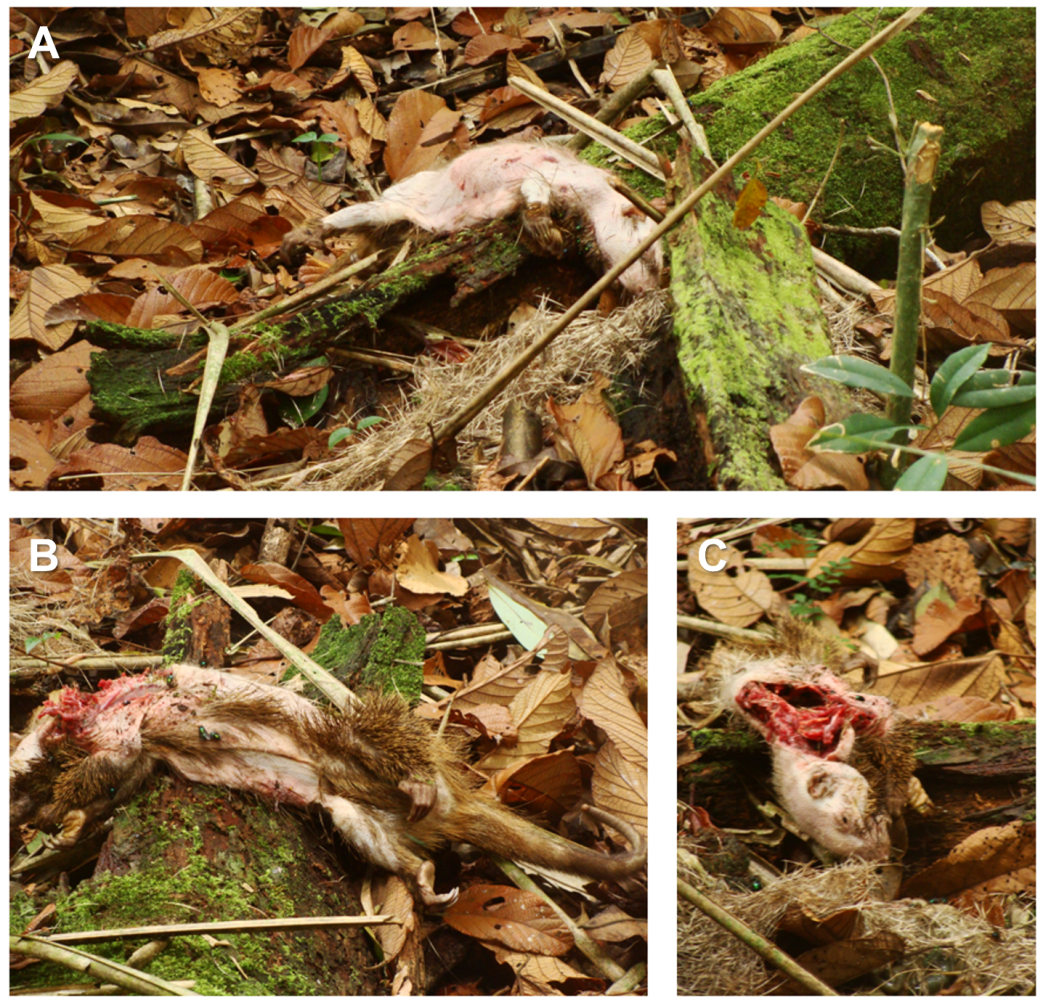
The porcupine recorded at RNV was over a fallen tree trunk and had a cut in the thoracic region through which the predator had removed its stomach and intestines (Figure 2). Curiously, the predator had also removed almost all the spines of the head and ventral portion of the rodent, including neck, thorax, abdomen, and proximal half of the limbs, except distal half of the limbs (forefeet and hind feet) and tail (Figure 2). The stomach, the intestines, and the spines were lying on the forest floor, next to the carcass (Figure 2), indicating that the prey had not been dragged after the removal of the entrails and spines. By the approach of the observers (two visitors and a local guide), the predator left the carcass and flew away, not been possible to identify the bird species precisely. However, it was possible to see that it was a medium to large-sized bird of prey (Humberto Luiz Cerri Junior, personal communication). Given the time of day, the guide’s knowledge of the region’s avifauna and the list of bird species present in the RNV [16], it was probably a hawk or a hawk-eagle (Family Accipitridae). Upon returning to the area few minutes later (the local guide and I), the carcass had been removed from the site. Spines and some hairs were collected, which helped confirm the identification of the porcupine species.
The use of tall trees with high amount of lianas and the avoidance of resting and traveling on the top of tree crowns are considered strategies to reduce the predation risk by limiting the access by terrestrial and aerial predators [8]. These behavioral aspects may provide advantages, helping to explain the scarcity of records (number of studies) and the low predation rate of Chaetomys subspinosus in the diet of its known predators (Percent occurrence: Jaguar = 0.7% [12]; Puma = 1.9% [13]; Frequency of occurrence: Harpy eagle = 0.8% in Espírito Santo, and 0.3% in Bahia state [14]). I would like to emphasize that the previous studies providing information on predation of Chaetomys subspinosus (except for the record from Bahia) were conducted in the same region as the present record.
Chaetomys subspinosus is classified as Vulnerable to extinction and its main threats are the loss of habitat to agriculture (crop and livestock production) and the isolation of populations due to habitat fragmentation [17, 18]. The genetic assessment from natural populations along its geographical distribution (sampled from south of Sergipe, central coast of Bahia and south of Espírito Santo) shows that the species may have formed a continuum along its past distribution but the recent human historical events in the biome resulted in recent divergence among sampled populations [11]. The hunting pressure [17, 19] and roadkills [20, 21] are other relevant threats that also should be considered to the species.
The Thin-spined Porcupine is present in lowland forest [5, 8, 19] and mountain forest [6], in primary and secondary forests, although it’s found much more commonly in Restinga, a vegetation type of Atlantic Forest occurring on sandy soils close to the beach [7, 10]. However, the high abundance in Restinga may be a biased data because might be easier to spot the species in forests with less complex structure [7]. Whereas the remaining of native vegetation in Sergipe, Bahia and other regions of Espírito Santo are small sized fragments, the BLS is currently the largest Atlantic Forest remaining with confirmed occurrence of this endemic species. In this scenario, this large remnant may be classified as the most important area for Chaetomys subspinosus conservation in the entire biome. Future studies on population ecology in this area are strongly recommended to access the local status of the species.
The present communication provides information on the natural history of Chaetomys subspinosus, confirming that medium to large-sized bird of prey, in addition to the harpy eagle, can be its predators. It also reinforces the importance of the lowland forests of the northern Espírito Santo, specially the BLS, for the knowledge and conservation of this threatened porcupine species.
Conflicts of Interest
The author declares that there are no conflicts of interest associated with this publication.
Acknowledgments
I thank Vale S.A. / Instituto Ambiental Vale for the support of the activities conduced at Vale Natural Reserve; and the Fundação de Amparo à Pesquisa e Inovação do Espírito Santo for a productivity fellowship (Bolsa Pesquisador Capixaba - FAPES 404/2022). I’m also grateful to Humberto Luiz Cerri Junior (local guide) for providing information on the predation record; and Alice Menezes (visitor) for kindly providing the photos used in the manuscript.
References
-
Vilela RV, Machado T, Ventura K, Fagundes V, Silva MJ, Yonenaga-Yassuda Y (2009) The taxonomic status of the endangered thin-spined porcupine, Chaetomys subspinosus (Olfers, 1818), based on molecular and karyologic data. BioMed Central Evolutionary Biology 9: 29-46.
-
Bonvicino CR, Oliveira JA, D’Andrea PS (2008) Guia dos Roedores do Brasil, com chaves para gêneros baseadas em caracteres externos. Rio de Janeiro: Centro Pan- Americano de Febre Aftosa.
-
Oliver WLR, Santos IB (1991) Threatened endemic mammals of the Atlantic Forest region of south-eastern Brazil. Wildlife Preservation Trust Special Scientific Report 4: 1-126.
-
Moojen J (1952) Os Roedores do Brasil. Rio de Janeiro: Instituto Nacional do Livro / Biblioteca Científica Brasileira.
-
Giné GAF, Duarte JMB, Motta TCS, Faria D (2012) Activity, movement and secretive behavior of a threatened arboreal folivore, the thin-spined porcupine, in the Atlantic Forest of southern Bahia, Brazil. Journal of Zoology 286(2): 131-139.
-
Chiarello AG, Passamani M, Zortéa M (1997) Field observations on the thin-spined porcupine, Chaetomys subspinosus (Rodentia: Echimyidae). Mammalia 61(1): 29-36.
-
Oliveira PA, Souto Lima RB, Chiarello AG (2012) Home range, movements and diurnal roosts of the endangered thin-spined porcupine, Chaetomys subspinosus (Rodentia: Erethizontidae), in the Brazilian Atlantic Forest. Mammalian Biology 77(2): 97-107.
-
Giné GAF, Barros EH, Duarte JMB, Faria D (2015) Home range and multiscale habitat selection of threatened thin-spined porcupine in the Brazilian Atlantic Forest. Journal of Mammalogy 96(5): 1095-1105.
-
Giné GAF, Duarte JMB, Faria D (2010) Feeding ecology of a selective folivore, the thinspined porcupine (Chaetomys subspinosus) in the Atlantic Forest. Journal of Mammalogy 91(4): 931-941.
-
Souto Lima RB, Oliveira PA, Chiarello AG (2010) Diet of the thin-spined porcupine (Chaetomys subspinosus), an Atlantic Forest endemic threatened with extinction in southeastern Brazil. Mammalian Biology 75(6): 538- 546.
-
Oliveira CG, Martinez RA, Giné GAF, Faria D, Gaiotto FA (2011) Genetic assessment of the Atlantic Forest bristle porcupine, Chaetomys subspinosus (Rodentia: Erethizontidae), an endemic species threatened with extinction. Genetics and Molecular Research 10(2): 923- 931.
-
Garla RC, Setz EZF, Gobbi N (2001) Jaguar (Panthera onca) food habits in Atlantic Rain Forest of southeastern Brazil. Biotropica 33: 691-696.
-
Brito BFA (2000) Ecologia alimentar da onça parda Puma concolor na Mata Atlântica de Linhares, Espírito Santo. Master Thesis. University of Brasília, Brasil.
-
Kaizer M, Fabres B, Aguiar-Silva FH, Sanaiotti TM, Dias AR, Banhos A (2023) The prey of the Harpy Eagle in its last reproductive refuges in the Atlantic Forest. Scientific Reports 13: 18308.
-
Srbek-Araujo AC, Rocha MF, Peracchi AL (2014) A Mastofauna da Reserva Natural Vale, Linhares, Espírito Santo, Brasil. Ciência & Ambiente 49: 153-167.
-
Srbek-Araujo AC, Simon JE, Magnago GR, Pacheco JF, Fonseca PSM, et al. (2014) A Avifauna da Reserva Natural Vale, Linhares, Espírito Santo, Brasil. Ciência & Ambiente 49: 169-191.
-
Catzeflis F, Patton J, Percequillo A, Bonvicino C, Weksler M (2017) Chaetomys subspinosus. In: IUCN 2017. The IUCN Red List of Threatened Species.
-
MMA (2022) Portaria nº 148, de 07 de junho de 2022: Atualização da Lista Nacional de Espécies Ameaçadas de Extinção. Brasília: Ministério do Meio Ambiente.
-
Castilho LC, Martinez RA, Giné GAF, Ribeiro GC, Schiavetti A (2013) The thin-spined porcupine, Chaetomys subspinosus (Rodentia: Erethizontidae), within protected areas in the Atlantic Forest, Brazil: local knowledge and threats. Tropical Conservation Science 6(6): 796-810.
-
Klippel AH, Oliveira PV, Britto KB, Freire BF, Moreno MR, et al. (2015) Using DNA Barcodes to identify road-killed animals in two Atlantic Forest Nature Reserves, Brazil. PLoS One 10(8): e0134877.
-
Srbek-Araujo AC, Alvarenga AC, Bertoldi AT (2018) Do we underestimate the impact of roads on arboreal animals? Roadkill as an important threat to Chaetomys subspinosus (Mammalia: Rodentia). Biota Neotropica 18(3): e20170511.
- California Red-Legged Frog and Non-Listed Amphibians Response to Non-Native Fish Removal
- Industrial Standardization of the Bio-OS: Algorithmic Codification of Resilience Engineering Guidelines and Version V8 Architecture
- Climate Variability and the Sustainability of Snail Farming in Nigeria: Past Trends, Present Challenges and Potential Outlook
- The Evaluation of the Surveillance System of Anthrax in Gilgit-Baltistan, Pakistan, 2018
- Natural Decline to Extinction of A New Zealand Rabbit Population
- Mitochondrial Bio-Logistics: Steering Co-Enzyme Q10 and Lycopene Synergies within the Science 4.0 Bio-OS Framework