
Perspectives and Potentials of the Objective Regressive Regression Methodology in Terms of One Health
The possibility of having a methodology that allows the modelling and prediction, in the short, medium and long term, of biological, social and natural disaster processes and/ or phenomena is something great.
Opinion
The possibility of having a methodology that allows the modelling and prediction, in the short, medium and long term, of biological, social and natural disaster processes and/ or phenomena is something great. The aim of the research was to demonstrate the potential and real applicability of the methodology of Objective Regressive Regression (ORR) in different fields and branches of scientific research, especially in the medical and veterinary sciences. Wide possibilities of modelling and forecasting in time offer this methodology, which go beyond the modelling of infectious entities of parasitic and viral etiology, Acute Respiratory Infections, Acute Bronchial Asthma crises, forecasting of extreme meteorological disturbances, prediction of the latitude and longitude of earthquakes, modelling of climatic variables, and even the electricity consumption of a municipality, province and nation. The ROR methodology has demonstrated potential and real capacities for application in different fields and branches of science, making it a novel contribution to the science of modelling and forecasting variables to know the future, as well as the impact that different variables contribute to an event or phenomenon, and as it is universal, Opinion it can be applied anywhere in the universe.
Humanity has suffered throughout history from the scourge of potentially fatal viral and parasitic diseases, including Yellow Fever, Dengue, Zika, Chikungunya and Malaria, most of which often involve a mosquito (Diptera: Culicidae) as a common factor. These diseases are widespread in the tropics, with local variations in risk largely dependent on rainfall, temperature and rapid unplanned urbanisation, among others.
In addition to these problems, global warming and the intensification of extreme weather disturbances have brought about changes in disease behaviour and transmission, with the establishment of vector species in previously unrecorded locations.
The increase in diseases transmitted by vector-borne organisms increasingly commits the scientific community to prioritise the search for much more efficient, economic, feasible and sustainable control alternatives over time, where the use of mathematical modelling has been applied in different fields of study in recent decades. There are about 77 known equations referring to sigmoidal growth models, which are used in epidemics, bioassays, agriculture, engineering fields, tree diameter, forest height distribution, etc., and where cumulative growth models over time have played an important role, as well as many researchers who have contributed to the knowledge of models developed in a relevant way.
There is the possibility of making high quality, precise and accurate forecasts using various methodologies, among which the methodology of Objective Regression (ORR) stands out, which due to its simplicity and accuracy can open an important window to know the future of climatic variables or daily data, years in advance and even many more; This cycle can be extended to the 11 years of the solar cycle, or to higher cycles that are known in nature; it can also model the population dynamics of mollusks and insects, such as culicidae and their interactions with certain environmental variables, in order to establish prophylactic and timely control measures in entomoepidemiological surveillance programmes. Consequently, there is a growing need to develop and implement other strategies and alternatives for the control of infectious entities and their vector organisms, which can complement existing methods in a more effective and efficient way.
A synthesised compendium discussion of the main results obtained and published from 2000 to 2023 related to the application of the ROR methodology on six fronts/lines of research was carried out:
- The ROR methodology as a function of the control of Culicidae populations.
- ROR methodology and its impact on river and terrestrial malacofauna of veterinary medical interest.
- The ROR methodology and its application to transmissible infectious entities
- The ROR methodology applied to Acute Respiratory Infections and Bronchial Asthma Crises
- The applicability of the ROR methodology in natural disasters
- The ROR methodology vs COVID-19 The methodology of the Objective Regressive Regression ROR, in a first step, dichotomous variables DS, DI and NoC are created, where: NoC: Number of base cases, DS = 1, if NoC is odd; DI = 0, if NoC is even, when DI=1, DS=0 and vice versa. Subsequently, the module corresponding to the Regression analysis of the statistical package SPSS version 19.0 (IBM Company) is executed, specifically the ENTER method where the predicted variable and the ERROR are obtained.
Then the autocorrelograms of the variable ERROR will be obtained, paying attention to the maximums of the significant partial autocorrelations PACF. The new variables are then calculated according to the significant Lag of the PACF. Finally, these regressed variables are included in the new regression in a process of successive approximations until white noise is obtained in the regression errors.
The ROR Methodology for the Control of Culicidae Larval Populations
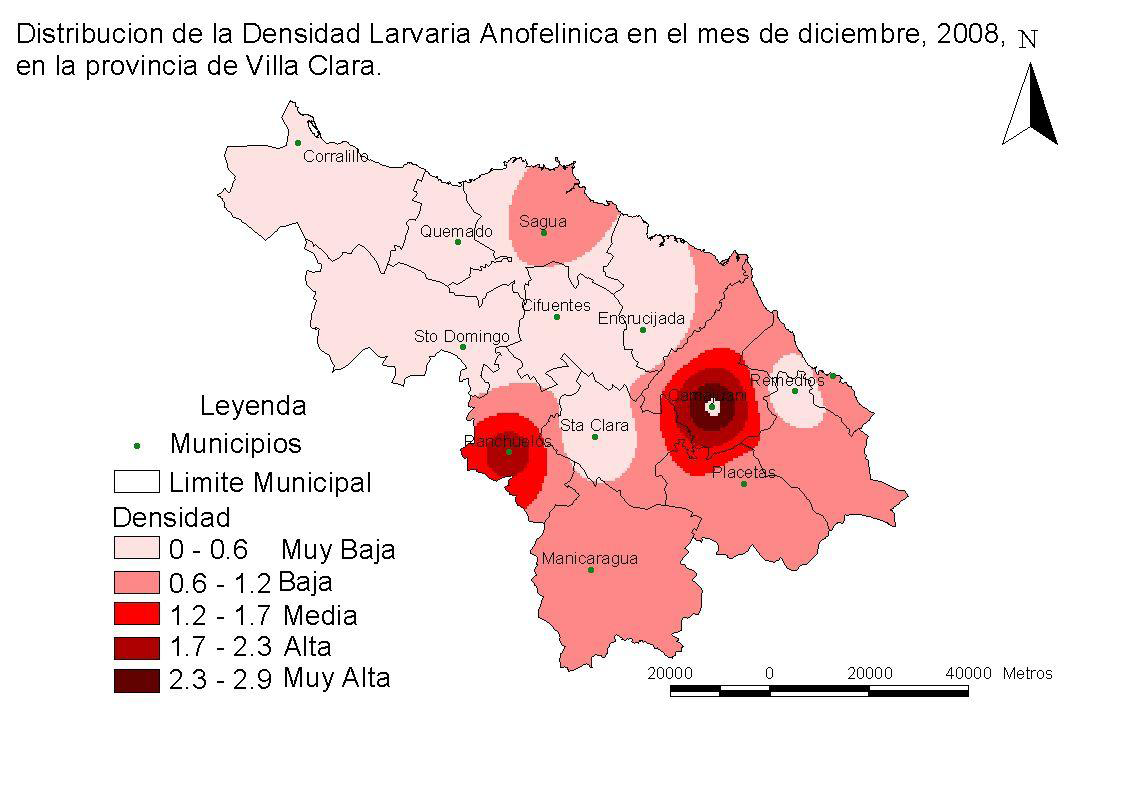
A set of monthly data on general and specific larval density (Anopheles) was processed for the period from 2000 to December 2008 for nine municipalities in Villa Clara province, which allowed us to make short-, medium- and long- term forecasts of larval density, as shown in Figures 1 & 2.
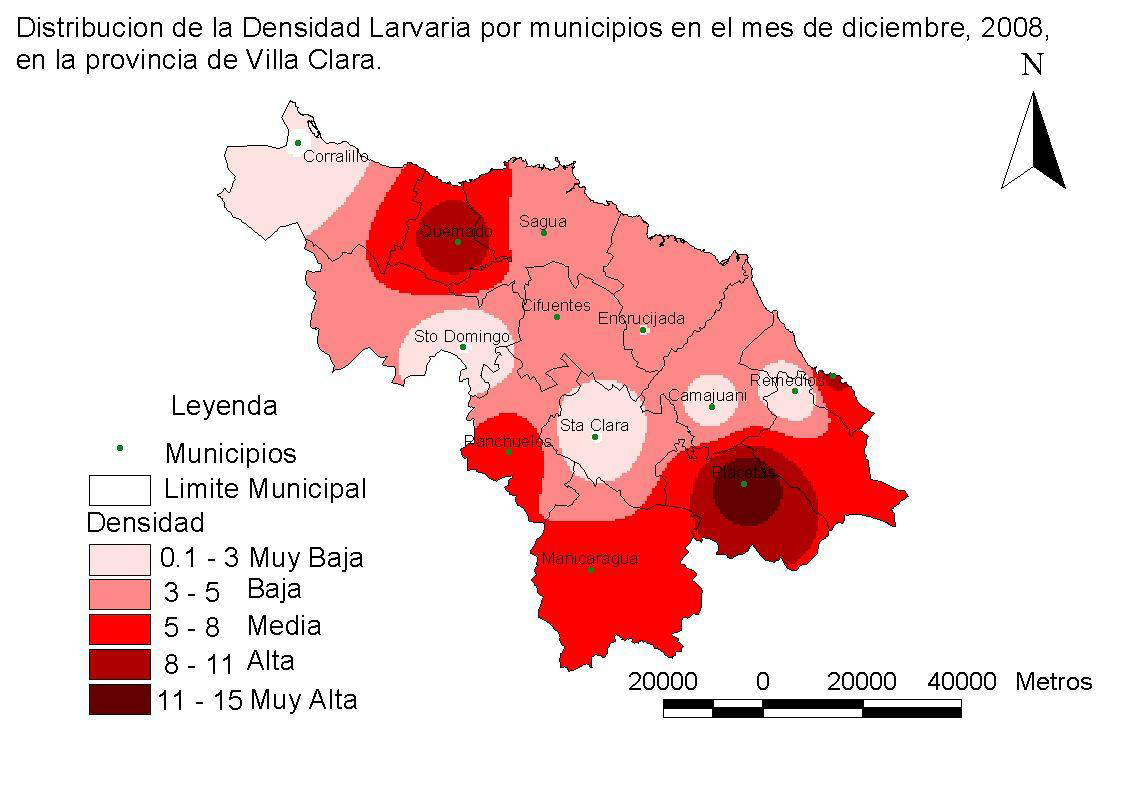
The following shows the general larval density forecast (DLG) for the municipalities of Villa Clara province that were studied in December 2008. The municipalities Quemado de Güines and Placetas stand out, with high and very high densities respectively, while Caibarién, Manicaragua and Ranchuelo have medium densities and in the rest of the municipalities, the values were low or very low.
In the case of Anopheline/specific larval density (ALD), values were very high in Camajuaní, high in Ranchuelo, while in Placetas there were low values in almost the entire territory, except for the central northern part of the municipality. In Sagua and the rest of the municipalities, the values were low and very low. It should be noted that the municipality of Santa Clara did not provide data, so the values shown on the map correspond to extrapolations.
The following shows the general larval density forecast (DLG) for the municipalities of Villa Clara province that were studied in December 2008. The municipalities Quemado de Güines and Placetas stand out, with high and very high densities respectively, while Caibarién, Manicaragua and Ranchuelo have medium densities and in the rest of the municipalities, the values were low or very low.
All this allowed us to create an Early Warning entomological surveillance system, which allows us to stratify the epidemiological risk in a prophylactic/preventive manner, as well as the preparation of epidemiological bulletins by means of stratified maps, which results in savings of resources, both material, economic and human; it should be noted that this collaboration between the UPVLA and the Provincial Meteorological Centre of Villa Clara yielded excellent results and magnificent results in practice, during the years of implementation of these forecasting models (2007-2010).
The ROR Methodology and its Incidence in Fluvial and Terrestrial Malacofauna of Veterinary Medical Interest
The objective of the research was to model the bimonthly mollusk data series for total angiostrongylosis in Villa Clara province, Cuba in the period from 2004 to 2015 and to forecast the behaviour until 2020 of this entity, using the ROR methodology.
The model for the angiostrongylosis entity was obtained using the ROR methodology, which presents an R of 0.96, with an error of 324.15. Fisher’s F 166.235, significant at 100, this model presents as independent variables the values predicted by the previous regressed models. Angiostrongylosis regressed on three bimesters (Lag3angiostot) and the average temperature of the Yabú station, also regressed on three bimesters. The DS and DI variables, which reflect the ups and downs of the series, were not significant, as was the trend, but this should not worry us, because we are using predicted variables, which have less variability than the real ones, to predict. Angiostrongylosis regressed on three bimesters is still significant at 90%. The NoC trend is lower than that reported by other authors.
The ROR Methodology and its Application in Infectious Communicable Entities Dengue
The distribution of confirmed cases of dengue fever in Villa Clara province during the period from January 2019 to December 2020 is shown below. It is observed that there is an increasing trend from May to October (Figure 3).
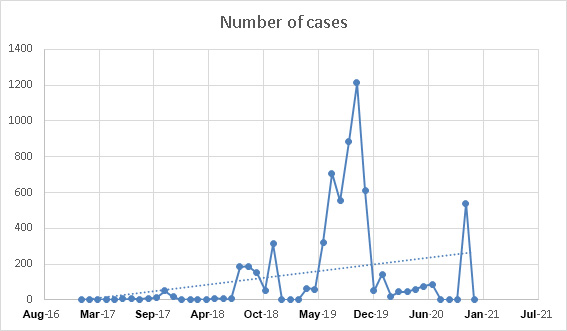
Source: Overview of notifiable diseases. Villa Clara 2017-2020. Figure 3: Distribution of confirmed cases of Dengue according to month of confirmation. Villa Clara 2017-2020.
The ROR model in question consists of the following variables: SD and DI, which are dichotomous variables and the number of Dengue cases in backward steps in 1, 2, 8, 10 and 14 months (Lag1Total, Lag2Total, Lag8 Total,Lag10 Total, lag14 Total), depends furthermore, on the regressed Tmin in 1 month (Lag1Tmin), and the Precipitation regressed on 17 months (Lag17Prec), as this increases, the cases of Dengue increase, for example, when the precipitation is 100 mm, the number of cases of Dengue increases by 131 cases in the month, the tendency was significant to increase in 41 cases.
The ROR Methodology Applied to Acute Respiratory Infections and Bronchial Asthma Crises
Acute Respiratory Infections (ARI) and Acute Bronchial Asthma Crises (ABAB) are diseases that can be monitored well in advance. In the following work a one-year ahead prognosis is made for these two variables, yielding highly significant correlations and small errors. Daily data from the hospital in Sagua La Grande, Villa Clara, Cuba, from January 2006 to 28 February 2011 were used. The long-term independent sample or prediction period was from 1 March 2010 to 28 March 2011, with a total of 365 cases. Modelling was also performed by first calculating the long-term forecast, where the predicted value was used as a predictor for the short-term model, and the errors for the independent sample were calculated, resulting in an improvement in the errors in the case of CAABs, with the mean error decreasing from 18.7 cases to 1.68 cases. It is possible to predict daily ARI and CAAB cases up to one year in advance using the Objective Regressive Regression (ORR) methodology.
The correlation between predicted value and independent sample for CAAB was 0.384, significant at 99%. This prediction method for daily CAABs one year in advance exceeds by six months that obtained by other authors in this respect, which was six months in the case of municipal CAABs, which logically presented less variability and used dummy variables, our method also exceeds other previous works, where municipal data were also used six months in advance, even further back in time models had been obtained that predicted four months in advance, but these referred to monthly CAAB values, and here they are also surpassed by our results; Furthermore, it is our conviction that CAAB and IRA can be estimated on the daily scale 11 years in advance and even further, as well as the three-hourly air pressure.
The above has a direct impact on the species of vector organisms transmitting infectious entities, to which climate change, with its more than 20 natural phenomena, is directly responsible for the increasing spread and presentation in different tropical and subtropical regions of infectious entities of viral and parasitic etiology, as well as the spread, irradiation and propagation of the different genera and species of vectors, mainly Anopheles, Aedes aegypti (Linnaeus, 1762) and Ae. albopictus Skuse 1895.
If we take into account all of the above, plus the results obtained in articles published on the subject under analysis, we can expect, in the very near future, transient/temporary ecological shifts/shifts for culicid species from coastal ecosystems to urban ecosystems/settlements, even more than 50 km away from the coasts, with the consequent epidemiological consequences that this phenomenon could bring with it, both for human health and for the rest of the animals; i.e. focal outbreaks of zoonotic entities in areas/ sites that do not coincide with the ecology and biology of vector and intermediate host species.
Earthquakes in Haiti
The objective of the work consisted of modelling the data series of earthquakes in Haiti of magnitude 6 or more that have occurred in this country in the period 2000-2011, and in this way, achieve a forecast until the year 2096 to try to save lives and have a better management of earthquakes.
Figure 4 shows the forecast for the year and its increase according to the trend of earthquakes at a global level, which is increasing.
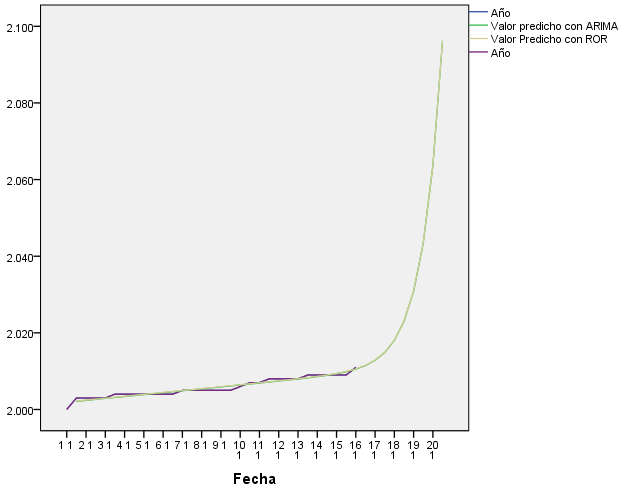
Next, the long-term model for latitude explains 99.3 with an error of 4.97, there is no trend in latitude. While for the longitude the model explains 99.9 with an error of 5.71, in this case the tendency is to decrease, i.e. the earthquakes tend to occur towards shorter longitudes in the Haitian territory. As we do not have the latitude and longitude data for the earthquake of 14 August, since we do not have Internet due to COVID-19, we will focus on the next large magnitude earthquake (6.6 ° on the Risterch scale), which should occur in the year 2031, according to the forecast for all parameters (latitude, longitude, depth, month, day, hour and minute).
Methodology ROR vs COVID-19
Table 2 shows the model obtained according to ROR; the trend is positive and significant at 99%, the other parameters contribute explained variance to the model, although they are not significant. This model depends on the number of deaths 14 days ago, and the value is negative, which indicates that, from 14 days until now, the trend of deaths is negative, i.e. decreasing, so that the procedures in the wards for these patients are highly valued.
The model of severe cases depends on the cases six days ago (Lag6Graves) and shows an increasing trend, although not significant. As known, SD and DI are parameters that describe the ups and downs of the series and keep the data within a certain range.
Results for New Cases in Cuba
The long-term model for Cuba, particularly the new cases, it can be seen that the model explains 98 % with an error of 9.47 cases, the Durbin Watson statistic is close to 2, so we are dealing with a model where the errors are white noise and can be considered a good model. The long-term model for the municipality of Santa Clara explains 96.8 % with an error of 1.76 cases, where the Durbin Watson statistic is close to 2, so we are dealing with a model where the errors are white noise and can also be considered a good model.
When analysing the long-term model ten days in advance (this model explains 88.5 % of the cases), where without any doubt, all the isolation measures have had a positive effect and the process has behaved as predicted by the mathematical model; or rather, the mathematical model has followed what is happening in reality, so this is the most important result, which coincides with results obtained in previous years for other entities and living organisms. Everything seems to indicate that this pandemic is closely related to climatic variables, and something very important to bear in mind is that the maximum temperature is increasing and the number of cases is decreasing with respect to the peak of 8, which has been corroborated in research carried out in previous years for other entities and the ARI themselves.
The adjusted ROR model predicted that the number of new cases could reach 10,000, so hygienic sanitary measures such as massive, daily and sustained use of masks and social distancing should be intensified.
It is concluded that COVID-19, despite being a new disease in the world, can be monitored, followed up, supervised and controlled using the ROR methodology, which allows for a reduction in the number of deaths, serious and critical patients and new cases, as well as better management and handling of the pandemic by the health authorities. It is necessary to carry out studies correlating data on meteorological variables or the behaviour of ARI at the national level to see how they behave, which could provide a better understanding of the pandemic and its control.
For all of the above reasons, the ROR methodology as a linear mathematical methodology has demonstrated potential and real capacities for application in different fields and branches of science. This methodology allows not only to mathematically model the larval densities of mosquitoes, as well as the population dynamics of mollusks, but also goes further (possibility of modelling infectious entities of different etiologies (parasitic and viral), such as HIV/AIDS, Cholera, Chikungunya, Dengue, Influenza, Acute Respiratory Infections (ARI), Acute Respiratory Infections (ARI), acute respiratory crises (ARI) and other infectious diseases, Acute Respiratory Infections (ARI), Acute Bronchial Asthma (CAAB), Zika, Angiostrongylosis, Fasciolosis, Malaria and even in the estimation of the longitude and area of the universe, monthly forecasting of precipitation and extreme temperatures, forecasting of extreme meteorological disturbances (cyclones and hurricanes); predicting the latitude and longitude of earthquakes, searching for information on white noise, modelling the Equivalent Effective Temperature (EET) and Atmospheric Pressure (AP), and even the electricity consumption of a municipality, province and nation. Undoubtedly, the methodology in question is a contribution to the science of modelling and forecasting variables to know the future, as well as the impact of different variables, and what they contribute to an event or phenomenon; so it is a powerful tool to explain the phenomena of nature and society, since being universal, it can be applied anywhere in the universe.
- California Red-Legged Frog and Non-Listed Amphibians Response to Non-Native Fish Removal
- Industrial Standardization of the Bio-OS: Algorithmic Codification of Resilience Engineering Guidelines and Version V8 Architecture
- Climate Variability and the Sustainability of Snail Farming in Nigeria: Past Trends, Present Challenges and Potential Outlook
- The Evaluation of the Surveillance System of Anthrax in Gilgit-Baltistan, Pakistan, 2018
- Natural Decline to Extinction of A New Zealand Rabbit Population
- Mitochondrial Bio-Logistics: Steering Co-Enzyme Q10 and Lycopene Synergies within the Science 4.0 Bio-OS Framework