
A Social Epigenetic Theory of Systemic Transitions
In high-stakes environments—such as air traffic control, emergency management, or complex logistics—the human operator is the central pivot of an uninterrupted flow of information and action. These individuals are required to maintain constant vigilance under extreme pressure. However, modern organizational science often overlooks the fundamental biological limits of human adaptation.
Introduction
The Human Factor in Critical Flow Systems
In high-stakes environments—such as air traffic control, emergency management, or complex logistics—the human operator is the central pivot of an uninterrupted flow of information and action. These individuals are required to maintain constant vigilance under extreme pressure. However, modern organizational science often overlooks the fundamental biological limits of human adaptation.
This paper introduces the S.E.T. Theory (Stress- Epigenetic-Transition). We observe that under chronic social and professional pressure, individuals do not merely suffer from mental fatigue; they undergo a structural epigenetic mutation. The shift from a state of controlled performance to systemic failure is not a gradual slope but a sharp, non-linear transition triggered by a cellular “locking” mechanism.
The Biological Mechanism: The NR3C1 Gene Locking
At the core of this theory lies the Stress Response Axis, known as the HPA Axis (Hypothalamic-Pituitary-Adrenal axis). Under normal conditions, the body produces cortisol to react to stimuli, and the NR3C1 gene creates receptors that “capture” this cortisol to signal the system to calm down.
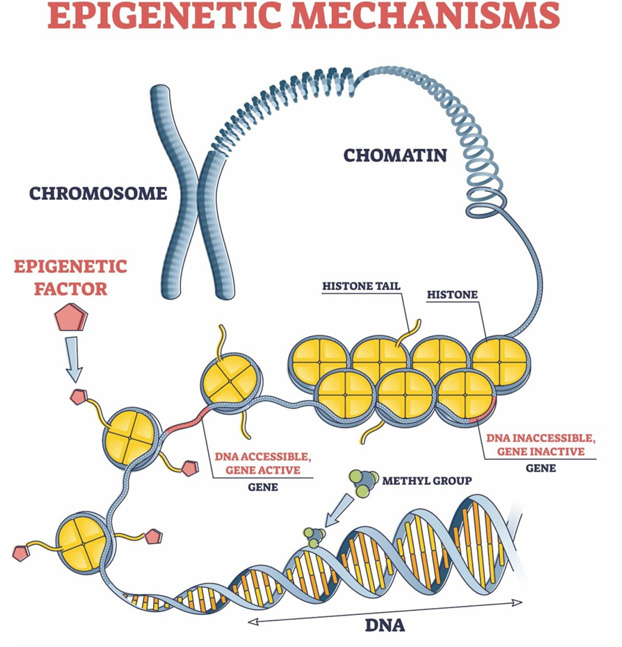
The Epigenetic Lock: In a subject exposed to years of micro-stress without adequate recovery, the NR3C1 gene undergoes DNA methylation. This chemical modification acts as a biological “lock,” preventing the gene from being expressed (Figure 1).
The Result: The brain’s “off-switch” for stress becomes rusted in the “ON” position. The individual remains in a state of hyper-vigilance and biological alert, even during rest, leading to a permanent state of physiological exhaustion.
The S.E.T. Modeling: Stress, Epigenetic, Transition To formalize this phenomenon, we propose a state transition equation that quantifies the risk of systemic failure: T = S * E lock S (Cumulative Stress): The sum of external environmental and social constraints such as traffic volume, noise, and high- stakes decision-making. E lock (Epigenetic Lock): The coefficient of NR3C1 gene methylation, representing the biological resistance limit. T (Transition Point): The rupture point where the subject loses cognitive processing capacity and becomes a threat to the system’s safety.
This modeling demonstrates that as long as the E lock threshold is not reached, the individual appears resilient. However, once the epigenetic modification occurs, the system inevitably tips toward human error and systemic collapse.
Convergence with Systemic Dynamics Individual biological stress does not exist in a vacuum; it fuels collective instability. To understand how the failure of a single “locked” individual can trigger a total system collapse, the S.E.T. Theory integrates biological data into macroscopic flow models.
Phase transitions toward instability in complex organizations are biologically driven. By identifying the NR3C1 biological lock as a key variable, we can mathematically predict the tipping points of systemic failure. Biological individual stress is the primary fuel for collective decomposition.
Conclusion Towards Epigenetic Management The S.E.T. Theory proves that “burn-out” or systemic failures are not inevitable accidents but the predictable consequences of ignored biological parameters.
Key Recommendations: Detection: To secure global flows—whether in aviation, finance, or logistics—we must develop tools to detect NR3C1 gene locking. Rethinking Labor: This manuscript is a call to rethink human labor, moving away from pure productivity metrics and toward Epigenetic Integrity. Systemic Risk: If we fail to protect the genome of the actors within these flows, the systems will eventually self- destruct.
- Industrial Standardization of the Bio-OS: Algorithmic Codification of Resilience Engineering Guidelines and Version V8 Architecture
- Climate Variability and the Sustainability of Snail Farming in Nigeria: Past Trends, Present Challenges and Potential Outlook
- The Evaluation of the Surveillance System of Anthrax in Gilgit-Baltistan, Pakistan, 2018
- Natural Decline to Extinction of A New Zealand Rabbit Population
- Mitochondrial Bio-Logistics: Steering Co-Enzyme Q10 and Lycopene Synergies within the Science 4.0 Bio-OS Framework
- Hymenoptera Specimens from the Caño Negro Wetland, of the National Museum Collection, Costa Rica