
Australian Magpies Copy an Unrecorded Behaviour of Brown Hares: "Watch-Guarding"
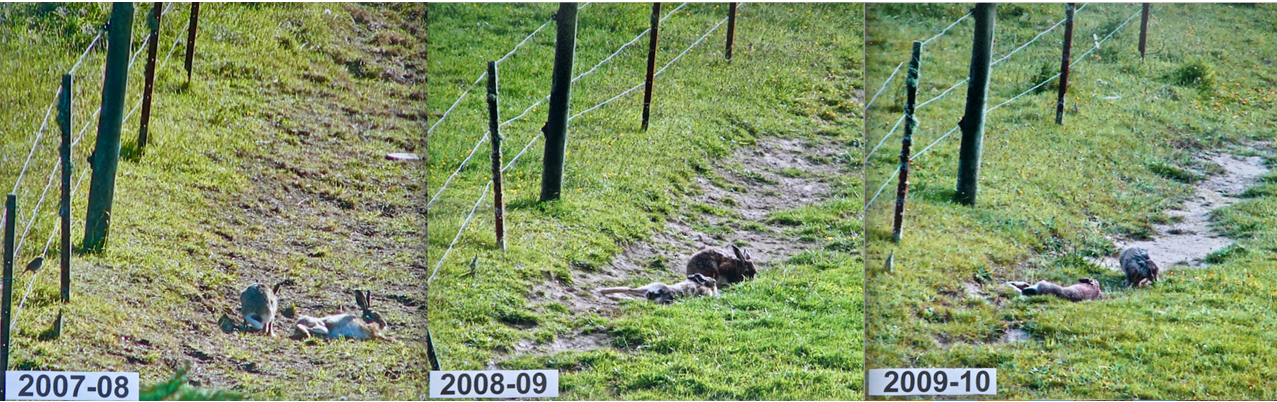
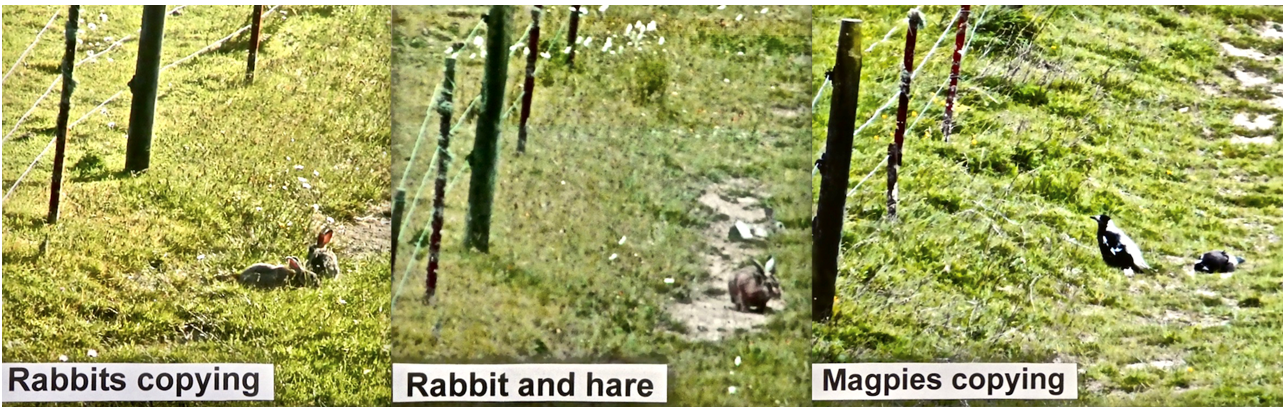
Hundreds of photographs of hares (Lepus europaeus Pallas, 1778), taken at random whenever seen in the field opposite our house in Belmont, Lower Hutt, New Zealand, 2005-2016, revealed a curious, apparently unrecorded, behaviour. Each summer, two hares came to the same fence-post. One lay on its side for several minutes, not moving, while the other stood within 1m watching it. Then both ran away. No hares behaved like this anywhere else in the field; and nothing like it has been reported overseas. Rabbits (Oryctolagus c. cuniculus (Linnaeus, 1758)) copied the hares, but often behaved like this elsewhere. Two Australian magpies (Gymnorhina tibicen (Latham, 1801)) copied them exactly, at the same fencepost. Both were adult, and such extraordinary behaviour has never been recorded before. Other birds, horses, cattle, sheep, dogs, cats, possums (Trichosurus vulpecula (Kerr,1792)), stoats (Mustela erminea Linnaeus, 1758) and weasels (M. nivalis vulgaris Erxleben,1777), and rats (Rattus norvegicus (Berkenhout, 1769) and R. rattus (Linnaeus 1758)), watched from the house, paid no attention to this location.
Introduction
The following text of the abstract submitted to the conference organisers, describing unrecorded hare (Lepus europaeus) behaviour, was printed as a poster-paper in the Proceedings of the 5th World Lagomorph Conference, California State University Stanislaus, Turlock, California, July 11-15, 2016.
Long-Term use of a Rest Area by Brown Hares in New Zealand
Hundreds of photos taken at random whenever hares (Lepus europaeus) or rabbits (Oryctolagus cuniculus) were seen from our house, on analysis showed one curious, apparently unreported, behaviour. In nine of the past 11 years, each summer (November to February) at various times of day, two hares spent 10-30 minutes near a fencepost. One lay on its side without moving for 3-10 minutes while the other “stood guard” close by, usually within a metre: then both ran off together to resume feeding. Different pairs were involved, but always at the same place each year. This behaviour was not seen elsewhere, although single hares rolled in dust or slept on their sides in other places. Once a pair of rabbits copied them, but rabbits often lay down on their sides anywhere. One hare even guarded a rabbit lying at the fencepost. Australian magpies (Gymnorhina tibicen), an intelligent and unusually playful bird, copied the behaviour.
The spot chosen was kept bare by 2-5 resident horses running the fence-line, but no other parts of the pathway were used, or the many bare patches elsewhere. There were no pellets or unusual scent, and the hares did not sniff the ground or dig as they do at dusting places. The aspect and shelter from the wind seemed no different from other parts of the field. Horses, cattle, sheep, dogs, mustelids, rats, and cats that were watched from the house paid no attention to this location.
Has anyone else seen such behaviour, or is able to suggest an explanation? At the last minute I was unable to attend, so this text, and 30 photographs I had prepared, illustrating the study area and annual repetition of this curious posture adopted by hares, were not displayed for comment at that meeting.
Materials and Methods
To promote discussion on the problem, I circulated a small selection of the poster photographs to other scientists, especially those working on hares, rabbits, or magpies, showing hares watch-guarding (Figure 1), and the rabbits and magpies copying them (Figure 2).
Results
The scientists consulted have suggested the following ideas, in an approximate order of probability: To dust bathe: This was seen elsewhere for hares and rabbits in dry weather, but never at that post. A pair of hares, one on its side, one watching like mine, is drawn to illustrate “sand-bathing” in Germany by Schneider [1]. To get warm: Being used only on fine days in summer, the lying hare would get warm; but only on one side, as they never turned over. This is recorded in Russia: “In early spring European hares prefer to lie down on slopes warmed by the sun...” [2]. A form of sleep: Hares normally “sleep” alone all day with their eyes open, and 2-4 minutes lying on their sides twitching with eyes shut [3]. Tame Irish hares showed “deep sleep never lasts for more than five minutes” [4] and “my hare will sleep, and sleeping dream, with closed eyes” [5]. Having a guard may allow the necessary relaxation; but they did not relax and twitch, and the odd location remains unexplained. To get salt, held in the clay soil from a cattle lick attached to the post in the past: But neither hare ever sniffed the ground here, or at other posts used for a cattle lick. To collect ants for lice control: No ants were ever seen there, the clay surface was often wet, and few lice have been found on hares in NewZealand. Some effect of the electrified fence-wires: Why was it restricted to one post? And the power was on only when cattle were there. That some odd genetic response was imported among the few original hares from Australia: Hares in New Zealand, and the UK where they came from, both arose from small numbers of the European population, reducing genetic variability [6]. New Zealand hares have aberrant molar teeth, and abnormally high incidence (5.6%) of ovarian cysts [7], so this behaviour may also be unique, as there is no sign of it overseas. Any function remains unclear.
Extremely accurate descriptions, backed by infra red videos, of every aspect of hare behaviour I know, in a small group of hares in rural England [8] do not feature watch- guarding.
Road-kill counts in New Zealand Flux, et al. [9] show that hare numbers have remained stable from 1963 to 2018. Rabbits were rarer than hares before 1980, when intensive control stopped, but soon became ten times more abundant. Observations began when rabbits were far commoner than hares, and hares may be copying this normal rabbit pose, not vice versa. The restriction to one fencepost remains unexplained.
Although a pair of hares is involved, none were individually marked, so the sexes were unknown. However, no recorded reproductive behaviour resembles this lying posture [10, 11, 12].
Anni Bock, who has many years experience watching and photographing these hares in Germany, reminded me (pers. com., 12 Oct. 2025) that “guarding” is common behaviour of a dominant male protecting a chosen mate from competing males, allowing her to feed and rest undisturbed. What is unusual here is the restriction to a single fence-post location by different pairs, and to the end of their long breeding season, which starts in mid-winter.
Three-year studies of the same species of hare in Nelson Lakes National Park, South Island, NZ; of L. timidus Linnaeus, 1758 in Scotland; and one year of L. capensis Linnaeus, 1758 and L.victoriae Thomas, 1893 in East Africa, by night and day, showed nothing resembling this behaviour.
Discussion
What ecological or evolutionary significance this novel, apparently previously unrecorded, form of behaviour may have is very hard to assess. Some reason/function must be found first. As McFarland [13] warns, “we can always invent a plausible adaptive advantage for an observed or supposed trait, and such speculation does not lead very far.” That rabbits occasionally copied the hares I attribute to chance. They live in groups, out-number and dominate the hares, and often copy each other, lying down, dusting, and feeding together. However, as suggested in comment No 9 above, they may well be the model copied by hares.
The copying by Australian magpies was totally unexpected. Gisela Kaplan an expert on these magpies, describes the recent awareness of science to cognition in birds, which “may not be ‘mindless’ at all, but...applied creatively in new situations”; and illustrates the ability of Australian magpies to point out objects to conspecifics.
A curious response to dogs by magpies arriving in Hawke’s Bay, NZ, in 1882 is recorded by Guthrie-Smith [14] “attacks on the sheep-dogs had become so intolerable...the wretched collies dared not follow their owners, who...were unable to muster the run without canine assistance”. Possibly the dogs’ black-and-white colour upset the birds, which were shot.
Anyone who has kept a tame magpie knows their remarkable intelligence, recognition of individual people, and diverse forms of play. Brockie, et al. [15] describe how a magpie identified itself in a mirror, and gave warning calls when snakes or crocodiles appeared on television. This bird even copied an artist by holding a paintbrush correctly. I have often seen young magpies play, pulling another lying on its back along the ground by its beak. My tame one swung upside-down on washing hung out to dry, as photographed by Kaplan, and played with clothes-pegs.
However, these are adult birds, one clearly lying on its side, and not being touched by the other. Such exact copying of the hares’ behaviour, incidentally, strongly supports the authenticity of my own observations. It is not a form of play.
Acknowledgements
The project was self funded. I am grateful to many scientific friends, especially Linda Sorensen and Anni Bock, for informal discussions on this problem. Both have given permission to be quoted. Also to family members, and visitors, for calling attention to any animals seen in the fields opposite our house.
References
-
Schneider E (1978) Der Feldhase; Biologie-Verhalten- Hege und Jagd. BLV Verlagsgesellschaft: Munchen.
-
Sokolov VE, Ivanitskaya E, GruzdevVV, Heptner VG (1994) English translation 2009, Science Publishers, Enfield, NH, USA.
-
Flux JEC (1981b) Field observations of behaviour in the genus Lepus. In: Myers K, MacInnes CD (Eds.), Proceedings of the World Lagomorph Conference. University of Guelph: Guelph, pp: 377-394.
-
Webb CS (1955) A hare about the house. Hutchinson & Co. London, pp: 72.
-
Drane R (1895) The hare in captivity. Trans. Cardiff Naturalists Society 27: 101-109.
-
Suchentrunk F, Hartl GB, Flux JEC, Parkes J, Haiden A, et al. (1998) Allozyme heterozygosity and fluctuating asymmetry in brown hares Lepus europaeus introduced to New Zealand: Developmental homeostasis in populations with a bottleneck history. Acta Theriologica 5: 35-52.
-
Flux JEC (1995) Brown Hare. In: King CM (Ed.), The Handbook of New Zealand Mammals. Oxford University Press: Auckland, pp: 161-172.
-
Dalton C (2025) Raising hare. Canongate Books, Edinburgh pp: 313.
-
Flux JEC, Tryjanowski P, Zduniak P (2023) Road-kills in New Zealand: Long-term effects track population changes and reveal colour blindness. European Journal of Ecology pp: 30-42.
-
Raczynszi J (1964) Studies on the European Hare. V. Reproduction. Acta Theriologica 9(19): 305-352.
-
Flux JEC (1981a) Reproductive strategies in the genus Lepus. In: Myers K, MacInnes CD (Eds.), Proceedings of the World Lagomorph Conference. University of Guelph: Guelph pp: 155-174.
-
Bock A (2020) Lepus europaeus (Lagomorpha: Leporidae). Mammalian Species 52(997): 125-142.
-
McFarland D (1985) Animal Behaviour: Psychobiology, Ethology and Evolution. Longman Scientific & Technical, Harlow, England, pp: 576.
-
Guthrie-Smith H (1969) Tutira: The story of a New Zealand Sheep Station. In: Reed AW (Ed.), 4th (Edn.), Auckland, pp: 464.
-
Brockie RE, Sorensen L (1998) An Australian Magpie’s Gymnorhina tibicen response to fake snakes in New Zealand. Notornis 45: 269-270.
- Industrial Standardization of the Bio-OS: Algorithmic Codification of Resilience Engineering Guidelines and Version V8 Architecture
- Climate Variability and the Sustainability of Snail Farming in Nigeria: Past Trends, Present Challenges and Potential Outlook
- The Evaluation of the Surveillance System of Anthrax in Gilgit-Baltistan, Pakistan, 2018
- Natural Decline to Extinction of A New Zealand Rabbit Population
- Mitochondrial Bio-Logistics: Steering Co-Enzyme Q10 and Lycopene Synergies within the Science 4.0 Bio-OS Framework
- Hymenoptera Specimens from the Caño Negro Wetland, of the National Museum Collection, Costa Rica