
First Record of Hooded Wheatear Oenanthe monacha in Lebanon 2021
The Hooded Wheatear Oenanthe monacha is a small insectivorous passerine (L 15 ½ - 17 cm) that was formerly classed as a member of the thrush family Turdidae, but is now more generally considered to be an Old World flycatcher, Muscicapidae. It has an extremely large range and a population that is suspected to be stable in the absence of evidence for any declines or substantial threats. It’s a resident breeder in unvegetated desert from eastern Egypt through the Arabian peninsula (it used to be in UAE and Oman a scarce breeder in Hajar mountains) to Iran and Pakistan. It occurs at elevations from sea-level to around 1,400 meters. This species is named for the distinctive white plumage on the top of the head and the back of neck, which resembles a hood. It also has a long thinnish beak, a large head and short legs. This bird was seen for the first time in Lebanon on the 17th of April 2021, in Hilan, Zgharta District, North Lebanon on an altitude of 400 meters, during a routine bird conservation patrol shift in the area.
Mini Review
Wheatears are small but conspicuous birds of open landscapes, distributed predominantly in semiarid or arid regions of Africa, the Middle East, and the western parts of central Asia. The greatest diversity of Oenanthe species is found in the Mediterranean region [1].
The Hooded Wheatear Oenanthe monacha is a small insectivorous passerine (L 15 ½ - 17 cm) that was formerly classed as a member of the thrush family Turdidae, but is now more generally considered to be an Old-World flycatcher, Muscicapidae. It has an extremely large range and a population that is suspected to be stable in the absence of evidence for any declines or substantial threats. It s a resident breeder in unvegetated desert from eastern Egypt through the Arabian peninsula (it used to be in UAE and Oman a scarce breeder in Hajar mountains) to Iran and Pakistan. It occurs at elevations from sea-level to around 1,400 meters. This species is named for the distinctive white plumage on the top of the head and the back of neck, which resembles a hood. It also has a long thinnish beak, a large head and short legs. The population trend appears to be stable, and hence the species does not approach the thresholds for Vulnerable under the population trend criterion (>30% decline over ten years or three generations). The population size has not been quantified, but it is not believed to approach the thresholds for Vulnerable under the population size criterion (<10,000 mature individuals with a continuing decline estimated to be >10% in ten years or three generations, or with a specified population structure). For these reasons the species is evaluated as Least Concern. The global population size has not been quantified, but the species is described as moderately common in Egypt, scarce in south-eastern Israel, where the population is estimated as 100-200 pairs and scarce on the Arabian Peninsular [2, 3, 4, 5].
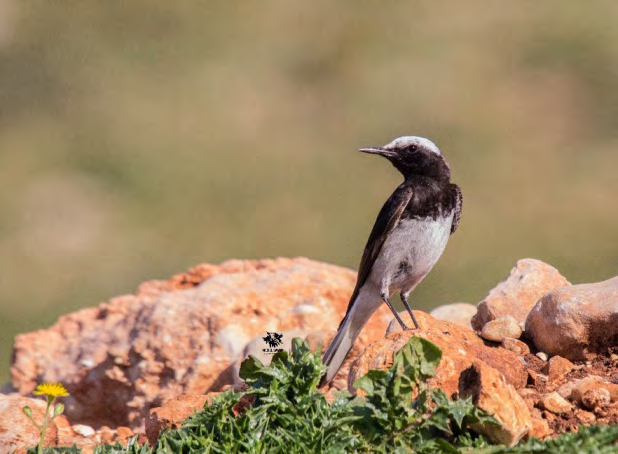
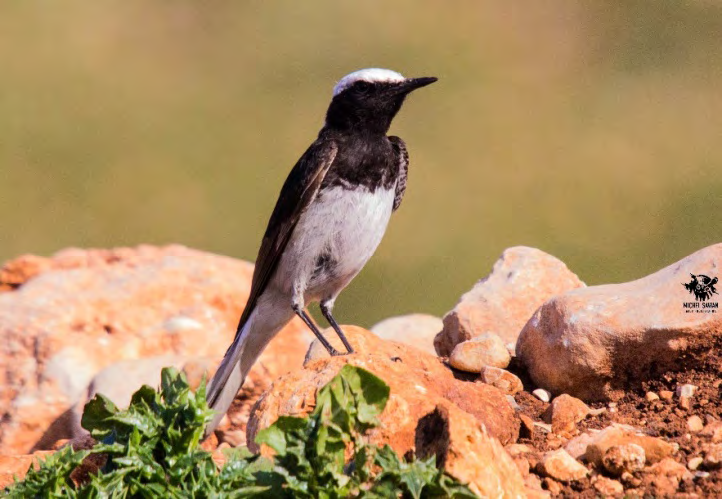
On the 17th of April 2021, I was doing a routine bird conservation patrol shift in one of the most important spots of bird migration in Lebanon during the Spring, when I noticed a Hooded Wheatear sitting a small rock on the side of the rocky road (Figure 1). The bird was staring at me and I managed to get close to it for almost 5 meters distance (Figure 2). I took around 12 shots then the bird flew away down to the valley. After confirming the ID of the bird with another birdwatcher, I sent the photos to Dr Ghassan Jaradi who accepted it on the local ornithology check-list with the Lebanese Rare Bird Committee (LRBC).
The reason why this bird showed up in Lebanon is unknown, theories can talk about the warm spring windstorm called Khamsin Windstorm that affect Lebanon in this specific time of the year coming from the Saudi Sahara
Acknowledgement
I would like to thank Bassel Abi Jumaa and Dr Ghassan Ramadan Jaradi for the confirmation of the identification of the bird
References
-
Kren J (2006) Wheatears of Palearctic: Ecology, Behaviour and Evolution of the Genus Oenanthe. The Condor 108(1): 245-247.
-
del Hoyo J, Elliot A, Christie DA (2005) Handbook of the birds of the world. Volume 10. Cuckoo-shrikes to thrushes Lynx Edicions, Barcelona.
-
Bird Life Internations (2015) Hooded Wheatear Oenanthe monacha.
-
Svensson L, Mullarney K, Zetterstroöm D, Grant P (2009) Collins Bird Guide. 2nd (Edn.), Harper Collins, London, UK.
-
The Birds of Kuwait website.
- California Red-Legged Frog and Non-Listed Amphibians Response to Non-Native Fish Removal
- Industrial Standardization of the Bio-OS: Algorithmic Codification of Resilience Engineering Guidelines and Version V8 Architecture
- Climate Variability and the Sustainability of Snail Farming in Nigeria: Past Trends, Present Challenges and Potential Outlook
- The Evaluation of the Surveillance System of Anthrax in Gilgit-Baltistan, Pakistan, 2018
- Natural Decline to Extinction of A New Zealand Rabbit Population
- Mitochondrial Bio-Logistics: Steering Co-Enzyme Q10 and Lycopene Synergies within the Science 4.0 Bio-OS Framework