
Results of the Management of Fractures of the Upper Extremity of the Femur in a Sahelian Hospital
Objective: To report the results of the management of upper femur fractures (FESF) in adults in the orthopedic trauma department of the National Hospital of Niamey. Materials and Methods: This was a prospective, descriptive study carried out in the Traumatology-Orthopedics and Reconstructive Surgery department of the National Hospital of Niamey in Niger, over a period of 6 months, from September 1, 2022 to February 28, 2023. The study included patients aged at least 15 years of all sexes with a fracture of the upper end of the femur and treated in our department. The parameters studied were epidemiological, clinical, paraclinical, therapeutic and evolutionary. Results: In 6 months we recorded 1207 cases of fracture in our department, of which 79 fractures concerned the upper end of the femur (FESF), i.e. a hospital frequency of 6.54%. There was a male predominance of 72.15% (n=57) with a sex ratio M/F of 2.59. The average age was 63.94 years with extremes of 20 and 103 years. The circumstances of occurrence were a fall in 45.57% (n=36) and a road accident in 34.18% (n=27). The trochanteric massif was the most frequent site of injuries with 63.29% (n=50), followed by the femoral neck 36.71% (n=29). Garden stages III and IV represented 72.41% (n=12) of femoral neck fractures. Surgical treatment was indicated in all cases and performed in 96.20% (n=76), three patients died before surgery. Therapeutic outcomes were favorable in the vast majority of cases. Conclusion: Fracture of the upper end of the femur is common in our context. Its treatment is essentially surgical. The therapeutic results are favorable in the vast majority of cases.
IDE G¹*, Abdoulwahab MA², Boka Tounga Y¹, IDE Saley Oumarou¹ and Illé S³
Keywords: Fracture; Upper end of the femur; Treatment; Niamey National Hospital
Introduction
Upper femur fractures (EFSF) are bone continuity solutions whose features affect the region located between the femoral head and the line located 2.5 cm below the lesser trochanter. They are grouped into three major nosological entities: femoral head fractures, femoral neck fractures and trochanteric fractures [1, 2, 3, 4, 5]. Upper femur fractures are increasingly common [4, 5]. The increase in this frequency is linked to two factors: road traffic accidents that have become very frequent and the aging of the population, advanced age being a risk factor for this fracture. In young adults, they occur following high-energy trauma, in the elderly it is generally a fall from their height that is the cause, favored by osteoporosis [6]. In young subjects, they affect the functional prognosis, in geriatric subjects, the vital prognosis can be engaged. This risk is increased by the frequency of comorbidities at this age [6]. The treatment of these fractures requires a multidisciplinary approach, in fact this treatment involves the geriatrician, the anesthesiologist-resuscitator, the orthopedic surgeon and the physiotherapist [3, 7]. The objective of this work is to present our experience in the management of fractures of the upper end of the femur. Materials and methods: This was a prospective, descriptive study carried out in the Orthopedics, Traumatology and Reconstructive Surgery department of the National Hospital of Niamey in Niger, over a period of six (6) months from September 1, 2022 to February 28, 2023. Patients aged over 15 years with a fracture of the upper end of the femur and treated in our department were included in the study. We used the Garden classification [7] to classify femoral neck fractures and that of AO Muller [8] for fractures of the trochanteric region.
The parameters studied were epidemiological, clinical, paraclinical, therapeutic and evolutionary. The data thus collected on a pre-established survey form were analyzed on Epi-Info 3.5.4 software. The functional result was judged, after consolidation of the fracture on the basis of the Postel Merle D’Aubigné (PMA) criteria [9].
Results
In 6 months we recorded 1207 patients in our department, including 79 cases of fracture of the upper end of the femur, i.e. a hospital frequency of 6.54%. We noted 57 men 72.15% and 22 women 27.85% with a sex ratio M/F of 2.59. The mean age was 63.94 years with extremes of 20 and 103 years. The age group of 60 to 74 years was the most represented with 34.18% (n = 27) of cases. Table 1 reported the distribution of patients according to age groups.
| Age group (years) | Number (n) | Percentage % |
|---|---|---|
| 15 to 30 | 4 | 5.06 |
| 30 to 45 | 8 | 10.13 |
| 45 to 60 | 15 | 18.99 |
| 60 to 75 | 27 | 34.18 |
| 75 to 90 | 23 | 29.11 |
| 90 and more | 2 | 2.53 |
| Total | 79 | 100.00 |
Table 1: Distribution of patients according to age group.
The injuries were due to a fall from one’s own height in 45.57% (n=36) of cases. Pre-hospital transport was medicalized in 51.90% (n=41) of cases (Firefighters 21.60%, ambulance drivers from health facilities 11.10% and the Emergency Medical Aid Service 7.60%). Patients admitted with a delay of less than 6 hours represented 32.91% (n=26), with extremes of one hour and 45 days. The fracture was neglected in 14% of cases (n=11). The trauma was closed in all cases. A comorbidity was found in 29.114% (n=23), including hypertension in 22.78% of cases (n=17).
| Fracture location | Number (n) | Percentage% |
|---|---|---|
| FCF | 29 | 36.71 |
| FMT | 50 | 63.29 |
| FTF | 0 | 0.00% |
| Total | 79 | 100.00 |
Table 2: Distribution of patients according to the site of the fracture on the upper end of the femur.
A frontal X-ray of the pelvis and the affected hip in profile was performed in all patients. The trochanteric massif was the most noted site of injuries with 63.29% (n = 50) and the femoral neck in 36.72% (n = 29). No fracture of the femoral head was noted. Table 2 reported the repair of patients according to the site of the fracture.
Among the neck fractures, the Garden IV type was the most represented with 44.83% of FCF. Table 3 reported the distribution of neck fractures according to Garden classification.
| Number | Classification De Garden | Percentage % |
|---|---|---|
| 3 | Garden I | 10.34 |
| 6 | Garden II | 17.24 |
| 8 | Garden III | 27.59 |
| 12 | Garden IV | 44.83 |
| 29 | Total | 100.00 |
Table 3: Distribution of femoral neck fractures according to Garden classification For the fracture of the trochanteric massif, t
| Classification AO | Number | Percentage % |
|---|---|---|
| A.1.1 | 6 | 12.00 |
| A.1.2 | 21 | 42.00 |
| A.1.3 | 12 | 24.00 |
| A.2.1 | 6 | 12.00 |
| A.2.2 | 3 | 6.00 |
| A.3.1 | 2 | 4.00 |
| Total | 50 | 100.00 |
Table 4: Distribution of trochanteric fractures according to Muller’s AO classification.
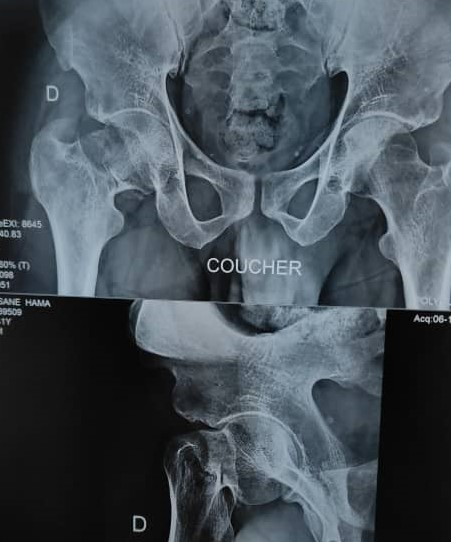
In terms of treatment, the specific treatment was surgical in all cases. Osteosynthesis was the most commonly used type of treatment with 77.63% (n=59) and osteosynthesis consisted of a dynamic screw-plate (DHS) in 68.42% (n=52) of cases (Figure1).
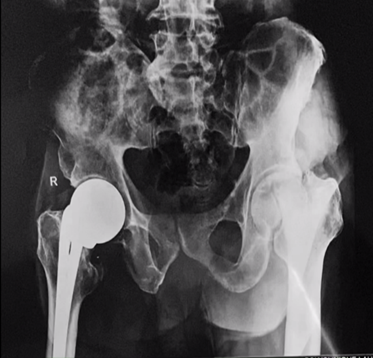
Femoral neck fractures were treated by hemi- arthroplasty in 45% (n=13). Figure 2 reported a femoral neck fracture treated by hemi-arthroplasty.
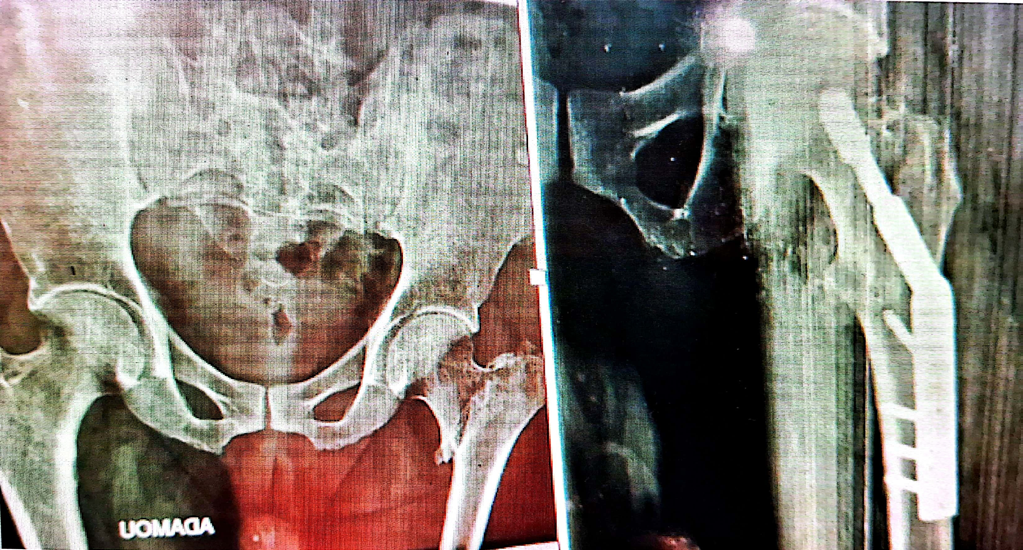
Trochanteric fractures were treated by osteosynthesis in 91.49% (n=43). The average length of hospitalization was 20.63 days, extremes of 1 and 28 days. The therapeutic follow-up was favorable in 89.87% (n=71). There were 3 cases of death 3.79%. Four (4) 5.06% had a surgical site infection and one (1) 1.26% had a decubitus complication (bed sore).
The functional result was excellent and good for 70 patients or 88.56% according to the Postel Merle D’Aubigné functional score.
Discussion
Fractures of the upper end of the femur are common in traumatology. They represent 6.54% of all hospitalizations in the Traumatology-Orthopedics and Reconstructive Surgery department of the National Hospital of Niamey. This frequency is comparable to those of authors such as Rakotoherisoa HM, et al. [10] in Madagascar in 2022 reported a frequency of 6.28 and Mamane M, et al. [11] in Niamey in 2019 reported a frequency of 6.31%. In our series, the average age of patients was 63.94 years with extremes of 20 and 103 years. The age group from 60 to 75 years was the most represented with 34.18% (n = 27). These epidemiological data were superimposable with those reported by certain African authors [11, 12]. The age group from 60 to 75 years corresponds to the beginning of the geriatric age; The predominance of patients in this age group could be explained by the fact that at this age adults begin to lose cognitive capacity, are subject to osteoporosis and comorbidities [6]. But our results are lower than those of many authors from the North such as Keskes HF [13] in Tunisia in 2006, Maalouf G [14]; Sanner G [15] in 2012 in France; Adrien D, et al. [16] in 2019; Philippe O, et al. [17] and Manzino LB, et al. [18] who found mean ages of 76.6 years, 75 years and 84.4 years respectively. This could be explained by the life expectancy which is higher in the countries of the North, these elderly people are victims of falls and have bones weakened by osteoporosis. The male predominance found in our study was also reported by Tidjani IF, et al. [19] and Keskes HF [13] who found a sex ratio of 3.6 and 1.59 respectively in favor of men. This male predominance could be explained by the youth of our patients and that in countries like Niger, men go out to look for something to provide for the family’s needs, use two-wheeled vehicles more and are therefore more exposed than women to road accidents.
A comorbidity was found in 29.11% of patients in our series including high blood pressure and diabetes with respectively 18.98% (n = 15) and 3.80% (n = 3), our results are superimposable to those of many African authors [11, 20, 21]. This low comorbidity rate is explained by the youth of our patients. Just as in our study, falls and road accidents were the first circumstance of occurrence of fractures of the upper end of the femur in the Barry series [22]. But different from those of most authors [12, 13, 23] who found a predominance of the fall, favored by the frequency of comorbidities. In our series, the predominant seat of the fracture was the trochanteric massif 63.29% of cases. Our data are similar to those reported by Mogalia Y [24] in France with 66.7% and Barry [22] in 2021 in Senegal who found 64%. This could be explained by the fact that this part of the femur is very exposed. In our series, unstable fractures of the femoral neck are predominant. Our results are similar to those of Randriambololona VH, et al. [25] who found 71.42% of cases. They are higher than those of Manasse [10], and Barry [22], who found 65.38%, 66.7% of unstable fractures but lower than the results of Agoda Koussema [23] Yasmine [24] who noted 80% and 86.44% of cases respectively. As with many authors [8, 26, 27, 28] in fractures of the trochanteric massif, we found a high frequency of type A.1.1 (per-trochanteric) with 42% (n = 21). In our study, the dynamic screw-plate DHS osteosynthesis (68.42%) was the most used bone fixation method in fractures of the trochanteric massif. For Barry [22], the dynamic screw-plate is the method of choice for stabilizing fractures of the upper end of the femur due to the stability provided by this implant. On the other hand, for the Bouarda team [29], intramedullary nailing by gamma nail was the most used 59.69%. For these latter authors, the dynamic screw-plate DHS increases the risk of material loosening in an osteoporotic bone. For femoral neck fracture, 55% (n=16) of patients in our series were treated by osteosynthesis and 45% (n=13) by hemi arthroplasty. Our result is comparable to that of many authors [25]. In our series, the bone consolidation rate obtained was 88.59% (n=70), the 5-month follow-up noted 3 cases of pseudarthrosis and 6 cases of malunion. Our results are comparable to those of Tidjani IF, et al. [19] in Benin. The assessment of the management of our patients according to the Postel Merle D’Aubignér functional score was generally satisfactory. The patients were classified as excellent and good in 88.59% (n=70). Our results are comparable to those reported by Tidjani IF, et al. [19] who found 76.2%. These excellent results recorded in our series could be explained by the early management and the youth of our patients.
Conclusion
Fractures of the upper end of the femur in adults are frequent at the National Hospital of Niamey and predominate in adult male subjects. Road accidents and falls are the first circumstances of occurrence of these traumas. Osteosynthesis by DHS was the most used surgical modality. In the vast majority of cases, post-surgical results were good.
References
-
Faure C, Merloz P, Plaweski S, Tonetti J (2004) Fractures of the upper end of the femur. RMO France 27(239): 1-9.
-
Youmachev G (1981) Traumatology and orthopedics. In: 2nd (Ed.), Mir edition, Moscow, pp: 280-290.
-
Scheerlinck T, Haentjens P (2003) Fractures of the upper end of the femur in adults. Encycl Med Chir. Locomotor apparatus, 23: 3.
-
(2016) Surgery of fractures of the proximal end of the femur in elderly patients. High Authority of Health. Method recommendations for clinical practice 4: 11-12.
-
Duquennoy A, Decoulx J, Capron JC, Torabi DJ (1975) Traumatic dislocations of the hip with fracture of the femoral head. Rev Chir Ortho 61: 209-219.
-
Marmor S, Nizard R (2005) Fracture of the upper end of the femur. The book of the intern Traumatology. Flammarion 286-301.
-
Garden RS, Barnes R, Nicolle A (1961) Sub capital fractures of the femur. JB S 4: 647-663.
-
Hauschild O, Ghanem N, Oberst M, Baumann T, Kreuz PC, et al. (2009) Evaluation of Singh index for assessment of osteoporosis using digital radiography. European Journal of Radiology 71(20): 152-158.
-
D’Aubigne RM, Postel M (1954) Functional results of hip arthroplasty with acrylic prosthesis. J Bone Joint Surg (Am) 36(3): 451-457.
-
Rakotoherisoa HM, Randriambololona VH, Razaka AI, Rabemazava AZLA, Razafimahandry HJC, et al. (2022) Epidemiological and therapeutic aspects of fractures of the proximal end of the femur in adults. International Journal of Medical and Health Science 8(12): 1-18
-
Mamane M, Hamissou (2019) Fracture of the proximal end of the femur in the orthopedic trauma surgery department of the Amirou Boubacar Diallo National Hospital in Niamey. Medical thesis. Abdou Moumouni University of Niamey. Faculty of Health Sciences of Niamey, pp: 76.
-
Laila B, M Latifi (2011) Management of trochanteric fractures at the Mohamed VI University Hospital in Marrakech. Cadi Ayyad University. Medical thesis 17: 136.
-
Keskes HF, Gdoura M, Trigui N, Tounsi L, Bahloul M, et al. () Aoui, M. Zribi, Ayadi. Prognostic factors for fractures of the upper end of the femur in the elderly (Prospective study of 88 cases); traumatology and orthopedics department of Sfax. J.I.M. Sfax, (Tunisia); J.I. M. Sfax, No. 11/12; JUNE 06 / DEC 06: 21- 26.
-
Maalouf G, Bachour F, Hlais S, Maalouf NM, Yazbeck P, et al. (2013) Epidemiology of hip fractures in Lebanon: a nationwide survery. Orthopaedics & traumatology: surgery & research 99: 675-680.
-
Sanner G (2012) Responsibility of the fracture of the upper end of the femur in the loss of autonomy of the resident in EHPAD. Medical thesis. University of Lorraine Faculty of Medicine of Nancy, pp: 168.
-
Adrien D, Saint-Genez F, Gayet LE, Paccalin M, Ounajim A, et al. (2019) Impact of surgical delay in the management of fractures of the upper end of the femur in the ortho- geriatric sector. Orthopedic Surgery and Traumatology Review 105(5): 624-628.
-
Philippe O, Mouquet MC (2010) Femoral neck fractures in France between 1998 and 2007: what impact of aging? Studies and Results 723(4): 1-6.
-
Manzino LB, Laborde T, Pinto-Carral A, Rodriguez AFL, Mourey F (2021) Fracture of the upper end of the femur. Rehabilitation and recovery of functional capacities in the follow-up care and rehabilitation center at the Legregore medical center: prospective study. Rev Geriatr 44(4): 197-206.
-
Tidjani IF, Chigblo P, Goukodadja O, Lawson E, Hans- Moevi AA (2017) Preliminary results of the treatment of trochanteric fractures by the Gamma nail in Cotonou. J Afr Chir Orthop Traumatol 2(1): 26-32.
-
Sow I (2016) Treatment of femoral neck fractures by an intermediate hip prosthesis. About 62 cases Medical thesis Senegal pp: 54.
-
Lamiyae B (2011) Neck fractures treated by intermediate hip prostheses. Med thesis 3: 1.
-
Mohamed BAB, Galle DI, Yoro D, Claude SJ (2021) Upper femur fractures in adults: epidemiological and therapeutic aspects in the Orthopedics-traumatology department of Matlaboul Fawzaini hospital in Touba. Senegal.
-
Agoda-Koussema Lk, Anoukoum T, Adigo A, Adjénou K, Dagbé M, et al. (2015) Contribution of conventional radiography in trauma of the upper extremity of the femur and pelvis in adults in a district hospital in Togo. African Journal of Medical Imaging 7(1): 1-9.
-
Mogalia Y (2019) Fracture of the upper extremity of the femur in subjects aged 65 and over: 1-year mortality rate after treatment at the GHER from January 2013 to August 2017. Thesis in Human Medicine and Pathology, In: (Edn.), University of the Antilles, Faculty of Medicine Hyacinthe Bastaraud, Guadeloupe pp: 100.
-
Randriambololona VH, Rakotoherisoa HM, Razaka AI, Rabemazava AZLA, Razafimahandry HJC, et al. (2022) Epidemiological and therapeutic aspects of fractures of the proximal end of the femur in adults at the Soavinandriana hospital center. EPH - International Journal of Medical and Health Science 8(12): 11-16.
-
Sidi S (2012) Epidemiological-clinical study of fractures of the trochanteric massif in the orthopedic and trauma surgery of the Gabriel Touré University Hospital about 37 cases Doctoral thesis medicine. In: (Edn.), University of Science, Technology and Technology of Bamako (U.S.T.T.B), pp: 79.
-
Sanati Y (2017) Trochanteric fractures treated with DHS screw-plate (about 24 cases). In: (Edn.), Medical thesis Fez Sidi Mohammed Ben Abdellah University, Morocco, pp: 163-188.
-
Bouarda L, Latifi M (2011) Fractures of the upper end of the femur. In: (Edn.), Orthopedic Traumatology Department, IBN TOFAÏL Hospital, Medical thesis at Mohammed VI University Hospital. Marrakech, Morocco, pp: 25-128.
-
Sina D (2008) Study of femoral neck fractures in the orthopedic and trauma surgery department of Gabriel TOURE University Hospital: about 20 cases. In: (Edn.), Medical thesis, University of Bamako, Mali, pp: 76.
- Return to Work Among Manual Workers After the Latarjet Procedure: A Cohort Study of 43 Patients
- Refractory Pelvic Collection Following Modified Stoppa Approach for Both-Column Acetabular Fracture Fixation: A Case Report
- Comparative Study of Dynamic Knee Phenotypes Under Loaded and Unloaded Conditions: Clinical Impact
- Locked Intramedullary Nailing of the Tibia Using a Humeral Nail: A Care Case Report
- Subtalar Dislocation: About a Case Report
- Surgical Site Infection in Orthopedics in a Country with LimitedResources: Indications, Treatment and Results