
Diversity of Micromycetes Inhabiting Technogenic Zones
As result of conducted study micromycetes capable to grow in extreme conditions (high and low pH level, high salt concentration, and high temperature) were isolated. It was determined that out of all diversity of mycobiota the best capability to grow in compose conditions is characteristic to representatives of genera Aspergillus (strains A. terreus 252 and 253, A. flavus 257) and Penicillium, and strain Cladosporium cladosporioides 244 as well. Scarce diversity of micromycetes and extensive presence of representatives of genus Aspergillus in collected samples are characteristic features of fungal community in sewage of the studied gas-processing enterprises.
Introduction
Pollution of the environment with toxic persistent compounds produced as result of anthropogenic activity becomes one of the most important problems nowadays. These compounds include different carbohydrates and their halogenated derivatives. Oil, gas and products of their processing are one of the main sources of the environment pollution. Getting to soil, they worsen the total ecological situation and considerably change a geophysical and agrochemical property of soil. High anthropogenic pressure on water resources and soil is often accompanied by ecological factors unfavorable to destruction of pollutants, in particular high mineralization and wide range of temperature and pH levels [1]. Microscopic fungi are one of the important components of the soil biota. Having mycelial composition, they accumulate high quantities of biomass in soil. Possessing high absorption capacity and exerting active exometabolites, they play important role in processes of destruction and transformation of organic matter in soil [2, 3, 4]. A changes in composition of microscopic fungi in anthropogenic conditions attracts attention of many scientists worldwide [5, 6, 7]. Microscopic fungi are essential inhabitants of soil, which participate in processes linked with degradation of organic substrates of different origin, and qualitative and quantitative composition varies in accordance with character of pollution. Thus, comparative analysis of developing mycobiota revealed that micromycetes characteristic for grey forest soil dominated in the initial grey unpolluted soil. Taxonomic composition of mycobiota was characterized by prevalence of Penicillium and Aspegillus species. Pollution of the soil with oil products promoted to increased number of phytopathogenic forms of micromycetes, such as Aspergillus fumigatus, A. niger, A. ochraceus, Penicillium decumbens, P. frequentans, Р. lanosum, Trichoderma koningii [8, 9].
There are many reports on oil pollution of soil and its microbial degradation. However, problems of environment pollution with wastes of gas-processing enterprises are not covered sufficiently and diversity of microorganisms in such ecosystems is not studied well enough. Nowadays, the most promising method for cleansing of such pollutions in soil and sewage, both economically and ecologically is biotechnological approach, which is based on application of different groups of microorganisms possessing higher ability to degrade oil-and-gas products and pollutants [10, 11, 12]. In these regards, the development of methods for cleansing of sewage and soil polluted with products of oil-and-gas processing is one of important tasks leading to degreased anthropogenic pressure on environment.
Materials and Methods
Microscopic fungi isolated from polluted industrial and household sewage of the Shurtan gas-chemical enterprise, Mubarek gas-processing enterprise and Ustyurt gas- processing enterprise were objects of study. Czapek medium was used for isolation of micromycetes [13]. Observation on fungal development was conducted 7days. After appearance of exactly formed colonies, micromycetes were transferred to tubes containing Czapek medium. Taxonomic position of isolated micromycetes was identified according classical guidebooks [14, 15, 16, 17]. Five-day-old cultures of studied fungi were used to determine extremophilic strains. Cultures were transferred to liquid nutrient media with wide range of pH level [pH 2 & 3 (acidophiles), pH 8, 9 & 10 (alkaliphiles)]. Czapek broth containing different salt concentrations (5, 10 & 15% of NaCl) was prepared for halophilic strains. Cultures of acidophiles, alkaliphiles and halophiles were incubated at 27°C. Thermophilic micromycetes were determined on Czapek broth while incubated at 40°C and 45°C. The growth indices of micromycetes were analyzed after 5days of cultivation.
Results and Discussion
Republic of Uzbekistan is characterized by considerable number of mineral resources, large industrial and production potential, unique agricultural production, considerable volumes of semi- finished products and well- developed industrial infrastructure. There are large deposits of oil and gas in the republic. About 60% of country’s territory is supposed to be perspective for oil and gas production. The largest regions of natural gas production are Republic of Karakalpakstan, Bukhara and Kashkadarya regions. Nowadays about 75% of natural gas production in Uzbekistan is located in Kashkadarya region. Uzbekistan plans to continue further development of gas production industry and enterprises, which are linked to processing of natural gas and gas condensate. We studied samples of industrial and household sewage of the Shurtan gas-chemical enterprise (SGCE), Mubarek gas-processing enterprise (MGPE) and Ustyurt gas-processing enterprise (UGPE), out of which 27strains of microscopic fungi were isolated (Figure 1 & Table 1).
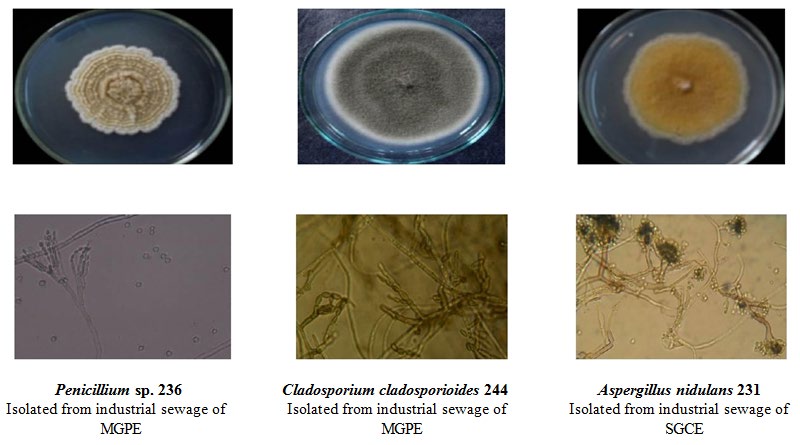
Presented data reveals increase of the number of representatives of genera Penicillium and Aspegillus, with increasing share of phytopathogens. Therefore, the structure of mycobiota changes under action of pollution: diversity of isolated species decreases, while in heavily polluted sites only several dominating forms may preserve. The danger of formation of micromycetes’ community atypical for natural conditions becomes possible under action of high levels of pollution. That is why it is important to clarify capabilities of micromycetes’ adaptation to unexpected chemical compounds-analogues of natural compounds, which may serve as a source of carbon and energy in the medium, to identify reaction of certain, the most widespread, species on supply of certain compounds, and to identify strains, from one side, possessing ability to easily adapt to new compounds and matters, and from another side, aiming determination of their ecological and physiological properties and their application for acceleration of destructive processes of the matters of anthropogenic origin and wide utilization for solution of different tasks in national economy.
| Site of Isolation | |
|---|---|
| 1 | 2 |
| Penicillium sp.237 | Industrial sewage of MGPE |
| Penicillium sp.236 | Industrial sewage of MGPE |
| Penicillium sp.234 | Household sewage of MGPE |
| Cladosporium sp.233 | Household sewage of MGPE |
| Cladosporium sp.235 | Household sewage of MGPE |
| Cladosporium sp.239 | Industrial sewage of MGPE |
| C. cladosporioides 244 | Industrial sewage of MGPE |
| Cladosporium sp.240 | Bioponds of MGPE |
| Aspergillus nidulans230 | Household sewage of MGPE |
| A. nidulans 231 | Industrial sewage of SGCE |
| A. versicolor 232 | Industrial sewage of SGCE |
| Aspergillus sp.243 | Bioponds, household sewage of SGCE |
| Aspergillus sp.245 | Bioponds, household sewage of SGCE |
| Penicillium sp.242 | Bioponds, household sewage of SGCE |
| Cladosporium sp.241 | Bioponds, household sewage of SGCE |
| Cladosporium sp.246 | Bioponds, household sewage of SGCE |
| Penicillium sp.238 | Household sewage of SGCE |
| Trichoderma sp.251 | 100% industrial sewage of UGPE |
| A. terreus 252 | 75% industrial sewage of UGPE + 25% water |
| A. terreus 253 | 75% industrial sewage of UGPE + 25% water |
| A. niger 254 | 50% industrial sewage of UGPE + 50% water |
| A. versicolor 255 | 50% industrial sewage of UGPE + 50% water |
| A. niger 256 | 10% industrial sewage of UGPE + 90% water |
| A. flavus 257 | 10% industrial sewage of UGPE + 90% water |
| A. versicolor 258 | 10% industrial sewage of UGPE + 90% water |
| Penicillium sp.259 | 10% industrial sewage of UGPE + 90% water |
| Acremonium sp.260 | 10% industrial sewage of UGPE + 90% water |
Table 1: Distribution of micromycetes in sewage of gas-processing enterprises.
Adaptation process of micromycetes is of evolutionary character and it is long-term process with a number of transition states, which are determined not only by stress-factor itself but also by time [18]. Under action of anthropogenic factors in soil and water systems accumulation of species of microscopic fungi hazardous for human (potentially pathogenic, allergenic, mycotoxic species; like А. fumigatus, A. flavus, A. niger, F. moniliforme, F. oxysporum, Paecilomyces variotii, Penicillium chrysogenum) may take place [8]. Such tendencies in distribution of microscopic fungi were observed in our study as well, which was specifically noted in distribution of Aspergillus fungi with different intensity depending on character of anthropogenic action, its level and type of biogeocenosis. Analysis of development of biological systems reveals that species structure of biocenosis is determined by diversity and importance of species of organisms, which compose it. Microorganisms isolated from extreme ecological niches (extremophiles) are well adapted to unfavorable factors of the environment and possess considerable biotechnological potential. Enzymes they synthesize usually possess high activity, stability and may function at high temperature, high salt concentration and high and low pH level and in other extreme conditions (high pressure, low temperature and so on) [19, 20].
Micromycetes are essential component of soil and water
biocenoses and they control wide spectrum of biospheric functions. They occupy a special ecohorizon in ecosystems and play role of intermediaries between live and dead matter of the biosphere [21]. Moreover, existence of micromycetes in considerably wide limits of extremophility makes possible receipt of microorganisms with polyfunctional properties. In these regards, the growth of isolated micromycetes in different extreme conditions was studied. Data on extremophility of studied micromycetes are presented in the Table 2. It was determined that out of all diversity of mycobiota the best capability to grow in compose conditions is characteristic to representatives of genus Aspergillus (strains A. terreus 252 and 253, A. flavus 257), in lesser state to representatives of genus Penicillium and strain Cladosporium cladosporioides 244 as well.
| Micromycetes | Acidophiles (pH2) | Alkaliphiles (pH 10) | Thermoalkaliphiles (pH10, +40°C) | Halophiles (15% NaCl) |
|---|---|---|---|---|
| 1 | 2 | 3 | 4 | 5 |
| Aspergillus nidulans 230 | - | ++ | +++ | - |
| A. nidulans 231 | + | ++ | ++ | + |
| A. versicolor 232 | - | +++ | +++ | - |
| A. versicolor 258 | - | + | - | ++ |
| A. versicolor 255 | - | ++ | - | ++ |
| A. terreus 252 | + | + | ++ | ++ |
| A. terreus 253 | + | + | ++ | ++ |
| A. niger 254 | - | ++ | ++ | - |
| A. niger 256 | + | + | - | ++ |
| A. flavus 257 | + | + | ++ | ++ |
| Aspergillus sp. 243 | - | +++ | +++ | ++ |
| Aspergillus sp. 245 | - | +++ | - | ++ |
| Cladosporium cladosporioides 244 | ++ | +++ | +++ | + |
| Cladosporium sp. 233 | - | +++ | ++ | - |
| Cladosporium sp. 235 | - | +++ | ++ | - |
| Cladosporium sp. 239 | - | +++ | - | ++ |
| Cladosporium sp. 240 | - | ++ | - | ++ |
| Cladosporium sp. 241 | - | ++ | - | ++ |
| Cladosporium sp. 246 | - | ++ | - | - |
| Penicillium sp. 236 | ++ | +++ | ++ | - |
| Penicillium sp. 237 | - | +++ | ++ | ++ |
| Penicillium sp. 238 | +++ | ++ | ++ | - |
| Penicillium sp. 242 | +++ | + | - | ++ |
| Penicillium sp. 259 | + | + | - | ++ |
| Penicillium sp. 234 | - | +++ | ++ | ++ |
Table 2: Influence of extreme factors of medium on growth of micromycetes.
As result of conducted study micromycetes capable to grow in extreme conditions (high and low pH level, high salt concentration and high temperature) were isolated. The complex of species of microscopic fungi inhabiting polluted sewage differs from fungal community inhabiting water resources and soil with other ecological conditions.
Scarce diversity of micromycetes and extensive presence of representatives of genus Aspergillus in collected samples are characteristic features of fungal community in sewage of the gas-processing enterprises. Conducted analysis of diversity of microscopic fungi inhabiting anthropogenic media and of their ability to normal vital functions in extreme conditions revealed that they are essential component of soil and water biocenoses and represent a ground for development of new directions in both ecology and biotechnology.
References
-
Plotnikova EG, Altynceva OV, Kosheleva IA, Puntus IF, Filonov AE, et al. (2001) Bacteria-destructors of polycyclic aromatic hydrocarbons isolated from soils and bottom sediments of the area of salt development. Microbiology 70(1): 61-70.
-
Mirchink TG (1988) Pochvennaya mycology. Moscow: MSU Publishing House, pp: 220.
-
Zvjagincev DG (1999) The structure and functioning of the complex of soil microorganisms. Structural and functional role of soil in the biosphere. Moscow, pp: 101- 112.
-
Rayner ADM (1988) Life in a collective: lessons from the fungi. New Scientist 120: 49-53.
-
Zhdanova NN, Vasilevskaja AI (1982) Extreme ecology of mushrooms in nature and experiment. Kiev: Nauka Dumka, pp: 168.
-
Zhdanova NN, Redchic TI, Vasilevskaja AI (1986) Species composition and sorption properties of deuteromycetes in soils contaminated with industrial wastewater. Microbiology 4: 44-50.
-
Bahtijorova MS, Fajzieva FH, Kukanova SI, Tashpulatov Zh (2015) Morfologo-biohimicheskie svojstva griba Cladosporium cladosporioides (Fres) de Vries, vydelennogo iz stochnyh vod Mubarekskogo gazopererabatyvajushhego zavoda. Mikrobiologija i virusologija-Almaty 2(9): 30-37.
-
Kireeva HA, Rafikova GF, Bakaeva MD (2007) Vlijanie neftjanogo zagrjaznenija na mikromicety seroj lesnoj pochvy Respubliki Bashkortostan i gleepodzolistoj pochvy respubliki Komi. Mikologija I fitopatologija 41(2): 164-171.
-
Bahtijorova MS, Tashpulatov Zh, Kukanova SI, Zajnitdinova LI (2015) Science and innovative technologies in integrated management of land resources, a collection of reports of the Republican scientific-practical seminar. Tashkent, pp: 293-295.
-
Tashpulatov Zh, Bakhtierova MS (2012) Micromycetes of Technogenic zones of Uzbekistan. Uzbek Biological Journal 5(6): 59-61.
-
Velikanov LL (1997) The role of fungi in the formation of myco- and microbiota of soils of natural and disturbed biocenoses and agro Ecosystems. Dis Dr Biol Sci Moscow, pp: 547.
-
Cooke RJ, Rayner AM (1984) Ecology of saprotrophic fungi. London, pp: 415.
-
Litvinov MA (1969) Methods for studying soil microscopic fungi. Leningrad Science, pp: 118.
-
Litvinov MA (1967) Keys to microscopic soil fungi. Leningrad Nauka, pp: 302.
-
Pidoplichko NM (1972) Penicillii (Key to defining species) Kiev. Naukova Dumka, pp: 148.
-
Bilaj VI, Koval’ Je Z (1988) Aspergillus Determinant Kiev, Naukova Dumka, pp: 202.
-
Ellis MB (1971) Dematiaceous Hyphomycetes. Kew: London, pp: 608.
-
Karasevich YN (1975) Experimental adaptation of microorganisms. Moscow, pp: 179.
-
Plotnikova EG, Rybkina DO, Anan’ina LN, Yastrebova OV, Demakov VA (2006) Haracterization of microorganisms isolated from anthropegenically impacted zones of Kama river basin. Ecology 4: 261-268.
-
Caroll GC, Wicklow DT (1992) Estimating fungal biomass and productivity in decomposing litter. 2nd (Edn.), the fungal community. New York, Basel: Marcel Dekker, рp: 521-556.
-
Karatygin IV (1994) Fungi and their role in the evolution of ecosystems. Botanical journal 79(2): 13-20.
- Diversity of Candida sp and Antifungal Susceptibility Patterns in Digestive Candidiasis among People Living with HIV in CHU of Libreville, Gabon
- Vulvovaginal candidiasis: Retrospective study (2019- 2021) at the Centre Hospitalier National de Pikine, Suburban Dakar, Senegal
- Identification of Environmental Fungal Species in Clinical Services of University Hospital of Angre, Abidjan (Cote d’Ivoire)
- New Location of some Gasteroid Basidiomycetes in Western Kazakhstan
- Evaluation of Various Extracellular Enzymes of Ectomycorrhizal Mushrooms
- Morphology and Phylogeny of Lactarius Wallichianae sp. nov and Xerula magnispora sp. nov. from India