
On the Treatment of SARS-COV-2 Including Omicron Type
Introduction
The most recent common ancestor (MRCA) of all coronaviruses has been placed at around 8000 BCE [1]. The MRCAs of the Alpha-coronavirus line has been placed at about 2400 BCE, the Beta-coronavirus line at 3300 BCE, the Gamma-coronavirus line at 2800 BCE, and the Delta coronavirus line at about 3000 BCE. It appears that bats and birds, as warm-blooded flying vertebrates, are ideal hosts for the coronavirus gene source (with bats for Alpha-coronavirus and Beta coronavirus, and birds for Gamma-coronavirus and Delta-coronavirus) to fuel coronavirus Evolution and dissemination [2]. Bovine coronavirus and canine respiratory coronaviruses diverged from a common ancestor in 1951 [3]. Bovine coronavirus and human coronavirus OC43 diverged around the 1890s. Bovine coronavirus diverged from the equine coronavirus species at the end of the 18th century [4]. The MRCA of human coronavirus OC43 has been dated to the 1950s [5]. MERS-CoV, although related to several bat coronavirus species, appears to have diverged from these several centuries ago [6]. The human coronavirus NL63 and a bat coronavirus shared an MRCA 563–822 years ago [7]. The most closely related bat coronavirus and SARS-CoV-2 diverged in 1986 [8]. A path of evolution of the SARS virus and keen relationship with bats has been proposed. The coronaviruses have been coevolved with bats for a long time and the ancestors of SARS-CoV first infected the species of the genus Hipposideridae, subsequently spread to species of the Rhinolophidae and then to civets, and finally to humans [9, 10]. Alpaca coronavirus and human coronavirus 229E diverged before 1960 [11]. The information above demonstrates that even 8000 years ago and so on, all the kinds of COVID-19 existed, Alpha, Beta, Gamma and even Delta kinds of this disease existed and it is not a novel or new infectious disease we are fighting against. Drift and also Reassortment plays vital role in mutations and adaptation of COVID-19 specially Omicron which is nowadays contaminated high amounts of people and will be present in the future.
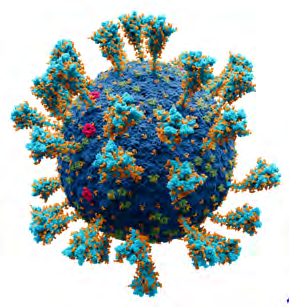
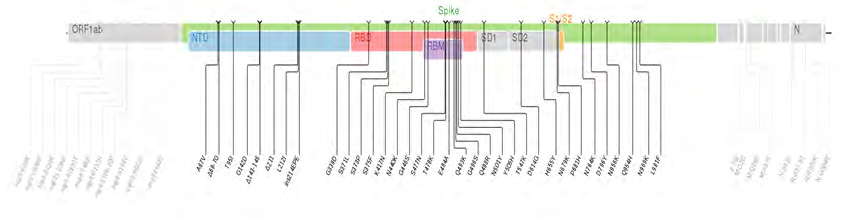
![Figure 2: Illustration of the locations of the Omicron mutations in the spike protein, top Left picture and right picture, showing amino acid substitutions which have shown in color yellow, deletions (red), and insertions (green). In this trimeric structure, two monomers (gray and light blue) have their receptor-binding domains in the down conformation while one (dark blue) is in the up or open conformation. Mutation data from WHOn structure from PDB: 6VYB [12,13].](/fulltextimages/8300/fig_2.png)
Figure 2: Illustration of the locations of the Omicron mutations in the spike protein, top Left picture and right picture, showing amino acid substitutions which have shown in color yellow, deletions (red), and insertions (green). In this trimeric structure, two monomers (gray and light blue) have their receptor-binding domains in the down conformation while one (dark blue) is in the up or open conformation. Mutation data from WHOn structure from PDB: 6VYB [12, 13].
Materials and Methods
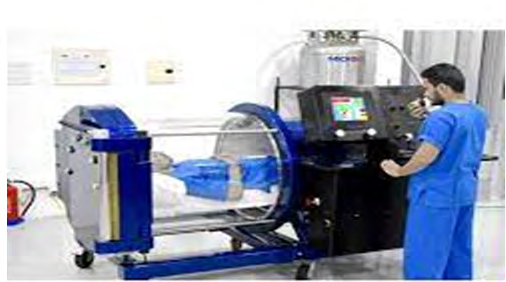
Since the Omicron virus has strongly high rate of mutation compared with other kinds of Coronaviruses and therefore; cause severe symptoms of inflammation in the patients including lungs as we observed in 2 of our patients with high age. In our research, all the patients were under unique control and it was a controlled study. They received HBO2T with 2% Ozone mixture with Oxygen in special cube. Also they had an injection of liquid ozone which dramatically declines the inflammation in all tissues. They had under strict diet of special Ketogenic diet to maintain their mitochondria to remain high metabolism to hamper the fatigue and tiredness. The had also gain supplements necessary for the disease. The Ketogenic diet we used was 60% fat and 40% high fiber carbohydrates. They had Amino Acid 10% Serum once a day in the morning not to destroy the and diminish the muscles in their body and also maintain their dosage of amino acid since they did not have appetite to eat regularly. Plus, they had Dextrose/salt 9% serum with B-Complex, special Neurobion and Vitamin C injected into their serum once a day in the evening. Their supplements included 1200 mg of NAC, 30 mg Zinc Oxide, Vitamin b6 40 mg, Vitamin B1 100mg every night after their meal. We gave those 500mg vitamin c every two hours to maintain their blood of vitamin C levels to decrease the inflammation as well. Medical ozone is produced in varying concentrations. The quantity of ozone in comparison with the quantity of oxygen in the gas stream is called percent concentration. It is measured in micro grams (ug) of ozone per milliliter (or cc) of the mixture. A liter of oxygen weights 1.4 grams. Therefore; 0.5% x 1.4 gm = 7 ug/cc, 1.0% x 1.4 gm = 14 ug/cc, 1.5 x 1.4 gm = 21 ug/cc, 2.0% x 1.4 gm = 28 ug/cc, 2.5% x 1.4 gm = 35 ug/cc, 3.0% x 1.4 gm = 42 ug/cc, 3.5% x 1.4 gm = 49 ug/cc, 4.0% x 1.4 gm = 56 ug/cc, 4.5% x 1.4gm = 63 ug/cc, 5.0% x 1.4 gm = 70 ug/ cc [14]. 5% or 70 ug/cc is considered to be the upper limit of the concentration for the internal use of medical ozone. The medical internal ozone therapy in Omicron or Covid-19 treatment. We used the average concentration means 21 ug/cc. This method of Ozone Therapy with liquid ozone injection, higher the blood flow through the body, decrease inflammation in the whole body, decrease inflammation in lungs dramatically and the most important which we also intrigued by was that this method stopped the virus activation in the tissues and the body.
| Number | Sex | Age | Disease |
|---|---|---|---|
| 1 | Male | 60 | Omicron |
| 2 | Male | 20 | Omicron |
| 3 | Male | 35 | Omicron |
| 4 | Male | 50 | Omicron |
| 5 | Male | 70 | Omicron |
| 5 | Male | 15 | Omicron |
| 7 | Female | 65 | Omicron |
| 8 | Female | 20 | Omicron |
| 9 | Female | 24 | Omicron |
| 10 | Female | 31 | Omicron |
| 11 | Female | 47 | Omicron |
| 12 | Female | 54 | Omicron |
Table 1: Number of patients after the PCR test with positive Omicron Virus
Results
All the patients of any age showed in the table got treatment in three days. After 6 days all the side effects of Omicron virus diminished. They regain their strength and their weaknesses, muscle pain, tiredness, joint pain and bone pain went away. We call this novel protocol: Sorush Covid-19 Treatment Protocol. Although it needs some more research in this field and protocol, but it is a huge breakthrough in Covid control and treatment.
| Number | Sex | Age | Disease | Cured |
|---|---|---|---|---|
| 1 | Male | 60 | Omicron | Cured |
| 2 | Male | 20 | Omicron | Cured |
| 3 | Male | 35 | Omicron | Cured |
| 4 | Male | 50 | Omicron | Cured |
| 5 | Male | 70 | Omicron | Cured |
| 5 | Male | 15 | Omicron | Cured |
| 7 | Female | 65 | Omicron | Cured |
| 8 | Female | 20 | Omicron | Cured |
| 9 | Female | 24 | Omicron | Cured |
| 10 | Female | 31 | Omicron | Cured |
| 11 | Female | 47 | Omicron | Cured |
| 12 | Female | 54 | Omicron | Cured |
Table 2: The rate of the treatment of the patients selected.
Acknowledgement
We would like to thank the US Department of Defense, American Beirut University, Sen. Mark R. Warner, Sen. Kaine and Representative Ben Cline for their encouragement in our research. Also we would like to specifically thank Professor Stephanie Seneff PhD from Massachusetts Institute of Technology and Professor Thomas N Seyfried who always encouraged and motivated me.
References
-
Sexton NR, Smith EC, Blanc H, Vignuzzi M, Peersen OB, et al. (2016) Homology-Based Identification of a Mutation in the Coronavirus RNA-Dependent RNA Polymerase That Confers Resistance to Multiple Mutagens. J Virol 90(16): 7415-7428.
-
Wertheim JO, Chu DK, Peiris JS, Kosakovsky Pond SL, Poon LL (2013) A case for the ancient origin of coronaviruses. J Virol 87(12): 7039-7045.
-
Woo PC, Lau SK, Lam CS, Lau CC, Tsang AK, et al. (2012) Discovery of seven novel Mammalian and avian coronaviruses in the genus delta coronavirus supports bat coronaviruses as the gene source of alpha coronavirus and beta coronavirus and avian coronaviruses as the gene source of gamma coronavirus and delta coronavirus. J Virol 86(7): 3995-4008.
-
Bidokhti MR, Tråvén M, Krishna NK, Munir M, Belák S, et al. (2013) Evolutionary dynamics of bovine coronaviruses: natural selection pattern of the spike gene implies adaptive evolution of the strains. The Journal of General Virol 94 (Pt 9): 2036-2049.
-
Vijgen L, Keyaerts E, Moës E, Thoelen I, Wollants E, et al. (2005) Complete genomic sequence of human coronavirus OC43: molecular clock analysis suggests a relatively recent zoonotic coronavirus transmission event. J Virol 79(3): 1595-1604.
-
Lau SK, Lee P, Tsang AK, Yip CC, Tse H, et al. (2011) Molecular epidemiology of human coronavirus OC43 reveals evolution of different genotypes over time and recent emergence of a novel genotype due to natural recombination. J Virol 85(21): 11325-11337.
-
Lau SK, Li KS, Tsang AK, Lam CS, Ahmed S, et al. (2013) Genetic characterization of Beta coronavirus lineage C viruses in bats reveals marked sequence divergence in the spike protein of pipistrellus bat coronavirus HKU5 in Japanese pipistrelle: implications forthe origin of the novel Middle East respiratory syndrome coronavirus. J Virol 87(15): 8638-8650.
-
Huynh J, Li S, Yount B, Smith A, Sturges L, et al. (2012) Evidence supporting a zoonotic origin of human coronavirus strain NL63. J Virol 86(23): 12816-12825.
-
Vijaykrishna D, Smith GJ, Zhang JX, Peiris JS, Chen H, et al. (2007) Evolutionary insights into the ecology of coronaviruses. J Virol 81(8): 4012-4020.
-
Meriadeg Ar G, Puechmaille SJ, Jean-Paul G, Emma T, Kittayapong P, et al. (2011) SARS-Coronavirus ancestor’s foot-prints in South-East Asian bat colonies and the refuge theory. Infect Genet Evol 11(7): 1690-1702.
-
Cui J, Han N, Streicker D, Li G, Tang X, et al. (2007) Evolutionary relationships between bat coronaviruses and their hosts. Emerg Infect Dis 13(10): 1526-1532.
-
(2021) Classification of Omicron (B.1.1.529): SARS- CoV-2 Variant of Concern. World Health Organization.
-
Walls AC, Park YJ, Tortorici MA, Wall A, McGuire AT, et al. (2020) Structure, Function, and Antigenicity of the SARS-CoV-2 Spike Glycoprotein. Cell 181(2): 281-292.
-
Niknamian S, Zaminpira S, Seneff S, Seyfried TN, Agostino DD, et al. (2019) Introducing the Sorush Cancer Treatment Protocol (SCTP). J Cancer Res Clin Pract 2(1): 110.
- Diversity of Candida sp and Antifungal Susceptibility Patterns in Digestive Candidiasis among People Living with HIV in CHU of Libreville, Gabon
- Vulvovaginal candidiasis: Retrospective study (2019- 2021) at the Centre Hospitalier National de Pikine, Suburban Dakar, Senegal
- Identification of Environmental Fungal Species in Clinical Services of University Hospital of Angre, Abidjan (Cote d’Ivoire)
- New Location of some Gasteroid Basidiomycetes in Western Kazakhstan
- Evaluation of Various Extracellular Enzymes of Ectomycorrhizal Mushrooms
- Morphology and Phylogeny of Lactarius Wallichianae sp. nov and Xerula magnispora sp. nov. from India