
Analog Astronaut Mission Habitat Bio Contamination Test
The presence of viable particles in materials, devices, people, surfaces, liquids, gases, or air is referred to as bio-contamination. Mold can grow anywhere there is enough moisture or a water problem. Most molds emit musty odors, which are the first indication of a problem. Mold can manifest itself as slightly fuzzy, discolored or slimy patches that expand in size. Mold growth can be significant in hermetically sealed and environmentally controlled environments. The enclosed habitats are well-exemplified by Analog Astronaut Mission Habitats (AAMH). A bio-contamination test was conducted at the AAMH in Poland from November 1 to 10, 2023. Mold was discovered growing in a bio-contamination experiment mixture of wheat flour, tomato powder and sugar. AAMHs should develop a bio-contamination control strategy as well as an internal system to protect the crew and citizens from diseases that the crew may transmit.
Introduction
Bio-contamination is the biological contamination of products by microorganisms and their toxic by-products. Soil and water contamination, cross-contamination, raw materials, and pests are the four main sources of biological contamination. Any type of biological contamination can enter the food processing system at any point. Bacteria, viruses, parasites and fungi are the most common biological contaminants. Bacteria, viruses, animal dander and cat saliva, house dust, mites, cockroaches and pollen are examples of biological contaminants. These pollutants come from a variety of sources. The growth of some biological sources can be reduced by controlling the relative humidity level in the home [1]. Despite good design and adherence to available guidelines, cleanrooms are vulnerable to contamination from a variety of sources, the most significant of which is people. According to some studies [2, 3, 4], humans can contribute up to 70% of microorganisms found in a standard cleanroom. The second major source of contamination is water, which not only allows contamination to spread but also promotes the growth of microorganisms. When contamination moves from a less critical to a critical location, the risk increases. As a result, it is critical to minimize contamination transfer. The goal of this study is to measure and simulate bio- contamination in an enclosed habitat. Furthermore, this article suggests bio-contamination control strategies. The manuscript has been divided into four sections: Introduction, Materials, Instruments, and Methodology, Results and Discussions, and Conclusions and Recommendations.
Materials, Instruments and Methodology
The experiment is carried out in an environmentally controlled and hermetically sealed ‘Analog Astronaut Mission Habitat’. The habitat has a total living surface area of 52,7m2. It has a dormitory (16,2m2), a galley with an operations bench and a clean laboratory (15,3m2), and a geological laboratory (12 m2) with an analytic laboratory and hydroponics. Emergency shelter with a non-functioning shower chamber, a separate toilet (4,4m2), and a gym (4m2). To observe the bio-contamination in the habitat, a mixture of wheat flour, tomato powder, and sugar was prepared. It is critical to identify the locations in the zone that can cause the most contamination. Three different compartments of the mission area were chosen for this purpose because they were thought to be the best locations for bio-contamination. The mixture was prepared in galley medium and poured into petri dishes, as shown in Figure 1.
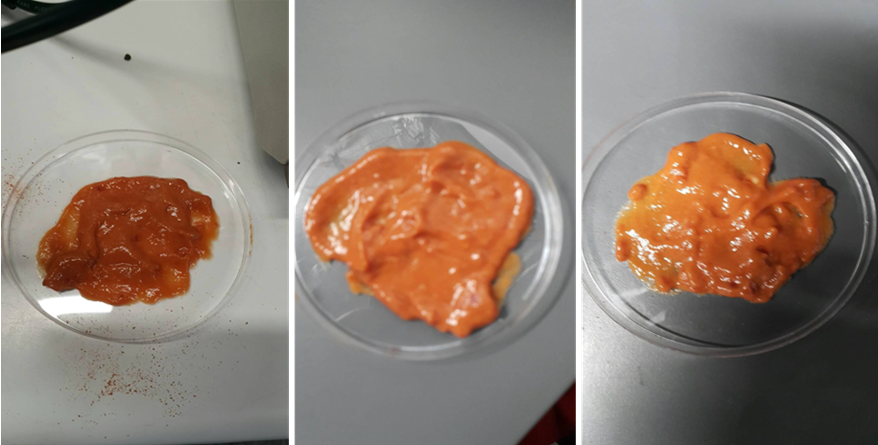
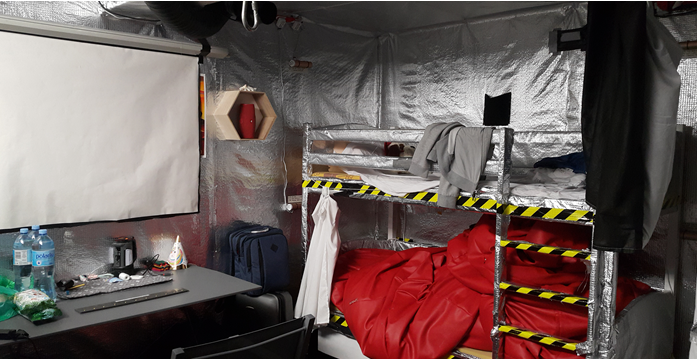
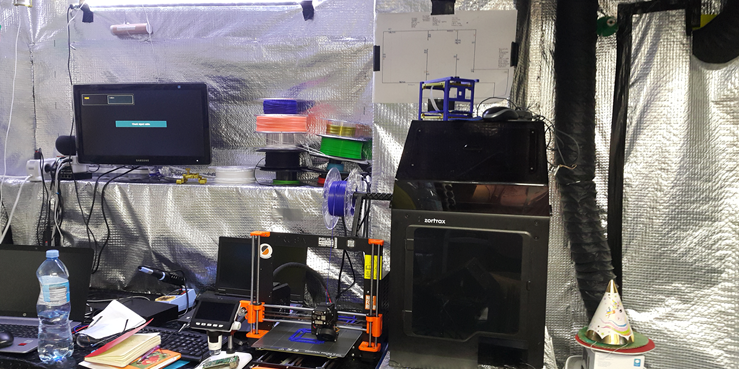
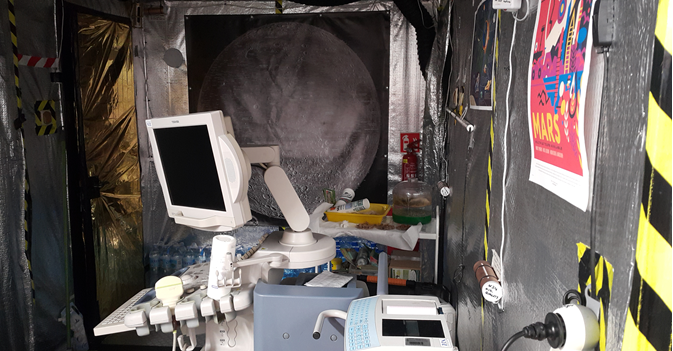
To keep contamination at bay, the petri dishes are covered. The petri dishes are then placed in three different compartments of the mission center, where they are thought to be the most vulnerable to bio-contamination. The locations chosen are the dormitory (Figure 2), the galley with an operations bench (Figure 3), and the geological laboratory (Figure 4) respectively.
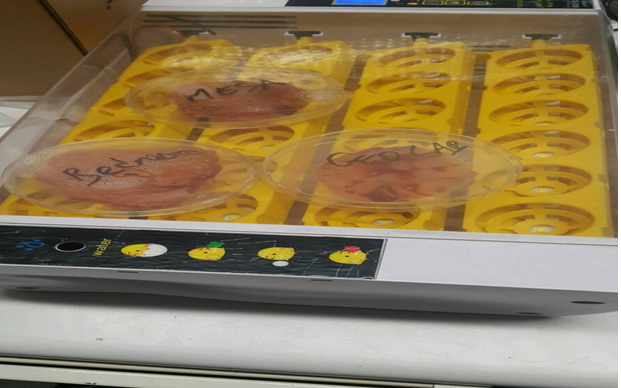
The petri dishes are closed and placed in the incubator after 5 minutes of air exposure as seen in Figure 5.
The mixtures are examined using the WF16X Microscope. Molds have been observed to form in significant numbers in the mixtures. The dormitory mixture has the highest level of
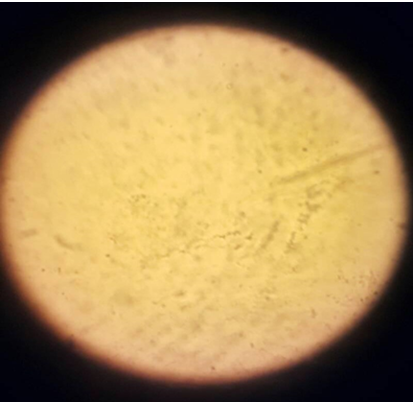
contamination, followed by galley with an operations bench, and the geological laboratory has the lowest level. Below is an example of a microscopic image (Figure 6).
Molds within the enclosed habitats could cause problems. Mold issues should be one of the Analog Astronaut Mission Habitats' primary concerns in order to ensure the health of their crews. Molds have been linked to a variety of diseases, including respiratory issues, allergic reactions and infections. Molds can easily contaminate habitats because they produce spores that are easily spread through the air. Molds, on the other hand, are naturally resistant. They can withstand high temperatures, chemicals, arid environments, and even ultraviolet light. Molds prefer moist environments and habitats. Humans are moist creatures, and moisture will be transferred to the walls if they are placed in an enclosed space [5]. Acting immediately poses a risk and should be addressed as soon as possible. Inactive mold is not a direct threat to collections, but it can be spread through handling and air currents and will readily bloom if favorable environmental conditions exist.
Conclusions and Recommendations
Molds have been observed to grow in significant numbers in environmentally controlled and hermetically sealed environments (primarily human-centered locations). To protect the crew and citizens from diseases that the crew could spread, Analog Mission Habitats should develop a bio-contamination control strategy based on:
Designing Contamination-Free Process Systems
To reduce the risk of contamination, a good process workflow could be designed. Each should progress from high-risk to low-risk areas. A careful design and proper barriers will prevent raw ingredients, airborne pathogens, and personnel from crossing back into higher-risk areas. The facility's next points of entry should be separated from the production and packaging areas.
Checking Process Systems for Contamination
Mold can be detected using an indoor air quality sensor. Molds all have one thing in common: they thrive in moist environments. If the humidity in the room exceeds 60%, mold is most likely growing somewhere. A good air quality sensor can detect temperature, humidity and particulate matter (PM2). Mold detection equipment could be used. Hygrometers compare the moisture in the air to the maximum amount of dampness that space can contain, indicating higher levels. Because of the link between mold and high humidity levels, hygrometers are popular in mold testing. Professional-grade sensors are built into the BioMatrix Mold Monitor. Each sensor is calibrated to detect mold contamination-related variables. Urine tests for mold exposure in enclosed habitats are also necessary. In most cases, detoxing from mold (after confirming the individual has a clean environment) takes about a year. With a urine or environmental test, mycotoxin testing detects the presence of harmful mycotoxin metabolites caused by mold or fungi in the body or home. Mold in urine could be detected using a test kit. MycoTOX detects eleven different mycotoxins from 40 different mold species in a single urine sample.
Providing Proactive Measures in Response to Contamination Events
Proactive measures could include [6]:
- Details on how to classify airborne bio-contamination in cleanrooms, including measurement methods and sampling method validation.
- Detail on methods for classifying and monitoring cleanroom surfaces.
- Limits for microbial monitoring are established.
- Techniques for risk management and assessment.
- Examining the relationship between enumeration and the types of isolates found.
- Consideration of the shortcomings of EM sampling techniques such as active (volumetric) air-samplers.
- Introduction of a possible classification scheme for maximum permitted viable counts, similar to the ISO 14644 and ISO 14698.
References
-
Guarneri G, Olivieri B, Senna GHG, Vianello A (2023) Relative Humidity and Its Impact on the Immune System and Infections. International Journal of Molecular Sciences 24(11): 9456.
-
Sandle T (2019) Biocontamination Control for Pharmaceuticals and Healthcare. SCRIBD, pp: 1-9.
-
Nazaroff WW (2004) Indoor Bio Aerosol Dynamics. Indoor Air 14: 175-183.
-
Raponen T, Lehtonen M, Raunemaa T, Nevalainen A (1992) Effect of Indoor Sources on Fungal Spore Concentrations and Size Distributions. Journal Aerosol Sci 23(1): 663-666.
-
Moeller R, Fujimori A (2019) The resistance of bacterial spores to space radiation. Astrobiology Science Conference.
-
Sandle T, Ancrum T (2015) Development of a bio-contamination strategy. Cleanroom Technology.
- Diversity of Candida sp and Antifungal Susceptibility Patterns in Digestive Candidiasis among People Living with HIV in CHU of Libreville, Gabon
- Vulvovaginal candidiasis: Retrospective study (2019- 2021) at the Centre Hospitalier National de Pikine, Suburban Dakar, Senegal
- Identification of Environmental Fungal Species in Clinical Services of University Hospital of Angre, Abidjan (Cote d’Ivoire)
- New Location of some Gasteroid Basidiomycetes in Western Kazakhstan
- Evaluation of Various Extracellular Enzymes of Ectomycorrhizal Mushrooms
- Morphology and Phylogeny of Lactarius Wallichianae sp. nov and Xerula magnispora sp. nov. from India