
Native Chicken Beauty Contest for Agritourism in the Philippines and Thailand
Agritourism industry shows a promising future in the Philippines and Thailand. The countries of the Philippines and Thailand are known to be culturally diverse coupled with magnificent land and water biodiversity. Due to this characteristics various agritourism initiatives is being introduced. The native chicken beauty contest is one among the initiative. This paper assessed the perceived socio-cultural impact of the native chicken beauty contest as an agritourism initiative in the province of Isabela, Philippines. Data were gathered among randomly selected stakeholders on the initiatives. The study was participated mostly by female respondents who are at their adulthood, married and those who are educated by at least the basic education. Most of the respondents are engaged in farming and government employment. Most of the respondents are raising less than 50 heads of native chicken, the respondents are positive that the initiative that it can be a form of entertainment and recreational. Also, they belief that the initiative can promote local heritage and cultural conservation. This result can imply that the initiative is well accepted and is recommended for the continuance since the stakeholders of the activity has a positive assessment on the impact to their social and cultural development. Statistically, when group according to their sex the participants have comparable positive perception on the impact of the initiatives. In addition, the participants who are at their middle age, unemployed, with higher educational attainment and higher number of native chickens being raised, have more positive perception on the impact of the initiatives.
Introduction
The Philippines and Thailand considers itself to be tourist destination hub in Asia and the world. Also, according to according to Asia Travel Guide, for 2023 and 2024, the Philippines and Thailand are included among the best place to travel in terms of cultural activities.
The tourism industry of the country is focusing on promoting tourist sites and activities that can be culture- based, nature-based or farm-based otherwise known as agritourism. According to Chang [1], along with remittances coming from the Overseas Workers (OW), income generated from the tourism industry of the country is one among the fuel of Philippine economy before and beyond the pandemic.
The country’s rich cultural heritage displays the uniqueness of the people as a country and as a member of the global community. Each province in the country has their own unique culture and traditions that is best manifested in their religion, customs, fiestas and festivals. On the other hand, the natural heritage of the country provides majestic scenery of mountains, beaches, terrains and the like. These beautiful cultures and natural sceneries, that provides one of a lifetime experience among the local and foreign tourists.
Agritourism is a distinct area of tourism industry which can be referred to as rural tourism, ethnic tourism, eco- based or nature-based tourism or even educational tourism. The concept evolves just recently, however, the practice of agritourism can be traced as early as 1800’s in Europe and North America. Recently, the evolution of agritourism focused on creating the bar on needs, concepts, definition and types of agritourism. Agritourism is the combination of agriculture and tourism. It refocuses the practice and framework of agriculture towards economic development, sustainable development and becoming more environmentally friendly industry. Agritourism provides opportunities for people from urban societies to experience and gain knowledge to get acquainted with rural life and their previous life set-up with beauty and simplicity in the province or field. Also, it helps the rural people to generate additional income aside from their income generated from their agricultural products [2]. Also, Arellano [3] explains that agritourism industry is one among fastest growing areas in the field of tourism industry. In agritourism industry, tourists are given opportunity to reflect agricultural landscape of a place including the factors the affects this landscape. They may also participate in the various agricultural processes for the purpose of enjoyment and learning. Activities for this matter may include daily visits, harvesting, hunting and fishing, observation of wildlife, tree planting, etc. It is a sustainable form of livelihood and tourism. For various countries, it is included in their regional development plan with the end view of empower rural areas to actively participate in their local economies and to promote green tourism.
With the aim of further developing the agritourism industry of the Countries, starting 2018, the native chicken beauty contest was introduced as agritourism initiatives. The main purpose of the initiatives is to encourage the farmers to increase their production of native chicken. Also, it aims to offer another form of agritourism initiative in the province that will give new and exciting first and hands-on experience among the visiting tourists in country. On the outset, the initiatives also aimed at developing the native chicken industry to be part of the business industry of the province. Generally, the implementation was a success for several years.
This study aimed at assessing the socio-cultural impact of the native chicken beauty contest as an agritourism initiative in the Philippines and Thailand. The assessment is based on the perception of the various stakeholders of the initiatives for the purpose of looking at the areas that needs improvement.
Framework of the Study
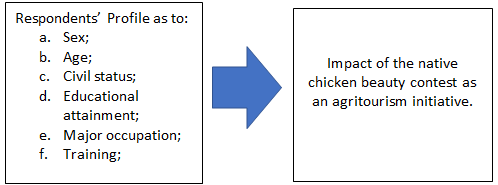
Null Hypothesis
There is no significant difference on the socio-cultural impact of the native chicken beauty contest as an agritourism initiative in the Philippines and Thailand when the respondents are grouped according to their profile.
Methodology
Research Design
The study used descriptive-comparative research design. The design aims to illustrate the physical and none physical characteristics of concept on its natural set-up. In addition, comparative design aims to look at possible similarities and differences of concepts and variables of research.
The Locale and Respondents of the Study
The study was conducted among the 634 randomly selected stakeholders from the difference municipalities of the province of the Philippines and Thailand. They were selected using the probability sampling of 97% confidence level and 3% allowable error. Also, proportional allocation was also done to ensure equal representation from the different municipalities.
Data Gathering Procedure and Statistical Tool
The study made used of a survey questionnaire as the main tool in gathering data. It was adapted from the study. It has two (2) parts. Part 1 aims to gather data related to the profile of t respondents while Part 2 of the questionnaire was devoted to gather the perception of the respondents on the impact of the native chicken beauty contest as an agritourism initiative. A five-point Likert Scale [4] was used to aid the respondents in their assessment.
Data were processed using the Statistical Package for Social Science (SPSS). Descriptive statistics like frequency counts, percentages, and mean were used to describe the demographic characteristics and the perceived socio-cultural impact of the native chicken agritourism initiative.
Results
As shown in the table 1, majority of the respondents were female with 53.797% from the total frequency against the male respondents with only 46.21 %. From this, an age bracket of 51 to 60 dominated with 245 respondents or a total of 38.64 % while the 29.02 % for respondents ages 31- 40 and 32.33 % for ages 41 to 50.
In terms of their civil status, married respondents dominated the list with a total of 334 participants or 52.68% following single with 165 heads or 26.02% and 135 participants from the group of separated respondents or a total of 26.02%. As far educational attainment is concerned, majority of the respondents are secondary school with 166 participants or 26.18%. Meanwhile, the elementary school were noted with 157 total of responses or 24.76 % followed by vocational school with 135 or 21.29%, graduate with 98 heads or 15.46%, and 78 participants from postgraduate or 12.30%.
The table also presented that the respondents whose occupation is farming dominated the participants with 306 participants or 48.26%, 114 or 17.98% government employees, 105 or 16.56% of private employees, while 109 or 24.76 percent from the total respondents are noted to be jobless. The researchers also considered the number of heads being managed by the participants and the table gleaned that 332 of them manages less than 50 or 52.37%, 170 or 26.81 % were managing 51-100 heads and 132 or 20.82 % are managing 101-150 heads.
| Profile | Frequency | Percentage |
|---|---|---|
| (n=634) | -100% | |
| Sex | ||
| a. Male | 293 | 46.21 |
| b. Female | 341 | 53.79 |
| Age | ||
| a. 31 – 40 | 184 | 29.02 |
| b. 41 – 50 | 205 | 32.33 |
| c. 51 – 60 | 245 | 38.64 |
| Civil Status | ||
| a. Married | 334 | 52.68 |
| b. Separated | 135 | 21.29 |
| c. Single | 165 | 26.02 |
| Educational Attainment | ||
| a. Elementary school | 157 | 24.76 |
| b. Secondary school | 166 | 26.18 |
| c. Vocational school | 135 | 21.29 |
| d. Graduate | 98 | 15.46 |
| e. Postgraduate | 78 | 12.3 |
| Major Occupation | ||
| a. None | 109 | 17.19 |
| b. Farming | 306 | 48.26 |
| c. Government Employee | 114 | 17.98 |
| d. Private Employee | 105 | 16.56 |
| Number of Heads being Managed |
Table 1: Respondents Perceived Socio-Cultural Impact of the Native Chicken Beauty Contest as an Agritourism Activity.
- a. Less than 50
- 332
- 52.37 b. 51 – 100
- 170
- 26.81 c. 101 – 150
- 132
- 20.82
- Trainings Related to Raising Native Chicken a. None
- 378
- 59.62 b. Local/Municipal Level
- 133
- 20.98 c. Provincial Level
- 123
- 19.4
Table 2: The Profile Variables of the Respondents.
Finally, the researchers also surveyed the trainings attended by the respondents with relevance on raising native chicken. The table gleaned 378 of them or 59.62 % had not yet attended any trainings related to native chicken raising, 133 of them or 20.98% attended local/municipal trainings, and 123 of them, or 19.40 % were able to attend in the provincial level.
Table 2 presents the perceived socio-cultural impact of the native chicken beauty contest as an agritourism activity in the Philippines and Thailand. Mostly were “Strongly Agree” by the respondents with mean rating from 4.50 to 4.83. The respondents strongly agreed that the native chicken beauty contest has able to provide entertainment and recreational opportunities, enhance family and community cohesion.
| Mean | Description | |
|---|---|---|
| The Native Chicken Beauty Contest has able to... | ||
| 1. Encourage local communities to develop more interesting events | 4.48 | Agree |
| 2. Provide entertainment and recreational opportunities | 4.8 | Strongly Agree |
| 3. Enhance family and community cohesion, attachment, integration, and solidarity | 4.55 | Strongly Agree |
| 4. Provide avenue for meeting and interacting with tourists and new people | 4.36 | Agree |
| 5. Encourage volunteerism and other social values | 4.78 | Strongly Agree |
| 6. Provide platform for attaining new skills, talents, and knowledge | 4.61 | Strongly Agree |
| 7. Provide a better understanding of visitors’ cultures | 4.5 | Strongly Agree |
| 8. Improve a healthy lifestyle (e.g. sports events). | 4.49 | Agree |
| 9. Promote local heritage/culture preservation and conservation | 4.83 | Strongly Agree |
| 10. Engage community people in various cultural activities and experiences | 4.82 | Strongly Agree |
Table 3: Respondents Perceived Socio-Cultural Impact of the Native Chicken Beauty Contest as an Agritourism Activity.
Conclusion
This study was conducted to assess the native chicken beauty contest as an agritourism initiatives in the Philippines and Thailand. The assessment was based on the perception of the various stakeholders of the initiatives. The study was participated mostly by female respondents who are at their adulthood, married and those who are educated by at least the basic education. Most of the respondents are engaged in farming and government employment. Most of the respondents are raising less than 50 heads of native chicken and but no training about native chicken management. In terms of the perceived socio-cultural impact, the respondents are positive that the initiative that it can be a form of entertainment and recreational and can promote unity among the members of the community. Also, they participants have positive assessment on the ability of the initiative to engage the community in various cultural activities and experience. Also, they belief that the initiative can promote local heritage and cultural conservation. Statistically, when group according to their sex, the participants have comparable positive perception on the impact of the initiatives.
References
-
Chang, H (2007) Analysis of the Philippine Chicken Industry: Commercial Versus Backyard Sectors. Asian Journal of Agriculture and Development 4(1): 41-56.
-
Pcaarrd (2020) Native Chicken: Industry Strategic Science and Technology Program. Department of Science and Technology.
-
Arellano A (2019) The Image of The Philippines as Tourism Destination in Finland. Thesis in Tourism Degree at Haaga-Helia, University of Applied Sciences.
-
Likert RA (1932) Technique for the Measurement of Attitudes. Arch Phychology 22(140):55.
- Diversity of Candida sp and Antifungal Susceptibility Patterns in Digestive Candidiasis among People Living with HIV in CHU of Libreville, Gabon
- Vulvovaginal candidiasis: Retrospective study (2019- 2021) at the Centre Hospitalier National de Pikine, Suburban Dakar, Senegal
- Identification of Environmental Fungal Species in Clinical Services of University Hospital of Angre, Abidjan (Cote d’Ivoire)
- New Location of some Gasteroid Basidiomycetes in Western Kazakhstan
- Evaluation of Various Extracellular Enzymes of Ectomycorrhizal Mushrooms
- Morphology and Phylogeny of Lactarius Wallichianae sp. nov and Xerula magnispora sp. nov. from India