
Prevalence of Tinea capitis in Schoolchildren in Three Villages of Woleu-Ntem Province
Introduction: Tinea capitis is a benign alopecising fungal infection mainly affecting school children with a tendency to spontaneous healing at puberty, and caused by dermatophytes. Objective: To determine the prevalence of Tinea capitis in school children in the Haut Ntem department. Materials and Methods: This was a descriptive cross-sectional study conducted from November 11, 2021 to April 7, 2022 in 3 villages in the Haut Ntem department. The ringworm lesions were taken from school children head using a scalpel and collected in a sterile Petri dish. Each sample was examined directly and cultured on Sabouraud Chloramphenicol Actidione medium. Tinea capitis was diagnosed if either direct examination or culture was positive. Results: Among the 128 children, included, median age was 9 years; Tinea capitis with small plaques (66.4%) were more frequent than those with large plaques (33.6%). The frequency of Tinea capitis was higher on direct examination (23.6%) than on culture (9.4%). The age group most affected by both direct examination and culture was [6-9 years] (p=0.27). After culture, Tinea capitis of the scalp was more frequent in Gabon-Ville (41.7%); whereas its frequency (25.0%) was similar in Akok and Gabon-Ville on direct examination. Endotrix parasitism was significantly more frequent (p<0.0001). Tinea capitis was mainly due to the Trichophyton genus (100%, p<0.0001). Conclusion: Tinea capitis are a public health problem in rural Gabon. They are dominated by small-plate ringworm caused by fungi of the Trichophyton genus.
Introduction
Dermatophytes are a group of microscopic fungi that can affect the hair and cause Tinea capitis [1]. It is a benign, alopecising fungal infection that mainly affects school children, with a tendency to spontaneous recovery at puberty [2]. They are caused by zoophilic, telluric or anthropophilic species whose cosmopolitan geographical distribution may vary according to rural or urban areas [3]. The epidemiology and species involved in the occurrence of ringworm are constantly evolving worldwide [4].
In Africa, data on Tinea capitis are more extensive in North and West Africa than in Central Africa, with prevalence ranging from 11.3% to 76.4% [3, 5, 6, 7, 8, 9, 10, 11, 12]. In Central Africa, in Cameroon, scalp ringworm in school-age children has a prevalence ranging from 8.1%-21.48%, with anthropohilic species as the causative agents [13, 14].
In Gabon, Afene NS, et al. [15] and Hogewoning AA, et al. [16] respectively in urban and semi-urban environments found that scalp ringworm was highly prevalent, with a predominance of Trichophyton species. These data are among the few found in Gabon. With the aim of contributing to our knowledge of the epidemiology of childhood scalp ringworm, we carried out this study to investigate the prevalence of scalp ringworm in rural areas.
Materials and Methods
Study Site and Population
A cross-sectional study was conducted from January to April 2022 among school-aged children from three village schools (Gabon-Ville, Akok, Mbounaville) in the Woleu- Ntem province of the Haut Ntem department, Gabon. Children clinically suspected of having scalp lesions were included after written informed consent and parental agreement. A questionnaire was submitted to all parents of included children to collect sociodemographic data and health status. Children under 3 years of age were not included in the study
Sample Collection and Handling
For each child included, hair was removed from the scalp using a scalpel blade, and cultured. Samples were inoculated on Sabouraud Chloramphenicol actidione for 7-14 days at
30-35°C.
Diagnosis of Fungal Species
Mycological diagnosis is carried out by two methods: direct examination and culture. Direct examination is performed on hair. It required 30% KOH (potassium hydroxide). A drop of potassium hydroxide is placed on a clean slide, then a fragment of the sample is placed on the slide, covered with a coverslip and observed with a x10 (tracing) and x40 (identification) objective. The type of parasitism (endothrix, Trichophytic hair and endo- ectothrix, microsporic hair) was revealed by microscopy. For fungal culture, samples were seeded in Sabouraud- chloramphenicol-actidione (SCA) medium contained in tubes and incubated at 27-30°C for 21 to 30 days. Identification was based on macroscopic and microscopic criteria for scalp dermatophytes.
Statistical Analysis
Data from children with suspected scalp lesions were collected and password-protected. Data included age, sex, residence and type of suspected lesion. Data were entered into MS Excel® (Microsoft Corporation Seattle, USA). All statistical calculations were performed using SPSS version 20 (IBM SPSS, Chicago, USA) and Staview 05.
Ethical considerations: Participants gave written informed consent through their parents or legal guardians. Confidentiality was ensured by concealing the names of children suspected of having scalp ringworm through the use of identification numbers in the questionnaires. Participants diagnosed with various lesions of scalp ringworm were treated at their own health center, while others requiring further treatment were referred to the appropriate health services.
Results
Socio-Demographic and Clinical Characteristics of Children with Suspected Ringworm Lesions of the Scalp
The total number of children included in the study was 128. Table 1 shows that the study population consisted mainly of children aged [6, 7, 8, 9] years with a median age of 9 years with q1: 5.2 years and q3: 10.0 years. The sex ratio was 0.7 in favor of males. Small plaque ringworm was more frequent than large plaque ringworm. Small-plate ringworm was twice as frequent as large-plate ringworm.
| Frequency (n) | Percentage (%) | |
|---|---|---|
| [3-5] | 32 | 25,0 |
| [6-9] | 50 | 39,1 |
| [10-13] | 46 | 35,9 |
| Sex | ||
| Male | 74 | 57,8 |
| Female | 54 | 42,2 |
| Locality | ||
| Akok | 48 | 37,5 |
| Gabon-ville | 36 | 28,1 |
| Mbounaneville | 44 | 34,4 |
| Type of scalp ringworm | ||
| Small plaque moth | 85 | 66,4 |
| Large plaque moth | 43 | 33,6 |
Table 1: Distribution According to Socio-Demographic and Clinical Characteristics of Children with Suspected Ringworm Lesions of
Frequency of Scalp Ringworm in Rural Schoolchildren
Among 128 children with suspected scalp ringworm lesions examined, direct examination was positive in 30 (23.6%) children, while culture was positive in 12 (9.4%) children.
Socio-Demographic and Clinical Characteristics of Children with Positive Direct Examination and Culture Results
The socio-demographic, clinical and microscopic characteristics of the samples of children with scalp ringworm according to the results of direct examination and culture are given in Table 2.
Male were twice as affected by scalp ringworm as girls on culture (71.4% vs. 3.7%), while on direct examination both sexes were affected in almost equal proportions. Small plaque ringworm (n=21; 24.7%) was more common than large plaque ringworm (n=9; 20.9%), both on direct examination and after culture. The same was true for endothrix parasitism, which was significantly more frequent than endo-ectothrix parasitism (p<0.0001). Both on direct examination and culture. Other socio-demographic and clinical characteristics of the study population were not associated with either direct examination or culture positivity.
| Positive direct exam | Positive Culture | |||||
|---|---|---|---|---|---|---|
| Frequency (n) | Pourcentage (%) | p | Frequency (n) | Pourcentage (%) | p | |
| Age groups | 0,17 | 0,27 | ||||
| [3-5] | 5 | 15,6 | 3 | 4,3 | ||
| [6-9] | 16 | 32,0 | 7 | 9,4 | ||
| [10-13] | 9 | 19,6 | 2 | 4,3 | ||
| Sex | 0,78 | 0,06 | ||||
| Male | 18 | 24,3 | 10 | 71,4 | ||
| Female | 12 | 22,2 | 2 | 3,7 | ||
| Locality | 0,85 | 0,53 | ||||
| Akok | 12 | 25,0 | 4 | 33,3 | ||
| Gabon-ville | 9 | 25,0 | 5 | 41,7 | ||
| Mbounaneville | 9 | 20,4 | 3 | 25,0 | ||
| Type of scalp ringworm | 0,63 | 0,19 | ||||
| Small-plate moth | 21 | 24,7 | 10 | 11,8 | ||
| Large-plate moth | 9 | 20,9 | 2 | 4,6 | ||
| Type of hair parasitism | <0,0001 | <0,0001 | ||||
| Endotrix | 24 | 80,0 | 10 | 41,7 | ||
| Endo-ectothrix | 6 | 20,0 | 2 | 33,3 |
Table 2: Prevalence of Leather Moths on Direct Examination and Culture According to Socio-Demographic, Clinical and Microscopic C
Fungal Agents Responsible for Tinea capitis in the Study Population
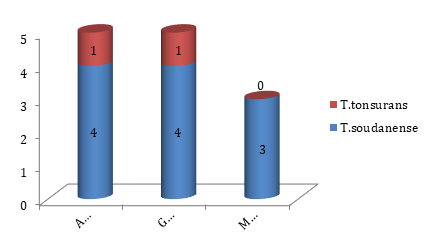
Scalp ringworm was mainly due to the genus Trichophyton (n=12; 100%; p<0.0001). The species isolated were Trichophyton soudanense (n=10; 91.7%) and Trichophyton tonsurans (n=1; 8.3%).
One case of association between T. soudanense and T.
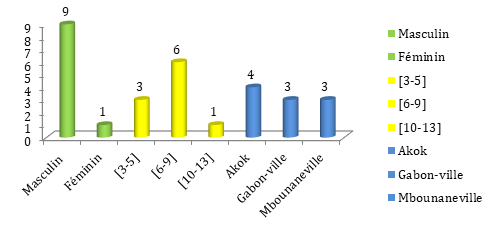
tonsurans (8, 3%) was found. T. soudanense was significantly more isolated than T. tonsurans (p<0.0001). Significantly (p=0.03), T. Soudanense was more frequent in boys (n=9/12), than in girls (n=1/12). The [6, 7, 8, 9] age group was the one in which T. soudanense was most frequently identified (n=6/12). As for its distribution between localities, it was not statistically different (Figure 1).
The distribution of etiological agents of scalp ringworm by locality is shown in Figure 2. Scalp ringworm caused by T. soudanense was more frequent in the different localities.
Discussion
School children with suspected enrolled scalp ringworm lesions were predominantly male. This gender distribution was also observed in (Gabon, Marocco Cameroon and Benin), by Hogewoning AA, et al. [16] in Lambarene, Gabon, Kechia FA, et al. [13] in Meiganga, Cameroon, Elmaataoui A, et al. [17] in Rabat, Morocco, Degboe B, et al. [18] in Cotonou, Benin, where the number of male with suspected scalp ringworm was higher than that of female. On the other hand, some authors Coulibaly O, et al. [7] in Mali, Oussou MA, et al. [8] in Bouke, Cote d’Ivoire, Sidat MM, et al. [19] in Mozambique had a predominance of female over male. Others, Afene NS, et al. [15] in Libreville, Gabon, obtained as many female as male in their studies.
The higher incidence of suspicious lesions in male than in female can be explained by the fact that female generally have longer hair than males. This means that the visible destruction of the hair takes place more slowly than in males, whose hair is shorter. Male hair is more rapidly broken by dermatophyte contamination. Since dermatophytes are keratinophilic, they eat away at the hair bulb, altering the structure of the hair and causing it to break faster. In addition, hair care for female may explain the greater number of suspicious lesions observed in female [15].
As for the greater presence of suspicious lesions with small plaques compared to those with large plaques. All these could be due to the rarity of proximity between humans and animals, as in northern African countries, and the fact that we are in a rainy rather than a dry zone.
Mycological examination of our samples showed that the frequency of scalp ringworm was higher on direct examination than on culture. This observation is also mixed in the literature, with some authors reporting results with trends similar to our own Oussou MA, et al. [8] and Olarinoye GM, et al. [9] while others have observed that culture increases the frequency of scalp ringworm [6, 11], and that culture results overlap well with those of direct examination [3].
The role of culture and direct examination in mycological procedures remains irrefutable. However, their sensitivity depends on a number of factors, such as the quality of the reagents used for culture and direct examination. But also, the performance of technicians in reading samples on direct examination and after culture. It may also be considered that patients may have used fungistatic or fungicidal substances that have the capacity to inhibit the growth of fungi in culture [5].
The prevalence of scalp ringworm based on culture results was 9.4% in our study. These results are lower than those of Sy O, et al. [20] who found a prevalence of 10.4% in rural Mauritania, and Ngwogu AC, et al. [10]. Adesiji YO, et al. [21] found a prevalence of 91% in the rural community of Osogbo in Nigeria. However, other authors, such as Testa J, et al. [22] in Bangui found lower prevalences than ours [13, 18, 23].
The prevalence of scalp ringworm varies from region to region, country to country. This variation in frequency is also observed within the same country, from one locality to another. This has been attributed to geographical, ecological, climatic, socio-economic and even genetic differences. Even differences between urban and rural areas have been reported [7, 8, 19]. This could explain the difference in results between the studies by Afene NS, et al. [15] carried out in urban areas and our own study carried out in rural areas.
Our results showed that scalp ringworm most affected children aged [6-9 years]. Males showed small-plate ringworm with Endotrix parasitism. Data on the profile of scalp ringworm are just as variable as prevalence. Indeed, some authors find identical data to ours concerning age and sex [10, 15, 16, 24]. Others, such as Kechia, et al. [13], found a predominance of males, with an average age of 10 years.
With regard to the type of ringworm, our results are contrary to those of Kallel in Tunis [25], which showed ringworm with a large ectothrix plate. As for the type of parasitism, the literature has shown that it depends on the species responsible for the ringworm. Mezouari EE, et al. [26] found a predominance of Endotrix parasitism, as we did, whereas other teams found ectothrix parasitism [26].
The type of Endotrix parasitism found in this study was linked to the exclusive existence of the Trichophyton genus. Among Trichophyton species, only two were isolated. These were T. soudanense (91.7%) and T. tonsurans (8.3%). These are the species most frequently found by Hogewoning AA, et al. [16] in rural Gabon, while Afene NS, et al. [15] found a prevalence of T. soudanense and T. gourvilii in urban areas.
These two studies, although small in number, help to demonstrate the place occupied by T. soudanense in the ecology of scalp ringworms in Gabon. In Mauritania, T. soudanense and T. rubrum were the species most frequently found by Sy O, et al. [21]. In Nairobi, T. tonsurans was the species most frequently found along with T. rubrum [27].
The exclusive detection of Trichophyton can be explained by the fact that these are mostly anthropophilic species. The rarity or even absence of co-habitation with animal species would explain the absence of zoophilic species such as Microsporum. In addition, factors such as family poverty, contact and shared use of certain toiletries, combined with the neglected nature of Tinea capitis [22] could explain our results. The species we isolated in our study are among those most frequently found in sub-Saharan Africa [28]. Similar results were obtained by Hogewoning AA, et al. [16] and Afene SN, et al. [15], except that in Afene N’s study, the second species was T. gourvilii.
These results are in contrast to those found in North Africa (Tunisia, Morocco, Algeria), where zoophilic species are the most isolated [25, 29, 30]. However, the change in lifestyle with proximity to animals has begun to be noticed in some studies, where the genus Microsporum is gaining prominence in the ecology of scalp dermatophytes [31].
Conclusion
Scalp ringworm is still a public health problem in rural Gabon. They are dominated by small plaque ringworm. The anthropophilic species T. soudanense and T. tonsurans are the only species responsible for this pathology. Rapid diagnosis and management of these diseases in rural areas could help reduce their prevalence and human-to-human contamination.
Acknowledgement
We thank the patients who consented to participate in this study, as well as the Department of Parasitology and Mycology of the University of Health Sciences of Libreville and the Department of Infectious Diseases of the University Hospital of Libreville for the supply of reagents and the collection of biological material, and all those who participated directly or indirectly in the realization of this work. We would also like to thank EDCTP, through the PHYLECOG project, for their contribution to the development of this study.
References
-
Diop A (2018) Epidemiological-clinical and etiological profile of TBI in adults in Dakar (Senegal). Ann Dermatol Venerol, pp: 2-6.
-
Iken M, Lemkhente Z, Lmimouni BE (2019) Practical driving in front of ringworm of the scalp. Journal of Medical Biology 8(31): 186-189.
-
Ndiaye N, Diongue K, Seck MC, Badiane AS, Diallo MA, et al. (2015) Epidemiological profile of _Tinea capitis_ in Dakar (Senegal). A 6-year retrospective study. Journal of Mycology 25(2): 169-176.
-
Dominique C, Audonneau NC (2013) Ringworms of the scalp. French-Speaking Laboratory Review 43(454): 49- 57.
-
Oudaina W, Biougnach H, Riane S, Yaagoubil IE, Tangi R, et al. (2011)Epidemiology of ringworm of the scalp among external consultants at the children’s hospital in Rabat (Morocco). Journal Of Medical Mycology 21(1): 1-5.
-
Saghrouni F, Bougmiza I, Gheith S, Yaakoub A, Meksi SG, et al. (2011) Mycological and epidemiological aspects of Tinea capitis in the Sousse region of Tunisia. Annals of Dermatology and Venereology 138(8-9): 557-563.
-
Coulibaly O, Kone AK, Doumbo SN, Goita S, Gaudart J, et al. (2016) Dermatophytosis among school children in three eco-climatic zones of Mali. Plos Negl Trop Dis 10(4): e0004675.
-
Oussou MA, Gue I, Zika KD, Kouassi KA, Kassi K (2020) Ringworm in schools in Bouake: epidemiological, clinical and microbiological aspects. RISM 22(1): 25-33.
-
Olarinoye GM, Katibi OS, Apeh AJ, Fayemiwo SA, Ogunbiyi AO, et al. (2021) _Tinea capitis_: aetiology, clinical features, and associated sociodemographic factors among school pupils in Ilorin, Kwara states, Nigeria. The African hair type 11(3): 36-47.
-
Ngwogu AC, Otokunefor TV (2007) Epidemiology of dermatophytoses in rural community in Eastern Nigeria and review of literature from Africa. Mycopathologia 164(4): 149-158.
-
Mebazaa A, Fathallah A, Aouamri EK, Meksi GS, Ghariania N, et al. (2010) Clinical and epidemiological profile of tinea capitis in central Tunisia. A 16-year retrospective study (1990–2005). Journal of Medical Mycology 20(2): 91-96.
-
Makhni F, Neji S, Sellami A, Cheikrouhou F, Sellami H, et al. (2008) Ringworms of the scalp in the area of fax (Tunisia). Journal of Medical Mycology 18(3): 162-165.
-
Kechia FA, Kouoto EA, Nkoa T, Nweze EI, Fokoua DCM, et al. (2014) Epidemiology of _Tinea capitis_ among school- age children in Meiganga, Cameroon. Journal of Medical Mycology 24(2): 129-134.
-
Kouotou EA, Fokoua DCM, Kechia FA, Somo MR (2016) Ringworm of the scalp: epidemiological profile in Cameroonian schools. Annals of Dermatology and Venereology 143(4S1): S42.
-
Afene NS, Kendjo E, Akotet BM, Manfoumbi MM, Kombila M (2009) _Tinea capitis_ in school children in Libreville, Gabon. Journal of Medical Mycology 19(3): 155-160.
-
Hogewoning AA, Adegnika AA, Bavinck BJN, Bakhsh Y, Kremsner PG, et al. (2010) Prevalence and causative fungal species of _Tinea capitis_ among school children in Gabon. Mycoses 54(5): e354-e359.
-
Elmaataoui A, Zeroual Z, Lyagoubi M, Aoufi S (2012) Etiological profile of ringworms of the scalp in Ibn Sina Hospital in Rabat (Morocco). Journal of Medical Mycology 22(3): 261-264.
-
Degboe B, Koudoukpo C, Habib A, Kouassi A, Djodjo M, et al. (2020) Scalp disorders in black Africans treated in a dermatology department in Cotonou (Benin): age- sex-specific epidemiological and clinical features. Pan African Medical Journal 37: 303.
-
Sidat MM, Correia D, Buene TP (2007) _Tinea capitis_ among children at one suburban primary school in the city of Maputo, Mozambique. Rev Soc Bras Med Trop 40(4): 473-475.
-
Sy O, Diongue K, Ba O, Ahmed C, Elbechir M, et al. (2020) _Tinea capitis_ in school children from Mauritania: a comparative study between urban and rural areas. Journal of Medical Mycology 31(2).
-
Adesiji YO, Omolade FB, Aderibigbe IA, Ogungbe O, Adefioye OA, et al. (2019) Prevalence of _Tinea capitis_ among children in Osogbe, Nigeria, and the associated risk factors. Diseases 7(13): 1-7.
-
Testa J, Kaimba C, Georges A, Delmont J (1992) Epidemiology of _Tinea capitis_ in Bangui (Central African Republic). Bull Soc Pathol Exot 85(5): 395-396.
-
Fenosoa TAM, Norosoa ZJ, Zanadraibe KJ, Rakotozandrindrainy N, Razanakolona LR (2019) Mycological profile of scalp ringworms seen at the UPFR Parasitology-Mycology of the HU-JRA Antananarivo, Madagascar from 2005-2018. J accr Africa 3(4): 321- 327.
-
Mtibaa L, Rabhi F, Abderrahim A, Baccouchi N, Kahena J, et al. (2022) Ringworms of the scalp: epidemiological study in the Tunis region from 2012 to 2020. Pan African Medical Journal 41(168): 1-9.
-
Kallel A, Hdider A, Fakhfakh N, Belhadj S, Salah BN, et al. (2017) Scalp ringworm: main mycosis in children. Epidemiological study over 10 years in Tunis. Journal de Mycologie Médicale 27(3): 345-350.
-
Mezouari EE, Hocar O, Atarguine H, Akhdari N, Amal S, et al. (2016) Tinea capitis in the military hospital Avicenna (Morocco): Review of 8 years (2006–2013). Journal of Medical Mycology 26(1): 1-5.
-
Moto JN, Maingi JM and Nyamache AK (2015) Prevalence of _Tinea capitis_ in school going children from Mathare, informal settlement in Nairobi, Kenya. BMC Res Notes 8: 274-277.
-
Bryn KDA, Assoumou A, Haddad RN, Aka BR, Ouhon J (2004) Epidemiology of ringworm in Abidjan (Ivory Coast). Med Trop 64(2):171-175.
-
Benmezdad A, Moulahem T (2015) Fungal profile of superficial mycoses diagnosed in the parasitology- mycology laboratory of Constantine University Hospital. Retrospective study: years 2011-2012-2013. Journal of Medical Mycology 25(3): 243.
-
Boumhil L, Hjira N, Naoui H, Zerrour A, Bhirich N, et al. (2020) Tinea capitis in the military hospital Mohammed V (Morocco). Journal of Medical Mycology 20(2): 97-100.
-
Ndiaye D, Ndiaye M, Badiane A, Seck MC, Faye B, et al. (2013) Dermatophytosis diagnosed at the laboratory of parasitology and mycology of Le Dantec Hospital in Dakar between 2007 and 2011. Journal of Medical Mycology 23(4): 219-224.
- Diversity of Candida sp and Antifungal Susceptibility Patterns in Digestive Candidiasis among People Living with HIV in CHU of Libreville, Gabon
- Vulvovaginal candidiasis: Retrospective study (2019- 2021) at the Centre Hospitalier National de Pikine, Suburban Dakar, Senegal
- Identification of Environmental Fungal Species in Clinical Services of University Hospital of Angre, Abidjan (Cote d’Ivoire)
- New Location of some Gasteroid Basidiomycetes in Western Kazakhstan
- Evaluation of Various Extracellular Enzymes of Ectomycorrhizal Mushrooms
- Morphology and Phylogeny of Lactarius Wallichianae sp. nov and Xerula magnispora sp. nov. from India