
Retinopathy Stages Detection using Circular Hough Transformation
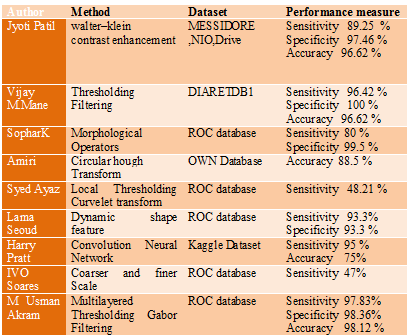
Diabetic retinopathy is progressive disease that leads patients to blindness. Diabetic retinopathy is classified into two main stages, namely non-proliferative diabetes retinopathy (NPDR) and proliferative diabetes retinopathy (PDR). In realism, there is not much difference in risk between diabetic eyes with normal eye and those having mild retinopathy. Both have a very low risk of progressing to PDR; in fact, the Early Treatment of Diabetic Retinopathy Study is necessary so that ophthalmologist can avoid severe stage. In this research used Circular Hough-Transformation method in which we find that sensitivity 89.25%, specificity 97.46 and accuracy 96.62% .It is found that the rate of progression to PDR after four years was less than 1% for both young and older patients with no diabetic retinopathy, compared to 4.1% in younger patients with a rare microaneurysm and hemorrhage.
Introduction
Classification of Retinopathy
Generally, diabetic retinopathy is classified into two main stages, namely nonproliferative diabetes retinopathy (NPDR) and proliferative diabetes retinopathy (PDR).
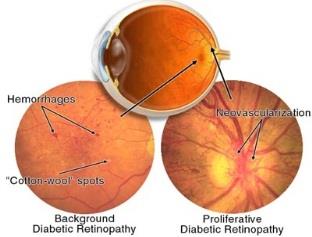
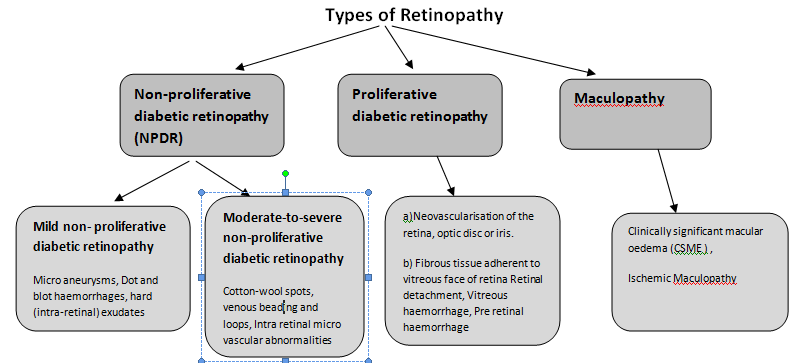
In NPDR, counting on the presence and extent of the options like onerous exudates, micro aneurysms or cotton wools spots because of outpouring of fluid and blood from the blood vessels, can be classified to mild, moderate or severe stages as followings: DR can be broadly classified as non-proliferative diabetic retinopathy (NPDR) and proliferative diabetic retinopathy (PDR), as shown in Figure 1. There are four DR stages: [2].
Pre-Proliferative DR
In this case, the changes are captured in the retinas which do not require much treatment but a little care should be taken which may lead to risk in progress which affects the eyesight.
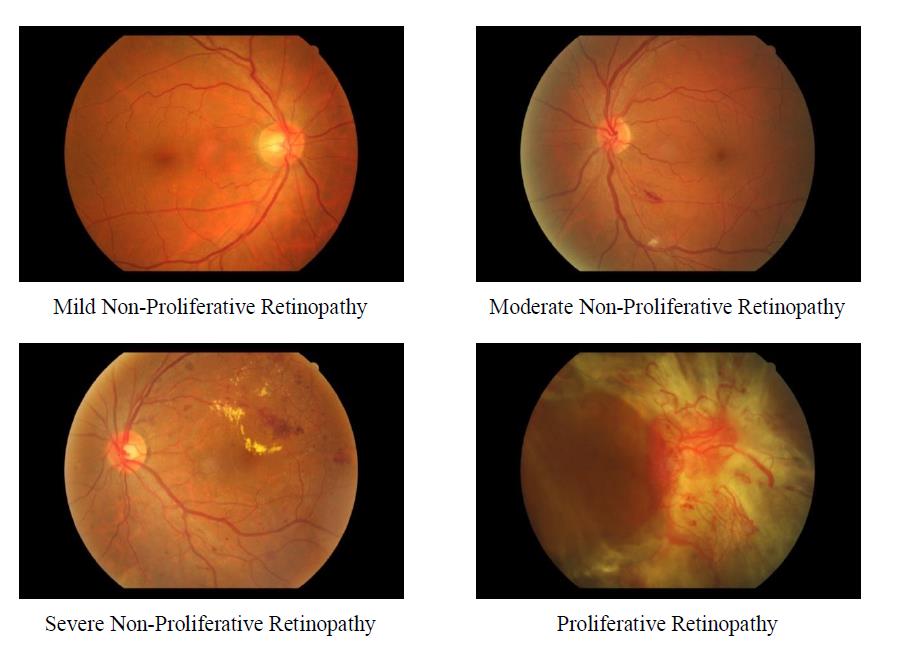
Stage 1: A. Mild Condition/ Mild NPDR: This is the earliest stage of retinopathy and vision is sometimes traditional except in some cases. However, deterioration of the blood vessels within the tissue layer has already started. Blood vessels erupt when there is not enough oxygen in the blood because of high levels of glucose. At least one micro aneurysm with or without the presence of retinal haemorrhages, hard exudates, cotton wool spots or venous loops will be present. Small swellings known as Micro-aneurysms or flame-shaped hemorrhages start to develop in the fundus quadrants [1]. Stage 2: Moderate NPDR: As the disease progresses, some of the blood vessels that irrigate the retina become blocked. It is over “mild” however but “severe” stage. There will be micro-aneurysms or hemorrhages of greater severity in one to three quadrants and leakage might occur, resulting cotton wool spots and exudates etc. to be present in the retina. Moderate non-proliferative retinopathy. Numerous micro aneurysms and retinal haemorrhages will be observed. Cotton wool spots and a restricted quantity of blood vessel beading may be seen [2]. Stage 3: Severe NPDR: As a lot of blood vessels area unit blocked, those areas within the tissue layer are going to be empty blood offer. Signals will then be sent to the body for the growth of new vessels in order to compensate for the lack of nourishment. Severe non-proliferative retinopathy. Many options like haemorrhages and microaneurysms area unit gift within the tissue layer.
Other features are also present except less growth of new blood vessels; many more blood vessels are now blocked and these areas of the retina start to send signals to the body to grow new blood vessels for nourishment. Severe (more than 15) hemorrhages and micro- aneurysms in all four quadrants of the fundus. The malady would be thought of severe NPDR stage once any of the subsequent criteria area unit met:
- Definite venous beading in at least two quadrants
- Severe damage to the small blood vessels in at least one quadrant but no signs of any proliferative diabetic retinopathy. Stage4: Proliferative Diabetic Retinopathy: PDR is the advanced stage whereby signals are sent by the retina to the body for the lack of blood supply and this triggered the growth of new blood vessels. These blood vessels will grow on the tissue layer and also the surface of the jelly- like substance (vitreous gel) that fills the centre of the attention. Although they are fragile and abnormal, they do not cause symptoms or vision loss. It is only if their skinny and weak walls leak blood, severe visual loss or even irreversible blindness would occur [3]. 3) Exudates (proteins and other lipids) and blood from the leakage forms around the retina and in some cases, leakage may form on the fovea, resulting in sudden severe vision loss and blindness. 4) Proliferative DR comes when new vessels of blood occupy on overview portions of retina surface eventually. Thus the anomalous vessels will start bleeding then emerges from scar tissue leading to a brutal sight loss. Age Related-Macular Degeneration (AMD) AMD is frequently observed retinal disease which occurs mainly in the people of the age of 50 and more. Macula a small dark portion near the middle of the retina is the exaggerated portion. Most of the people experience the effect of sight loss slowly but in some people, it is seen at the sooner phase a blurred region in the center portions of vision is a regular symptom.
Walter–Klein Contrast Enhancement
This preprocessing technique aims to boost the distinction of structure pictures by applying grey level transformation victimization the subsequent operator:
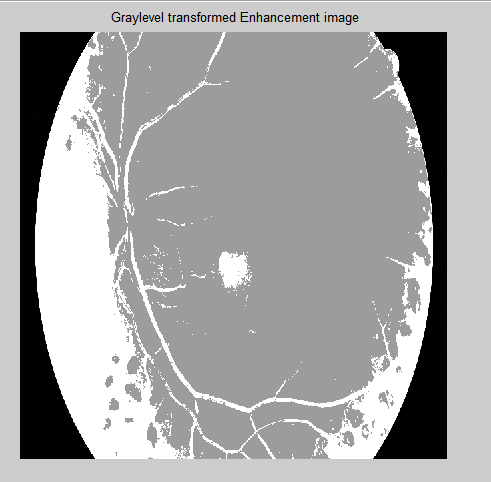
From the input complex body part image, the vascular map is extracted by applying twelve morphological top- hat transformations with twelve turned linear structuring components (with a radial resolution 15◦).Then, the vascular map is subtracted from the input image, which is followed by the application of a Gaussian matched filter. The ensuing image is then binarized with a set threshold [4]. Since the extracted candidates aren't precise representations of the particular lesions, a district growing step is additionally applied to them.
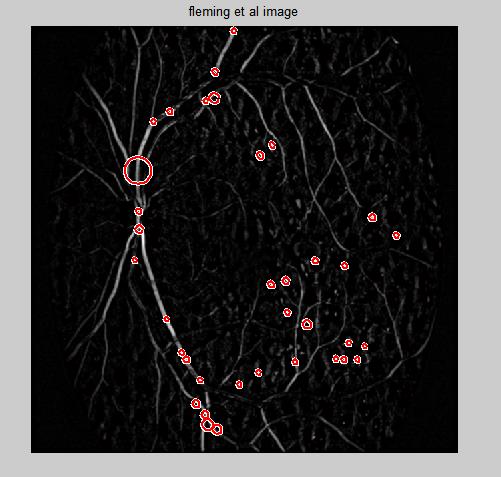
Following the thought conferred in, we tend to established associate approach supported the detection of tiny circular spots within the image. Candidates are obtained by detecting circles on the images using circular Hough transformation. With this system, a group of circular objects is extracted from the image.
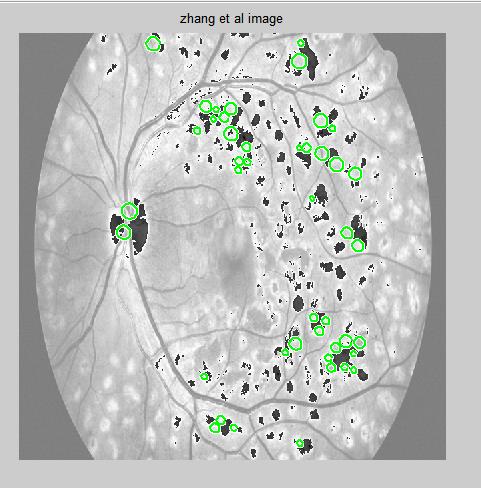
In order to extract candidates, this technique constructs a highest correlation response image for the input retinal image. This is accomplished by considering the maximal correlation coefficient with five Gaussian masks with different standard deviations for each pixel. The maximal correlation response image is threshold with a fixed threshold value to obtain the candidates. Vessel detection and region growing is applied to reduce the number of candidates, and to determine their precise size, respectively [5].
![Figure 7: Lazar, et al. Sensitivity = [TP/(TP+FN)]*100 → (1) Specificity = [TN/(TN+FP)]*100 → (2) Accuracy = [(TP+TN)/(TN+FP+FN+TN)]*100 → (3)](/fulltextimages/3780/fig_7.jpeg)
Pixel-wise cross-sectional profiles with multiple orientations square measure accustomed construct a multidirectional height map. This map assigns a set of height values that describe the distinction of the pixel from its surroundings in a particular direction. In a changed construction attribute gap step, a score map is made from that the MAs square measure extracted by thresholding [6].
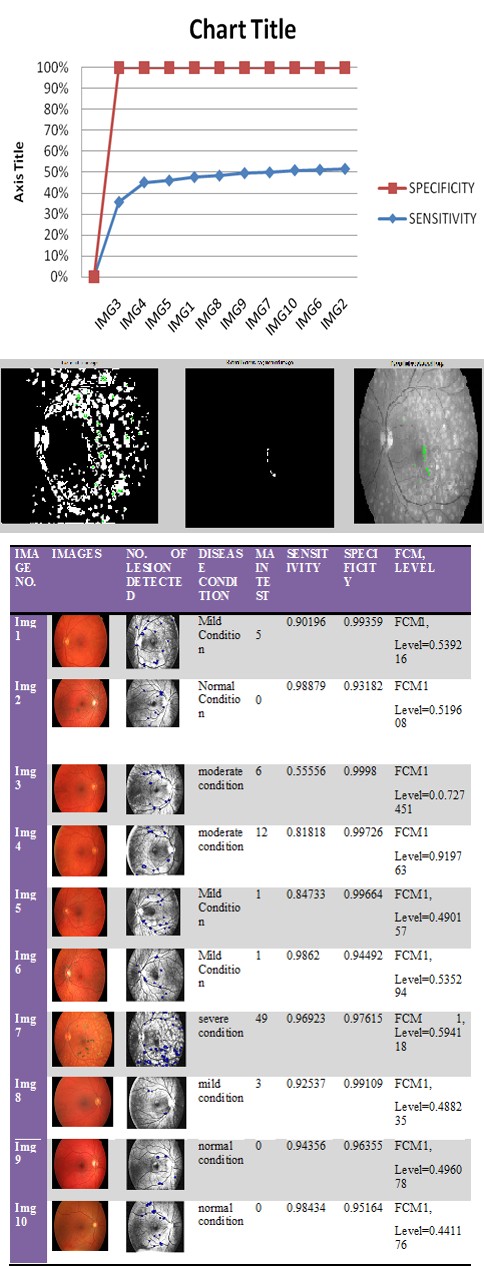
| IMAGE NO. | IMAGES | NO. OF LESION DETECTION | DISEASE CONDITION | MAIN TEST | SENSITIVITY | SPECIFICITY | FCM LEVEL |
|---|---|---|---|---|---|---|---|
| Img 1 | Mild Condition | 5 | 0.90196 | 0.99359 | FCM1, Level=0.5392 16 | ||
| Img 2 | Normal Condition | 0 | 0.98879 | 0.93182 | FCM1 Level=0.5196 08 | ||
| Img 3 | moderate condition | 6 | 0.55556 | 0.9998 | FCM1 Level=0.0.727 451 | ||
| Img 4 | moderate condition | 12 | 0.81818 | 0.99726 | FCM1 Level=0.9197 63 | ||
| Img 5 | Mild Condition | 1 | 0.84733 | 0.99664 | FCM1, Level=0.4901 57 | ||
| Img 6 | Mild Condition | 1 | 0.9862 | 0.94492 | FCM1, Level=0.5352 94 | ||
| Img 7 | severe condition | 49 | 0.96923 | 0.97615 | FCM 1, Level=0.5941 18 | ||
| Img 8 | mild condition | 3 | 0.92537 | 0.99109 | FCM1, Level=0.4882 35 | ||
| Img 9 | normal condition | 0 | 0.94356 | 0.96355 | FCM1, Level=0.4960 78 | ||
| Img 10 | normal condition | 0 | 0.98434 | 0.95164 | FCM1, Level=0.4411 76 |
Table 1: Results of the Performance Measurement Training Output 75 Value Plot (3 Images *25 Combinations) 25
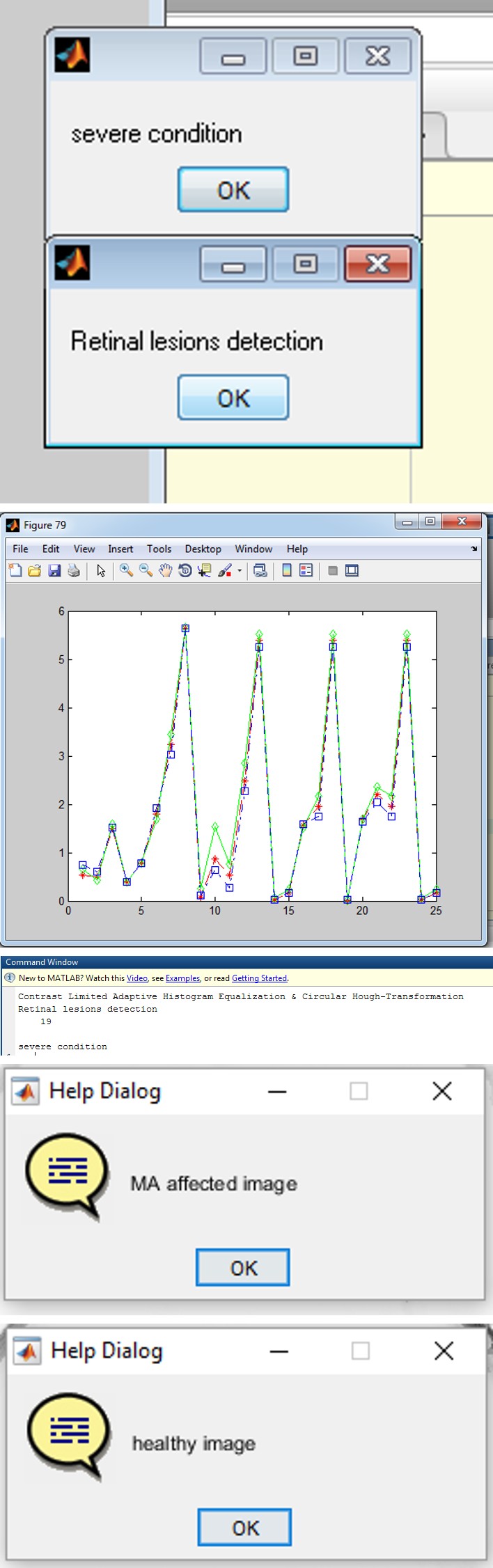
Depending on the measured feature values And based on the count of Red lesions, the image is classified as Normal/Healthy and Diseased and if it is diseased further sub-classified as Mild, Moderate and Severe. A pop up is displayed as follows.
Conclusion
We have measure the parameters like sensitivity, specificity and accuracy which determine stages of disease. This research used Circular Hough- Transformation method sensitivity 89.25 %, specificity 97.46 and accuracy 96.62 % which is based on the count of Red lesions, thus the image is classified as if it is normal, mild and severe stages of Diabetic retinopathy. Ultimately it can be dividing into non-proliferative diabetes retinopathy (NPDR) and proliferative diabetes retinopathy (PDR).
References
-
Daniel Moges Tadesse (2014) An Automated Segmentation of Retinal Images for use in Diabetic Retinopathy Studies, Addis Ababa University.
-
Herbert J, Michael JC (2017) Automated Image Detection of Retinal Pathology.
-
Jyoti Pati (2013) Development of Digital Image processing tool. LAMBERT Publication, Germany, pp: 96.
-
Heikki K¨alvi¨ainen, Lappeenranta University of Technology Finland.
-
Ramasubramanian B, Prabhakar G (2013) An Early Screening System for the Detection of Diabetic Retinopathy using Image Processing. International Journal of Computer Applications (0975 –8887) 61(5): 6-10.
-
Color segmentation by Delta E color difference.
- Screening of Hospital Staff During World Glaucoma Week in a Tertiary Eye Care Centre
- Angioid Streaks with Macular Neovascularization: Clinical Insights from Two Cases
- Giant Kissing Naevus: An Oculoplastic Challenge
- Why Freedom of Vision Should Not Cost the Freedom of Feeling - LASIK in the Climate of Change
- Asymmetric Optic Nerve with Small Disc and Large Cup: A Rare and Challenging Case of Unilateral Optic Nerve Hypoplasia
- Large Angle Exotropia in a Child: A Case Report