
Flock Uniformity – A New Poultry Welfare Indicator?
Directive 2007/43/CE establishes the system for assessing the welfare of poultry at the slaughterhouse level, which consists of a systematic assessment of indicators by the slaughterhouse's official veterinarian (OV). In Portugal those indicators include mortality rate on the farm and during transport to the slaughterhouse, as well as post mortem findings such as footpad dermatitis (FPD). Nevertheless, the increasing importance of this topic leads to a dynamic search for novel welfare indicators such as flock uniformity. Reduced animal welfare can be indicated by poor flock uniformity due to either general housing or management problems, or bird health problems. For that reason, the aim of this study was to investigate the usefulness of the parameter “flock uniformity “(FU) as an indicator of animal welfare to be used during slaughter of commercial broiler flocks. For that, a total of 26 randomly selected mixed-sex Ross 308 broiler flocks were studied. All batches were raised under similar farm management systems with a medium age of slaughter of 35 days. To study the uniformity, 10% of each batch was observed and categorized after stunning at the slaughterhouse, using the following scores based on % of small animals observed: score 1 ([0 -2,5%[; high uniformity); score 2 ([2,5-5%[; normal uniformity); score 3 ([5-7,5%[; bad uniformity); score 4 (≥7,5%; no uniformity). Additionally, the following percentage data were collected for each flock: mortality in transport, total condemnation (TC), the % of TC only due to disease cause and the % of TC due to errors related to slaughter process. The results showed that poorer uniformity was highly associated with increased rejection level (p= 0.002) and increased rejections caused by disease (p = 0.001). This highlights the potential use of this parameter as an animal welfare indicator and also as a criterion to be used under a risk-based meat inspection approach: The worse the FU, the more time the OV must dedicate to the post-mortem inspection of that batch.
Introduction
The growing increase in the world population and the urbanization poses a major challenge to the food production sector: Increase production and productivity to meet demand, in a sustainable way, without compromising animal health and animal welfare [1].
In poultry production chain, it is also being seen an increase production rate, with improvement of lineage genetics, management and feed composition, in order to decrease the feed conversion rate and increase the proportion of breast muscle/fat [2]. Under this rising production rates scenario, animal welfare (AW) is receiving increasing attention from the authorities, the consumers and NGOS. For that reason, cost-effective monitoring AW systems are of relevance for meat industry [3].
According to Huneau-Salaün, et al. [4], animal-based welfare indicators are more easily collected at slaughter than on farm, conferring to meat inspection an attractive tool to assess poultry welfare. In fact, based on Council Directive 2007/43/EC that lays down minimum rules for the protection of chickens kept for meat production, a monitoring and follow-up at the slaughterhouse must be assured. This monitoring scheme is based on official controls performed by official veterinarians (OV) under the Regulation (EC) No 2019/627. In this context, OV must evaluate the results of the post-mortem inspection to identify other possible indications of poor welfare conditions such as abnormal levels of contact dermatitis (Council Directive 2007/43/EC). Up to now, in Portugal, Footpad Dermatitis are evaluated and scored by routine for each slaughtered batch (100 feets/ batch) as part of post-mortem inspection procedures.
Although several studies had shown the importance of use Footpad Dermatitis (FPDs) as animal-based welfare indicator are not yet completely clear regarding which stage of the process and welfare are related to [5]. For this reason, and due to the increasing importance of welfare monitoring at slaughterhouse, it is a priority demand to evaluate new feasible welfare indicators such as flock uniformity. Reduced AW can be indicated by poor flock uniformity due to either general housing, management or bird health problems. Based on these considerations, the aim of this study was to investigate the usefulness of the parameter “flock uniformity” (FU) as an indicator of AW to be used during slaughter of commercial broiler flocks.
Material and Methods
The present study was conducted in a Portuguese poultry slaughterhouse during January and February 2020. Ante-mortem (AMI) and post-mortem inspection (PMI) were followed for all slaughtered flocks during the study period.
A total of 34 mixed-sex Ross 308 broiler flocks were analyzed. All flocks were raised under similar farm management systems having a medium age of slaughter of 35 days.
For each flock, information from FCI, such as number of animals that arrived the slaughterhouse and density at farm, were observed and registered before the slaughter. During the AMI the dead-on-arrival (DOA) was recorded and the time of permanence on lairage before slaughter (min) was calculated by the difference between the hour of flock arrival at abattoir and hour of starting batch slaughter.
During PMI it was registered the % of total condemnation (TC), the % of TC by disease and the % of TC due to errors related to slaughter process. Per each flock footpad dermatitis (FPD) were scored 100 footpads, being this value also registered.
The classification of FPD severity grade was considered based on the scheme defined in the guideline published by National Veterinary Competent Authority [6]:
- Score 0 – No lesions or small lesions (<1cm), which are only characterized by small discoloration and are not accompanied by hyperkeratosis;
- Score 1 – Small superficial lesions (>1cm), minimally invasive, single or multiple, accompanied by the presence of black papillae and medium hyperkeratosis, without the presence of ulceration.
- Score 2 – Severe lesions (>2cm), with evident thickening and hyperkeratosis, and may be accompanied by ulcers and signs of bleeding.
The causes of condemnation were also registered using the following codes: Aerossaculitis. Cachexia; Celulitis; Enterite; Fever Status; Insufficient Bleeding; Liver lesions; Pericarditis; Skin lesions; Trauma.
To study the uniformity, only 26 from the 34 flocks were analyzed. The following scores were created based on dialogue and opinion with poultry veterinarians’ experts.
- score 1: [0 -2,5% [ of small animals (high uniformity);
- score 2: [2,5-5% [ of small animals (normal uniformity);
- score 3: [5-7,5% [ of small animals (bad uniformity);
- score 4: ≥7,5% of small animals (no uniformity). The score classification was applied to the first 10% of each flock observed after stunning.
Statistical Analysis
Initially, all data collected were organized and saved in a Microsoft Excel® file (Office 2016).
After this, descriptive statistics, mean (M), standard deviation (SD) and graphic representations were made for the variables evaluated. To determine the effect of the independent variables on the dependent variables a multivariate analysis of variance (MANOVA) was performed followed whenever possible by univariate analysis (ANOVA) and multiple comparison tests.
The chi-square test of independence was used to verify if there was a significant relationship between the FPD and batch uniformity. In order to calculate the magnitude of the effect, what respect to the chi-square test, we calculated the V of Crame.
All these statistical analyses were performed through the SPSS Statistics software (version 22.0). A probability value p of ≤ 0.05 was considered indicative of statistical significance.
Results and Discussion
During this study, a total of 150 035 animals were analyzed. General results mainly collected during AMI and PMI are summarized in Table 1.
| Variables | n (%) | |
|---|---|---|
| Animals that arrived the slaughterhouse | 150035 | |
| Density at farm | Flocks with < 33 (Kg/m2) | 32 (94%) |
| Flocks with >33 (Kg/m2) | 2 (6%) | |
| Medium time waited on lairage before slaughter | 277 min | |
| Animals dead-on-arrival | 149 (0.1%) | |
| Total condemnation | 477 (0.32%) | |
| TC by disease | 286 (60%) | |
| TC due to errors related to slaughter process | 191(40%) | |
| FPD | Score 0 | 20 (59%) |
| Score 1 | 9 (26%) | |
| Score 2 | 5 (15%) | |
| Causes of condemnation | Aerossaculitis | 12 (2.5%) |
| Cachexia | 142 (29.9%) | |
| Celulitis | 16 (3.4%) | |
| Enterite | 30 (6.3%) | |
| Fever status | 67 (14%) | |
| Insufficient bleeding | 4 (0.8%) | |
| Liver lesions | 5 (1%) | |
| Pericarditis | 13 (2.7%) | |
| Skin lesions | 1 (0.2%) | |
| Trauma | 187 (39.2%) | |
| Flock Uniformity* | Score 1 | 0 (0%) |
| Score 2 | 6 (23.1%) | |
| Score 3 | 13 (50%) | |
| Score 4 | 7 (26.9%) |
Table 1: General results obtained. *Flock Uniformity was only studied in 26 batches Relatively to the mortality in transport, 0.1
In terms of TC, 0.32% of the inspected broilers were totally condemned. Hosseini Aliabad S.A. et al., (2011) in their studies found cachexia as the main cause of broilers condemnation, followed by septicemia and air sac infection.
In disagreement with this study, trauma had just contributed 0.05% of the TC.
DGAV [6] has stipulated the maximum limit to trauma of 2%. In the present study, the condemnation by trauma was the higher cause with 39.25 % of condemnation. The maximum value registered was 1.12% not exceeding the maximum limit. Trauma may be caused by pre-slaughter processes or during the slaughter process. If the trauma has a redder color it can be said that it is recent and a yellower color that it is older than 24 hours. The OV should be aware of this situation because trauma is an indicator of AW only if it is caused during ante mortem steps.
For Salines, et al. [8], the main cause of condemnation was generalized congestion (41.39%), followed by cachexia (24.80%) and skin lesions (20%). In terms of cachexia is similar to this study but the other causes aren´t, at all.
It is natural that there are differences between studies because flocks are raised in different conditions. The important thing is to harmonize the terminology of the causes of condemnation so that they can be compared. Emaciation and cachexia can be easily confounded as fever status and generalized congestion, as it was aforementioned.
The influence of age in FPD was studied and no statistical differences were found. That goes in disagreement with Bilgili, et al. [9] that found a positive influence of age in FPD.
The medium age of slaughter in this study was 35 days and the maximum of 44 days but in the study of Bilgili, et al. [9] the animals were slaughtered at an age of 56 days. This can explain why in the present study age had no influence in FPD in opposite to the result found in the study developed by Bilgili, et al. [9].
Also, no statistical differences were found on the influence of weight in FPD. This result is in concordance with Kapell, et al. [10], but in disagreement with Broom and Reefmann, [11] that found a positive influence of weight in FDP.
In terms of TC, FPD had no statistical differences which disagree with Lopes, (2014) [12] that found a statistical difference between the level of condemnation and the prevalence and severity of FPD.
Regarding to FU, score 1 was not found in broiler flocks but statistical differences were found for score 2, 3 and 4 regarding DOA and TC, as shown in Table 1.
In this study, FU did not affect the DOA, in opposite, to % of TC and TC by disease or condition as it is possible to see from table 1 analyses. The worse the flock uniformity, the higher the TC. This information contrast with the study of Vasdal, et al. [13] that revealed a reduced TC with worse FU.
In addition, in this study no statistical differences were found between FU and FPD scores as revealed Vasdal, et al.
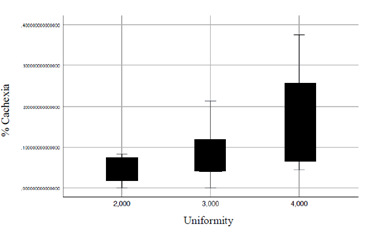
In terms of causes of condemnation, no association was found with FU, but cachexia (p=0.063) was observed in more condemned animals where the FU was worse (Figure 1).
According to Da Costa et al. [14] the fact that this study was made in mixed-sex flocks lows the uniformity of the flock. By opposite, recent studies made by England et al. [15, 16] (20229 shows that the uniformity is higher in mixed sex flocks comparing to single-sex flocks.
| Uniformity Variables | Score 2 M+SD | Score 3 M+SD | Score 4 M+SD | p |
|---|---|---|---|---|
| % DOA | 0.051=0.038 | 0.189+0.363 | 0.061=0.077 | 0.452 |
| % TC | 0.111=0.058 | 0.267+0.114 | 0.654=0.482 | 0.002 |
| % TC by disease or condition | 0.071+0.047 | 0.193=0.115 | 0.368=0.174 | 0.001 |
| % TC by technopathies | 0.039=0.049 | 0.074=0.056 | 0.286=0.398 | 0.07 |
Table 2: Study of the effect of flock uniformity in variables DOA and TC.
In synthesis, MI is an important official control to ensure that animals entering the food chain according to the legal hygiene, health and welfare requirements.
A WI must be import to the surveillance of animal health and welfare but also to indicate the Official Veterinarians that one or other flock requires most attention during inspection.
Additionally, these results showed the potential use of “flock uniformity” as a poultry welfare indicator and as criteria to be used under a risk-based meat inspection approach: The worse the flock uniformity, the more they must be dedicated to the post-mortem inspection on that batch.
More studies must be done to validate this parameter as a potential animal WI.
Final Remark: “flock uniformity” can also be seen at the farm level and this output could be introduced in the FCI in order to apply, at the slaughterhouse level, to a logistic slaughter process and a risk-based MI.
Acknowledgments
The authors would like to thank all the poultry veterinarians and personal that transmitted knowledge and helped us during the data collection.
This work was supported by the project UIDB/ CVT/00772/2020 funded by the Fundação para a Ciência e Tecnologia (FCT).
References
-
FAO (2018) Shaping the future of livestock. The 10th Global Forum for Food and Agriculture (GFFA) Berlin, 18–20 January 2018, I–VIII.
-
Petracci M, Cavani C (2012) Muscle Growth and Poultry Meat Quality Issues. Nutrients 4(1): 1-12.
-
Støier S, Larsen HD, Aaslyng MD, Lykke L (2016) Improved animal welfare, the right technology and increased business. Meat Science 120: 71-77.
-
Huneau-Salaün A, Stärk KD, Mateus A, Lupo C, Lindberg A, et al. (2015) Contribution of Meat Inspection to the surveillance of poultry health and welfare in the European Union. Epidemiology and Infection, 143(11): 2459-2472.
-
Jacobs L, Delezie E, Duchateau L, Goethals K, Tuyttens FAM (2017) Impact of the separate pre-slaughter stages on broiler chicken welfare. Poultry Science 96(2): 266-
-
Directorate General for Food and Veterinary Medicine (DGAV) (2011) Interpretive guide for evaluating the welfare parameters of chickens in the slaughterhouse.
-
Hosseini Aliabad SA, Mortazavi P, Khoshbakht R, Mousavi AS (2011) Causes of Broiler Carcasses Condemnation in Nowshahr Poultry Slaughters (North of Iran) with Histopathologic Study of Cases Suspected to Marek’s Disease. Journal of Agricultural Science and Technology A, 1(11).
-
Saif YM (2008) Diseases of Poultry, 12th (Edn.) Blackwell Publishing Professional, Ames, IA.
-
Salines M, Allain V, Roul H, Magras C, Le Bouquin S (2017) Rates of and reasons for condemnation of poultry carcases: Harmonised methodology at the slaughterhouse. Veterinary Record 180(21): 516.
-
Bilgili SF, Alley MA, Hess JB, Nagaraj M (2006) Influence of age and sex on footpad quality and yield in broiler chickens reared on low and high density diets. J Appl Poult Res 15(3): 433-441.
-
Kapell DN, Hill WG, Neeteson AM, McAdam J, Koerhuis AN, et al. (2012) Genetic parameters of foot-pad dermatitis and body weight in purebred broiler lines in 2 contrasting environments. Poult Sci 91: 565-574.
-
Broom DM, Reefman N (2005) Chicken welfare as indicated by lesions on carcases in supermarkets. Br Poult Sci 46: 407-414.
-
Lopes MCS (2014) Estudo Da Prevalência E Da Gravidade Da Dermatite De Contacto Em “Frango Do Campo ”.
-
Vasdal G, Granquist EG, Skjerve E, De Jong IC, Berg C, et al. (2019) Associations between carcass weight uniformity and production measures on farm and at slaughter in commercial broiler flocks. Poultry Science 98(10): 4261- 4268.
-
Da Costa MJ, Zaragoza-Santacruz S, Frost TJ, Halley J, Pesti GM (2017) Straight-run vs. sex separate rearing for 2 broiler genetic lines Part 1: live production parameters, carcass yield, and feeding behavior. Poult Sci 96(8): 2641-2661.
-
England AD, Gharib-Naseri K, Kheravii SK, Wu SB (2022) Rearing broilers as mixed or single-sex: relevance to performance, coefficient of variation, and flock uniformity. Poultry Science 101(12): 1-8.
-
Anonymous (2019) Commission Implementing Regulation (EU) 2019/627 of 15 March 2019 laying down uniform practical arrangements for the performance of official controls on products of animal origin intended for human consumption in accordance with Regulation (EU) 2017/625 of the European Parliament and of the Council and amending Commission Regulation (EC) No 2074/2005 as regards official controls. Official Journal of the European Union 131: 51-100.
- The Digital Stethoscope: Harnessing AI in Veterinary Medicine Without Losing Our Healing Touch
- Meningoencephalomyelitis of Unknown Etiology: Short-Term Effect of Two Treatment Protocols on Cerebrospinal Fluid
- Safety and Efficacy of the HomeoPet Cough in Domestic Pets –A Clinical and Correction Analysis Based Upon User Response Survey
- Non Human Animals Responses to Social Loss
- Owner Reported Clinical Outcomes of a Homeopathic Proprietary Preparation for the Treatment of Upper Respiratory and Nasal Disorders in Companion Animals
- Effects and Diagnostic Approach of Ultrasound in Veterinary Practice: A Systematic Review