
Accuracy of FNAC in Diagnosing Thyroid Swelling - A Retrospective Study
Aim: To determine the accuracy of FNAC in diagnosing thyroid swellings. Materials and Methods: A Retrospective study was conducted over a period of 1 yr, which included 54 patients, who presented with thyroid swelling to the ENT outpatient department. All the above patients were subjected to FNAC, and those patients who were operated for the swelling, their histopathological report were correlated with the pre-operative FNAC report to determine the accuracy of FNAC in correctly diagnosing the thyroid swelling. Results: Majority of the patients were in 3rd decade and females were more than males. The accuracy of FNAC in diagnosing thyroid swelling in the present study was found to be 77.78%. Conclusion: FNAC is a safe, quick and inexpensive technique in diagnosing thyroid swelling with high degree of accuracy.
Introduction
Fine needle aspiration cytology is a simple and cost effective method to sample superficial masses found in the region of head and neck [1]. The technique is performed in the outpatient department and causes minimal trauma to the patient and carries virtually no risk of complications.Swellings located in the head and neck region including thyroid can be readily diagnosed using this technique [2, 3]. FNAC is particularly important in planing the further treatment of the neck swelling as it helps in differentiating between benign and malignant disease.There is no evidence that tumour spreads through the skin tract created by fine hypodermic needle used in this technique [4]. FNAC does not give same architectural detail as histology but it can provide cells from the entire lesion, as many passes through the lesion can be made while aspirating [5]. Materials and Methods-A retrospective study of 96 patients who presented with thyroid swelling to the ENT outpatient department over a period of 1 yr in our institute was done . After taking a detailed case history and completing the clinical examination, all the above patients were subjected to FNAC.FNAC was done using 22-23gauge, 3-5cms long needle with 10ml syringe. 54 out of 96 patients who underwent surgical excision for the thyroid swelling were included in our study. The histopathological report of the excised specimen post -operatively was obtained in these 54 patients. The pre-operative FNAC report was compared with the histopathology report to determine the accuracy of FNAC in establishing a correct diagnosis.
Results
The present study included 54 patients in the age group of 11 to 70yrs, with maximum incidence amongst those in their 3rd decade of life . Majority were females-45 patients and males-9 patients. On Clinical examination, out of the 54 patients only 4 patients had tenderness over the swelling (Table 1) and consistency varied amongst different swellings (Table 2).
| Tenderness | Number | Percentage |
|---|---|---|
| Present | 4 | 7.41% |
| Absent | 50 | 92.50% |
| Total | 54 | 100.00% |
Table 1: Swelling with / without tenderness.
| Number | Percentage | |
|---|---|---|
| Firm | 43 | 79.63% |
| Hard | 3 | 5.56% |
| Variable | 8 | 14.81% |
| Total | 54 | 100.00% |
Table 2: Consistency of the swelling.
Classification of Cytological reports (Table 3) In cases where the FNAC features of swelling were similar to HPE report –These were considered as positive. In cases where cytological features were suspicious of a lesion which was confirmed by histopathology-these were considered as doubtful or inconclusive.In our study out of 54 patients with thyroid swelling who underwent surgery, 4 of them had a doubtful FNAC, 2 of these were reported as suspicious of malignancy and the other 2 as suspicious of hashimoto’s thyroiditis on FNAC.Since clinically diagnosis seemed more in favour of multinodular goitre, all these 4 cases underwent total thyroidectomy. In cases where the cytological features did not correlate with histopathological features –these were considered as negative.
| Number of cases operated and also pre-op FNAC done | Positive | Doubtful | Negative | |
| Thyroid | 54 | 42 (77.78%) | 4(7.41%) | 8(14.81%) |
Table 4: Classication of FNAC report.
Diagnostic accuracy of FNAC of thyroid swellings
Out of 54 patients who underwent surgery the histopathology proved 20 cases as follicular adenoma, 14 nodular goitre, 10 hashimoto’s thyroiditis and 10 as malignancy.Interestingly the 10 cases proved as hashimoto’s thyroiditis by histopathology, during pre- operative clinical examination the clinical diagnosis did not go in favour of cytological diagnosis and therefore in view of clinical diagnosis of nodular goitre in 4 patients ,adenoma in 3 patients and suspected malignancy in another 3 patients all the 10 patients were operated and histopathology proved hashimoto’s in all the 10 patients thereby proving that 8 out of 10 cases was accurately diagnosed by FNAC. Thus the overall accuracy of FNAC in thyroid swelling was found to be 77.78% in our study with 42 cases out of 54 proved positive by FNAC (Table 4).
| Type of thyroid swelling | Number of cases histologically proved | Number of cases proved positive by FNAC | Percentage |
|---|---|---|---|
| Follicular Adenoma | 20 | 15 | 75.00% |
| Nodular goitre | 14 | 11 | 78.57% |
| Hashimoto's | 10 | 8 | 80.00% |
| Malignancy | 10 | 8 | 80.00% |
| Total | 54 | 42 | 77.78 |
Table 3: Diagnostic accuracy of FNAC of Thyroid swellings.
Diagnostic accuracy of follicular adenoma thyroid
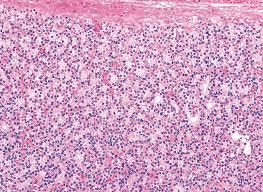
Amongst 20 cases of follicular adenoma (Figure 1) 14 were without cystic change and 6 were with cystic change.Diagnostic accuracy of aspiration cytology of follicular adenoma without cystic change was 85.71% with 12 cases proved by FNAC, in cases with cystic change the diagnostic accuracy was 50% with only 3 cases proved positive by FNAC (Table 5).
| Number of cases histologically proved | Number of cases proved positive by FNAC | Percentage | |
|---|---|---|---|
| Without cystic change | 14 | 12 | 85.71% |
| With cystic change | 6 | 3 | 50.00% |
| Total | 20 | 15 | 75.00% |
Table 5: Diagnostic accuracy of follicular adenoma thyroid.
Diagnostic accuracy of malignant thyroid swellings
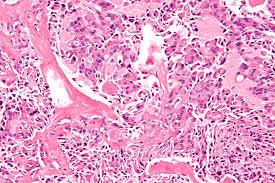
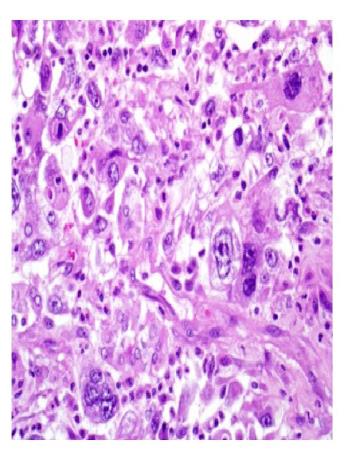
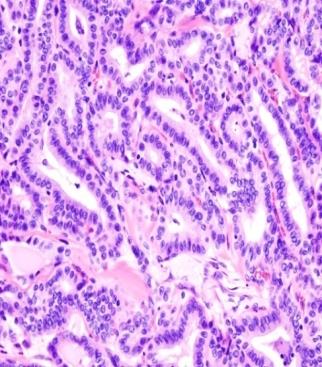
Amongst malignant thyroid swellings there were 5 papillary carcinoma (Figure 2), 3 anaplastic carcinoma (Figure 3) and 1 medullary carcinoma (Figure 4) proved histologically.The diagnostic accuracy of aspiration cytology for papillary carcinoma was 60% with 3 out of 5 cases proved positive by FNAC.The diagnostic accuracy for other types of thyroid malignancies was 100% with all cases proved positive by FNAC in each group (Table 6).
| Type of malignant thyroid swelling | Number of cases histologically proved | Number of cases proved positive by FNAC | Percentage |
|---|---|---|---|
| Papillary carcinoma | 5 | 3 | 60.00% |
| Anaplastic carcinoma | 3 | 3 | 100.00% |
| Follicular carcinoma | 1 | 1 | 100.00% |
| Medullary carcinoma | 1 | 1 | 100.00% |
| Total | 10 | 8 | 80 |
Table 6: Diagnostic accuracy of malignant thyroid swellings.
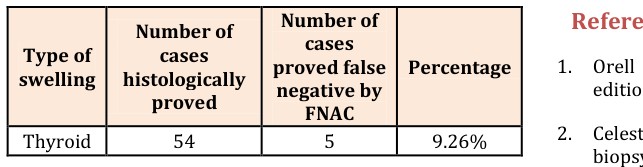
False negative reports of FNAC- In our study out of 54 thyroid swellings who underwent surgery, FNAC in 5 cases showed false negative results (Table 7) i.e. pre- operative cytology in 2 cases was negative for malignancy but post operatively histopathology proved papillary carcinoma.In yet another 2 cases FNAC was suggestive of colloid nodular goitre but histopathologically proved as hashimoto’s thyroiditis. In another patient cytology did not suggest of follicular adenoma but clinically and post operative histopathology proved the above diagnosis.
- References
- Number of
- Number of cases proved false
- Type of swelling cases histologically
- Percentage edition. negative by proved
- FNAC
- Thyroid
- 54
- 5
- 9.26%
Table 7: False negative results.
Discussion
The use of needle aspiration in the diagnosis of neck swellings was reported by Greig and Gray in 1904, when they aspirated lymph nodes for the identification of trypanosomes. But it was popularised in 1930’s by Martin et al. Since then several reports on cytodiagnosis of neck swellings have been published from different parts of the world. The advantages of aspiration biopsy are that it is simple, rapid and economical procedure.It may clear up a questionable diagnosis or provide histological material in an obvious case without need for hospitalisation.It can easily distinguish inflammatory lesion from neoplastic lesion.It frequently eliminates a more formidable open biopsy procedure with its attendant hazards of non healing and other operative complications. The usefulness of FNAC has been questioned through many studies in cases of small, non palpable masses (<1.5cm) [6, 7, 8, 9]. In our study, the accuracy of FNAC in diagnosing thyroid swelling is encouraging, the overall accuracy rate in our study is 77.78%, which is comparable to the findings in earlier studies, Jens Thomsen had 75% accuracy in their 17 aspirates from thyroid gland, Hamming JF reported 75% accuracy in 169 cases and Mondal A reported 92.7% of accuracy in 192 thyroid tumours.
Conclusion
Fine needle aspiration cytology is a simple, quick, economical and least traumatic procedure that can be easily carried out in outpatient department or at bedside with high degree of accuracy in diagnosing thyroid swellings. However the small percentage of false negative results can also be overcome if the pathologist work more closely with the clinician and correlate the clinical findings while reporting the cytological slides as well as to determine the best possible sites of aspirates from swelling .
3. Gamba PG, Messineo A, Antoniello LM, Boccato P,
Blandamura S, et al. (1995) A simple exam to screen superfial masses: fine-needle aspiration cytology. Med Pediatr Oncol 24(2): 97-99.
4. Russel RCG, William NS, Bulstrode CJK (2004) Bailey
and Love’s short practice of surgery. 24th edition London: Arnold.
5. Kirk RM, Ribbans WJ (2004) Clinical Surgery in General. 4th (edn) Edinburgh: Elsevier.
6. Khurana KK, Kichard VC, Izequierdo PR, Rubend D,
Mesonetop C (1998) The role of untrasonographic guided fine neele aspiraton biospy in the manamgne tof no palpable and plapbale thyroid nodule. Thyroid 8: 511-514.
7. MacDonald L, Yazdi HM (1996) Non-diagonistic fine needle aspirtion biopsy of thyorid gland: a diagnostic dilemma. Acta Cytol 40(3): 423-428.
8. McHenry CR, Walfish PG, Rosen IB (1993) Nondiagonstic fine needle aspiration biospy: a dilemma in managment of nodular thyroid disease. Am Surg 59(7): 415-419.
9. Schmidt T, Riggs MW, Speights VO (1997) Significance of non diagonistic fine needle aspiration of the thyorid. South Med J 90(12): 1183-1186.
- 4th Branchial Cleft Sinus Anomaly Presenting as Recurrent Thyroid Abscess in A Child: A Case Report
- Parotid Duct Injury Repaired Using an Angiocatheter Stent: A Case Report
- Organization and Functionality of the Referral and Counter-Referral System for ENT Disorders in District Hospitals of N’Djamena, Chad: A Cross-Sectional Analytical Study
- Facial Metastases from a Gastrointestinal Stromal Tumor: A Case Report
- Panorama of Ent Cancers and Literature Review: Epidemiological Profile and Therapeutic Management
- Could Antimicrobial Resistance Prove to Be Both a Threat and an Opportunity for us?