
Cervico-Thoracic Goiter Indicating a Sternotomy: Report of One Case
Introduction: The Otolaryngologist is daily confronted about management of goiters with cervical expression, whether they are benign or malignant. Goiter can be only plunging easily controllable by cervical approach. In rare cases goiter can occur as a cervical and thoracic expression, thereby requiring multidisciplinary team management involving thoracic surgeon, anesthesiologist and Otolaryngologist. Results: The diagnosis of goiter was based on clinic on airway signs worsen during pregnancy and also chest CT scans. Surgery treatment had been done by cervicotomy in order to control the cervical part, and median sternotomy for control of the most voluminous chest part. Post-operative was uneventful. Pathological exam confirmed benign lesion. Conclusion: CT scan is effective exam in diagnosis of thoracic goiter. In our daily practice, ORL must keep in mind possibility of thoracic goiter if compression respiratory signs are present. Treatment of that disease requires multi disciplinary approach.
OUEDRAOGO Bertin Priva1*, BONKOUNGOU Gilbert1, ZAGHRE
Noé1, BOUGMA W-P Hafid Cheik T1, GYEBRE Yvette MC2 and
OUOBA Kampadilemba2
Ouagadougou Burkina Faso, West Africa, Tel: 00226 70 03 63 46; E-mail: bertin_oued@yahoo.fr surgeon, anesthesiologist and Otolaryngologist.
disciplinary approach.
Keywords: Cervico-thoracic goiter; Sternotomy; Cervicotomy
Introduction
The goiter is an increase in volume of the thyroid body with generally a cervical expression. It can become plunging while developing towards the thorax. The Otorhinolaryngologist and cervico-facial surgeon are usually confronted with the assumption of responsibility of plunging goiters which they are benign or malignant. In rare cases, the goiter can have an important thoracic development, thus requiring a sternotomy. We want to bring back the methods of assumption of responsibility of a cervico-thoracic case of goiter with an important development mediastinal former.
Clinical Case
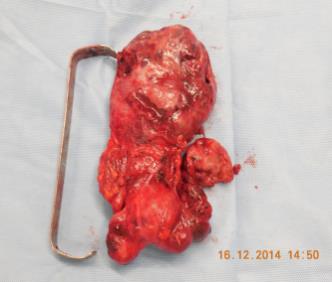
We report the case of Mrs. AHFR 38years which has consulted for a goiter evolving for more than 5years, discovered during a pregnancy in a table of dyspnea with orthopnea having constrained its gynaecologist- obstetricien to carry out a premature birth followed by a hospitalization of the patient in reanimation. There was no dysphonia or of dysphagia. The respiratory signs of compression were gradually amended after the child birth with however the persistence and the increase in the volume of the thyroid gland with a feeling of retrosternal tension. The patient had preserved a general good state. The examination made it possible to note a low, painless, firm, mobile mass cervical former median with the swallowing, whose lower pole was not palpable, with a normal skin in glance, without cervical adenopathies. The naso fibroscopy was normal. The thyroid biological assessment was also normal, as well as the calcemy. The thoracic radiography of face and profile showed an opacity mediastinale former higher compatible with a plunging goiter. Cervical echography revealed a multinodulaire goiter without piece of healthy parenchyma and cervical adenopathies. The cervico thoracic CT scan found a former density evoking a plunging goiter in the former mediastin and measuring 128mm height and 64mms in diameter antero-posterior with one bordered greasy separating it from the mediastinal structures, the trachea was not deviated, the vessels were driven back without being invaded. There were no mediastinal adenopathies (Figures 1,2). The patient profited from a total thyroidectomy 4months after her consultation. The intervention consisted of a cervicotomy allowing a control of the cervical part, the recurring ones and parathyroid glands. This way was not sufficient for an exerese of the thoracic part. It was thus supplemented by a median sternotomy (Figure 3) which was not sufficient for the exerese and we opened and aspired the liquid contents sero-hematic of the lesion to allow its exerese in mono bloc (Figure 4). The sternotomy was closed on 2 aspiration drains of the former mediastin (Figure 5). The immediate operational continuations were simple with a 48hours stay in reanimation. The exit intervened in operational J7 after. A substitute opotherapy containing L-thyrox in with the amount of 100 micrograms per day was prescribed. The anatomo- pathological examination of the operational part concluded with a macro and micro benign goiter nodular. After a 6 months retreat, the complaints disappeared. The patient presented a scar cheloide treated successfully by local corticoid injection.
Discussion
The plunging goiter is in keeping with the development towards the thorax of the thyroid gland in cervical position. Its extension is done towards the zones of less resistance in the former or posterior mediastin [1]. The bulky thoracic goiters generally meet on the level of the former mediastin where the lesion has more space for its extension than in the posterior mediastin where the vessels limit its growth. There also exists of authentic described primary mediastinal goiters [2]. One of the circumstances of discovered most frequent is dyspnea by tracheal compression [3] as that was the case in our patient. The frequency of the plunging goiters requiring a sternotomy is relatively rare, that is to say 1 to 2.5% [1, 4]. The cervicotomy alone in rule is sufficient for a control of the plunging lesions in the mediastin [4, 5]. However, the thyroidectomy by assisted video thoracoscopy [6] would be an auxiliary technique for this kind of bulky thoracic goiters as in our case. The lateralization on the right side of the lesions is quickly dyspne is anteas in our observation because of no extensibility of the sternum and the dextro position of the trachea which is quickly compressed. The thyroidectomy in the thoracic goiter is facilitated by the Sternotomy which makes it possible to control the mass in full safety and to avoid the lesions of the vessels of the former mediastin .In addition this medianster no to my put safe from possible recurrent nervous lesions because these nerves can have unusual ways in the bulky endothoracic goiters. There course to the sternotomy is rare in the cervico-thoracic goiters. Indeed in literature 95 to 96% of the goiters with development retrosternal can be operated by cervical way exclusively [7, 8]. There would exist predictive factors of Sternotomy in this kind of goiter such as the duration of evolution higher than 160 months, the posterior localization and the tissue density [9]. These factors were however not present in our patient.
Conclusion
The cervico thoracic goiters requiring a sternotomy are rare. When it exists a significant mediastinal development as that was the case of our patient, the CT scan is essential for a good preoperative evaluation and makes it possible to pose the indication of a sternotomy. A multidisciplinary team allows optimizing this assumption of responsibility.
References
-
Makeieff M, Marlier F, Khudjadze M, Garrel R, Crampette L, et al. (2000) Les goitres plongeants. A propos de 212 cas Ann chir 125: 18-25.
-
Oueriachi FE, El Hammoumi MM, Arsalane A, Slaoui O, Diouri H, et al. (2014) Primary mediastinal goiters. Springer plus 3: 503.
-
Nistor C, Ciuche A, Motaş C, Motaş N, Bluoss C, et al. (2014) Cervico-mediastinal thyroid masses - our experience. Chirurgia (Bucur). 109(1): 34-43.
-
Zainine R, El Aoud C, Bachraoui R, Beltaief N, Sahtout S, et al. Les goîtres plongeants à propos de 43cas. La tunisie medicale 89(11): 860-865.
-
Cougard P, Matet P, Goudet P, Bambili R, Viard H, et al. (1992) Les goîtres plongeants 218 cas operes. Ann Endosc 53(5-6): 230-235.
-
Gupta P, Lau KK, Rizvi I, Rathinam S, Waller DA (2004) Video assisted thoracoscopic thyroidectomy for retrosternal goitre. Ann R Coll Surg Engl 96(8): 606- 608.
-
El Hammoumi M, El Oueriachi F, Arsalane A, Kabiri el H (2014) Surgical management of retrosternal goitre: experience of a Moroccan centre. Acta Otorrinolaringol Esp 65(3): 177-182.
-
Blondeau P, Binet JP, Mercadier M, Pialoux P, Hollender L, et al. (1994) Les goitres plongeants: problèmes diagnostiques et therapeutiques (à propos d'une serie personnelle de 585 interventions). Bulletin de l'Academie nationale de medecine 178(7): 1257-1266.
-
McKenzie GA, Rook W (2014) Is it possible to predict the need for sternotomy in patients undergoing thyroidectomy with retrosternal extension? Interact Cardiovasc Thorac Surg 19(1): 139-143.
- 4th Branchial Cleft Sinus Anomaly Presenting as Recurrent Thyroid Abscess in A Child: A Case Report
- Parotid Duct Injury Repaired Using an Angiocatheter Stent: A Case Report
- Organization and Functionality of the Referral and Counter-Referral System for ENT Disorders in District Hospitals of N’Djamena, Chad: A Cross-Sectional Analytical Study
- Facial Metastases from a Gastrointestinal Stromal Tumor: A Case Report
- Panorama of Ent Cancers and Literature Review: Epidemiological Profile and Therapeutic Management
- Could Antimicrobial Resistance Prove to Be Both a Threat and an Opportunity for us?