
On GESL Verbal Paradigms
The verb in Georgian Sign Language (GESL) has morphological means to convey the relevant meanings and forms of all verbal paradigms from spoken Georgian, although it is important, that GESL verbs do not repeat the paradigms of spoken Georgian. The only paradigm that GESL verbs may have is the combination of verbal-person forms, which appear with socalled incorporated verbs. These relations are kinetically expressed in GESL.
Short Communication
The verbs is sign languages distinguish the spatial marking – the first person is conveyed by the hand close to the body and with the hand towards the body as well as the fingers towards the body; The second person is delivered with the hand in front of the body and the fingers of the same direction; And the third person is given with the hand pointing to the side and fingers in the same direction [1, 2]. These parameters the direction of the hand and the fingers, and of course, the palm orientation will also change accordingly, within one configuration may be understood as signs of the verbal persons [3, 4, 5]. It is noteworthy that the subject and the object do not differ in this respect. The only thing that distinguishes the subject from the object is that the subject is the beginning of the action and the object is the purpose as the last point [6, 7, 8, 9, 10]. It should be also noted that the indirect object in GESL has additional marking. Thus in GESL the subject is well separated from the object, and the data described above seems to be typologically universal – with deductive approach. The paper also defines the three types of morphological marking in sign language verbal paradigms [11, 12, 13].
The verbs in Georgian Sign Language (GESL) have the proper grammatical means to display the all rows (so called screeves) of spoken Georgian without any exception, but GESL paradigms do not repeat the paradigms of spoken Georgian [14]. The conjugation of GESL verbs can be presented by morphological marking of tense and mood. Verbs in GESL receive the additional morphemic markers without any kind of inner verbal changes [15, 16]. The only kind of verbal paradigm, which can be observed in GESL, is the table of verbal person combinations. Such paradigms are available only for so-called incorporated verbs [17]. In spoken Georgian such paradigms show subject and object markers on horizontal and vertical columns of the table. In GESL (just like in many other sign languages) these relations are spatial identities. The example below shows subject- object combination only in singular. The same relations occur in plural [18, 19].
Let’s look at the verb ‘criticize’. It is so called incorporated or polypersonal verb, as verbal kinetic is directed to the (indirect) object oriented area and this is a main factor distinguishing the incorporated and plane verbs [20, 21].
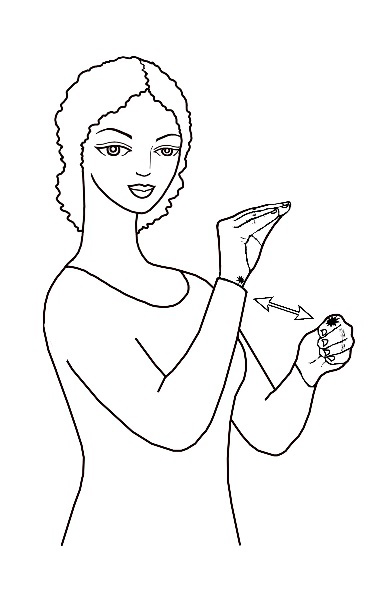
‘criticize’
| S/Oind. | 1s. | 2 s. | 3 s. |
|---|---|---|---|
| 1s. | ---------- | I criticize you | I criticize him/her |
| 2 s. | You criticize me | ------------- | You criticize him/her |
| 3 s. | He/she criticizes me | He/she criticizes you | He/she criticizes him/her |
| S/ Oind. | 1s. | 2 s. | 3 s. |
| 1s. | ---------- | I tell you | I tell him/her |
| 2 s. | You tell me | ------------- | You tell him/her |
| 3 s. | She/he tells me | She/he tells you | She/he tells him/her |
As we can see in the table above, the seven forms distinguish the manual kinetics for the object. The same type of combination will take place for all incorporated verbs. In verb ‘tell’/’I tell’’ both - subject and object are displayed, the subject as the beginning of verbal action/dynamics, and the object is a goal or the final destination of the verbal action/ dynamic.
From the tables above one can clearly observe the following: in case of the first object the hand is body oriented (see the first vertical column). In case if the second object the hand moves forward (see the second vertical column), and in case of the third object hand is navigated aside (see the third vertical column).
To display the first subject, the hand moves from the body (see the first horizontal cell). To expose the second subject, the hand begins moving from the space in front of the body and near the body (see the second horizontal cell), acting in a space for the second person – you. In case for the third subject, the hand begins moving from aside (see the third horizontal cell).
In the tables above we can see the kinetic marking for the subject and object. The verbal dynamic form the subject is directed to the object oriented area. Subject is the beginning and the object is a goal or the last spatial point for verbal phases.
The paradigms above have clearly shown that sign verbs distinguish spatial marking – the first person is expressed with the hand near/at/towards the body and fingers are directed to the body. The second person is displayed by the hand in front of the body, with the same vector for the fingers, and the third person is expressed by the hand and fingers both directed aside. These paradigm parameters (of course with proper handshape and palm orientation as well) seem to be universal for the all sign languages, and these parameters/options can be taken as for verbal personal markers. Interestingly, there is no difference between subject and object in this term – the spatial definition is the same. Only the beginning and ending of verbal action is different for subject-object in sign languages, although there are some additional markers for subject cases and indirect object markers as it was discussed in 2015 and 2019 (Makharoblidze).
Here is the common parading for GESL existential (‘to be’) and possessive (‘to have’) including the negative forms as well:
| TM/ verb | to be | Not to be | Have (anim./inanim.) | Not to have (anim/inanim.) | |
|---|---|---|---|---|---|
| Present | (I) am | (I) am not | (I) have | (I) have not | |
| Future | (I) will be | (I) will not be | (I) will have | (I) will not have | |
| Past | (I) was | (I) was not | was+is (I) had | was+not+is+not (I) had not | |
| I Perfect | (I) have/had been | (I) have/had not been | (I) had have/had | (I) had not have/had |
Thus, the morphological marking of the verbal arguments in GESL can be presented in three ways:
- Deictic marking, (see the paradigms of the incorporated verbs above ‘criticize’ and ‘tell’)
- Destination marking with semantic kinetic (see the indirect object marking at Makharoblidze 2015, 2019)
- Morpho-syntactic marking, when the nominal arguments (nouns) accept the case markers. The human class subject of transitive verbs in aorist receives the ergative marker and the animated, human class indirect object receives the vectored (deictic) dative marker, and here we have the combination of the first and third types of argument marking.
GESL uses the all three types for verbal person marking.
Acknowledgment
I would like to thank my Deaf GESL sources: Lamara and Natia Japoshvilis
References
-
Mark A, Meir I, Sandler W (2005) Aronoff, Mark, Irit Meir & Wendy Sandler. The paradox of sign language morphology. Language 81(2): 301-344.
-
Carl B (2019) Differential object marking in sign languages. _Glossa:_ A Journal of General Linguistics 4(1): 3.
-
Börstell Carl (2017) Object marking in the signed modality: Verbal and nominal strategies in Swedish Sign Language and other sign languages. Stockholm: Stockholm University dissertation.
-
Fabian B (2018) Differential object marking in German Sign Language: Animacy and definiteness as cross- linguistically stable cognitive concepts. Presentation at the VIII International Symposium on Intercultural, Cognitive and Social Pragmatics. Universidad de Sevilla,
-
Lynn AF (1976) The manifestation of subject, object, and topic in American Sign Language. In: Charles N Li, et al. (Eds.), _Subject and topic_, pp: 127-148.
-
Holler A, Steinbach M (2018) Sign language agreement: A constraint based perspective. In: Stefan M, & Frank R, et al. (Eds.), Proceedings of the 25th International Conference on Head-Driven Phrase Structure Grammar, University of Tokyo, Japan, pp: 49-67.
-
Giorgio I (2011) _Towards a typological study of differential_ _object marking and differential object indexation._ Pavia: University of Pavia dissertation.
-
Kimmelman V (2018) Basic argument structure in Russian Sign Language. A Journal of general linguistics 3(1): 116.1-39.
-
Scott KL (2011) Agreement disagreements. Theoretical Linguistics 4(3-4): 161-172.
-
Diane ML, Meier RP (2011) On the linguistic status of ‘agreement’ in sign languages. Theoretical Linguistics 37(3-4): 95-142.
-
Tamar M (2015) Indirect object markers in Georgian Sign Language. Sign Language & Linguistics 18(2): 238- 250.
-
Tamar M (2019) Verbal morphology of GESL. Shota Rustaveli National Science Foundation. Tbilisi pp: 248.
-
Tamar M (2019) Valency of GESL verb. Language and Culture_._ Foundation for Development of Art and Pedagogical Sciences. Kutaisi pp: 31-40.
-
Tamar M (2017) On Modality in Georgian Sign Language (GESL). Languages of the Caucasus 2.
-
Gaurav M, Rathmann C (2012) 7 Verb agreement. In: Pfau R, Steinbach M, Woll B, et al. (Eds.), Sign language: An international handbook pp: 136-157.
-
Carol P, Meir I, Sandler W, Aronoff M (2010) Against all expectations: Encoding subjects and objects in a new language. In: Gerdts DB, Moore JC, Polinsky M, et al. (Eds.), _Hypothesis A/hypothesis B: Linguistic explorations_ _in honor of David M. Perlmutter_ pp: 383-400.
-
Roland P, Steinbach M (2013) Person climbing up a tree: (and other adventures in sign language grammaticalization). Sign Language & Linguistics 16(2): 189-220.
-
Roland P, Salzmann M, Steinbach M (2018) The syntax of sign language agreement: Common ingredients, but unusual recipe. Glossa: A Journal of General Linguistics 3(1): 107.
-
Christian R (2003) The optionality of agreement phrase: Evidence from German Sign Language (DGS). In: Griffin WE, et al. (Eds.), The role of agreement in natural language: Proceedings of the 5th Annual Texas Linguistics Society Conference, pp: 181-192.
-
Christian R, Mathur G (2002) Is verb agreement the same cross-modally?. In: Meier RP, Cormier K, Quinto-Pozos D, et al. (Eds.), Modality and structure in signed and spoken languages, Cambridge: Cambridge University Press, pp: 370-404.
-
Galini S (2012) Agreement auxiliaries. In: Pfau R, Steinbach M, Woll B, et al. (Eds.), _Sign language: An_ _international handbook,_ pp: 204-227.
- 4th Branchial Cleft Sinus Anomaly Presenting as Recurrent Thyroid Abscess in A Child: A Case Report
- Parotid Duct Injury Repaired Using an Angiocatheter Stent: A Case Report
- Organization and Functionality of the Referral and Counter-Referral System for ENT Disorders in District Hospitals of N’Djamena, Chad: A Cross-Sectional Analytical Study
- Facial Metastases from a Gastrointestinal Stromal Tumor: A Case Report
- Panorama of Ent Cancers and Literature Review: Epidemiological Profile and Therapeutic Management
- Could Antimicrobial Resistance Prove to Be Both a Threat and an Opportunity for us?