
Experimental Viscosity Data for Binary and Ternary Systems of Arab Heavy Crude Oil and Diluents
To meet the global exponential demand for crude oil, development of unconventional crude oil deposits is essential but the major limitation is seen in pipeline transportation, given its exceptionally high viscosity. Saudi Aramco is the world’s leading crude oil producer with a significant contribution of Arab Heavy crude oil in the total production mix. In this paper, we have measured the viscosities of both binary and ternary mixtures of this heavy oil crude for the first time, using toluene and natural gas condensate fluids over temperatures encountered in pipeline transportation. Our study shows that both binary and ternary systems show excellent viscosity reduction characteristics with increase in viscosity index with temperature. The degree of viscosity reduction shows polynomial trends with excellent fits that facilitated the determination of the wax appearance temperature using differential calculus approach. The range of experimental temperature in this study and the excellent viscosity reduction characteristics of the systems testify to the suitability of our experimental data for pipeline transportation planning.
Introduction
Since the beginning of the industrial revolution, fossil fuels have powered sustained global economic growth through sustained and affordable supply of energy resources due to their initially proven abundance albeit their limited geographical distribution [1, 2]. In this regard, they provide about 80% of annual global energy [3, 4, 5] supply. Consequently, crude oil in addition to providing energy resources also provides feedstock for the petrochemical industry [6] and its sustained supply is critical to sustained global economic growth.
Since the discovery of crude oil as a critical energy resource, distinction has been made between conventional and unconventional resources [7], with the former referring to oil from geological formations where production can be achieved using standard proven methods [8]. On the other hand, the history of crude oil discovery shows that the discovery of conventional giant petroleum fields peaked in the late 1960s, with the discovery of the Ekofisk field [9] in the Norwegian Sector of the North Sea, and the Prudhoe Bay oilfield in Alaska [10]. However, in recent times, the Kashagan in Kazakhstan [11], with an estimated 38 billion barrels of proven reserve has demonstrated to be another giant oil field, but the excessive concentration of hydrogen sulfide content [12] tends to compromise its conventional nature. Therefore, given that unconventional crude oils, such as heavy oils have the potential to supplement sustained supply of fossil fuel energy albeit the technical problems associated with their production and transportation, their production is deemed essential. Consequently, the development and research status of heavy oil deposits [13, 14, 15, 16] have been gaining momentum since time immemorial. However, the problem of transportation of produced heavy oils in pipe lines due to the exceptionally high viscosity is a major setback in the development of heavy oil deposits, causing relevant regulatory bodies to set a standard of viscosity for pipe line transport of heavy crude [17, 18]. To mitigate the problem, viscosity reduction of heavy crude has been used through thermal and physical methods [19, 20]. Thermal methods involve the application of heat [21] to reduce viscosity and it is mostly applied to field development while, the physical methods involve viscosity reduction using diluents [22] for pipeline transportation. In this study, we tested the dilution efficiency [23] of two known diluents (natural gas condensate and toluene), using Saudi Heavy Crude oil [24]. Saudi Heavy crude oil was chosen because its structure has been characterized based on Nuclear Magnetic Resonance (NMR) Spectroscopy [25] and the research findings provide a scientific basis for discussing experimental results related to solubility theory. Moreover, Saudi Aramco produces five different grades of crude oil. These are: Arabian Heavy, Arabian Medium, Arabian Light, Arabian Extra Light, and Arabian Super Light, which give flexibility and assessment of future refinery requirements in their markets leading to optimization of crude oil production mix to always meet customer’s needs [26]. Generally, heavy oils are characterized by high proportions of asphaltene [27] which precipitates in low molecular weight paraffins [28]. To maximize homogeneity in mixtures in ternary systems in this study, we chose toluene as a cosolvent [29, 30]. We measured the kinematic viscosity of Arab Heavy crude oil containing different fractions of toluene and different fractions of natural gas condensate as separate experiments, and then a mixture of these diluents with the crude oil as ternary systems. Trend in viscosity reduction of different systems were discussed. The effect of temperature on viscosity reduction was also discussed for ternary systems. The novelty of this work is seen, considering that viscosities of diluent blends with the chosen heavy crude oil is lacking in the literature, given its significant contribution to Saudi Aramco’s crude oil production mix in the energy market.
Backgrounds
Degree of Viscosity Reduction
In line with the generally known strong effect of temperature on the viscosity of fluids, the extent of temperature effect on viscosity is often quantified using the concept of degree of viscosity reduction given as [19]:
(1) In which, ƞr is the kinematic viscosity at a reference temperature (cSt) and ƞT is the kinematic viscosity of the fluid at the temperature of interest (cSt). In this study, the lowest temperature for the experiments (close to room temperature) was used as the reference temperature for each system.
Experimental Procedures
Materials and Resources
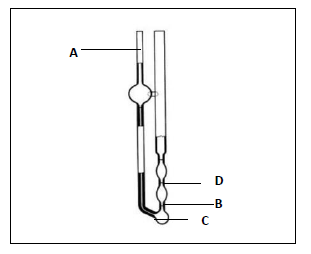
Heavy oil sample was used for this experiment. Saudi Arabian Heavy crude was supplied by Saudi Aramco (°API 27.31 and Sulfur content 3.066%) [31]. Natural gas condensate diluent of purity 99.9% was supplied by Exxon Mobil Canada Ltd sourced from the baud platform, Sable Island offshore Nova Scotia. Reagent grade diluent was toluene of purity 99.9% purchased from fisher Scientific. In this experiment, Cannon Fenske calibrated reversible glass viscometer (Figure 1) was used to measure the viscosity in accordance with ASTM D445.
Methodology
Binary and ternary mixtures of heavy crude oils were prepared with different low viscosity solvents at different concentrations as follows:
- Different fractions of toluene and Saudi Heavy crude oil were prepared with the following concentrations (Toluene: Saudi Heavy):5%,10%,15%,20%25% and 30%
- Different fractions of Natural Gas Condensate and Saudi Heavy crude oil were prepared with the following concentrations (Natural Gas Condensate: Saudi Heavy): 5%,10%,15%,20%25% and 30%
- 30% of toluene was mixed with 70% of natural gas condensate and the resulting mixture was used to prepare a ternary dilution mixture (Toluene: Natural Gas Condensate-Saudi Heavy) with concentrations 5%, 10%, 15%, 20%, 25% and 30%.
To reduce cost of dilution, higher proportion of natural gas condensate was chosen to minimize the cost of dilution in view of its lower price per barrel as well as being a Wellhead fluid compared to toluene which is refined.
All solutions described above were homogenised by shaking for 30 minutes in the New Brunswick scientific shaker at a speed of 150 rpm. After proper mixing, viscosity measurements were carried out, using the Cannon-Feske reversible viscometer immersed in a water bath. To measure the viscosity, a suitable size viscometer was chosen according to the viscosity of the sample (i.e. higher the viscosity, higher the tube size). Kinematic viscosity was calculated by multiplying measured time and viscometer constant. In all cases, experiments were carried out at 5 temperatures i.e. 24°C, 30°C, 40°C, 50°C and 60°C. To eliminate hotspots in the water-bath, a magnetic stirrer was used to homogenize fluid bath temperatures.
Results and Discussion
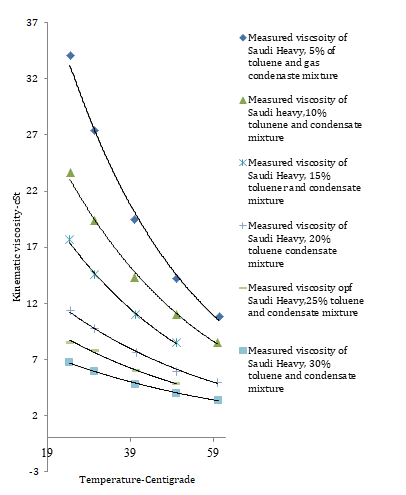
In all experimental plots in this study, points represent experimental data while curves represent fits. Figure 2 shows a plot of the kinematic viscosity of Saudi Heavy crude oil versus temperature while Figure 3 shows a similar plot for different diluents, indicating higher viscosity of natural gas condensate compared to toluene. In all plots, kinematic viscosity decreases with temperature in accordance with theoretical [32, 33], and empirical [34, 35] models of viscosity.
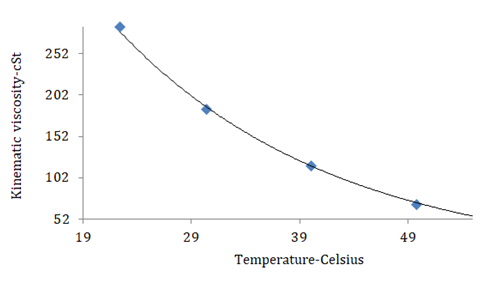
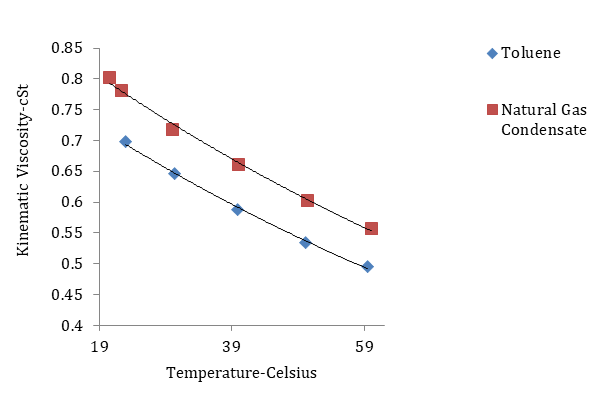
Figure 4 shows plots for binary combinations of Saudi Heavy crude oil and different concentrations of toluene as a diluent, with a monotonous decrease in viscosity with temperature as expected. The plots show that as the concentration of diluent increases, the temperature derivative of kinematic viscosity decreases, which translates to higher viscosity index.
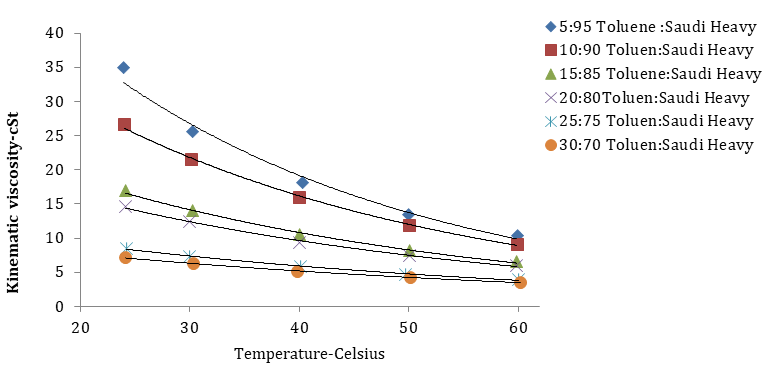
Figure 5 shows a similar plot for different concentrations of natural gas condensate as a diluent, indicating an increase in viscosity index with increase of diluent concentration.
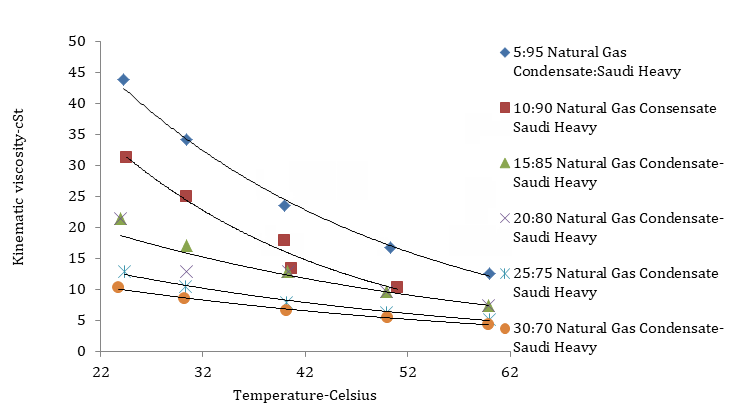
Figure 6 shows a ternary plot of Saudi Heavy crude oil with different fractions of the blend of toluene: natural gas condensate (30:70) by volume. Again, as the concentration of diluent increases, the temperature derivative of kinematic viscosity decreases as observed for separate combinations of oil and the different diluents (toluene and natural gas condensate). Ternary systems were prepared by choosing the 30:70 volume ratio of toluene to natural gas condensate, considering the that natural gas condensate is a well fluid with the lowest price per barrel that will provide optimum cost for viscosity reduction by dilution.
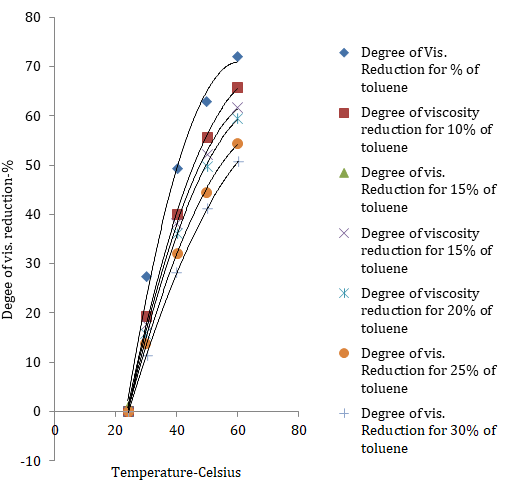
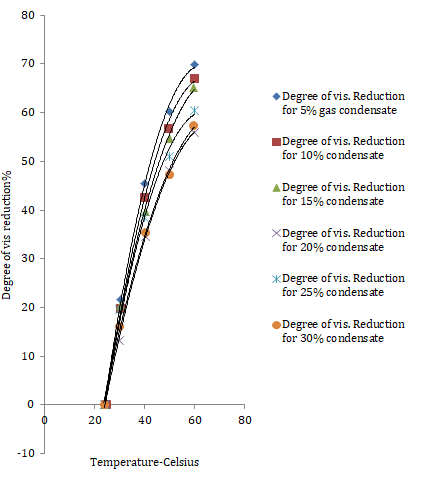
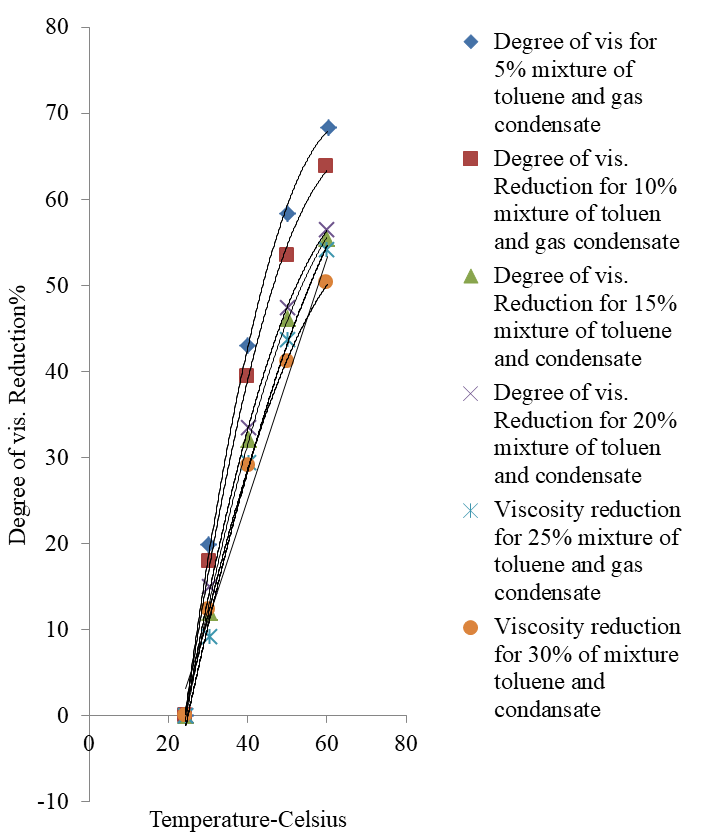
Figure 7 through Figure 8 show plots of the degree of viscosity reduction for binary systems while Figure 9 shows plots for ternary systems. In all cases thermal agitation encountered at higher temperatures tends to destroy ordered structures among entangled species in bulk oil leading to reduced viscosity [19].
The extent of molecular interaction in each system is essential in understanding the degree of viscosity reduction. Consequently, the cohesion energy parameter is fundamental to quantifying such interaction as dispersion due to van der Waal interaction [36], polar due to electrostatic interaction [36] and hydrogen bonding interaction [37]. Table 1 shows values of the individual interaction parameters for the chosen solvents. The table shows that the chosen solvents have predominantly dispersion contribution with negligible polar contributions. Therefore, given that heavy crude oil has an abundant hydrocarbon group that interact by dispersion contributions, simple dilution in this study provided a technically suitable means for viscosity reduction, which reflects experimental data. From Figure 1, the viscosity of toluene in the measured temperature range is lower than that of hexane and this compensates for its tendency to cause viscosity reduction anomaly due to its aromatic character. Despite this advantage, toluene still shows a lower viscosity reduction at the highest temperature compared to that for gas condensate for the highest concentration of diluent.
| Solvent Type | Dispersion | Polar | Hydrogen bonding |
|---|---|---|---|
| Toluene | 18 | 1.4 | 2.0 |
| Gas condensate | 15 | 0.09 | 0.13 |
In all plots found in Figures 2 through 6, fitting exponential trends show excellent regression coefficients up to 0.999, testifying to very good measured experimental data, given the universally accepted exponential trend [38]. However, plots for the degree of viscosity reduction for both binary and ternary systems show very good second degree polynomial fits with maximum turning points based on equations. The implication is that above a certain temperature corresponding to the maximum degree of reduction, the extent of viscosity reduction will reduce with temperature. However, the range of temperature used in viscosity measurement did not permit the experimental verification of this anticipation, but the trends shown by second degree polynomial fits have been experimentally demonstrated elsewhere [39].
At a temperature below the wax appearance temperature (WAT), the viscosity of crude oil reduces with temperature. As the WAT temperature approached there no much effect on the crude oil viscosity reduction and this is indicated by regions close to the apex of the polynomial in this study. In this regard, the wax crystals in crude oil are high in density, thus the interspace between the waxes crystals are relatively small, resulting in three-dimensional agglomeration of wax crystals that increases friction between crystals, resulting in significant decrease in the viscosity of crude oil [40]. In our study, the extent of viscosity reduction will depend on the diluent concentration. Table 2 shows values of WATs for the ternary system with selected concentrations of diluent based on visibility of the plots. To determine WATs, equations of the fits were differentiated and equated to zero [41], facilitating determination of temperature in view of the second degree nature. Accordingly, there appears to be no definite correlation between WATs and concentration of diluents.
| Concentration of diluent % | WAT-°C |
|---|---|
| 5 | 66 |
| 10 | 78 |
| 15 | 71 |
| 20 | 90 |
| 30 | 76 |
Table 1: WAT.
Conclusions
As conventional oil reserves deplete, production of unconventional crude oil deposits is expected to supplement the global fossil fuel energy need and the reduction of crude oil viscosity using diluents is a proven method. Given the increasing daily crude oil production by Saudi Aramco and the significant contribution of its heavy crude oil to the production mix, we have studied for the first time binary and ternary systems of this oil and mixtures of toluene and natural gas condensate. Due to the rather limited temperature range, we could not predict experimentally a wider range of plot of the degree of viscosity reduction with temperature and this will be part of our next experimental work for all systems studied. The following sum up the conclusions of this study:
- Both toluene and natural gas condensate show consistent viscosity reduction of Saudi Heavy crude oil with temperature.
- Viscosity reduction using toluene as a diluent is slightly lower than that of gas condensate.
- The degree of viscosity reduction with temperature can be theoretically described by a second degree polynomial fits up to experimental temperatures with excellent regression coefficients.
- At the wax appearance temperature, the degree of viscosity reduction attains a maximum value and declines for temperatures above this point.
- Both binary and ternary systems studied show excellent viscosity reduction.
- The intelligent supervisory control and data acquisition system was used to collect production data of an oilfield in Western China [42] and the ambient temperatures recorded fall within those used in our study, testifying to the suitability of our data for transportation purpose.
References
-
National-Geographic (2022) Distribution of Fossil Fuels. Fossil fuels form from the remains of prehistoric dead animals and plants due to geologic processes.
-
McGlade C, Ekins P (2015) The geographical distribution of fossil fuels unused when limiting global warming to 2 °C. Nature 517(7533): 187-190.
-
Foster S, Elzinga D (2015) The Role of Fossil Fuels in a Sustainable Energy System. UN Chronicle 52(3): 17-19.
-
Fobes (2020) Fossil Fuels Still Supply 84 Percent Of World Energy-And Other Eye Openers From BP’s Annual Review.
-
National-Geographic (2019) Fossil fuels, explained.
-
Intertek (2022) Crude Oil and Petroleum Feedstocks Tests.
-
Energy-Education (2022) Conventional vs unconventional resource.
-
PSAC (2015) Conventional vs. Unconventional Resources.
-
Hester J (2019) Spirit Now.
-
Fact-Sheet (2022) Prudhoe Bay.
-
NS-Energy (2016) Kashagan Oil Field Development.
-
Kvarekval J, Dugstad A, Omar IH, Gunaltun Y (2005) H2S Corrosion of Carbon Steel under Simulated Kashagan Field Conditions. CORROSION 2005, Houston.
-
Xue L, Liu P, Zhang Y (2022) Development and Research Status of Heavy Oil Enhanced Oil Recovery. Geofluids.
-
Jayasekera AJ, Goodyear SG (2000) The Development of Heavy Oil Fields in the United Kingdom Continental Shelf: Past, Present, and Future. SPE Res Eval & Eng 3(5): 317-379.
-
Briggs PJ, Baron PR, Fulleylove RJ, Wright MS (1988) Development of Heavy-Oil Reservoirs. J Pet Technol 40(2): 206-214.
-
Jayasekera AJ, Goodyear SG (2013) The Development of Heavy Oil Fields in the United Kingdom Continental Shelf: Past, Present, and Future. SPE Reservoir Evaluation & Engineering 3(05).
-
Muñoz JA, Ancheyta J, Castañeda LC (2016) Required Viscosity Values To Ensure Proper Transportation of Crude Oil by Pipeline. Energy Fuels 30(11): 8850-8854.
-
Abdulrazak AA, Al-Khatieb M, Faris HA (2015) Problems of Heavy Oil Transportation in Pipelines And Reduction of High Viscosity. Iraqi J Chem Pet Eng 16(3): 1-9.
-
Hasan S, Ghannam M, Esmail N (2010) Heavy crude oil viscosity reduction and rheology for pipeline transportation. Fuel 89(5): 1095-1100.
-
Li X, Zhang F, Liu G (2022) Review on new heavy oil viscosity reduction technologies. Earth Environ Sci 938: 1-6.
-
Zhao F, Liu Y, Lu N, Xu T, Zhu G, et al. (2021) A review on upgrading and viscosity reduction of heavy oil and bitumen by underground catalytic cracking. Energy Reports 7: 4249-4272.
-
Martínez-Narro G, Núñez-Delgado A, Morán-Medellín D, Elizabeth V (2020) Heavy crude oil viscosity reduction by dilution with hydrocarbons obtained via pyrolysis of polypropylene and polystyrene. Petroleum Science and Technology 38(8): 651-658.
-
Selby R, Alikhan A, Farouq AS (1989) Potential of non- thermal methods. J Can Pet Technol 28(4).
-
APS-Review (2001) Saudi Arabia’s Crude Oil Capacity by Grades and Cost Structures. Energy Explor 19(6): 627- 629.
-
Hassan MU, Ali MF, Bukhari A (1983) Structural characterization of Saudi Arabian heavy crude oil by n.m.r. spectroscopy. Fuel 62(5): 518-523.
-
Saudi-Aramco (2022) Oil Production.
-
Ilyin S, Arinina M, Polyakova M, Bondarenko G, Konstantinov I, et al. (2016) Asphaltenes in heavy crude oil: Designation, precipitation, solutions, and effects on viscosity. J Pet Sci Eng 147: 211-217.
-
Wiehe IA, Yarranton HW, Akbarzadeh K, Rahimi PM (2005) The Paradox of Asphaltene Precipitation with Normal Paraffins. Energy Fuels 19(4): 1261-1267.
-
Miadonye A, Evans L (2010) The Solubility of Asphaltenes in Different Hydrocarbon Liquids. Petroleum Science and Technology 28(14): 1407-1414.
-
Yousuf HH, Shaarani NN, Warrior A, Abdullah B, Salam MA, et al. (2016) The Effect of Co-solvent on the Solubility of a Sparingly Soluble Crystal of Benzoic Acid. Procedia Engineering 148: 1320-1325.
-
McKinsey (2022) Energy-Insight.
-
Zheng Q, Mauro JC, Ellison AJ, Potuzak M, Yue Y, et al. (2011) Universality of the High-Temperature Viscosity Limit of Silicate Liquids. Physical review B 83(21).
-
Baled HO, Gamwo IK (2019) Viscosity Models Based on the Free Volume and Entropy Scaling Theories for Pure Hydrocarbons over a Wide Range of Temperatures and Pressures. In: Shahzad A (Ed.), Thermophysical Properties of Complex Materials. Intechopen, pp: 132.
-
Stratiev D, Nenov S, Shishkova I, Dinkov RK, Zlatanov K, et al. (2021) Comparison of Empirical Models to Predict Viscosity of Secondary Vacuum Gas Oils. Resources 10(8): 82.
-
Gabriel R, Vieira WT, Solett JI, Ribeiro LMO, Carvalho SHV (2020) Empirical modeling of different viscosity and density behavior of biodiesel from chicha (Sterculia striata) with diesel versus temperature variation. J King Saud Univ Sci 32(1): 628-635.
-
Gateau P, Henaut I, Barre L, Argillier JF (2004) Heavy Oil Dilution. Oil & Gas Science and Technology 59(4): 503- 509.
-
Hansen CM (2007) Hansen Solubility Parameters: A User’s Handbook. 2nd (Edn), CRC Press, pp: 544.
-
Akbar SS, Mustafa M (2022) Application of Exponential Temperature Dependent Viscosity Model for Fluid Flow over a Moving or Stationary Slender Surface. Mathematics 10(18): 3269.
-
Subramanie PA, Padhi A, Ridzuan N, Adam F (2019) Experimental study on the effect of wax inhibitor and nanoparticles on rheology of Malaysian crude oil. Journal of King Saud University-Engineering Sciences 32(8): 479-483.
-
Wang F, Zhang D, Ding Y, Zhang L, Yang MS, et al. (2011) The effect of nanohybrid materials on the pour-point and viscosity depressing of waxy crude oil. Chinese Science Bulletin 56: 14-17.
-
Schwetlick H (1984) Effective Methethods for computing Turning Points Implictly Defined by Nonlinear Equations. Computational Mathematics 13: 623-645.
-
Zhu C, Liu X, Xu Y, Liu W, Wang Z, et al. (2021) Determination of boundary temperature and intelligent control scheme for heavy oil field gathering and transportation system. Journal of Pipeline Science and Engineering 1(4): 407-418.
- Nigeria’s Vulnerability in the Face of Global Energy Policy
- A Simulation Study of Investigation of Optimum Oil Production Performance by Applying Various Gas Injection Methods in Oil Reservoir
- Characterization of Permo-Triassic Reservoirs through Thermal Maturity Assessment of Westphalian Source Rocks in the Cheshire Basin
- Influence of Microwax on the Rheological and Thermal Behaviour of a Wax Crude Oil
- Real-Time Monitoring and Performance Optimization of Steam Injection in Heavy Oil Reservoirs Using Fiber Optic Sensing and Integrated Predictive Simulation Models
- Rapid On-Site Determination of the Total Petroleum Hydrocarbon Content of Soils by Handheld Fourier Transform Near-Infrared Spectroscopy: Development of a Global, Site- and Scanner- Independent Calibration Model