
Effects of Natural Gas Dilution with Hydrogen-Ammonia Addition for Industrial and Domestic Applications
This mini-review aims to provide a methodology for practical solutions to improve the existing natural gas combustion through dilution using ammonia/hydrogen/nitrogen for industrial and domestic applications. The dilution of ammonia-hydrogen with natural gas greatly influences its combustion characteristics. The characteristics of natural gas-hydrogen and natural gasammonia are discussed briefly in this mini-review. Soot emission has a severe adverse effect on the environment and human health. A major solution to mitigate this problem is fuel dilution using hydrogen, nitrogen, or even ammonia. Hydrogen is the least emissive fuel which does not produce soot or carbon dioxide. The feasible alternative for emission and soot control is to reduce carbon footprint by fuel dilution.
Introduction
Combustion systems are a vital part of everyday life, encompassing domestic burners, internal combustion engines, industrial furnaces, and rocket engines [1]. The understanding of combustion processes has long been the primary objective of the research community to increase the efficiency and reduce the pollution of the combustion systems for a wide range of domestic and industrial applications. The energy extraction from the combustion process leads to unwanted emissions and particulate matter. The particulate matter primarily from combustion systems is based on hydrocarbon fuels and has an everlasting impact on human health and, more importantly, global climate. Soot, the primary constituent of these unwanted emissions, comprises carbon and hydrogen, which arise from stubble burning, forest fires, etc. Soot consists of Poly Aromatic Hydrocarbons (PAHs), which are carcinogenic; when inhaled, they get transported deep into the human respiratory system to cause cardiovascular diseases and lung cancer [2, 3]. The soot particles have a detrimental impact on human health and climate change [4]. Over the years, it has been understood that the alternates to fossil fuel-based combustion systems like solar, wind, and hydropower alone cannot meet the swelling energy demands of the world. Hence, it is pertinent to find ways to improve the design of current combustion systems to reduce emissions. The shift toward hydrogen combustion and ammonia combustion is a significant step toward decarbonization [5, 6, 7, 8].
Sustainable fuel additives to natural gas are essential in reducing CO2 emissions. NASA has recently reported that soot and dust contribute rapid melting of glaciers. At times, higher soot concentration is more dangerous than the greenhouse gas effects on global warming. The combustion research community contributes effectively to green energy transformation [9, 10]. Catapano, et al. [11] experimentally investigated a spark ignition engine with different methane- hydrogen mixture compositions. The combustion efficiency increased with hydrogen content due to accelerated combustion in port fuel injection (PFI) spark ignition (SI) engines. Recently, Yang, et al. [12] studied the feasibility from the flame extinction perspective for a hydrogen-enriched natural gas, indicating greater stretch rates with hydrogen addition. Huang, et al. [13] experimentally proved that hydrogen-air flames give a larger value of stretched flame speed than natural gas-hydrogen flames. Further, there was an exponential increase in laminar burning velocity with an increase in hydrogen composition. In another recent study, Khanehzar [14] through numerical predictions, nitrogen dilution is more effective at decreasing the soot volume fraction. However, the soot characterization of industrial, lab-scale burner configurations with natural gas-hydrogen/ ammonia blend is not investigated on common grounds, which has a profound impact from the environmental perspective as this can be scaled to industrial and domestic applications.
Methodology to Investigate Hydrogen- Ammonia Dilution to Natural Gas Combustion
The process of soot evolution is a very complex process that involves fuel pyrolysis, poly-aromatic hydrocarbon (PAH) formation, coagulation, surface growth, carbonization, accumulation, and oxidation. A detailed experimental methodology is required to identify the effects of such processes. The optical techniques for soot measurements are pertinent because of their inherent quasi-non-intrusive nature that aids in obtaining soot evidence from the flames without perturbing (providing a marker for the combustion that has occurred) [15, 16]. A coflow-turbulent diffusion burner is used for this investigation with base fuel tested with natural gas and varying composition of natural gas with H2 and NH3. An outer tube supplied with compressed air for studying air dilution effects on flow and soot behavior (Figure 1).
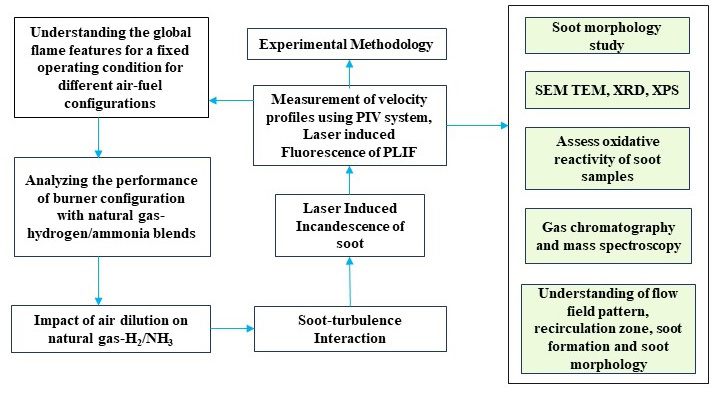
A planar PIV system can obtain the velocity distribution of burners with natural gas and natural gas-H2/CH4. The flow characterization will provide the fundamental step toward analyzing the characteristics. The Laser-induced Incandescence (LII) quantifies soot formation using a pulsed Nd-YAG laser that falls through a laser sheet forming optics onto the flame area. The flame region on which the laser falls gets heated up to a temperature greater than the surroundings to create incandescence which is tracked using an ICCD camera equipped with an ultraviolet enhancement lens. Laser-induced fluorescence (LIF) measures PAHs using an Nd-YAG laser to excite PAH fluorescence. The chemical effects of ammonia and hydrogen are investigated based on results from LII and PAH to reduce the formation of soot and PAH and impact the evolution of soot morphology. The thermophoretic sampling particle diagnostic system is implemented to track the soot morphology evolution. The soot particles would be adsorbed on the carbon film of copper mesh due to the action of thermophoresis. Scanning electron microscopy will help to assess the particle size, shape, and aggregation tendencies of NHN. The study on the arrangement of carbon atoms could be obtained from high- resolution transmission electron microscopy to improve the understanding of carbon reactivity and the internal structure of soot particles. The structural parameters can be extracted from the XRD (X-ray diffraction) spectrum, which can provide the diffraction variations of the soot particles. The XPS (X-ray photoelectron Spectroscopy) can further clarify the bond formed between carbon atoms. The soot particles’ graphitization, which indicates the oxidation reactivity of the soot samples, could be easily identified using this methodology. A soot morphology study is required to determine the maturity level of soot particles from the inception stage to the final graphitization of the soot particle. This process depends on the physical and chemical characteristics of the soot particles, carbon-atom structure, refractive index. Proper optimization of H2/NH3 blending of natural gas is required to find a possible alternative to natural gas combustion by reducing the harmful byproducts of the reaction, which can be achieved through this suggested experimental methodology. The thermophoretic sampling particle diagnostic system is implemented to track the soot morphology evolution where a temperature gradient induces the mass transfer process. The soot particles would be adsorbed on the carbon film of copper mesh due to the action of thermophoresis. Scanning electron microscopy (SEM) will help assess the particle size, shape and aggregation tendencies of natural gas-H2/NH3. The study on the arrangement of carbon atoms could be obtained from high-resolution transmission electron microscopy to improve the understanding of carbon reactivity and the internal structure of soot particles. The structural parameters can be extracted from the XRD spectrum, which can provide the diffraction variations of the soot particles. The bond formed between carbon atoms can be further clarified from the XPS spectrum. The soot particles’ graphitization, which indicates the oxidation reactivity of the soot samples, could be easily identified using this methodology. A soot morphology study is required to determine the maturity level of soot particles from the inception stage to the final graphitization of the soot particle. This process depends on the physical and chemical characteristics of the soot particles, carbon- atom structure, refractive index, etc. Proper optimization of H2/NH3 blending of natural gas is required to find a possible alternative to natural gas combustion from the soot reduction perspective, which can be achieved through this suggested experimental and numerical methodology.
Conclusion
A broader perspective to investigate the fuel dilution of natural gas flames used in industrial and domestic applications to reduce global carbon-foot print is brought out through this mini-review. Fuel dilution is a significant step towards minimizing soot and emissions for the existing combustion technologies. Hence, systematic experimental and numerical techniques need to be adopted to understand the dilution of natural gas with ammonia, hydrogen, or nitrogen.
References
-
Jacobson MZ (2001) Strong radiative heating due to the mixing state of black carbon in atmospheric aerosols. Nature 409: 695-697.
-
Lighty JS, Veranth JM, Sarofim AF (2000) Combustion aerosols: factors governing their size and composition and implications to human health. Journal of the Air & Waste Management Association 50(9): 1565-1618.
-
Khosousi A, Liu F, Dworkin SB, Eaves NA, Thomson MJ, et al. (2015) Experimental and numerical study of soot formation in laminar coflow diffusion flames of gasoline/ ethanol blends. Combustion and Flame 162(10): 3925- 3933.
-
Eaves NA, Zhang Q, Liu F, Guo H, Dworkin SB, et al. (2016) CoFlame: A refined and validated numerical algorithm for modeling sooting laminar coflow diffusion flames. Computer Physics Communications 207: 464-477.
-
Do HQ, Tran LS, Gasnot L, Mercier X, El Bakali A (2021) Experimental study of the influence of hydrogen as a fuel additive on the formation of soot precursors and particles in atmospheric laminar premixed flames of methane. Fuel 287: 119517.
-
Park SH, Lee KM, Hwang CH (2011) Effects of hydrogen addition on soot formation and oxidation in laminar premixed C2H2/air flames. International journal of hydrogen energy 36(15): 9304-9311.
-
De Iuliis S, Maffi S, Migliorini F, Cignoli F, Zizak G (2012) Effect of hydrogen addition on soot formation in an ethylene/air premixed flame. Applied Physics B 106: 707-715.
-
Gu M, Chu H, Liu F (2016) Effects of simultaneous hydrogen enrichment and carbon dioxide dilution of fuel on soot formation in an axisymmetric coflow laminar ethylene/air diffusion flame. Combustion and Flame 166: 216-228.
-
Huang Z, Lu L, Jiang D, Xing D, Ren ZJ (2017) Electrochemical hythane production for renewable energy storage and biogas upgrading. Applied energy 187: 595-600.
-
Cavinato C, Giuliano A, Bolzonella D, Pavan P, Cecchi F (2012) Bio-hythane production from food waste by dark fermentation coupled with anaerobic digestion process: a long-term pilot scale experience. International Journal of Hydrogen Energy 37: 11549-11555.
-
Catapano F, Di Iorio S, Sementa P, Vaglieco B (2016) Analysis of energy efficiency of methane and hydrogen- methane blends in a PFI/DI SI research engine. Energy 117(Part 2): 378-387.
-
Yang X, Wang T, Zhang Y, Zhang H, Wu Y, et al. (2022) Hydrogen effect on flame extinction of hydrogen- enriched methane/air premixed flames: An assessment from the combustion safety point of view. Energy 239(Part C): 122248.
-
Huang Z, Zhang Y, Zeng K, Liu B, Wang Q, et al. (2006) Measurements of laminar burning velocities for natural gas–hydrogen–air mixtures. Combustion and flame 146(1-2): 302-311.
-
Khanehzar A, Cepeda F, Dworkin SB (2022) The influence of nitrogen and hydrogen addition/dilution on soot formation in coflow ethylene/air diffusion flames. Fuel 309: 122244.
-
Desgroux P, Mercier X, Thomson KA (2013) Study of the formation of soot and its precursors in flames using optical diagnostics. Proceedings of the Combustion Institute 34(1): 1713-1738.
-
Tran MK, Dunn-Rankin D, Pham TK (2012) Characterizing sooting propensity in biofuel–diesel flames. Combustion and flame 159(6): 2181-2191.
- Nigeria’s Vulnerability in the Face of Global Energy Policy
- A Simulation Study of Investigation of Optimum Oil Production Performance by Applying Various Gas Injection Methods in Oil Reservoir
- Characterization of Permo-Triassic Reservoirs through Thermal Maturity Assessment of Westphalian Source Rocks in the Cheshire Basin
- Influence of Microwax on the Rheological and Thermal Behaviour of a Wax Crude Oil
- Real-Time Monitoring and Performance Optimization of Steam Injection in Heavy Oil Reservoirs Using Fiber Optic Sensing and Integrated Predictive Simulation Models
- Rapid On-Site Determination of the Total Petroleum Hydrocarbon Content of Soils by Handheld Fourier Transform Near-Infrared Spectroscopy: Development of a Global, Site- and Scanner- Independent Calibration Model