
Improvement of Oil Recovery in Hydrocarbon Fields by Developing Polymeric Gel-Forming Composition
The paper presents the results of laboratory and field experiments on a developed polymer gel-forming composition “PSB” that enhances oil recovery. In this composition, two aqueous solutions are used: a polymeric gelling agent and an inorganic crosslinker. An alternating injection of solutions that are mixed directly in the reservoir allows a bulk gel to be formed that blocks water or gas breakthroughs. This leads to an increase in oil production, and a decrease in water cut, resulting in more efficient wells. On five wells in a hydrocarbon field that was located within the Permian-Carboniferous deposits, a series of field tests were conducted. It has been observed that wells treated with this developed polymer gel-forming composition “PSB” show a decrease in water cut, a decrease in liquid flow rates, and an increase in oil production. This technology led to an increase in oil flow rates of 5 tonnes per day per well (2 times) and a decrease in water cut of 10-40%, confirming its effectiveness. According to the values of the cumulative effect as of February 2016, this effect continues to increase oil production by 20-600 tons per well.
Introduction
As the oil industry has grown, it has become increasingly important to achieve the highest oil recovery factor. Yet, there is only an average oil recovery factor of 20% to 40% worldwide [1, 2]. Recovery factors are heavily influenced by several enabling technologies. Limiting water and gas breakthroughs in producing oil wells is considered to be an important aspect of work to improve oil recovery and increase the efficiency of oil production [3, 4, 5, 6]. Thus, in the oil industry, gelling compositions based on polymers and crosslinkers are employed to waterproof and prevent gas breakthroughs in production wells. This results in improved recovery of crude oil. In wells where technical methods cannot stop the breakthroughs of water and gas, such as placing perforations and setting packers, the injection of hardening agents, such as gel-forming or high-viscosity plugging compositions, are used [7, 8, 9]. These can be compositions based on cement, curable resins, cross-linked polymers, or gel-forming solutions of inorganic salts. As for water insulation, there is a wide range of effective methods, but there are fewer compounds capable of containing gas breakthroughs [10, 11, 12, 13]. Additionally, the composition reaction time is an important issue - in the event of too fast reactions, there is a technological risk of not having enough time to inject a sufficient amount, which may result in wellbore blockages. In the case of a long reaction time, it is difficult to create a complete plugging slug in the right place in the formation [14, 15, 16, 17]. For hot reservoirs or steam- cycled reservoirs, the solution is the use of thermotropic compositions, in which gelation occurs under the influence of reservoir temperature [18, 19, 20, 21]. As for cold wells, this paper proposes a component-by-component injection of a gel-forming agent and a crosslinker, the mixing of which occurs directly in the formation due to the dispersion of the liquid when moving in a porous medium [22, 23, 24, 25].
Methodology
Polymeric Gel-Forming Composition PSB
The Polymeric gel-forming composition PSB is a system of two aqueous solutions: solution 1 (gelling agent) is based on a water-soluble polymer, adduct of an inorganic acid and a polyhydric alcohol; solution 2 (crosslinker) is based on a salt of an inorganic acid and a polyhydric alcohol [26, 27, 28, 29]. The PSB composition uses a polymer whose films have the lowest gas permeability among industrial polymers with an upper critical dissolution temperature [30, 31, 32, 33]. When alternating injections of the solutions are mixed directly in the reservoir, they form a bulk gel that prevents water or gas from breaking through, leading to improved well efficiency and increased oil production.
Results and Discussions
Laboratory Studies
An investigation was conducted into the physicochemical and rheological properties of PSB composition solutions and gels produced from alternating injections of gelling agent solutions and crosslinker solutions in various ratios, from 1:1 to 15:1. A crosslinker solution induces the formation of gel almost instantly and enhances the adhesion of gel to carbonate rock.
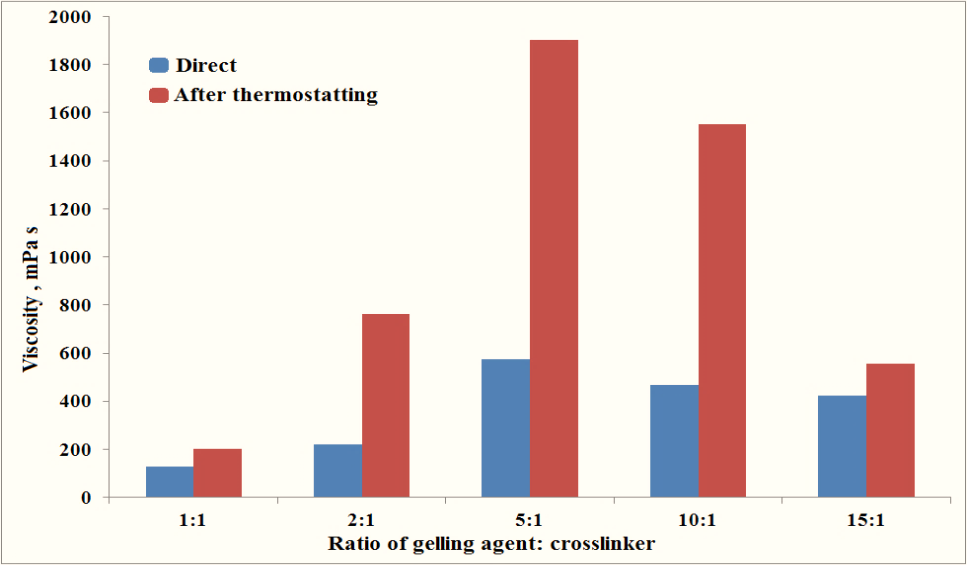
Viscosity measurements of solutions and gels were performed using a vibration viscometer (Rheokinetics) equipped with a tuning fork sensor [34, 35, 36]. The measurements were taken immediately after gel formation and after thermostating of the gel for 14 hours. In the 14 hours following conditioning, gel viscosity increases between 10-50%, reaching a maximum of 3.4-4.3 times. The results of the study are shown in Figure 1. Based on these results, gels that have the highest viscosity are obtained when a gelling agent and a crosslinker are mixed at a ratio of 5:1 - 10:1. As shown in Figure 1, the viscosity of the gels increases during the thermostating process, reaching values between 1550 and 1900 mPa s.
Under laboratory conditions on a high-pressure flow unit, PSB gel-forming composition was examined for its ability to limit gas breakthrough and water inflow. Linear and heterogeneous reservoir models were used to investigate the flow characteristics of gel-forming compositions at temperatures ranging between 9 and 24°C. The studies were conducted using a model of a flow medium (reservoir) consisting of one or two parallel columns in order to study the fluid flow at a constant flow rate. Bulk reservoir models prepared from disintegrated marble (fraction 0.16-0.5 mm), formation water model with salinity 15.33 g/l, or freshwater were used. The permeability of the models was in the range of 6.6-87 µm2.
Using PSB gel-forming composition, the following experiments were carried out on carbonate rock models at a temperature of 20-24°C in an attempt to simulate water inflow limitation and gas breakthrough in producing wells:
- Injection of the gelling agent of the PSB composition without a crosslinker;
- Injection of a hot solution of the crosslinker at a concentration of 30% and then injection of the gelling agent;
- Alternately injection of a crosslinker at a concentration of 2% and then gelling agent, followed by a crosslinker and gelling agent again.
The injection of a hot solution of a 30% crosslinker, followed by the injection of a gelling agent, was performed at a temperature of 20 ° in a marble rock model with an initial gas permeability of 6.808 μm2. This led to the formation of a practically impenetrable screen, and no flow was observed when the pressure drop increased to17 atm/m.
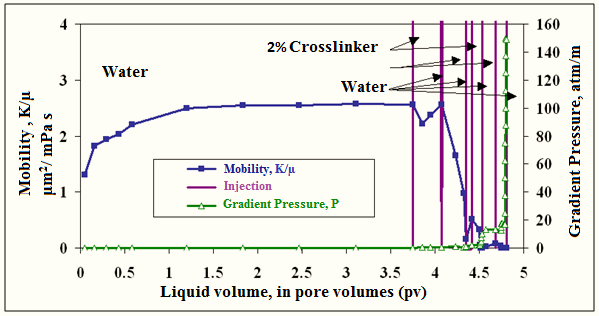
In a rock model containing disintegrated marble with an initial gas permeability of 5.712 µm2, alternating injections of solutions were carried out at a temperature of 20°C. By using a 2% crosslinker, water, gelling agent, water, and crosslinker again, an impervious screen was created, through which water could flow at a pressure drop of 13 atm/m. A further injection of the gelling agent of the PSB composition created an almost impenetrable screen, where no water could pass even when the pressure dropped to 149.5 atm/m (Figure 2).
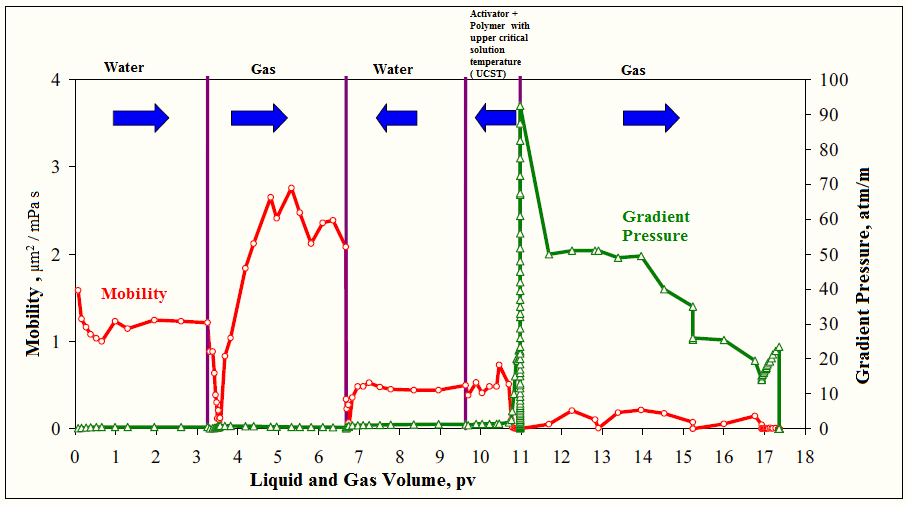
The PSB composition has been studied for its ability to prevent gas breakthrough through leaks in a cement ring. Columns filled with ground cement stone were used in this study to simulate a porous medium. The initial gas permeability of the models was within 2–3 µm2. The experiments were conducted at temperatures ranging from 0 to 40°C. Figure 3 shows the results of a flow experiment using a PSB composition. It displays the change in pressure gradient in the column and the fluid mobility in the forward and reverse flow of water, gas, and the solution of PSB composition.
In this diagram, arrows indicate which direction the flowing is going. Initially, a crosslinker solution is injected to improve the adhesion of the polymer to the cement stone and pipe surfaces, and then the gelling agent is injected. In this case, even after a gas breakthrough, the pressure gradient remains high when the gas is flowing in a volume bigger than the pore volume of the porous medium.
Experiential-Industrial Tests
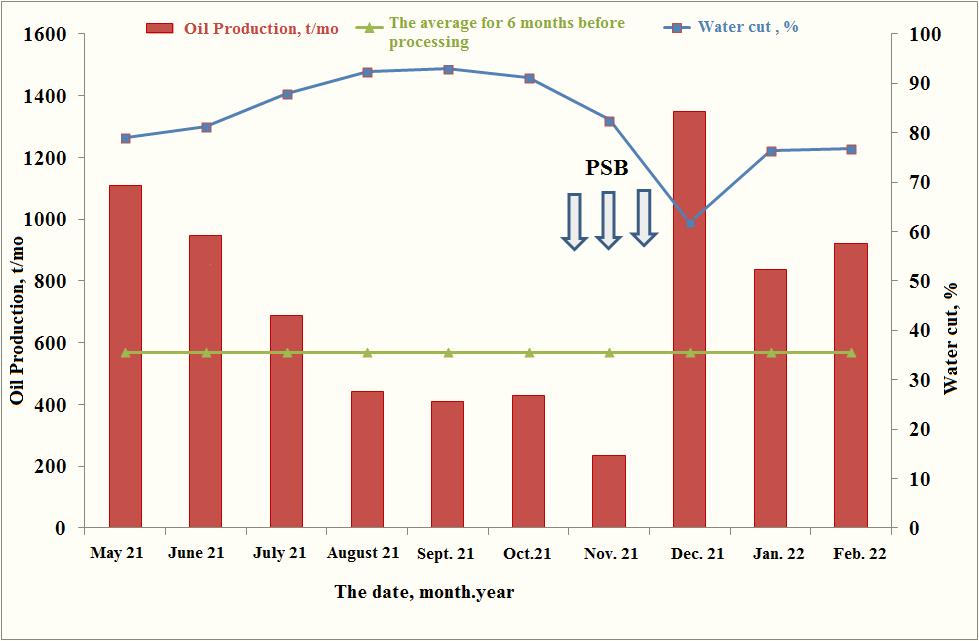
First field tests of the composition were conducted at the mid of 2021. The composition was tested at five production wells in a hydrocarbon field, which is part of the Permian-Carboniferous deposit. For each well, preparation and injection of 96 m3 of the composition, 48 m3 of the polymer solution, and 48 m3 of the crosslinker solution were performed. A liquid flow rate of 30-50 m3/day, oil flow rates of 0.3-9 t/day, and water cut rates of 73-98 percent were measured in the wells prior to treatment. It is generally observed that wells treated with PSB show a decrease in water cut, a decrease in liquid flow rates, and an increase in oil production. The average increase in oil production rate is 5 t/day, and the water cut reduction is 10-40%. Data from February 2022 indicate that the cumulative effect of the treatment continues to increase oil production by 20-600 tons per well (Figure 4).
Conclusions
The results of laboratory physicochemical, rheological, and flowing studies have shown the potential of using the PSB gel-forming composition in the technology of water inflow limitation and gas breakthrough in production wells. This technology can be used at temperatures ranging from 0 to 50°C, in oil fields with terrigenous and carbonate reservoirs, in various geological and physical conditions, and at different stages of field development. Based on the results of tests conducted on a Permian-Carboniferous deposit with high viscosity oil, PSB composition is recommended for further experimental work and industrial implementation. A reduction in water cut, a decrease in liquid flow rates and increase in oil production are observed in wells treated with PSB. On average, oil production increased by 5 t/day, and water cut decreased by 10-40%. According to the cumulative effect as of February 2022, every well has produced an additional 20-60 tons of oil.
References
-
Muggeridge A, Cockin A, Webb K, Frampton H, Collinset I, et al. (2014) Recovery rates, enhanced oil recovery and technological limits. Philos Trans A Math Phys Eng Sci 372(2006): 20120320.
-
Al-Obaidi S (2007) Analysis of hydrodynamic methods for enhancing oil recovery. Journal of Petroleum Engineering and Technology 6(3): 20-26.
-
Batalov DA, Mukhametshin VV, Dubinskiy GS, Andreev VE (2018) Laboratory grounding of waterproofing sealant based on acrylic polymers. IOP Conf Ser Earth Environ Sci 194: 042003.
-
AL-Obaidi SH (2020) A way to increase the efficiency of water isolating works using water repellent. International Research Journal of Modernization in Engineering Technology and Science 2(10): 393-399.
-
Al-Mumen AA, Al-Umran MI, Agrawal P, Jorgensen T, Smith PE, et al. (2008) Unique Solution for Fracture Isolation Resolves Water/Gas Breakthrough Challenges in a Horizontal SlimHole Well. SPE Asia Pacific Oil and Gas Conference and Exhibition, Perth, Australia.
-
Al-Obaidi SH, Khalaf FH (2020) Prospects for improving the efficiency of water insulation works in gas wells. International Research of Journal of Modernization in Engineering Technology and Science 2(9): 1382-1391.
-
Kabir AH (2001) Chemical Water & Gas Shutoff Technology – An Overview. SPE Asia Pacific Improved Oil Recovery Conference, Kuala Lumpur, Malaysia.
-
Al-Obaidi SH (2015) The Use of Polymeric Reactants for EOR and Waterproofing. Journal of Petroleum Engineering and Emerging Technology 1(1): 1-6.
-
Smirnov V, Al-Obaidi S (2008) Innovative methods of enhanced oil recovery. Oil Gas Res 1: e101.
-
Jiapei D, Yuhuan B, Zhonghou S, Xuechao C (2019) A novel fluid for use in oil and gas well construction to prevent the oil and gas leak from the wellbore. Construction and Building Materials 217: 626-637.
-
Hofmann M, Al-Obaidi SH, Kamensky IP (2021) Calculation method for determining the gas flow rate needed for liquid removal from the bottom of the wellbore. J Geol Geophys 10(5): 1-5.
-
Al Brahim A, Bai B, Schuman T (2022) Comprehensive Review of Polymer and Polymer Gel Treatments for Natural Gas-Related Conformance Control. Gels 8(6): 353.
-
Al-Obaidi S, Smirnov V, Khalaf F (2020) New technologies to improve the performance of high water cut wells equipped with ESP. Technium 3(1): 104-113.
-
Jayakumar S, Lane RH (2012) Delayed Crosslink Polymer Flowing Gel System for Water Shutoff in Conventional and Unconventional Oil and Gas Reservoirs. SPE International Symposium and Exhibition on Formation Damage Control, Lafayette, Louisiana, USA.
-
Al-Obaidi S (2022) Investigation of Rheological Properties of Heavy Oil Deposits. In: Meghraoui M, et al. (Eds.), Advances in Geophysics, Tectonics and Petroleum Geosciences. CAJG 2019, Advances in Science, Technology & Innovation, Springer, Cham.
-
Nguyen NTB, Tu TN, Bae W, Dang CTQ, Chung T, et al. (2012) Gelation Time Optimization for an HPAM/ Chromium Acetate System: The Successful Key of Conformance Control Technology. Energy Sources, Part A: Recovery, Utilization, and Environmental Effects 34(14): 1305-1317.
-
Hofmann M, AL-Obaidi SH, Chang WJ (2022) Modelling the Development of Oil Rim Using Water and Gas Injection. J Geol Geophys 11(4): 1028.
-
Altunina LK, Kuvshinov VA (2007) Physico-chemical methods for enhancing oil recovery from oil fields (review). Russian Chemical Reviews 76(10): 1034-1052.
-
Al-Obaidi S (2016) Improve the efficiency of the study of complex reservoirs and hydrocarbon deposits – East Baghdad field. International journal of scientific & technology research 5(8): 129-131.
-
Altunina LK, Kuvshinov VA (2001) Thermotropic Inorganic Gels for Enhanced Oil Recovery. Oil & Gas Journal Russia 5(18): 64-72.
-
AL-Obaidi SH, Guliaeva NI, Khalaf FH (2020) Thermal cycle optimization when processing the bottom- hole zone of wells. International Research Journal of Modernization in Engineering Technology and Science 2(11): 266-270.
-
Kuvshinov IV, Kuvshinov VA, Altunina LK (2013) Technology of component-by-component injection of compositions for enhanced oil recovery. Oil industry 8: 98-100.
-
Bjørsvik M, Høiland H, Skauge A (2008) Formation of colloidal dispersion gels from aqueous polyacrylamide solutions. Colloids and Surfaces A: Physicochemical and Engineering Aspects 317 (1–3): 504-511.
-
Al-Obaidi SH, Khalaf FH (2019) Development Of Traditional Water Flooding to increase Oil Recovery. International Journal of Scientific & Technology Research 8(1): 177-181.
-
Fattakhov IG, Kadyrov RR, Galushka AS (2014) Isolation Of Water Inflow In Wells Through The Application Of Gel-Forming Compositions. Modern problems of science and education 6.
-
Al-Obaidi SH, Hofmann M, Smirnov VI, Khalaf FH, Alwan HH (2021) Study Of Compositions For Selective Water Isolation In Gas Wells. Natural Sciences and Advanced Technology Education 30(6).
-
Kuvshinova V, Kuvshinov VA, Altunina LK (2019) Field experience of chemical IOR/EOR at Permian- Carboniferous deposit of Usinsk oilfield. AIP Conference Proceedings 2167(1): 020194.
-
Al-Obaidi SH, Kamensky IP, Hofmann M, Khalaf FH (2022) An Evaluation Of Water And Gas Injections With Hydraulic Fracturing And Horizontal Wells In Oil-Saturated Shale Formations. Natural Sciences and Advanced Technology Education 31(4).
-
Lei S, Sun J, Lv K, Zhang Q, Yang J (2022) Types and Performances of Polymer Gels for Oil-Gas Drilling and Production: A Review. Gels 8(6): 386.
-
Zhang Q, Richard H (2015) Polymers with upper critical solution temperature behavior in alcohol/water solvent mixtures. Progress in Polymer Science 48: 122-142.
-
Miel H, Al-Obaidi SH, Hussein KF (2022) Modeling and Monitoring the Development of an Oil Field under Conditions of Mass Hydraulic Fracturing. Trends in Sciences 19(8): 3436.
-
Hassan AM, Al-Shalabi EW, Ayoub MA (2022) Updated Perceptions on Polymer-Based Enhanced Oil Recovery toward High-Temperature High-Salinity Tolerance for Successful Field Applications in Carbonate Reservoirs. Polymers 14(10): 2001.
-
Al-Obaidi SH, Khalaf FH (2017) The Effect Of Anisotropy In Formation Permeability On The Efficiency Of Cyclic Water Flooding. International Journal of Scientific & Technology Research 6 (11): 223-226.
-
Bogoslovsky AV, Kozhevnikov IS, Stasyeva LA (2020) Rheokinetics of gelation of injected high viscosity compositions, AIP Conference Proceedings 2310(1): 020037.
-
Al-Obaidi S, Galkin A, Patkin A (2006) Prospects of high viscosity oil flow rate in horizontal wells. JoPET 5(4): 56- 62.
-
Chang WJ, Al-Obaidi SH, Patkin AA (2021) The use of oil-soluble polymers to enhance oil recovery in hard to recover hydrocarbons reserves. International Research Journal of Modernization in Engineering Technology and Science 3(1): 982-987.
- Nigeria’s Vulnerability in the Face of Global Energy Policy
- A Simulation Study of Investigation of Optimum Oil Production Performance by Applying Various Gas Injection Methods in Oil Reservoir
- Characterization of Permo-Triassic Reservoirs through Thermal Maturity Assessment of Westphalian Source Rocks in the Cheshire Basin
- Influence of Microwax on the Rheological and Thermal Behaviour of a Wax Crude Oil
- Real-Time Monitoring and Performance Optimization of Steam Injection in Heavy Oil Reservoirs Using Fiber Optic Sensing and Integrated Predictive Simulation Models
- Rapid On-Site Determination of the Total Petroleum Hydrocarbon Content of Soils by Handheld Fourier Transform Near-Infrared Spectroscopy: Development of a Global, Site- and Scanner- Independent Calibration Model