
Modelling Supercritical CO2 Migration and Storage in Fractured Reservoirs
Editorial
Fracture networks exist at a wide range of scale in the earth crust and strongly influence the hydraulic behaviour of rocks, providing either pathways or barriers for fluid flow. Many oil, gas, geothermal and water supply reservoirs form in fractured rocks [1]. The main challenge is the application of numerical models that account for the fracture network geometries and the equations that govern the physical processes in fractured reservoirs in order to help with reservoir management decision to ensure safe and efficient operations.
Typically, fracture systems are characterized using outcrops through the measurement of several parameters (e.g., length, aperture, spacing) in one or two dimensions [2], that are used to generate statistical 3D discrete fracture network models (DFNs), models [3]. These parameters vary according to the tectonic settings, the lithologies, the thickness of the beds and the presence of fluids [4]. The study of the outcrop analogues is fundamental to understand the distribution of the fractures in depth in the reservoirs [5]. Usually, the workflow adopted to model fractured reservoirs consists of characterization and modeling of a three- dimensional fracture system through the use of Discrete Fracture Network (DFN) models [6] and upscaling of the network properties in an Equivalent Continuum Model (ECM) at reservoir scales [7, 8]. The ECM is a geo-cellular model with average value of permeability and porosity for each cell that allows the simulation of fluid flow. This simulation is usually based on dual porosity/dual permeability models, composed by two continuum media that represent matrix and fractures [9]. This approach, although useful and widely used in many studies, has a large gap, i.e., the representation of fractures as single, distinct, and discrete objects, can individually affect migration of fluids that is strongly influenced by the geometric characteristics of each individual fracture, e.g., aperture and connectivity.
We briefly introduce a new methodology to simulate multi-phase fluid flow in fracture networks (Figure 1) and to estimate the amount of CO2 that can be stored in the system. Our method uses only a discrete fracture network approach, able to catch the geometry and connectivity of the fracture networks, that is usually lost in the upscaling procedures commonly adopted in the modeling of fractured reservoirs.
The biggest challenge in a fractured reservoir flow simulation is combining the petrophysical properties of the rocks and the hydraulic properties of the fractures. Since the studies about fractured reservoirs highlight that fractures play a primary role in the migration and transport of the fluids [10, 11], modeling the interplay between fracture network properties (e.g., connectivity) and fluid migration is indeed necessary. Recently Hyman, et al. [12] applied a DFN approach to characterize the impact of fractured caprock heterogeneity to the injection of supercritical CO2, demonstrating how network structure plays a key role in controlling the displacement of water by scCO2.
We used a similar approach to simulate fluid flow in a fractured reservoir, in order to quantify the effective contribution of fracture networks geometry and connectivity to the CO2 migration and reservoir storage capacity [13, 14], reflecting a range of variability in fracture network characteristics (e.g., number of fractures, stress field). The
geometry of the fracture networks was modelled with the dfnWorks suite [15], while supercritical CO2 flow simulation were performed using FEHM, a “Finite Element Heat and Mass” code [16], a simulator, based on a multiphase flow and thermal approach. Our results suggest a direct relationship between the fracture intensity, geometry and the volume of fluids stored in the reservoir.
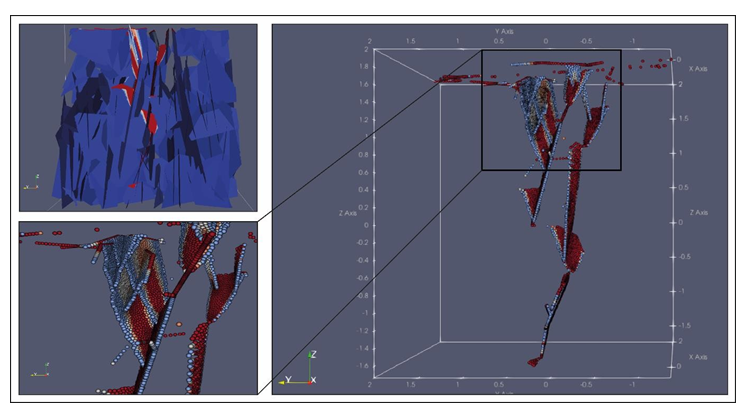
This method allows to model fractured systems at reservoir scale, in a variety of geological settings, using exclusively a DFN approach. The results confirm that it is possible to explicitly simulate the effective contribution of fractures to fluid migration and transport and to estimate fluid storage volumes in a fractured reservoir.
References
-
Nelson R (2001) Geologic analysis of naturally fractured reservoirs. 2nd (Edn.), Gulf Professional Publishing, Elsevier.
-
Dershowitz WS, Herda HH (1992) Interpretation of fracture spacing and intensity. Proceedings 33rd US symposium on rock mechanics (USRMS), American Rock Mechanics Association, USA.
-
Mauldon M, Dunne WM, Rohrbaugh Jr MB (2001) Circular scanlines and circular windows: new tools for characterizing the geometry of fracture traces. Journal of structural geology 23(2-3): 247-258.
-
Bond CE, Wightman R, Ringrose PS (2013) The influence of fracture anisotropy on CO2 flow. Geophysical Research Letters 40(7): 1284-1289.
-
Narr W, Schechter DS, Thompson LB (2006) Naturally fractured reservoir characterization. Society of Petroleum Engineers.
-
Hadgu T, Karra S, Kalinina E, Makedonska N, Hyman JD, et al. (2017) A comparative study of discrete fracture network and equivalent continuum models for simulating flow and transport in the far field of a hypothetical nuclear waste repository in crystalline host rock. Journal of Hydrology 553: 59-70.
-
Zhang X, Sanderson DJ (2002) Numerical Modelling and Analysis of Fluid Flow and deformation of Fractured Rock Masses. Elsevier, London, pp: 300.
-
Sweeney MR, Gable CW, Karra S, Stauffer PH, Pawar RJ, et al. (2019) Upscaled discrete fracture matrix model (UDFM): an octree-refined continuum representation of fractured porous media. Computational Geosciences 24: 293-310.
-
March R, Doster F, Geiger S (2018) Assessment of CO2 storage potential in naturally fractured reservoirs with dual‐porosity models. Water Resources Research 54(3): 1650-1668.
-
Iding M, Ringrose P (2010) Evaluating the impact of fractures on the performance of the In Salah CO2 storage site. International Journal of Greenhouse Gas Control 4(2): 242-248.
-
Le Gallo Y, De Dios JC (2018) Geological model of a storage complex for a CO2 storage operation in a naturally fractured carbonate formation. Geosciences 8(9): 354.
-
Hyman JD, Jimenez-Martinez J, Gable CW, Stauffer PH, Pawar RJ (2020) Characterizing the Impact of Fractured Caprock Heterogeneity on Supercritical CO2 Injection. Transport in Porous Media 131(3): 935-955.
-
Proietti G, Romano V, Conti A, Chiara Tartarello M, Bigi S (2020) An alternative method to evaluate fracture network efficiency to fluid flow. EGU General Assembly Conference Abstracts, pp: 4799.
-
Romano V, Bigi S, Carnevale F, Hyman JDH, Karra S, et al. (2020) Hydraulic characterization of a fault zone from fracture distribution. Journal of Structural Geology 135: 104036.
-
Hyman JD, Karra S, Makedonska N, Gable CW, Painter SL, et al. (2015) dfnWorks: A discrete fracture network framework for modeling subsurface flow and transport. Computers & Geosciences 84: 10-19.
-
Zyvoloski GA, Robinson BA, Dash ZV, Trease LL (1997) Summary of the models and methods for the FEHM application-a finite-element heat-and mass-transfer code (No. LA-13307-MS). Los Alamos National Lab, NM, USA.
- Nigeria’s Vulnerability in the Face of Global Energy Policy
- A Simulation Study of Investigation of Optimum Oil Production Performance by Applying Various Gas Injection Methods in Oil Reservoir
- Characterization of Permo-Triassic Reservoirs through Thermal Maturity Assessment of Westphalian Source Rocks in the Cheshire Basin
- Influence of Microwax on the Rheological and Thermal Behaviour of a Wax Crude Oil
- Real-Time Monitoring and Performance Optimization of Steam Injection in Heavy Oil Reservoirs Using Fiber Optic Sensing and Integrated Predictive Simulation Models
- Rapid On-Site Determination of the Total Petroleum Hydrocarbon Content of Soils by Handheld Fourier Transform Near-Infrared Spectroscopy: Development of a Global, Site- and Scanner- Independent Calibration Model