
Mathematical Modeling Investigation of V+5 Ion Removal from Wastewater by Nanographene Oxide
The objective of this work is to remove Vanadium V+5 ions from wastewater by batch adsorption utilizing Nano Graphene Oxide (NGO) since Vanadium presents a hazardous concern due to its effect on biological systems; According to the International Agency for Research on Cancer (IARC), vanadium V+5 ions are a potential human carcinogen. In the adsorption process, the effects of temperature (20-50)°C and initial concentration effect (100-800) mg L-1 were investigated. The adsorption isotherms were identified using a simulated aqueous solution of the V+5 ions and a kinetic and thermodynamic sorption analysis. Both the Langmuir and Freundlich isotherm models were used to fit the data. Due to the correlation coefficient (R2) of 0.999, analyses showed that the Adsorption of V+5 ions by NGO followed the Langmuir model. Kinetic models analyzed Intra Particle Diffusion, Pseudo First & Second Order Models revealed that an Intra-Particle Diffusion model was followed. Thermodynamically, The Adsorption processes were exothermic, random, and spontaneous, all shown by the negative values for Enthalpy ΔH, Entropy ΔS, and Gibbs free Energy ΔG.
Introduction
With the expansion of industry and human activity, more heavy metals are in industrial wastewater. The most significant source of wastewater from oil refineries [1, 2]. The wastewater from an oil refinery may contain heavy metals such as vanadium ions, and others shared in industrial effluent. Water polluted with vanadium ions permeates the ecosystem, endangering human health and the environment. They can cause cancer because vanadium ions do not biodegrade [3], and their excessive concentration in water can have significant consequences for the health of living creatures [4, 5]. Based on the guidelines of the World Health Organization (WHO), Permitted quantities of drinking water not exceed 100 (μg) [6]. Conventional approaches for removing heavy metal pollution from wastewater include precipitation via coagulation and flocculation [7], purification by electrochemical method [8], membrane separation [9], and Adsorption [10, 11]. The most promising of these technologies is Adsorption because of its low cost, high efficiency, adaptable design, and simplicity of operation. Nanomaterials are the adsorbent in most common adsorption systems because of their singular features, features that make them desirable adsorbents for the removal of heavy metals from contaminated industrial wastewater include a high specific surface area, a high number of binding sites for the adsorbates to be adsorbed, a large number of functional groups, and an acceptable pore size [12, 13]. According to several studies, the NGO has exceptional adsorption qualities, particularly in liquid-solid systems. Its structure demonstrates the presence of oxygen groups in the aromatic ring, like to carbonyl group, carboxyl group, and hydroxyl group, which makes it highly hydrophilic and gives the NGO a high capacity for Adsorption of metal ions pollutants because of its high surface area and ability to disperse in water [14]. Typically, NGO is produced by oxidatively exfoliating natural graphite using the renowned Hummers process [15, 16]. In this study, GO was produced using techniques described in the literature Ji, et al. [17], Considering how metal ion removal is affected by starting concentration and temperature, especially vanadium ions, from wastewater by batch adsorption procedure was also investigated as well as Various models were used to assess the adsorption isotherm, kinetics, and thermodynamics at the solid-liquid interface.
Experimental
Materials
The Raw Graphite (99% purity, GLS Ltd Co). HCl (35-38% concentration, BHD, Germany). H2SO4 (98% concentration, S-Aldrich, India). H2O2 (30% concentration, Pubchem, Germany). KMnO4 (FS, India), NaOH (98% concentration, SDFCL, India), and DI water.
Synthesis of Nano Graphene Oxide NGO
NGO was prepared by modifying the Hummers technique [18]. Raw Graphite powder 3.0 g and concentrated H2SO4 75 ml were poured into an ice bath and agitated at 200 rpm by using a Hotplate Magnetic Stirrer, followed by the gradual addition of KMnO4 10.0 g to keep a temperature below 10°C. The reaction system was then placed in a 40°C Paraffin-oil bath and aggressively stirred 300 rpm for about 30 min. After adding 150 ml of DI-water to the solution, it was stirred for 15 min at 95°C. 15 ml of H2O2 are added dropwise, then 500 ml of DI-water. Graphite oxidized, as evidenced by the solution’s transition from dark brown to yellow-brown. Metal ions were removed from the suspension by filtering and washing it with 250 ml of a 1:10 HCl aqueous solution. The remaining acidic or metallic substances were washed away with 1500 ml of water. The resulting NGO dispersion was placed in 900 ml of water and ultrasonicated for 30 minutes at a frequency of 40 kHz. The NGO dispersion was centrifuged at 5000 rpm for one hour to remove un-exfoliated particles. The resulting product was then dried for 24 hours at 60°C to yield NGO.
Characterization
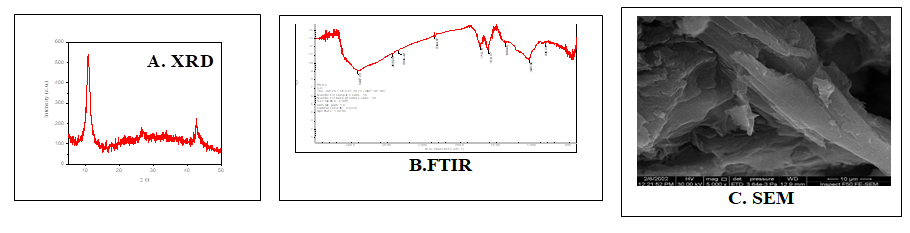
The X-ray diffraction (XRD), Fourier transform infrared spectrometer (FTIR), and Scanning Electron Micrographs (SEM) were three most significant tests used to confirm the presence of NGOs. The XRD determined that NGOs formed effectively at the peak 2θ range of 10–12 degrees [18], and Figure 1A illustrates that NGOs had a significant peak at 2θ=10.93 degrees. The FTIR reveals peaks corresponding to oxygen-containing functional groups; hydroxyl bonds O-H stretching are responsible for the strong peak between 3403.27 and 2925.2 cm-1, and the group of C=O bond is responsible for the highest absorption peak at 2344.97 cm-1. This result demonstrates that NGO was created [19], as shown in Figure 1B. SEM was used to conduct detailed morphological studies, in which the crystallization refers to the rate of graphite oxidation. The photograph reveals that NGO is randomly arranged and thin; Figure 1C shows folded papers with surface creases and folds [20].
Study isotherm, Kinetic, and Thermodynamics of the Adsorption process
As an adsorbent, 100 mg of NGO was added to 100 ml. of aqueous solutions containing V+5 ion at a set starting concentration of (100-800) mg L-1 and temperature (20-50) °C to perform the experiments for the adsorption kinetics investigation. The samples were gathered, and the AAS technique was used to calculate the concentrations of V+5 ion in the aqueous solutions; under ideal circumstances. Equation (1) was employed to determine the ability of heavy metal ions to adsorb at time t (qt) expressed in mg g-1 [21].
( ) t i e V q C C m = × − (1)
Where: Ci (mg L−1) the ion initial concentration and Ce (mg L−1) is the equilibrium adsorbed concentration, V is the corresponding ion solution volume (L) of, and m is the mass of the adsorbent (g).
Result and Discussion
Adsorption Performance
Temperature Effect (T): The impact of removing temperature on the efficiency for V+5 ion using NGO in a batch mode adsorption unit is shown in Figure 2 under optimal conditions.
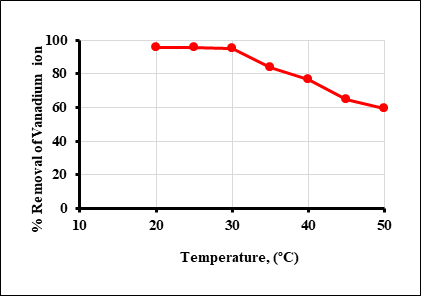
At the changing temperature (20-50) °C, the most effective removal occurs at the lowest temperature, implying an inverse relationship between temperature and Adsorption effectiveness for the Vanadium simulated solution tested and the adsorbent NGO used. This proves that the Adsorption was an exothermic process; consequently, an increase in temperature, The linkages connecting the functional groups at the active sites are extensive. the NGO’s surface with V+5 ion breakdown, enabling material to be released and returned to the solution while decreasing removal efficiency [19]. The highest removal of Vanadium ion was seen at 20°C, where the ability for Adsorption reduced as temperature rose; Adsorption then decreased continuously with increasing temperature until it reached its lowest value. Effect of Initial Concentration (Ci): The influence of the starting concentration on the heavy metal adsorbing process within the scope of 100-800 mg.L-1 for V+5 ion under optimal circumstances for the remainder of the other design, as shown in Figure 3. The data collected demonstrate an inverse link between the two variables. The percentage removal of Vanadium ion and adsorbent materials falls as the initial concentration value rises [22]. There is no change in the surface area of the NGO; this indicates that there are a limited number of ions that may be adsorbable on the surface of the adsorbent. Because the volume of the solution remains constant, a rise in metal ionic concentration with an increase in contaminant concentration suggests that V+5 ions compete for a certain number of active sites on the adsorbent surface [23]. Consequently, fewer ions will be adsorbed, and more Vanadium ions will be present in the contaminated solution, decreasing the effectiveness of the treatment. The highest adsorption capacity is at Ci 100 mg L-1, and the lowest is at Ci 800 mg L-1.
![Figure 3: The data collected demonstrate an inverse link between the two variables. The percentage removal of Vanadium ion and adsorbent materials falls as the initial concentration value rises [22]. There is no change in the surface area of the NGO; this indicates that there are a limited number of ions that may be adsorbable on the surface of the adsorbent. Because the volume of the solution remains constant, a rise in metal ionic concentration with an increase in contaminant concentration suggests that V+5 ions compete for a certain number of active sites on the adsorbent surface [23]. Consequently, fewer ions will be adsorbed, and more Vanadium ions will be present in the contaminated solution, decreasing the effectiveness of the treatment. The highest adsorption capacity is at Ci 100 mg L-1, and the lowest is at Ci 800 mg L-1.](/fulltextimages/9877/fig_3.png)
Adsorption Isotherm
By monitoring the adsorption isotherm of the ions from an aqueous solution on the NGO, one may determine the relationship between the concentration of the adsorbate and the quantity of Adsorption on the surface of the adsorbent at a constant temperature. to determine NGO’s capacity for adsorbing V+5 ions out of a solution. In order to get the best model fit and determine the amount of Adsorption, the experimental isotherm data were reviewed using models. parameters for every model. Freundlich and Langmuir were the models used. The simulations were utilized to understand how V+5 ions adsorb on the graphene sheets that make up the NGO structure as well as to mimic this process. The following equations, which also explain the relevance of each parameter, reflect these models [24].
Langmuir Model: It is predicated on the idea that when the adsorbed solute forms a monolayer, At all times and under all conditions, the adsorbent maintains the same adsorption energy.. Expresses the linear form equation (2) [24]:
1 1 1 1 e max L e max q q K C q = + (2)
Where 𝑞𝑒: equilibrium adsorption capacity (mg g-1), Ce:
concentration of adsorbed material at equilibrium (mg L-1), 𝐾𝐿: Constant of Langmuir (L mg-1) and 𝑞𝑚𝑎𝑥: a measure of Adsorption’s maximal capability (mg g-1).
Freundlich Model: According to this model, Adsorption takes place irregular topography with homogeneous energy across several layers, and equation (3) may be used to characterize this process linearly [25]:
1 n e F e q K C = (3) Where qe:: the quantity absorbed in relation to adsorbent mass (mg g-1). KF: Calculated adsorption capacity is denoted by the Freundlich constant. [(mg g-1). (mg-1)1/n]. 𝑛: intensity of Adsorption (-).
Table 1 demonstrates the constant quantity of the Langmuir and Freundlich isotherms. At the same time, Figure 4 shows these isotherms for NGO adsorption of Vanadium ion.
| Metal | Langmuir | Freundlich | |||||
|---|---|---|---|---|---|---|---|
| q max (mg/g) | K L (l/mg) | R L | R2 | K F (mg/g) | n | R2 | |
| V+5 | 621.1180 | 0.02546 | 0.0894 | 0.99943 | 40.4979 | 1.98428 | 0.95364 |
Table 1: the constants of Langmuir and Freundlich isotherm for Vanadium ion adsorption utilizing NGO.
These findings demonstrate that the experimental results exhibit the following degree of model conformity: According to the magnitude of the correlation coefficient (R2), Langmuir is superior to Freundlich for the metal V+5 due to the correlation coefficient (R2) is high. Depending on the
6.4 y= 0.53131x + 3.49138 R2= 0.95213
value of the separation factor, the adsorption procedure is chosen. Adsorption is a physical phenomenon that occurs on a heterogeneous surface. According to this idea, Adsorption occurs on a monolayer surface made up of a certain number of similar patches.
Adsorption Kinetics
It is a mathematical representation in the shape of a curve or a straight line that reflects the rate at which adsorbate ions were released from the aqueous medium or captured by the solid phase represented by the adsorbent surface under given operating conditions. Consequently, a kinetic investigation is required to Analyze the effectiveness and mechanics of the adsorption process. The pseudo first order model, pseudo second order model, Elovich model, and intra particle diffusion model are the most critical kinetic models for modeling the adsorption process, and they were used to analyze the experimental results in this study [26]. Pseudo First Order Model: According to this model, Adsorption happens at the adsorption surface in a single layer when describing a transition between a liquid and a solid state. Formalizing this concept is explained by Equation (4):
1 ( ) e t e ln q q lnq k t − = − (4)
Where qt: is adsorbate adsorbed onto adsorbent at time 𝑡 (mg g-1), qe: is capacity of equilibrium adsorption (mg g-1), and 𝑘1: is rate constant (min-1) [27]. Pseudo Second Order Model: This model assumes that the adsorption rate is proportional to the available surface area of the adsorbent medium. Equation (5) is the formula for this model in mathematics.
1 1 t t q q k q = + (5)
2 2 t e e Where qe: the quantity of vanadium ions adsorbed by a given adsorbent mass at equilibrium (mg g-1), qt: at each instant, the quantity of vanadium ion adsorbent per unit mass of adsorbent (mg g-1), : time (min), and k2: the second order rate constant (g mg -1 min-1) [27]. Intra Particle Diffusion Model: According to the model’s assumptions, the solute is transferred from the solution to the adsorption surface in four steps. If adsorbent material is present in the solution, the first step is the mass transfer (bulk movement), or the transfer of solute molecules. This procedure is relatively rapid. The subsequent phase is film diffusion, in which the solute moves inside the border layer of the adsorbent material. The other step is surface diffusion, which involves the dispersion of solute particles and their migration toward the pores of the adsorption surface. The subsequent phase is pore diffusion, which consists of the Adsorption of solute molecules to active sites on the adsorption surface. The formula (6) gives the mathematical equation that characterizes the intra particle diffusion paradigm.
t p q k t C = + (6) Where kp: rate constant (𝑚𝑔 𝑔-1 𝑚𝑖𝑛-0.5), and 𝐶: boundary layer thickness. The values of 𝐶 determine the boundary layer effect—the higher values, the greater the effect [27].
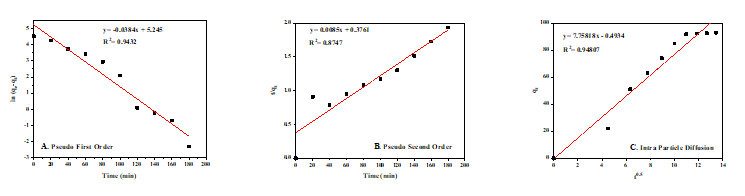
Table 2 includes the amount of the parameters of the three models of kinetic that were used to evaluate the study’s results. Figures 7-10 illustrate the experimental data from the kinetic research on V+5 ion removal from aqueous solutions using NGO (i.e., Pseudo First Order, Pseudo Second Order, and Intra-Particle Diffusion models).
| Metal | Pseudo First Order Model | Pseudo Second Order Model | Intra Particle Diffusion | ||||||
|---|---|---|---|---|---|---|---|---|---|
| q e | k 1 | R2 | Qe | k 2 | R2 | kp | C | R2 | |
| V+5 | 189.614 | -0.000214 | 0.9432 | 118.0638 | 0.00019 | 0.8747 | 7.7582 | -0.4934 | 0.9481 |
Table 2: Constant values of Pseudo First Order, Pseudo Second Order, and Intra Particle Diffusion models for Vanadium ion adsorpt
According to the correlation coefficient values (R2) of the outcomes for V+5, the following kinetic model is best appropriate for describing the data. Intra-particle diffusion > Pseudo first order model > Pseudo second order model.
According to the intra-particle diffusion model. A possible explanation for the V+5 finding is the fast motion of solute molecules and ions within the border layer of the adsorbent material, and the surface diffusion of those solute particles toward the adsorption pores.
Study of the Thermodynamics of Adsorption
The values of thermodynamic functions, vital in defining many processes, notably the adsorption process, may be used to understand the types of driving forces and the reaction’s direction. Additionally, they provide a convincing justification for the uniformity of molecules in diverse systems due to numerous molecular manipulations. The Van’t Hoff relation equation (7,8, and 9) might be used to calculate the thermodynamic variables.
1 ad H S lnk R T R ∆ ∆ =− + (7)
q k C = (8)
e ad e G H T S ∆ =∆ −∆ (9)
Where 𝑘𝑎𝑑: Adsorption thermodynamic equilibrium coefficient (dimensionless), R: universal gas constant (J mol-
1 K-1), 𝑇: Absolute temperature (K), 𝛥𝐻: Enthalpy change (J mol-1), and 𝛥𝑆: the Entropy change (J mol-1 K-1) [28].
Using equation (8) to calculate the adsorption thermodynamic equilibrium coefficient, the plot of versus 1/T determined the values of ∆H from the slope (∆H= - Slope * R) and ∆S from Intercept (∆S= Intercept * R). These are shown in Figure 6, where the outcomes of the thermodynamic analysis and there are tabular representations of the values of the thermodynamic functions in Table 3.
1/T Figure 6: Vanadium Ion Adsorption Thermodynamic Properties by NGO.
| Metal | Temperature, (°C) | Alteration of Enthalpy 𝛥𝐻, (kJ.mol-1) | Alteration of Entropy 𝛥𝑆, (J.mol-1. K-1) | Alteration of Gibbs free Energy 𝛥𝐺, (kJ.mol-1) |
|---|---|---|---|---|
| V+5 | 20 | -45.3358 | -132.3480 | -6.3015 |
| 25 | -6.0514 | |||
| 30 | -5.5354 | |||
| 35 | -4.4420 | |||
| 40 | -3.9462 | |||
| 45 | -3.19475 | |||
| 50 | -2.5364 |
Table 3: 3.00
It is well known that the thermodynamic functions (𝛥𝐻, 𝛥𝑆, 𝛥𝐺) are essential for figuring out the spontaneous process and describing how metal ions adsorb on the surface of adsorbent media. On the other hand, the inverse correlation between the thermodynamic equilibrium coefficient kad and the temperature t by the information acquired based on the diagrams and data describing the V+5 adsorption process on the surface of NGO. The value of the enthalpy function that was a factor in 𝛥𝐻 indicates exothermic Adsorption for V+5, a chemical process that increases the contact between the deposited metal ions and the adsorption surface, and the development of a novel electronic interaction with the functional groups that are located on the surface of the adsorbent material. During the adsorption process, the solid- liquid phase interface experiences a drop in the randomness state, as seen by all experiments utilizing NGO having a negative value for the entropy function altering 𝛥𝑆. This value may also quantify the Adsorption of V+5 ions from solutions. While the entropy function is negative during the adsorption phase, the molecules are more evenly dispersed than when in solution. During Adsorption, On the substance’s surface, V+5 ions swap places with ions that are less mobile, lowering the entropy of the system. The reduction in the randomness state of the solid & liquid phase border throughout the adsorption process is shown by the negative 𝛥𝑆 for Adsorption by NGO. This number also shows the surface affinities of V+5 ions for solution adsorption. Because the entropy function has a negative value during the adsorption phase, the molecules are scattered more uniformly than they are while they are in solution. Entropy is decreased due to the exchange of V+5 ions with less ions that are movable on the surface of the substance during Adsorption. Furthermore, it was shown that given the experimental circumstances tested, when negative values of Gibbs free energy 𝛥𝐺 , the process of Adsorption is spontaneous for V+5 ions using NGO.
Conclusion
The Hummers process was modified to create Nano Graphene Oxide NGO from graphite powder in this work. Vanadium ions’ enhanced ability to bind to NGO is due to their hydrophilic characteristics and the oxygen-containing functional group’s presence. Since they share an electron pair, these groups may effectively bind V+5 ions to create metal complexes. The removal efficiency of V+5 ions rose as the temperature decreased, reaching a maximum of 20°C and declining to 50°C. When the initial V+5 concentration is 100 (mg L-1). The concentration of equilibrium values was 6.9 (mg L-1). For V+5 ions, as the initial concentration value increases for adsorbent metals, the percentage removal decreases. The adsorption isotherms may explain the Langmuir model; they show that V+5 ions adsorb on monolayer-coated NGO sheets. Since it was fitted, the kinetic analysis implies that chemical adsorption (chemisorption), V+5 ions adsorption on NGO is regulated by the complexation of the surface for V+5 ions containing oxygen groups on the NGO surface. The kinetic model for V+5 ions was Intra-particle diffusion. The thermodynamic equilibrium coefficient kad for the Adsorption of V+5 ions declines with a rise in temperature t, and the values of the enthalpy function ∆H are negative, suggesting that it is exothermic. The process A negative entropy function, ∆S, causes the reduction in randomness. In addition, the adsorption material ions were spontaneous, with negative Gibbs free energy values influencing ∆G.
References
-
Breida M, Younssi SA, Ouammou M, Bouhria M, Hafsi M (2020) Pollution of Water Sources from Agricultural and Industrial Effluents: Special Attention to NO3ˉ, Cr(VI), and Cu(II). In: Eyvaz M (Eds.), Water Chemistry. IntechOpen.
-
Hayder MR, Ayad AHF (2018) Removal Of Dissolved Cadmium Ions from Contaminated Wastewater using Raw Scrap Zero-Valent Iron And Zero Valent Aluminum as Locally Available and Inexpensive Sorbent Wastes. Iraqi Journal of Chemical and Petroleum Engineering 19(4): 39-45.
-
Thamilarasi MJV, Anilkumar P, Theivarasu C, Venkatachalam Sureshkumar M (2018) Removal of Vanadium from wastewater using surface-modified lignocellulosic material. Environ Sci Pollut Res 25: 26182–26191.
-
Aikelaimu A, Yuchen G, Yuan M, Xuejing C, Jiwei L, et al. (2019) Review of plant-vanadium physiological interactions, bioaccumulation, and bioremediation of vanadium-contaminated sites. Science of the Total Environment 712: 135637.
-
Gao Y, Jiang J, Tian S, Liu N, Yang M, et al. (2017) BOF steel slag as a low-cost sorbent for Vanadium (V) removal from soil washing effluent. Sci Rep 7: 11177.
-
İlknur D, Canan S, Hakan D (2021) Enrichment of the surface functional groups of activated carbon by modification method. Surfaces and Interfaces 22: 100873.
-
Weizhi Z, Wenxiang G, Bo L, Zongsu W, Dionysios DD, et al. (2020) Kinetics and mechanistic aspects of removal of heavy metal through gas-liquid sulfide precipitation: A computational and experimental study. Journal of Hazardous Materials 408: 124868.
-
Hadi K, Mohammad KR, Pezhman A, Vinod KG, Zahra V (2010) Multi-walled carbon nanotubes-ionic liquid- carbon paste electrode as a super selectivity sensor: Application to potentiometric monitoring of mercury ion(II). Journal of Hazardous Materials 183 (1-3): 402- 409.
-
Tawfik AS, Vinod KG (2012) Synthesis and characterization of alumina nano-particles polyamide membrane with enhanced flux rejection performance. Separation and Purification Technology 89: 245-251.
-
Alexander EB, Evgeny VG, Irina VB, Kucherova AE, Agarwal S, et al. (2018) Adsorption of heavy metals on conventional and nanostructured materials for wastewater treatment purposes: A review. Ecotoxicology and Environmental Safety 148: 702-712.
-
Basma AA, Raheem JM, Nawras JJ (2018) Adsorption of Diclofenac Sodium and Ibuprofen by Bentonite Polyureaformaldehyde Thermodynamics and Kinetics Study. Iraqi Journal of Chemical and Petroleum Engineering 19(1): 29-43.
-
Xiangxue W, Chen L, Wang L, Fan Q, Pan D, et al. (2020) Synthesis of novel nanomaterials and their application in efficient removal of radionuclides. Sci China Chem 62 (8): 933-967.
-
Carlos GF, Liliana G, Juan MP (2020) Preparation and Characterization of Graphene Oxide for Pb(II) and Zn(II) Ions Adsorption from Aqueous Solution: Experimental, Thermodynamic and Kinetic Study. Nanomaterials 10(6): 1022.
-
Zhengxiao X, Zhaomin L, Aiwen J, Meng F, Dang F, et al. (2019) Synthesis of Magnetic Graphene Oxide (MGO) and Auxiliary Microwaves to Enhance Oil Recovery. Energy Fuels 33(10): 9585-9595.
-
William SH, Richard EO (1958) Preparation of Graphitic Oxide. J Am Chem Soc 80(6): 1339-1339.
-
Chaoke B, Ma Z, Guo T, Li B, Zhang Y, et al. (2021) Magnetic graphene oxide nanocomposite: One-pot preparation, adsorption performance and mechanism for aqueous Mn(Ⅱ) and Zn(Ⅱ). Journal of Physics and Chemistry of Solids 156: 110130.
-
Ji C, Bowen Y, Chun L, Gaoquan S (2013) An improved Hummers method for eco-friendly synthesis of graphene oxide. Carbon 64: 225-229.
-
Serhat ST, Sule SU, Banu ET, Nicholas F (2022) Evaluating the X-ray-Shielding Performance of Graphene-Oxide- Coated Nanocomposite Fabric. Materials 15(4): 1441.
-
Santosh KT, Huczko A, Oraon R, Adhikari AD, Nayak GC (2017) Facile electrochemical synthesis of few layered graphene from discharged battery electrode and its application for energy storage. Arabian Journal of Chemistry 10(4): 556-565.
-
Hongyan L, Zhijun W (2021) Impacts of Modified Graphite Oxide on Crystallization, Thermal and Mechanical Properties of Polybutylene Terephthalate. Polymers 13(15): 2431.
-
Michelle DA, Fernanda MA, Érika CC, Adriano AM (2016) Isotherm, kinetic, mechanism and thermodynamic studies of Adsorption of a microbial lipase on a mesoporous and hydrophobic resin. Chemical Engineering Journal 311: 1-12.
-
Venkata Ramana DK, Yu JS, Seshaiah K (2013) Silver nanoparticles deposited multiwalled carbon nanotubes for removal of Cu(II) and Cd(II) from water: Surface, kinetic, equilibrium, and thermal adsorption properties. Chemical Engineering Journal 223: 806-815.
-
Mahnaz P, Shabnam S, Soheila S (2021) Cross-linked chitosan into graphene oxide-iron(III) oxide hydroxide as nano-biosorbent for Pd(II) and Cd(II) removal. International Journal of Biological Macromolecules 166: 229-237.
-
Sedigheh P, Saman B, Mohammad EB, Masoud R (2021) Adsorption efficiency of glycyrrhiza glabra root toward heavy metal ions: Experimental and molecular dynamics simulation study on removing copper ions from wastewater. Separation and Purification Technology 275: 119215.
-
Aditya RK, Ponnusamy SK, Revellame ED, Gang DD, Zappi ME, et al. (2018) Pecan shell based activated carbon for removal of iron(II) from fracking wastewater: Adsorption kinetics, isotherm and thermodynamic studies. Process Safety and Environmental Protection 114: 107-122.
-
Jianlong W, Xuan G (2020) Adsorption kinetic models: Physical meanings, applications, and solving methods. Journal of Hazardous Materials 390: 122156.
-
Salaudeen AO, et al (2022) Thermodynamics and Mechanism of the Adsorption of Heavy Metal Ions on Keratin Biomasses for Wastewater Detoxification. Adsorption Science and Technology 2022: 7384924.
- Nigeria’s Vulnerability in the Face of Global Energy Policy
- A Simulation Study of Investigation of Optimum Oil Production Performance by Applying Various Gas Injection Methods in Oil Reservoir
- Characterization of Permo-Triassic Reservoirs through Thermal Maturity Assessment of Westphalian Source Rocks in the Cheshire Basin
- Influence of Microwax on the Rheological and Thermal Behaviour of a Wax Crude Oil
- Real-Time Monitoring and Performance Optimization of Steam Injection in Heavy Oil Reservoirs Using Fiber Optic Sensing and Integrated Predictive Simulation Models
- Rapid On-Site Determination of the Total Petroleum Hydrocarbon Content of Soils by Handheld Fourier Transform Near-Infrared Spectroscopy: Development of a Global, Site- and Scanner- Independent Calibration Model