
Microorganism Influence on Petrophysics Specifications
This study was prepared as part of a preliminary research program to study the effect of bacteria on the specifications of petrophysical models for reservoir rock -contrast-General in its porous reservoir permeability of the AL-Atta main/south Rumaila fluid. The technique was used permeability for the passage of fluid KL in the evaluation of the accounts permeability of a typical section diameter (1.5 inches) in this study, contrast between them in permeability and porosity, prepared charts and graphs (figures) in particular include the effect of bacterial on the permeability when injected liquid plus bacteria were calculated permeability of the rock for the passage of fluid First, the traditional way and then calculated the permeability for the passage of fluid inoculated with bacteria and the extent of change in the permeability for comparison purposes. To know how much this vulnerability isolated for this study three types of bacteria depending on their need for oxygen to produce energy used for effective bio-growth, reproduction and that gets my way, the redox, and the statement of the different effects of these species and types of vulnerability that could get the rocks of different permeability and identify the problem non-knowledge or non-diagnostic and the amount of impairment laboratory as a basis for opening a new science devoted to the importance of what caused microbiology damage and can be used in aspects of benefit in the field of oil production and minimize material losses due to this type of pollution produced by these microorganisms and to find ways to protect the oil fields of this serious problem. The findings of this study to the major axis are the effect of specific types of microorganisms on the rocks, the reservoir of permeability high, medium and thus lower the rate of oil production and this, in turn, leads to economic return is bad, which can be treated in ways that modern art advanced and modern methods in Part II of the study to achieve better ways to extract oil from oil wells by treating affected.
Introduction
The processes of extracting oil from the technical operations task within the production process in the oil fields and is divided into two phases, the first is primary production where the oil reservoirs of the highest production capacity depending on the driving forces behind the reservoir of self-paying the water and the payment of the Dome of the gas and pay the gas and the second phase secondary production where the reservoir has decreased the pressure reservoir continue decreasing until it reaches the stage where it needs to use a secondary means of helping to re-pressure reservoir to its previous position Water flooding improves oil recovery by displacing oil, and injection water is usually taken from the nearest available source [1]. Microorganisms play various roles in petroleum reservoirs during oil exploration and post-operation [2]. Recently, the microorganisms in petroleum reservoirs have received much attention, reflecting the effects of these microbes on oil recovery Microbial Improved oil recovery method has been investigated [3]. Since the 1950s, water flooding has been a widely accepted method for increasing oil recovery from petroleum reservoirs. Flood water, obtained from the sea, river, or groundwater, and recycled production water contain not only nutrients, dissolved oxygen, and inorganic ions but also microorganisms [4]. These microorganisms are continuously injected into the subsurface and likely affect the reservoir ecosystem one of the aids used in our oil and should be water specification is chemical and biological does not affect the specifications of petro physical reservoir and these, Water-flooded oil reservoirs have specific ecological environments due to continual water injection and oil production and water recycling. Using 16S rRNA gene clone library analysis, the microbial communities present in injected waters and produced waters from four typical water- flooded oil reservoirs with different in situ temperatures of 256C, 406C, 556C, and 706C were examined. The results obtained showed the higher the in situ temperatures of the oil reservoirs [5]. Must be injected water is completely free of microbial in a comprehensive manner prior to the injections and requires sure of the specifications of water injection and consistency with the reservoir rock Biodegradation of crude oil in subsurface petroleum reservoirs has adversely affected the majority of the world’s oil, making recovery and refining of that oil more costly [6], which does not lead to any damage to the reservoir water composition effective to be injected Previous reviews focused on microbial-enhanced oil recovery mechanisms, namely IFT reduction, selective plugging, gas production, biodegradation, and wettability alteration [7]. At temperatures up to about 80 °C, petroleum in subsurface reservoirs is often biologically degraded, over geological timescales, by microorganisms that destroy hydrocarbons and other components to produce altered, denser heavy oils [8]. The basic aim here is to prevent micro-organisms access and growing and multipling in the oil reservoirs. The capacity of some bacteria to metabolize hydrocarbons in the absence of molecular oxygen was first recognized only about ten years ago. Since then, the number of hydrocarbon compounds shown to be catabolized anaerobically by pure bacterial cultures has been steadily increasing [1]. To arrive at the depth of the problem can occur in reservoirs in the case of the arrival of these microbiologists to the importance of examining and determining the effectiveness of chemicals used to control the growth of microorganisms and their impact on the permeability. However, the majority of the organisms detected in the gene libraries were most closely related to cultivated organisms with optimum temperatures for growth well below the in situ reservoir temperature (70 degrees C) [9]. Therefore, this study contributes Shows an important part of these risks clearly and accurately through giving them an importance commensurate with the size of the problem caused by that possible be the cause of the destruction of oil reservoirs Growth media with different temperatures of 40, 50, 60, and 70°C; salinities of 1, 3, 5, and 7 wt%; and yeast extract concentrations of 0.5, 1, 1.5, and 2 g/L were used to find the optimum growth conditions. The results demonstrated that bacteria grown in a mineral salt solution with temperature of 50°C, salinity of 1 wt% and yeast extract concentration of 1 g/L has the highest growth rate therefore these conditions are the optimum conditions for growing the introduced bacterium [10] is a moderately halophilic methanogen, that grows optimally at 10% NaCl and tolerates up to 20% NaCl. It grows on trim ethylamine as energy sources [11] so the study cause kinds of important of these organisms and the following types of aerobic bacteria Elective (Actinomyces) and aerobic bacteria obligate (Gillonalla) and anaerobic bacteria obligate (SRB). Propagation of microorganisms in petroleum reservoirs; selective degradation of oil components to improve flow characteristics; and metabolites production by microorganisms and their effects [9]. This study confirms the importance of using filter size (0.45) micron reference standard for water injection and treatment with (a killer of microorganisms) with the effectiveness of specific non- observance of certain types only to prevent a reduction of efficiency or commitment dose used to obtain the economic limit the minimum to prevent a vulnerability within the periods productivity. The Microbial Improved Oil Recovery method has been investigated. Understanding active mechanisms to increase oil recovery is the key to predict and plan MIOR projects successfully [12]. Environmentally important activities displayed by SRB are a consequence of the unique electron transport components or the production of high levels of H2S. The capability of SRB to utilize hydrocarbons in pure cultures and consortia has resulted in using these bacteria for bioremediation of BTEX (benzene, toluene, ethylbenzene and xylene) compounds in contaminated soils. Specific strains of SRB are capable of reducing 3-chlorobenzoate, chloro ethane’s, or nitro aromatic compounds and this has resulted in proposals to use SRB for bioremediation of environments containing trinitrotoluene and polychloroethenes. ]2 Reservoir souring in offshore oil fields is caused by hydrogen sulphide (H2S) produced by Sulphate-reducing bacteria (SRB) specifications Souring in oilfield systems is most commonly due to the action of sulfate-reducing prokaryotes [13], most often as a consequence of sea water injection. Biocide treatment is commonly used to inhibit SRB, but has now been replaced by nitrate treatment on several North Sea oil fields. At the Stat fjord field, injection wells from one nitrate-treated reservoir and one biocide-treated reservoir were reversed (back flowed) and sampled for microbial analysis. The two reservoirs have similar properties and share the same pre-nitrate treatment history. A 16S rRNA gene-based community analysis (PCR-DGGE) combined with enrichment culture studies showed that, after 6 months of nitrate injection (0.25 mM NO3−), heterotrophic and chemolithotrophic nitrate-reducing bacteria (NRB) formed major populations in the nitrate-treated reservoir. The NRB community was able to utilize the same substrates as the SRB community. Compared to the biocide-treated reservoir, the microbial community in the nitrate-treated reservoir was more phylogenetic ally diverse and able to grow on a wider range of substrates. Enrichment culture studies showed that SRB were present in both reservoirs, but the nitrate-treated reservoir had the least diverse SRB community [14].
Supplies and Requirements
The Devices Used in the Laboratory of Biological Core Lab
- Device Anaerobic-Jar
- Incubator (incubator)
- Autoclave
- Sample models for reservoir rocks of different permeability and porosity
- Create a device KL reservoir conditions in order to fit with this study
Medium Test
1. Nutrient agar: medium that is solid at room temperature but can be liquefied by heating, and we use these media for the growth of aerobic bacteria after incubated in the incubator for three days for the growth of bacteria and air temperature 37 degrees Celsius. 2. Sulfate agar: a central core diet is used to isolate anaerobic bacteria after transplantation and placed in the device (Anaerobic-Jar) and then placed in the incubator for three weeks and under 37 degree Celsius. Can be prepared in solid food among non-liquefaction with the addition of a material with properties suitable to be frozen, where work is added to (agar) attend a substance of some marine algae and is working to hardening of the food medium.
Salts and Acids
- Added four salts to help the growth of bacteria Actinomyces on the medium Food Nutrient agar is MgSO4 (0.05gm), 7H2O 0.001gm FeSO4 Nacl 0.05gm
- Salts are added to assist the growth of iron bacteria, which Gallinolla 0.05 MgSO4.7H2O 0.05 l z gm (NH
- It was adopted as one of the Shatt al-Arab river sources to isolate the bacteria.
- The preparation of salt water Brine concentration (9%) NaCl sterile (free of Microbial).
- It was prepared salt water Brine concentration (20%) NaCl sterile (free of Microbial).
Been Cleaned Up Models
The rocks in the reservoir and dried after the treatment process biological Bioremediation and then measuring the permeability of air to each model and measuring its weight and is dry after it has been saturating this article in a new salt water to the solution of water, saline and measuring its weight and is saturated with the solution, which is known as (KL) to each model and to create variation and is permeability. As shown in Table 1.
| Weight form and is saturated | Weight model Dry | Ø% | Ka(md) | |
|---|---|---|---|---|
| 191.341 | 173.915 | 19.6 | 1024 | Ru-85 2H |
| 196.7919 | 180.6954 | 18.05 | 298 | Ru-85 5H |
Table 1: Reservoir been cleaned up models.
Procedure
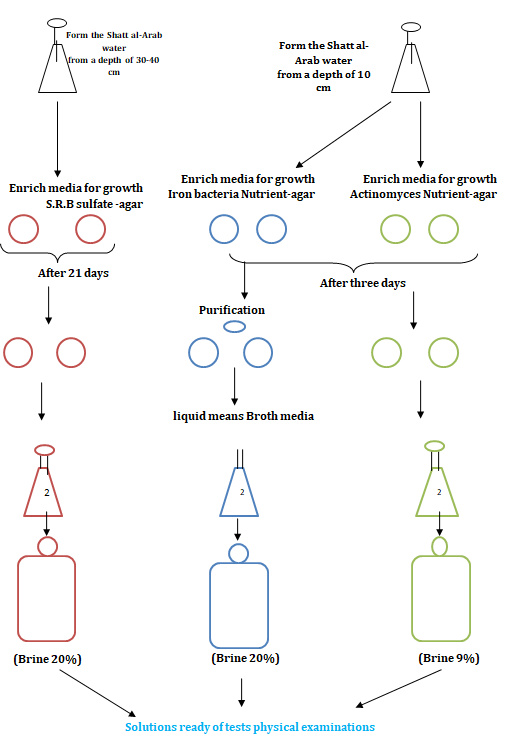
Includes two phases starting side bacteriologist and petro physical tests have completed: The Bacteriological Side A-first stage: It consists of three parts which are setup to isolate the three types of bacteria that were used for this study as shown the scheme.
Part I: aerobic bacteria were isolated from the optional type Actinomyces on Nutrient Agar nutrient medium salts has been added to help isolate these bacteria are K2HPO4 0.1g, NaCl 0.05g FeSo4-7H2O 0.001g through dissolved in a liter of distilled water with the center of Agar Nutrient (12.5 g).
- Water sample was taken at the site of the Shatt al-Arab River Ben Amor to isolate these bacteria.
- This model was planted on the center food prepared above and incubating for a period of three days and temperature of 37 degree Celsius, has been re-planted on the same center-a process called purification (Purification).
- The account number of cells or bacterial colonies for each one (ml) of the form before and after the completion of the experiments.
- Results are included on the agenda in particular.
- The preparation of saline water concentration (9%) to size (10 liters) was Autoclave sterilization device to prevent the growth of bacteria (and keep all the bacteria you want to study their effect).
- The preparation of nutrient medium liquid Nutrient Broth without addition rule of agar (a powder taken from seaweed based media solidify) and then added to the water, sterile saline and inoculated with bacteria Actinomyces with mean food liquid and leave for a day and one laboratory.
- Used for testing injection models of reservoir rocks.
Part II: was to isolate aerobic bacteria (bacteria of iron) of the type Gillonalla Fergenia the center of the diet Nutrient agar adding a salt to help isolate these bacteria are MgSO$_4$-7H$_2$O 0.05 g, K$_2$HPO$_4$ 0.02 g (NH$_4$) 2 SO$_4$ 1g through dissolved in a liter of distilled water with Central Nutrient agar (12.5g). Water sample was taken at the site of the Shatt al-Arab River, Ben Omar, to isolate these bacteria.
- The laying of this model to the above-mentioned center food and incubating for a period of three days and a temperature of 37°C. Has been re-planted on the same center-a process called purification.
- The account number of cells or bacterial colonies for each one (ml) of the form before and after the completion of the experiments.
- Included in the results table special.
- The preparation of saline water concentration (20% size (10 liters) was sterilized Auto clave device to prevent the growth of bacteria (retaining only the bacteria you want to study their effect).
- The food preparation center means Nutrient Broth without adding substance agar.
- Add this to mean food and water, sterile saline inoculated bacteria Gillonalla and left for one day at the laboratory.
- And was used for testing injection models of reservoir rocks.
Part III: The isolation of the anaerobic bacteria of the type SRB on the solid nutrient medium was prepared from the following articles:
Yeast Extract, Ascorbic Acid, MgSO$_4$ 7H$_2$O Fe (SO$_4$) 2 (NH)$2$ 6H$_2$O, K$_2$HPO$_4$ agar through dissolved in a liter of distilled water.
- Water sample was taken at the site of the Shatt al-Arab River, Ben Omar, to isolate these bacteria.
- The laying of this model to the center food prepared above and incubating for a period of three weeks and a temperature of 37°C. Has been re-planted on the same center-a process called purification.
- The account number of cells or bacterial colonies for each one (ml) of the form before and after the completion of the experiments.
- Included in the results table special.
- The preparation of saline water concentration (20%) size (10 liters) was Autoclave sterilization device to prevent bacterial growth (to keep the bacteria you want to study their effect).
- The food preparation center means Sulfate Broth without the addition of agar.
- Added to the water, sterile saline and inoculated with the bacterium SRB center food liquid and leave for a day and one laboratory.
- And was used for testing injection models of reservoir rocks.
Side Petro Physic
- Pulp samples were prepared by shutting down a cylindrical diameter of 3.8 cm and a length of (7 cm) and was then be cleaned by the use of coloring as a solvent to remove the remaining hydrocarbons in the rocks and dried forms a temperature of 70 degrees Celsius for six hours at least.
- Porosity was measured on all models by measuring device porosity Prose meter By using the helium or nitrogen and applied the law in the following measure:
$$\theta = \frac{VP}{VP + VG} \times 100$$
$$\theta = \text{porosity}$$
$$VP = \text{The size of pores}$$
$$VG = \text{Particle size}$$
The measurement of air permeability (Ka) by using the device to measure permeability and by the following equation:
$$Ka = \frac{2000 QP2 L \mu}{(P_1^2 - P_2^2) A}$$
$$Ka = \text{permeability of the Air}$$
$$Q = \text{Flow rate}$$
$$P2 = \text{pressure outside}$$
$$L = \text{length of the form}$$
$$A = \text{Sectional area of the form}$$
$$\mu = \text{The viscosity of air}$$
$$P1 = \text{pressure inside}$$
After that recharge models by saline water (Brine) by 20% and the rate of approach to water. The reservoir. Developed models saturated with salt water inside the container holder rock (core holder) with the plugging and highlights the pressure of the lining ((Sleeve pressure to about psi 1500 in order to avoid the descent of brine aspects of the rock and the pressure (pressure lining) represents the pressure class the reservoir.
Means of Measuring the Permeability of the KL
Permeability was measured by means of models (KL) factional parties saline water through the form located within the holder under the rock and the following equation:
245 $$ \mathrm {K} _ {\mathrm {L}} = \frac {2 4 5 \mu \mathrm {V L}}{\mathrm {A P T}} $$ KL = Permeability measured liquid P = Pressure off V = Displaced volume L = Length of the form A = Sectional area of the form T = Time μ = The viscosity of liquid The injection solution (inoculated with bacteria to be its influence) within the form where is the removal of water from the saline and replaced by this solution fully and measure the permeability of this solution. Repeat the process several times and in different proportions of the types of solutions mentioned above and measuring the permeability at a time to note the difference between these permeability measured and the extent of impairment winning after calculating the flow rate, which may become non-existent due to obstruction of the pores of the rock bacteria then stop the process because impairment was considerable.
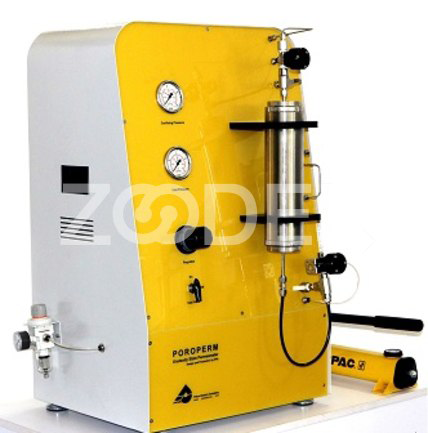
Represents the mechanical work to experience all the stages where the pressure change and change is injected liquid on the rock and is drawing at each stage and all the pressure (Figure 1):
- Accumulator is placed where the added solution of bacteria
- Filter passes a solution of purified of impurities
- Gage for measuring the pressure Inlay
4. Holder to put the rock in which a thick lining 5. Valve to open and close scales 6. Valve to open and close the device 7. Gauge for measuring the volume of water + time 8. Gage for measuring the flow rate 9. Stopwatch Figure 2 represents the action steps bacteriologically.
Findings
It was conducted measuring the permeability of reservoir rocks in this study and drew diagrams of their (1- 14) and included data for each form on the back page was the following conclusion: The Rock (Ru-85-2H) (Figure 3): Relative permeability curve with time to prepare the type of bacteria Actinomycese in model Ru -85 2H. Shows the pumping salt water concentration (9%) with bacteria aerobic kind of Actinomycese is number was by pumping 60x106/ml as in Table 2 showed low permeability and the continued injection of days and the other end of the experiment increase the number of live bacteria 845x106/ml. as in the Table 2. The Rock (Ru-85-5H) (Figure 4): Shows the pumping concentration (9%) salt water with bacteria aerobic kind of optional Actinomyces and numbered by pumping 240x106/ ml as in Table 2 give rise to damaged showed low permeability although large and number of bacteria after the end of the experiment 1710x106/ml. as in Table 2. The Rock (Ru-85-2H) (Ru -85 - 5H) (Figure 5): Shows a comparison between the model rocks (Ru - 85-2H) and (Ru -85 - 5H) by the bacteria Actinomyces, which showed decline in the rocks of medium permeability models in comparison with significantly high permeability rocks. The Rock (Ru-85 (2H)) (Figure 6): Shows the pumping salt water (20%) content the bacterium-air Gallinolla iron bacteria by number by pumping 645x106/ml as in Table 2 showed additional damage to a very large into rock after the end of the experiment 1230x106/ml. as in Table 2. The Rock (Ru-85 (5H) (Figure 7): Shows the pumping salt water (20%) the bacterium-type air Gillonalla and number was by pumping 100x106/ml as in the Table 2 showed additional damage to rock a very large number of living bacteria after the end of the experiment 500x106/ml. as in Table 2. The Rock (Ru-85-2H) (Ru -85 - 5H) (Figure 8): Shows a comparison between decline happening the model rocks (Ru - 85-2H) and (Ru -85 - 5H) by bacteria Gillonalla, which showed additional damage in rocks with high permeability from rocks the medium permeability. The Rock (Ru-85(2H) (Figure 9): Shows the comparison between the impact of bacteria Actinomyces and Gillonalla both from the type of antenna, which showed that the iron bacteria (Gillonalla) more effective than bacteria Actinomyces on rock Ru - 85 (2H). The Rock (Ru-852H) (Figure 10): Shows the pumping salt water concentration of 20% anaerobic bacteria of the type SRB and number was by pumping1200 X106/ml as in the Table 2 showed a decrease for permeability and damaged rock by a large number of bacteria after the end of the experiment 1600 x106/ml as in the Table 2 that was on the rock, Ru-85 2H. The Rock (Ru-85 5H) (Figure 11): Shows the pumping salt water concentration of 20% content anaerobic bacteria of the type of SRB and number was by pumping 1200 X106/ ml as in the Table 2 showed additional damage to decrease rock permeability, reaching number of bacteria 460X106/ml as in the Table 2 after the end of the experiment, which was conducted on the rock, Ru-85 5H The Rock Ru-85 2H, Ru-85 5H (Figure 12): Shows comparison between the rocks Ru-85 2H, Ru-85 5H by SRB and bacteria which showed additional decline in the medium- permeability rocks bigger than the high-permeability rocks. The Rock (Ru-85 2H) (Figure 13): Shows the comparison between the impact of aerobic bacteria of the type of Actinomyces and the effect of anaerobic bacteria of the type of SRB, which shows the difference between the two, which shows that the anaerobic bacteria more effective in causing decline permeability. The Rock (Ru-85 2H) (Figure 14): Demonstrates the advantages of using a chemical matter injection for Microbial Biocide with material (HCl) concentration of 15% on rock Ru-85 2H resulting in killing Actinomyces bacteria, which showed an permeability improvement. The Rock (Ru-85 2H) (Figure 15): Demonstrates the effectiveness of the use of deadly chemical for Microbial (Biocide) with material (HCl) concentration of 15% on the rock (Ru-85 2H) resulting in killing Gillonalla iron bacteria, which showed an improvement permeability. The Rock (Ru-85 5H) (Figure 16): Demonstrates the effectiveness of treatment with chemicals (Biocide) deadly Microbial by material (HCl) concentration of 15% for the rock Ru-85 5H resulting in killing bacteria SRB, which showed permeability improvement.
| NO | Bacteria | Type of bacteria | Type of rock | No. of bacteria prior to injection | No. of bacteria after injection | Treatment by biocide |
|---|---|---|---|---|---|---|
| 1 | Facultative aerobic | Actinomyces | Ru-85(2H) | 60X106(ml) | 845X106(ml) | No |
| Ru-85(5H) | 240X106(ml) | 1710X106(ml) | No | |||
| 2 | Obligate aerobic | Gallinolla | Ru-85(2H) | 645X106(ml) | 1230X106(ml) | 4 |
| Ru-85(5H) | 100X106(ml) | 500X106(ml) | No | |||
| 3 | Obligate Anaerobic | S.R.B | Ru-85(2H) | 1200X106(ml) | 1600X106(ml) | No |
| Ru-85(5H) | 1200X106(ml) | 460X106(ml) | No |
Table 2: Permeability of reservoir rocks.
Discussion
That the impact assessment of the true microbial found in the water injection is considered appropriate and according to the point of view bacterial as one of the scientific facts the task, halophilic bacteria content was 30%, which was twice as much as the reservoirs at lower salinity levels. One way of water injection a halotolerant, bio surfactant-producing bacterium that was initially described as a member of the specie [3], in high salinity reservoirs; the strictly obligate anaerobic and denitrifying bacteria were not the predominant species. The diversity of thermophilic microbial assemblages detected within two neighboring high temperature petroleum formations was shown to closely parallel the different geochemical regimes existing ]15[. High permeability viscous oil reservoirs after long period of water injection resulted in significant increase of microbial diversity by doubling the species and genera number of microorganisms ]16[, which clearly showed the importance of the killing and inhibition of micro-organisms in the water injection and the factors that control the growth and expansion of the (temperature, material, feeding, pressure osmotic and atmospheric pressure) characterize prokaryotic consortia associated with high-temperature, sulfur-rich oil reservoirs in California. Enrichment cultures designed for anaerobic thermophiles, both autotrophic and heterotrophic, were successful at temperatures ranging from 60 to 90 degrees C. [17] Standard Tests conducted on the model of rock reservoir and study the role of bacteria in the cause of damage and reduce the permeability showed the extent of the threat real and substantial and that may be makeup when the failure the chemical processors followed by the accuracy of the biological information complete and their relationship to the results of the wells injection, as established by the study bacteria that have been selectively chosen for this study of the following types: First: Facultative aerobic is (i.e. they tend to grow and reproduce the conditions the presence of oxygen or the lack of it can grow only). Second: Aerobic are (i.e. they tend to grow and reproduce the conditions the presence of oxygen only). Third: Obligate anaerobic (that is, they tend to grow and reproduce without the presence of oxygen).
These species are represent part a simple “for its environment of living numbers and types of many different Therefore, these specific types of results which are important and serious threat they specific bacteria and the impact on the reservoir rocks, adopted in this study as that of the two sample first represent type rocks high permeability the second type represent the rocks the medium permeability, as follows:
- An injection of salt water concentration (9%) containing the bacteria Actinomyces on the model of rock Ru-85 2H high permeability a damaged and low porous and rapidly due to get blockages in the necks of the pores and the stability of large numbers of cells and colonies bacteria are noting an increase and improve the porous when you take a further reading and this was due to metabolic processes (Metabolism) that contribute to the production of CO2 gas, that might be indigenous to the oilfield ecosystem. is a moderately halophilic methanogen which growths optimally at 10% NaCI and tolerates up to 20% NaCI. It grows on trimethylamine and methanol as carbon and energy sources ]7], which in turn contributes to the open corridors of the necks of the pores in the rock, this is one of the positive, can be the basis for the new study to improve production processes biological ways advanced, that upon the arrival of cells or colonies bacteria to the phase (Decline phase), the phase gets the drop of a food item and increase the number of cells and dead colonies, leading to lower permeability and a vulnerability model of the rock as a result of the fact that the cells and dead colonies also have a role to cause damage and lower the permeability as in Figure 3 (Appendix).
- An injection of salt water concentration (9%) containing the bacteria Actinomyces on the model of rock Ru-85 5H medium permeability a large damaged is due to get blockages in the necks of the pores and the stability of large numbers of cells and colonies of bacteria at their which with the observation that the model of rock here permeability medium, which helped to bring about these vulnerabilities great as in the previous sample Ru- 85 2H as a result of metabolic processes production CO2 gas has contributed to obtaining a slight improvement but did not take much, and then return again to the low permeability and access large damage of rock This is due to the accumulation of cells and bacterial colonies in the necks of the pores of the rock the medium permeability, as in Figure 4 (Appendix).
- To study contrast between the models of reservoir rock in the degree of damage and the decline permeability We compared between them and use to the same of the bacterium Actinomyces, which showed that the rock model of permeability medium-Ru-85 5H more affected by the model of rock with high permeability Ru-85 2H as in Figure 5 (Appendix).
- To study the effect of obligate aerobic bacteria type of iron bacteria Gillonulla showed concentration of salt water injection (20%) containing the bacteria on the model of rock Ru-85 2H high permeability on of a damaged low permeability is happening due to that the type of these bacteria have the ability to convert iron compounds soluble compounds iron is dissolved and this lead to a damaged swift as a result of the accumulation of colonies of bacteria with these materials, which are what is known as (Shelled) within the necks of the pores which leads to blockage, as in Figure 6 (Appendix).
- An injection of salt water concentration (20%) contain bacteria Gillonulla on the model of rock Ru-85 5H medium permeability and less than previously for the model of Ru-85 2H is being a damaged and low permeability rock due to that the number of colonies and cells In this experiment was less and this has a role in minimizing of vulnerability, as in Figure 7 (Appendix).
6. To study the differences between models of rock reservoir and the degree of vulnerability we had such a comparison between them is due to the same is the bacterium iron Gillonulla which gave the fact that new models of the rock reservoir high permeability is more affected from the models of rock reservoir permeability medium is attributable to the difference in the number of cells and colonies that have been injected for both models as in Figure 8 (Appendix). 7. The study showed that different types of microorganisms, each having a degree of damage and impact in line with specifications and ability on the suitability of the environment in which they are located as it showed that bacteria of the bacteria iron contribute to the events of damaged and low permeability very large when compared with that caused by other bacteria type of Actinomyces taking regard into the model is one of the Rock and Ru-85 2H as in Figure 9 (Appendix). 8. To study the effect of compulsory anaerobic bacteria were selected bacteria SRB Showed of salt water injection the concentration (20%) containing bacteria SRB, On the model of rock high permeability Ru-85 2H get vulnerable low permeability on model of the rock due to that these bacteria of the type of anaerobic and are capable of growth and reproduction in conditions of without oxygen and under high pressure in the reservoir, microbes require an environment containing some water, a two-phase oil-water system must be established to optimize contact between the microbes and the hydrocarbon, and such an emulsion is not easily created with viscous crude oil [18]. and when increasing numbers of their effectiveness is vital with the environment anaerobic , the process of Metabolism contribute to the production of gas H2S if they were present within the rocks, sulfurous, or with the contents of oil and this is what represents the seriousness of this species to its potential for growth and reproduction in the circumstances the reservoir where the united gas H2S with ion Ferrous Fe + + constituent sulfide ferrous a sediment and the sediment caused damaged in reservoir, as in Figure 10 (Appendix). 9. An injection of saline water concentration (20%) containing the bacteria SRB On the model rock medium permeability Ru-85 5H get low permeability model of the rock due to that anaerobic species can grow and multiply and increase their numbers within the necks of the pores and this leads to additional low permeability as in Figure 11 (Appendix). 10. To study the differences between models of reservoir rocks and their vulnerability to bacteria SRB We conducted the following comparison, which indicated that the models of the reservoir rocks of medium permeability represented by the rock model Ru-85 5H more than affected into rock Ru-85 2H reservoir rocks although has the high permeability as in Figure 12 (Appendix). 11. And to study the contrast between the impact of anaerobic bacteria SRB And aerobic bacteria Actinomyces on rock Ru-85 5H showed that anaerobic bacteria a great deal in bringing about vulnerability but aerobic bacteria impact low the impact on permeability as shown in Figure 13 (Appendix).
In order to reach to address the decline had been tested on models rock reservoir affected was the study treatments chemical to kill and inhibit the growth of bacteria followed by tests Bacteria conjunction with the use method of acidification, concentration (15%) of the acid Hcl using a technique injection dual (Biocide) + acid Hcl showed the effectiveness of the impact of improvement of reservoir rocks permeability through the following:
- Were injected into the core rock (Biocide) acid and Hcl concentration (15%) to form the rock Ru-85 5H and affected by the bacteria Actinomyces, which showed improvement porous significantly with the killing of all cells and colonies of bacteria and this is due to inhibition of the role of bacteria using decline as a result of accumulation in the necks of the permeability and the opening of the corridors is reinforced by the acid and this underlines the importance of using (Biocide) with acidification, as in Figure 14 (Appendix).
- Was injected into core rock (Biocide) acid and HCl concentration (15%) to form the rock Ru-85 2H and affected by the bacteria Gillonulla which showed that increase permeability highly at the end of the injection has been testing about the presence of cells and colonies of living and the result was bacteria without (Nil) underlines the effectiveness of treatment of dual injection as in Figure 15 (Appendix).
- Was injected into core rock (Biocide) acid and Hcl concentration (15%) to the rock Ru-85 5H showed affected without any bacteria SRB, which showed that for high permeability and improve the flow relative was testing bacteria about the presence of cells and colonies of living and the result was without bacteria (Nil) as in Figure 16 (Appendix).
Recommendations
- It was reached technology double injection (Biocide) and acid concentration of Hcl (15%) to improve the productivity of rock reservoir affected by microorganisms.
- It was found that microorganisms can be used as an effective means to improve the efficiency of productive wells to the higher levels of technology, our insistence on high by injecting a certain type of microorganisms have efficient and effective interaction within the rock reservoir to change this specification to the specification petro physic good and improve the quality of oils is done to keep the survival of these bacteria when the phase of growth (Log phase) In this phase, the effectiveness is bacterial at the top of its capabilities and continue to maintain this effectiveness that is improving the productivity of oil wells to be developed as a modern method of extraction subsidized in order to draw the largest possible oil reservoir The ways in which well- known thermal methods and the use of chemicals and the use of solvents so we recommend that this study in the future because of its many benefits and privileges.
- We recommend that the attention and intensive care for the use of chemical treatment of water injection and the appropriate emphasis and never neglecting him. Because Selected oil components are hydrolyzed to methane and CO2 by consortia of hydrocarbon-degrading syntrophic bacteria (syntrophs) and methanogens. The syntrophs convert oil components to either acetate or H2 and CO2, which is thermodynamically uphill unless methanogens are present [19].
- The study proved that the neglect of water treatment chemical injection lead to a damage-producing wells, leading to significant economic losses [20, 21, 22, 23].
References
-
Demirbas A, Alsulami HE, Hassanein WS (2015) Utilization of surfactant flooding processes for enhanced oil recovery (EOR). Pet Sci Technol 33(12): 1331-1339.
-
Magot M, Ollivier B, Patel BK (2000) Microbiology of petroleum reservoirs. Antoine van Leeuwenhoek 77(2): 103-116.
-
Afrapoli MS, Alipour S, Torsaeter O (2011) Fundamental study of pore scale mechanisms in microbial improved oil recovery processes. Transp Porous Media 90: 949- 964.
-
Chandankere R, Yao J, Cai M, Masakorala K, Jain AK, et al. (2014) Properties and characterization of bio surfactant in crude oil biodegradation by bacterium Bacillus methylotrophicus USTBa. Fuel 122: 140-148.
-
Zhang F, She YH, Chai LJ, Banat IM, Zhang XT, et al. (2012) Microbial diversity in long-term water-flooded oil reservoirs with different in situ temperatures in China. Sci Rep 2: 760.
-
Jones DM, Head IM, Gray ND, Adams JJ, Rowan AK, et al. (2008) Crude-oil biodegradation via methanogenesis in subsurface petroleum reservoirs. Nature 451: 176-180.
-
Gao CH, Zekri A (2011) Applications of microbial- enhanced oil recovery technology in the past decade. Energy Sources Part A Recovery Util Environ Eff 33(10): 972-989.
-
Head IM, Jones DM, Larter SR (2003) Biological activity in the deep subsurface and the origin of heavy oil. Nature 426: 344-352.
-
Dahle H, Garshol F, Madsen M, Birkeland NK (2008) Microbial community structure analysis of produced water from a high-temperature North Sea oil- field. Antonie Van Leeuwenhoek 93: 37-49.
-
Daryasafar A, Jamialahmadi M, Moghaddam MB, Moslemi B (2016) Using biosurfactant producing bacteria isolated from an Iranian oil field for application in microbial enhanced oil recovery. Pet Sci Technol 34: 739-746.
-
Ollivier B, Fardeau ML, Cayol JL, Magot M, Patel BKC, et al. (1998) Methanocalculus halotolerans gen. nov., sp. nov., isolated from an oil- producing well. Int J Syst Bacteriol 48: 821-828.
-
Folmsbee M, Duncan K, Han SO, Nagle D, Jennings E, et al. (2006) Re-identification of the halotolerant, biosurfactant-producing Bacillus licheniformis strain JF-2 as Bacillus mojavensis strain JF-2. Syst Appl Microbiol 29(8): 645-649.
-
Gieg LM, Jack TR, Foght JM (2011) Biological souring and mitigation in oil reservoirs. Appl Microbiol Biotechnol 92: 263-282.
-
Bødtker G, Lysnes K, Torsvik T, Bjørnestad E, Sunde E (2009) Microbial analysis of backflowed injection water from a nitrate-treated North Sea oil reservoir. J Ind Microbiol Biotechnol 36(3): 439-450.
-
Orphan VJ, Goffredi SK, Delong EF, Boles JR (2003) Geochemical influence on diversity and microbial processes in high temperature oil reservoirs. Geomicrobiol J 20: 295-311.
-
Lin J, Hao B, Cao G, Wang J, Feng Y, et al. (2014) A study on the microbial community structure in oil reservoirs developed by water flooding. J Pet Sci Eng 122: 354-359.
-
Orphan VJ, Taylor LT, Hafenbradl D, Delong EF (2000) Culture-dependent and culture-independent characterization of microbial assemblages associated with high-temperature petroleum reservoirs. Appl Environ Microbiol 66: 700-711.
-
Van Hamme JD, Singh A, Ward OP (2003) Recent advances in petroleum microbiology. Microbiol Mol Biol Rev 67: 503-549.
-
Voordouw G (2011) Production-related petroleum microbiology: progress and prospects. Curr Opin Biotechnol 22(3): 401-405.
-
Heider J, Spormann AM, Beller HR, Widdel F (1999) Anaerobic bacterial metabolism of hydrocarbons. FEMS Microbiol Rev 22(5): 459-473.
-
Barton LL, Fauque GD (2009) biochemistry, physiology and biotechnology of sulfate-reducing bacteria. Adv Appl Microbial 68: 41-98.
-
Davis JB, Updegraff DM (1957) Microbiology in the petroleum industry. Bacterial Rev 18: 215-238.
-
Lazar I, Petrisor IG, Yen TF (2007) Microbial enhanced oil recovery (MEOR). Pet Sci Technol 25(11): 1353-1366.
- Nigeria’s Vulnerability in the Face of Global Energy Policy
- A Simulation Study of Investigation of Optimum Oil Production Performance by Applying Various Gas Injection Methods in Oil Reservoir
- Characterization of Permo-Triassic Reservoirs through Thermal Maturity Assessment of Westphalian Source Rocks in the Cheshire Basin
- Influence of Microwax on the Rheological and Thermal Behaviour of a Wax Crude Oil
- Real-Time Monitoring and Performance Optimization of Steam Injection in Heavy Oil Reservoirs Using Fiber Optic Sensing and Integrated Predictive Simulation Models
- Rapid On-Site Determination of the Total Petroleum Hydrocarbon Content of Soils by Handheld Fourier Transform Near-Infrared Spectroscopy: Development of a Global, Site- and Scanner- Independent Calibration Model