
A New Approach for Enhancing Oil and Gas Recovery of the Hydrocarbon Fields with Low Permeability Reservoirs
A universal and multifunctional method for developing problematic oil and gas fields with low-permeability reservoirs is presented in this paper. The method is based on maintaining reservoir pressure and identifying the hydrogen formation mechanism. According to the analysis of previous laboratory experiments, the article summarizes the results of a computer simulation of a method for developing oil and gas fields with low permeable reservoirs using the commercial software product tNavigator from Rock Flow Dynamics. The proposed method results in multiple times more oil production per each studied well than its production using the depletion mode. Using CO2 in this manner results in additional, useful utilization, and laboratory experiments have indicated that saturated, unsaturated, and aromatic hydrogen are produced as by-products of CO2 injection. Moreover, the proposed method offers similar technological and technical solutions as those that have long been used in the oil and gas industry.
Introduction
Globally, hard-to-recover oil reserves keep increasing every year, while the active part of light oil reserves is growing rapidly [1, 2]. At the same time, the reserves of, for example, high-viscosity oils are an order of magnitude larger than conventional ones. Due to the growth in the share of hard- to-recover reserves, it becomes necessary to increase the efficiency of their extraction, and improve the technologies for their extraction. Moreover, the oil recovery factor (RF) by traditional methods in fields with hard-to-recover reserves rarely exceeds 30%, and in fields with high-viscosity oil, it is even lower [3, 4].
For oil and gas fields with low-permeability reservoirs, the most realistic way to develop them is through reservoir energy depletion. However, it is known that the depletion regime is usually characterized by the minimum values of oil, gas, and condensate recovery factors. Often, additional production is facilitated by the implementation of multi- stage hydraulic fracturing with various modifications in production wells [5, 6].
It is known that the most significant property of productive formations is the permeability coefficient. Namely, well flow rates for oil, gas, condensate, and other development indicators depend on the values of the formation permeability coefficient.
Until recently, reservoirs with a permeability of 1 millidarcy (md) or more were not considered to be profitable development targets. Today, however, the situation has changed. In the United States, oil and gas fields with low- permeability shale formations have begun to be successfully developed. In such formations, the permeability is about or well below 1 md. The production of shale oil and shale gas is also beginning to be developed in other regions [7, 8, 9].
The concept of “fields with low-permeability reservoirs” is very vague. Typically, a field consists of all its deposits or layers. From this perspective, it is better to talk about layers or deposits with low-permeability reservoirs. Since apparently there are no fields in which all the layers are represented by low-permeability reservoirs, except in cases where the field is represented by a single deposit.
The concept of low-permeability reservoirs is also vague. Until recently, deposits or formations with low-permeability reservoirs were considered unprofitable and their reserves were not evaluated, thus not being put on the balance sheet [10, 11].
In order to determine the unprofitability of reservoir development, the following factors were taken into account. Firstly, according to the collected data from sampling and research conducted on exploratory wells. The criterion for the unprofitability of reserves around a certain exploratory well was considered if its maximum flow rate did not exceed 1–5 tons per day [12, 13]. Similar data for other exploratory wells made it possible to classify reserves for deposits as a whole as unprofitable (off-balance). Secondly, low- permeability formations with off-balance reserves were established according to well-logging data. Accordingly, the permeability of the studied reservoir, as well as the lack of or low oil inflow from the reservoir during the productivity interval testing of the section, became important factors.
This approach to assessing the significance of formations and deposits with low-permeability reservoirs was incorrect for the following reasons:
- Such formations and deposits were not subsequently subjected to any additional studies;
- As a result, there were practically no studies aimed at creating and substantiating technological solutions to extract off-balance oil reserves.
The new era of 3D computer modelling has necessitated a shift in attitude towards low-permeability formations, which was the result of the justification, for example, of the concept of effective pore space, described in several articles [14, 15].
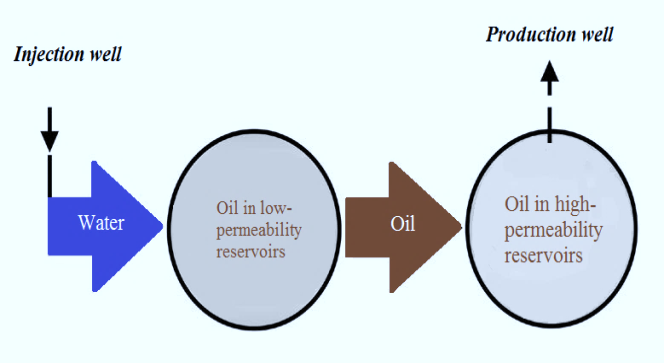
Therefore, it was justified to include low-permeability formations with their own porosity and permeability values in 3D geological and 3D hydrodynamic models of the deposit or field as a whole, rather than resetting their porosity and permeability values. Moreover, such an attitude towards low-permeability reservoirs began to stimulate research on the extraction of off-balance oil reserves. This led to the following fundamental axiom [16, 17]. The highest recovery factor, the least negative consequences of flooding will occur if oil from low-permeability reservoirs is displaced by a working agent into high-permeability reservoirs, and oil from high-permeability reservoirs is displaced to production wells by oil that has flowed from low-permeability reservoirs (Figure 1).
This principle has found its application, in particular, in substantiating the technology for developing oil deposits with lenticular reservoirs [18, 19]. In this context, lenticular reservoirs can be envisioned as a type of sandy lens surrounded by low-permeability sandstones. The balance sheet shows only oil reserves within the lens.
AL-Obaidi, et al. works [20, 21] show that the development of lenticular reservoirs in the mode of reservoir energy depletion or based on its waterflooding will be characterized by traditional, not very large values of recovery factor, with a significant water cut of the produced product. However, if several horizontal injection wells are drilled behind the lens contour in low-permeability reservoirs, and water is injected into them, then a 100% oil recovery factor can be achieved. This is possible provided that the cumulative oil production is divided only by the approved oil reserves in the lens.
With the introduction of oil deposits with ultra-low permeability values into development in the USA and other countries over the past decade, the situation with low- permeability reservoirs has changed drastically [22, 23]. It is well known that this achievement was credited to the drilling of horizontal wells and the use of multi-stage, reusable hydraulic fracturing in them (MRHF). This technology is widely used in the development of both conventional and unconventional fields.
As an example, Figure 2 shows the layout of planned wells in the largest shale oil field in the United States, Barnett
Shale Play.
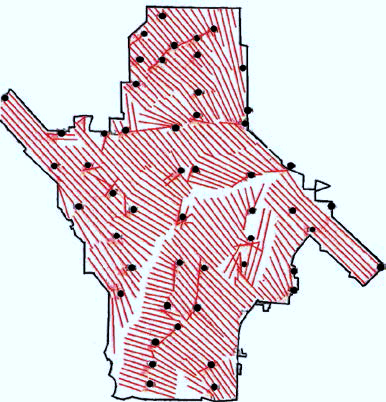
The peculiarity of the development of this and other similar oil fields is as follows: most of them are developed in the mode of reservoir energy depletion. It is known that in such cases, well flow rates decrease rather quickly with time. Therefore, in order to maintain a constant level of production at the field, more and more wells are drilled when multi- stage hydraulic fracturing with various modifications is implemented in production wells. Based on the publications, this development technology is cost-effective [24, 25].
Hydraulic fracturing may need to be repeated many times in some wells in order to maintain a steady flow rate. Even though horizontal drilling and hydraulic fracturing are being used, the productivity of operating wells is declining much faster than in traditional oil fields. So, if the average “lifetime” of gas wells in traditional US fields is 30–40 years, then about 15% of shale wells drilled in 2003 completely exhausted their resources after 5 years [26, 27, 28].
It should be noted that at present, some experts agree that oil and gas production based on hydraulic fracturing technology can be combined in the very near future with another technology that is gaining popularity – the geological storage of carbon dioxide [29]. Therefore, in addition to serving as a new hydrocarbon source, shale rocks can also be used as underground carbon dioxide storage traps in the framework of international projects. The main goal and task of such projects for the geological storage of CO2 are to reduce its concentration and stabilize its content in the atmosphere as part of the fight against global climate warming on the planet, as well as environmental pollution [30, 31].
Such projects can supply each other with missing data and bring mutual benefits. Promising geological storage projects for CO2 and traditional fracturing-based development can combine both the appropriate choice of the location of the relevant receptors and joint efforts to solve many common problems (groundwater pollution risks, water resource management, seismic risks, public approval or rejection) [32, 33, 34].
Researchers have shown that organic, shale-rich core samples are suitable for storing carbon dioxide in an experimental study Kang, et al. [35, 36, 37]. According to the authors of the study, despite the wide prominence of low- permeability sedimentary rocks with low porosity, organic shale has the ability to retain a significant amount of gas for a long time due to the ability to capture the gas in an adsorbed state through finely dispersed organic matter (i.e. kerogen). Thus, the suitability of shale for CO2 storage is also attractive because the spatial and thermodynamic effects are similar to those of coals, which are considered in coal bed methane extraction operations.
So far, there are no proven technologies to develop such deposits in Russian fields. At the moment, thermo-gas- chemical development technology, which is in pilot testing, is considered the most promising [38, 39, 40].
We refer to low-permeability fields as those where oil reserves are recognized as unprofitable based on the boundary values of porosity, permeability, and oil saturation. In shale oil fields, reservoir permeability is much lower than the traditional boundary value of permeability of 1 md.
Nevertheless, such fields are being developed in the mode of reservoir energy depletion, which predetermines low values of the expected recovery factor. Consequently, maintaining reservoir pressure would be possible if oil continued to flow to production wells.
To maintain reservoir pressure, many oil fields are developed by injecting water into the reservoir [41, 42, 43, 44]. Gases are less commonly injected into reservoirs, mainly simultaneously with water [45, 46, 47, 48]. High viscous oils can be extracted from reservoirs using different thermal methods. However, these methods are not relevant to the type of deposits under consideration. This is due to the presence of clay inclusions in such formations, which can swell upon contact with injected water.
It is currently beyond doubt that various technologies used in the development of traditional oil fields, based on the injection of carbon dioxide, are feasible and effective. Moreover, carbon dioxide is emitted into the atmosphere by many anthropogenic sources. Therefore, injecting carbon dioxide into oil reservoirs in various states and forms (for example, in the form of carbonized water) seemed reasonable, logical, and at the same time requiring specific laboratory studies and mathematical models.
Due to the low permeability of reservoirs, gaseous agents should be primarily considered as working agents. Our research focuses on the experience of the hydraulic fracturing method using carbon dioxide, among the world practice of different methods for producing gas and oil from unconventional reservoirs. This method is performed by forming a CO2 fracturing fluid and injecting supercritical CO2 to treat the formation through the wellbore at a pressure above the fracturing pressure [49, 50]. The formation being treated may have a permeability of less than 1 md. By injecting CO2 fluid into the formation at a pressure in excess of the formation’s fracture pressure, the integrity of the formation can be effectively compromised, which stimulates the influx of methane and other hydrocarbon gases into the well. Hydraulic fracturing (HF) relieves stress in the rock mass, releases gases from the dense matrix, and creates fractures and channels for gas flow from the formation to the wellbore. In addition, due to the predominant activity of the processes of methane displacement by carbon dioxide, the technology of such developed hydraulic fracturing becomes preferable compared to other methods of reservoir stimulation or using other gases. Thus, using CO2 in hydraulic fracturing is promising for increasing total gas production due to its ability to displace methane.
As part of the search for an effective displacement agent, a series of specialized laboratory experiments were conducted, revealing previously unknown physicochemical mechanisms associated with the generation of hydrogen, methane, and their homologs [51, 52, 53]. The results obtained from laboratory experiments formed the basis for the proposed development method in this work and were the basis for several patents.
It is important to note that the idea of injecting CO2 into oil-saturated reservoirs depends on the permeability coefficient boundary values. Therefore, it is no coincidence that the majority of shale deposits are developed in the mode of reservoir energy depletion. Unfortunately, the recovery factor in such cases usually does not exceed 10%. Therefore, a computer simulation was performed for an oil-bearing formation with a boundary value of effective permeability of 1 md.
Methodology
It should be noted that the idea of CO2 injection into oil-saturated reservoirs rests on the boundary values of the permeability coefficients. Therefore, it is no coincidence that most shale fields are developed in reservoir energy depletion. Unfortunately, the recovery factor in such cases usually does not exceed ten percent. Therefore, a computer simulation was performed for an oil-bearing formation with a boundary value of effective permeability of 1 md.
When setting the task, a multidimensional multiphase flow model was used, and tNavigator from Rock Flow Dynamics was used as a commercial software product [54, 55]. This simulator implements an extended non-volatile oil model, and the calculation results themselves are as close as possible to the results of the industry standard multiphase flow simulation - the Eclipse simulator from Schlumberger.
In this model, the reservoir is low-permeable (1 md), unprofitable, and refers to “non-reservoir” (substandard reservoir). Other initial data are as follows: initial reservoir pressure - 23.3 MPa, saturation pressure - 0.5 MPa, oil viscosity - 1 mPa s, volume formation factor - 1.6 , reservoir thickness - 20 m. With a decrease in bottom-hole pressure in production wells to 3 MPa, it is then left unchanged. The bottom-hole pressure in the injection well is constant and equal to 30.3 MPa. Oil production wells are stopped when their production rate drops to 1 m3/day (for the whole well). Relative phase permeabilities are taken as diagonal due to the high solubility of carbon dioxide in oil. The model of non- volatile oil (black oil) was taken as the calculation model. Accordingly, the following alternative calculations-scenarios were performed using such initial data.
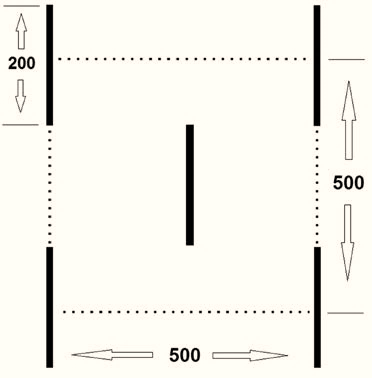
The five-spot development element has dimensions of 500 × 500 m. It is drilled with horizontal wells with a wellbore length of 200 m. During multistage hydraulic fracturing, the mesh around the horizontal wells is refined into one layer, and this layer has permeability ten times greater than the permeability of the formation itself. The scheme of calculation elements is shown in (Figure 3).
Neither the effect of the interfacial exchange of CO2 with dissolution in formation water and oil nor the change in volumetric properties of phases according to the amount of dissolved CO2 was accounted for. The miscibility of CO2 dissolved in water with oil was approximately taken into account due to the diagonal relative phase permeabilities in the oil–water system.
The computational grid had a dimension of 43×43×10 elementary grid cells. The grid is uneven in the horizontal plane, with fineness up to 1 m × 1 m in the area of each well. Then the size of the grid cells increased exponentially while maintaining the specified total distance between the wells. The grid is vertically uniform.
Results and Discussions
In the study, simulations are conducted under a variety of conditions. In option I, all wells in the development element are producing, i.e., the development is implemented using reservoir energy depletion, with the wells operating at 3 MPa bottom-hole pressure. In option II, one of the wells (the central one in the development element) becomes an injection well. This well is used to inject carbonated water with a viscosity of 1 mPa s at a bottom-hole pressure of 30.3 MPa. The results of calculations for the options under consideration are shown in graphical form in (Figures 4 & 5).
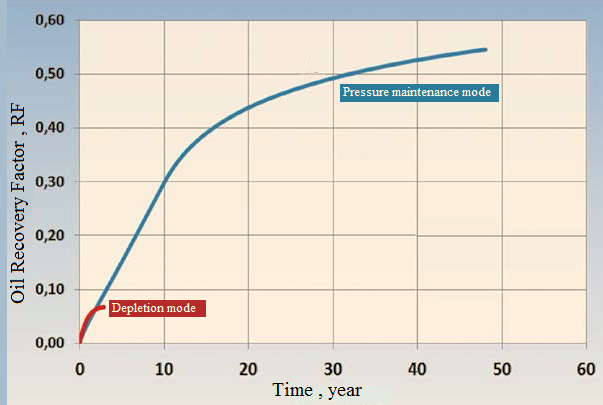
Figure 4 shows a comparison of the dependences of oil recovery factor on time in the options with depletion mode and reservoir pressure maintenance. This implies the idea of expediency in maintaining reservoir pressure in the considered low-permeability reservoir. True, here the dependence of the oil recovery factor on time in the option of maintaining pressure is overestimated since in the calculations a model of a reservoir homogeneous in permeability was adopted, and some other assumptions were also made. However, several technological methods can be used to take into account the layered heterogeneity of the reservoir and reduce its negativity. It is possible to uncover additional reserves, for example, if horizontal wells are drilled for 1000 or 2000 meters, etc. The reserves also increase when taking into account the results of the described laboratory studies.
In Figure 5, oil production rates are compared for various modes within the same development element, revealing a clearer picture of the results in Figure 4. One fact worth noting is that in the depletion mode, the recovery of oil from the development element initially turns out to be somewhat greater than in the case of maintaining reservoir pressure due to a larger number of production wells involved in the depletion mode. The pressure maintenance mode, however, enables each well to produce multiple times more oil.
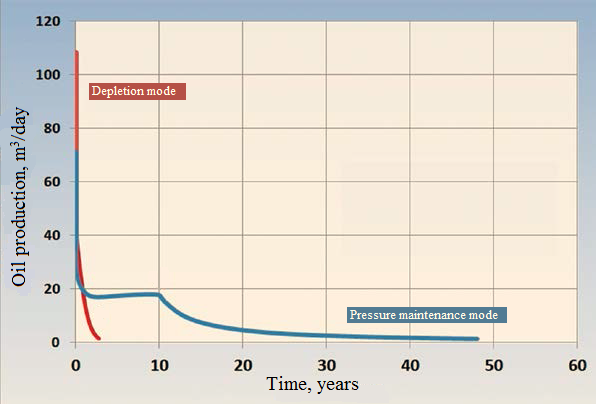
It is important to note that the calculation results given are based on a particular example and are not absolute. It is obvious that here it is possible to study a large number of variants, but this was not included in the goals of this work. Moreover, it is obvious that unpredictable effects will occur since reservoir heterogeneity often negatively impacts oil fields’ performance in real conditions. However, the results of the modelling at a qualitative level show that the proposed approach to the development of oil fields with low- permeability reservoirs can lead to increased oil recovery.
Not only is the proposed development approach realistic for oil deposits, but it may also be appropriate for gas condensate deposits, and in some cases, for gas deposits with low-permeability reservoirs.
Conclusions
In the study, the performed Laboratory studies and numerical experiments on the proposed model confirm the high efficiency of maintaining reservoir pressure by carbon dioxide injection in various modifications in low- permeability reservoirs. The described development method and technological solutions have a number of important features and additional positive factors. To begin with, pressure maintenance enables each well to produce multiple times more oil. Further, the injection of CO2 in this manner increases the usefulness of CO2, and laboratory experiments have shown that saturated, unsaturated, and aromatic hydrogen are produced as by-products. Lastly, the proposed method offers similar technical and technological solutions to those that have long been implemented in the oil and gas industry. In addition, global experience in the application of carbon dioxide in the development of oil fields confirms the multi-functionality, versatility, and prevalence of its use.
References
-
McGlade CE (2012) A review of the uncertainties in estimates of global oil resources. Energy 47(1): 262-270.
-
Al-Obaidi S, Hofmann M (2012) Prediction of Current Production Rates, Cumulative Production and Recoverable Reserves of Hydrocarbon Fields. OSF Preprints.
-
Yanjun Z, Yan L, Hongkui G, Liu S, Zhou D, et al. (2022) Experimental Study on Connection Characteristics of Rough Fractures Induced by Multi-Stage Hydraulic Fracturing in Tight Reservoirs. Energies 15(7): 2377.
-
Al-Obaidi SH (2022) Investigation of rheological properties of heavy oil deposits. In: Helder IC, et al. (Eds.), Advances in Geophysics, Tectonics and Petroleum Geosciences. Advances in Science, Technology & Innovation, Springer, Cham, Switzerland.
-
Li J, Liu Y, Huang C (2018) Multi-stage fracturing horizontal well interference test model and its application. Lithol Reserv 30(6): 138-144.
-
Al-Obaidi S, Smirnov VI, Khalaf F (2020) New technologies to improve the performance of high water cut wells equipped with ESP. Technium 3(1): 104-113.
-
Alvarado V, Manrique E (2010) Enhanced Oil Recovery: Field Planning and Development Strategies. Gulf Professional Publishing, Boston, USA.
-
Smirnov V, Al-Obaidi S (2008) Innovative methods of enhanced oil recovery. Oil Gas Res 1: e10.
-
Chang WJ, Al-Obaidi SH, Patkin AA (2021) The use of oil-soluble polymers to enhance oil recovery in hard to recover hydrocarbons reserves. International Research Journal of Modernization in Engineering Technology and Science 3(1): 982-987.
-
Al-Obaidi SH, Khalaf FH (2018) The Effects Of Hydro Confining Pressure on the Flow Properties of Sandstone and Carbonate Rocks. International journal of scientific & technology research 7(2): 283-286.
-
Al-Obaidi SH (2015) The Use of Polymeric Reactants for EOR and Waterproofing. Journal of Petroleum Engineering and Emerging Technology 1(1): 1-6.
-
Yanjun Z, Yan L, Hongkui G, Liu S, Zhou D (2022) Experimental Study on Connection Characteristics of Rough Fractures Induced by Multi-Stage Hydraulic Fracturing in Tight Reservoirs. Energies 15(7): 2377.
-
Al-Obaidi S (2007) Analysis of hydrodynamic methods for enhancing oil recovery. Journal of Petroleum Engineering and Technology 6(3): 20-26.
-
Keller LM (2021) 3D pore microstructures and computer simulation: Effective permeabilities and capillary pressure during drainage in Opalinus Clay. Oil & Gas Science and Technology-Rev IFP Energies nouvelles 76: 1-11.
-
Hofmann M, AL-Obaidi SH, Chang WJ (2023) Evaluation Of Quantitative Criteria For Triassic Reservoirs In The South Mangyshlak Basin. Natural Sciences and Advanced Technology Education 32(1): 7-24.
-
AL-Obaidi SH, Hofmann M, Smirnov VI, Khalaf FH, Alwan HH, et al. (2021) A Study of Compositions Relevant to Selective Water Isolation in Gas Wells. J Geol Geophys 10(7): 1000.
-
Santos JE, Chang B, Gigliotti A, Yin Y, Song W, et al. (2022) A Dataset of 3D Structural and Simulated Transport Properties of Complex Porous Media. Sci Data 9: 579.
-
Al-Obaidi SH, Kamensky IP (2022) Express study of rheological properties and group composition of oil and condensate using nuclear magnetic resonance- relaxometry. J Oil Gas n Coal Tech 4(1): 102.
-
Zakirov SN, Kontarev AA (2007) Oil recovery from lenticular reservoirs. Dokl Earth Sc 413: 180-182.
-
AL-Obaidi SH, Chang WJ, Khalaf FH (2021) Determination of the Upper Limit Up To Which the Linear Flow Law (Darcy’s Law) Can Be Applied. Journal of Xidian University 15(6): 277-286.
-
AL-Obaidi SH (2020) A way to increase the efficiency of water isolating works using water repellent. International Research Journal of Modernization in Engineering Technology and Science 2(10): 393-399.
-
Khan R, Al-Nakhli AR (2012) An Overview of Emerging Technologies and Innovations for Tight Gas Reservoir Development. SPE International Production and Operations Conference and Exibition. Doha, Qatar.
-
Al-Obaidi SH, Guliaeva N (2002) Determination of flow and volumetric properties of core samples using laboratory NMR relaxometry. JoPET 1(2): 20-23.
-
Leontiev D, Shamsutdinov N, Vaganov Y, Shalyapina A, Shalyapin D, et al. (2022) Multi-stage hydraulic fracturing technology in a well with horizontal working face. Boletín de Ciencias de la Tierra 52: 9-17.
-
Al-Obaidi SH, Galkin AP, Patkin AA (2006) Prospects of High Viscosity Oil Flow Rate in Horizontal Wells. JoPET 5(4): 56-62.
-
Vengosh A, Warner N, Jackson R, Darrah T (2013) The Effects of Shale Gas Exploration and Hydraulic Fracturing on the Quality of Water Resources in the United States. Procedia Earth and Planetary Science 7: 863-866.
-
Hofmann M, Al-Obaidi SH, Hussein KF (2022) Modeling and monitoring the development of an oil field under conditions of mass hydraulic fracturing. Trends in Sciences 19(8): 3436.
-
Al-Obaidi SH, Hofmann M, Khalaf F, Alwan HH (2021) The efficiency of gas injection into low-permeability multilayer hydrocarbon reservoirs. Technium: Romanian Journal of Applied Sciences and Technology 3(10): 100- 108.
-
Price PN, Oldenburg CM (2009) The consequences of failure should be considered in siting geologic carbon sequestration projects. International Journal of Greenhouse Gas Control 3(5): 658-663.
-
Patkin A, Al-Obaidi SH (2001) Influence of Temperature and Pressure of Incoming Oil- Containing Liquid from Field Wells on the Gas Separation Process. Journal of Petroleum Engineering and Emerging Technology 3(4): 20-24.
-
Al-Obaidi SH, Chang WJ, Hofmann M (2022) Modelling the Development of Oil Rim Using Water and Gas Injection. Natural Sciences and Advanced Technology Education 31(3).
-
Nicot JP, Duncan IJ (2012) Common attributes of hydraulically fractured oil and gas production and CO2 geological sequestration. Greenhouse Gases Science and Technology 2(5): 352-368.
-
Al-Obaidi SH, Kamensky IP, Hofmann M, Khalaf FH (2022) An Evaluation Of Water And Gas Injections With Hydraulic Fracturing And Horizontal Wells In Oil-Saturated Shale Formations. Natural Sciences and Advanced Technology Education 31(4).
-
Al-Obaidi SH (1998) Areas of Effective Application of Submersible Centrifugal Pump Installations with and Without a Gas Separator. EngrXiv 3.
-
Kang SM, Fathi E, Ambrose RJ, Akkutlu IY, Sigal RF (2011) Carbon Dioxide Storage Capacity of Organic-Rich Shales. SPE Journal 16(4): 842-855.
-
Al-Obaidi SH (1996) Development of a methodology and technology for processing logging and core data to determine the estimated parameters of oil and gas fields in Iraq. Russian State Library, 145.
-
Al-Obaidi SH (1996) Determination of the Shay Consistency of Productive Formations of Oil and Gas Fields in East Baghdad. OSF Preprints.
-
Xue L, Liu P, Zhang Y (2022) Development and Research Status of Heavy Oil Enhanced Oil Recovery. Geofluids 5015045.
-
Al-Obaidi SH, Kamensky P, Smirnov V (2020) Investigation of Thermal Properties of Reservoir Rocks at Different Saturation. International Research Journal of Modernization in Engineering Technology and Science 2(1): 12-16.
-
AL-Obaidi SH, Hofmann M, Smirnova V (2022) Improvement Of Oil Recovery In Hydrocarbon Fields By Developing Polymeric Gel-Forming Composition. Natural Sciences and Advanced Technology Education 3: 425-434.
-
Warner HR (2015) The Reservoir Engineering Aspects of Waterflooding 2nd (Edn.), Richardson, Society of Petroleum Engineers, Texas, USA, pp: 562.
-
Al-Obaidi SH, Khalaf F (2019) Development of traditional water flooding to increase oil recovery. International Journal of Scientific & Technology Research 8(1): 177- 181.
-
Al-Obaidi SH (2016) High oil recovery using traditional water-flooding under compliance of the planned development mode. Journal of Petroleum Engineering & Technology 6(2): 48-53.
-
Al-Obaidi SH, Kamensky IP, Hofmann M (2010) Changes in the physical properties of hydrocarbon reservoir as a result of an increase in the effective pressure during the development of the field. EngrXiv.
-
Alagorni H (2020) Effect of water alternating gas (WAG-N2) after water or gas flooding on crude oil recovery in sandstone reservoirs. IOP Conf Ser Mater Sci Eng 736: 022015.
-
Al-Obaidi SH (2020) Comparison of different logging techniques for porosity determination to evaluate water saturation. EngrXiv.
-
Lake L (1989) Enhanced oil recovery. Englewood Cliffs, Prentice Hall, USA, pp: 550.
-
Al-Obaidi SH (1996) Modification of Archie Equation for Determining Water Saturation of East Baghdad Oil Field. OSF Preprints.
-
Khan R, Al-Nakhli AR (2012) An Overview of Emerging Technologies and Innovations for Tight Gas Reservoir Development. SPE International Production and Operations Conference and Exibition, Doha, Qatar.
-
Al-Obaidi SH, Khalaf FH (2017) Acoustic logging methods in fractured and porous formations. J Geol Geophys 6: 293.
-
Barenbaum AA, Zakirov SN, Zakirov ES, Klimov DS, Serebryakov VA, et al. (2015) Physical and Chemical Processes During the Carbonated Water Flooding in the Oilfields. SPE Russian Petroleum Technology Conference.
-
Al-Obaidi SH (2016) Improve the efficiency of the study of complex reservoirs and hydrocarbon deposits – East Baghdad field. International journal of scientific & technology research 5(8): 129-131.
-
AL-Obaidi SH (2004) Modified use of microbial technology as an effective enhanced oil recovery. Journal of Petroleum Engineering and Emerging Technology 4(2): 41-44.
-
Harrison S (2015) tNavigator – breaking reservoir simulation speed limits in Europe. The First SPE Norway Magazine 5: 22-27.
-
Al-Obaidi SH, Patkin AA, Guliaeva NI (2003) Advance use for the NMR relaxometry to investigate reservoir rocks. JoPET 2(3): 45-48.
- Nigeria’s Vulnerability in the Face of Global Energy Policy
- A Simulation Study of Investigation of Optimum Oil Production Performance by Applying Various Gas Injection Methods in Oil Reservoir
- Characterization of Permo-Triassic Reservoirs through Thermal Maturity Assessment of Westphalian Source Rocks in the Cheshire Basin
- Influence of Microwax on the Rheological and Thermal Behaviour of a Wax Crude Oil
- Real-Time Monitoring and Performance Optimization of Steam Injection in Heavy Oil Reservoirs Using Fiber Optic Sensing and Integrated Predictive Simulation Models
- Rapid On-Site Determination of the Total Petroleum Hydrocarbon Content of Soils by Handheld Fourier Transform Near-Infrared Spectroscopy: Development of a Global, Site- and Scanner- Independent Calibration Model