
Investigating the Performance of Co [AM-AMPS-MALEIC-AAC]/PEI-MBA Nanocomposite Hydrogel in Sand Control from Oil Reservoirs
Sand production is one of the major challenges in oil and gas production from sandstone reservoirs. Production losses, formation damage, corrosion, and equipment failure are all consequences of sand production. Various mechanical and chemical methods are used to control sand production. One of the most efficient chemical methods is the injection of hydrogels, but its application has been constrained by the hydrogels' weak stability in the harsh conditions of the reservoir. A Co [AMAMPS- MALEIC-AAC]/PEI-MBA nanocomposite hydrogel with superior viscoelastic properties and double crosslinking was developed and synthesized to overcome these restrictions. Swelling, rheology, and morphology tests were utilized to predict the produced nanocomposite's effectiveness and performance in the harsh Iranian reservoirs. According to the obtained results, at ambient temperature (25°C, during injection) and reservoir temperature (90°C, placed in a porous medium), in distilled water, the maximum swelling ratio was 8.5 and 94, and in formation water, the maximum swelling ratio was 5.4 and 10.8, respectively. The X-ray diffraction test findings show that the nanoparticles are uniformly distributed throughout the structure. Also, according to the results of the thermal strength test, the sample’s thermal stability up to 90°C was confirmed with less than 0.6 wt% degradation. The results of the strain sweep, frequency sweep and stress-strain tests demonstrate the existence of a robust, three-dimensional, and viscoelastic structure up to a strain of 100% and a frequency of 100 Hz. In the strain sweep test with a constant frequency of 1 Hz, the maximum storage modulus was reported as 27,000 Pa, and in the frequency sweep test with a constant strain of 1%, 18,000 Pascals were reported. The stress-strain test revealed that the ultimate tensile strength of the synthesized material was 4630 pascals. These characteristics make the aforementioned nanocomposite hydrogel ideal for usage in porous media.
Introduction
The majority of hydrocarbon resources are found in sandstone reservoirs, which are fragile due to geological factors. In other words, it could be estimated that more than two-thirds of hydrocarbon resources are found in low- strength reservoirs [1, 2]. These reservoirs’ exploration, drilling, production, and exploitation lead to sand production [3]. Numerous problems are brought on by sand production, including severe erosion and corrosion on subsurface and surface equipment, the well choke phenomenon, various safety issues like loss of well control and fire, the accumulation of sand in separation equipment, and a resulting reduction in their capacity, and an increase in operating and maintenance costs [4, 5, 6]. Most notably, the migration and production of sand cause a significant pressure drop around the production well, leading to a sharp decline in oil production. Oil companies invest a lot of money in developing sand control technologies because of the aforementioned issues and other detrimental consequences that sand production and migration have on the exploitation, production, and separation of oil [7].
Any procedures, techniques, and equipment utilized in reservoirs with sand production or sand production potential with the intention of enhancing productivity, lowering reservoir disintegration, and minimizing sand production and movement within the reservoir are referred to as “sand control.” Sand control methods are divided into two general categories, active and passive [8]. Active methods are mostly mechanical techniques that collect the produced sand [9, 10]. As a result, the formation is still being destroyed while the produced sand is merely controlled by these methods [11]. Passive methods are more recent techniques that stop the production and movement of sand by injecting chemicals, altering the characteristics of the sand, and enhancing the mechanical properties of the formation [12, 13].
The most frequent and conventional methods of sand control are mechanical methods. The major drawbacks of mechanical methods include the clogging and closure of screen and liner pores, which results in a significant drop in pressure along the screen and subsequently reduce production [14]. Other problems with mechanical methods include challenges with material exploitation and selection, various difficulties with installation, particularly in wells with small diameters, corrosion of screens and liners brought on by the acidizing process, severe abrasion corrosion in gas reservoirs, and the extremely high cost [15]. Because of the aforementioned problems and limitations as well as the continued destruction of the formation, it is not practical to use mechanical methods of sand management and control in many wells; instead, chemical techniques must be used to stabilize and control sand in these wells. The employment of chemical methods improves sand control operations’ effectiveness, lowers operating expenses, and maintains well production [8]. In chemical approaches, a chemical material is injected into the formation; this chemical interacts with the formation and the sand particles inside it to strengthen the formation and stop sand production [16, 17]. Therefore, identifying the most suitable chemical to inject into the formation offers greater potential than other sand control strategies.
In the last decade, the performance of nanomaterials in controlling sand production has been evaluated positively [18]. Nanomaterials prevent sand production by the mechanisms of reducing zeta potential [19], altering the interaction between surfaces [20], and changing the surface characteristics of sand particles [21]. By altering the zeta potential, the attraction forces between particles increase, which prevents sand production. For this purpose, the sand particles are surrounded by nanoparticles, and with the change of electrostatic forces on their surfaces, the potential difference between the particles and the fluid also changes. As a result, the sand particles adhere to one another, which reduces sand production [22]. Injection of various nanoparticles such as Al2O3, MgO, SiO2, ZnO, etc. causes the sand particles to stick to each other, and the production and migration of sand particles decrease in the formation [23, 24]. Each of the nanoparticles has unique characteristics that can be useful in the sand control process. For example, aluminum oxide (Al2O3) has advantageous physical characteristics, including strong mechanical strength, abrasion resistance, corrosion resistance, thermal stability, and electrical insulation [25, 26]. Despite the advantages of using nanoparticles, it should be mentioned that the use of nanomaterials for sand control has some drawbacks. The most important challenge of using nanoparticles is their efficiency in reservoirs with different pHs and in the presence of ions, because charged ions can have a negative effect on the performance of nanomaterials. On the other hand, although nanoparticles raise the formation’s strength without diminishing permeability, the strength increase brought on by these materials is very tiny; therefore, nanoparticles cannot prevent heavy sand production. Finally, it may be said that nanoparticles are efficient for formations with little sand generation and low permeability [27].
Another group of materials that are widely used in the field of chemical sand control methods are polymer materials [28]. Resins were the first group of polymer materials that were used to strengthen the formation since 1940 [29]. Resins are soft to hard organic substances that are utilized to bind sand particles together or produce a protective layer in the formation. The two types of resins are thermosetting and thermoplastic resins. Phenol, furan, amino, epoxy, etc. are examples of thermosetting resins [30]. Thermosetting resin when placed in the reservoir’s temperature range, become hardened by forming cross-linking connections and stop the production of sand by adhering sand particles to one another [31, 32]. Despite the widespread use of resins for sand control, their efficiency has always faced serious problems. Numerous injection issues, like multi-stage injection and the need for specialized pumps because of high viscosity, a severe reduction in reservoir permeability, and formation damage, difficulties with accurately positioning the resin in the formation prior to hardening, as well as its high cost and toxicity, can be mentioned as crucial limitations of resin employment [33, 34]. Due to the restrictions mentioned for resins, the focus was on the utilization of hydrogels.
Hydrogels are smart polymeric materials with a three-dimensional structure that can hold water in their structure and have a dual function against water and oil [35]. Hydrogels are divided into two categories: in situ [34] and preformed [36]. Salehi, et al. [37] successfully used in situ hydrogels to control sand production. But even so, because the polymerization process and the development of the three-dimensional structure in this method occur within the formation environment, the in situ gel’s production is strongly influenced by the formation’s temperature, pressure, salinity, pH, and tensions [38]. As a result, the gelation time, placement, and creation of a three-dimensional structure are all subject to high uncertainty. So the success of the procedures using in situ gelation confronts significant obstacles [39]. The use of preformed particle gels is the suggested remedy for these difficulties. These materials are completely developed gels that are powdered, mixed with water, and then injected into the formation [40]. The simplicity of injection, controllable placement, and independence of gel formation from reservoir conditions are the three main benefits of employing these materials. As a result, preformed particle gels are better candidates for injection into the oil reservoir than in-situ gels [38]. However, the application of these materials has been constrained by their poor structural strength and low thermal stability. Considering the capability of nanoparticles in increasing the strength of the formation and, on the other hand, the performance of hydrogel in increasing the adhesion between particles due to its structural nature, it is expected that the design and manufacture of preformed polymer nanocomposite is a suitable alternative or a suitable solution to control sand production. Furthermore, preformed hydrogels’ structural strength and thermal stability are significantly improved by the incorporation of nanoparticles, making them appropriate for application in harsh reservoir conditions. In other words, problems with hydrogel instability in harsh conditions, such as high temperature and salinity, are alleviated by the incorporation of nanoparticles into the hydrogel’s structure [2].
In this paper, preformed hydrogel nanocomposite particles of Co[AM-AMPS-MALEIC-AAC]/PEI-MBA with Al nanoparticles were designed and tested. In the designed hydrogel nanocomposite, acrylamide is used as the base monomer. 2-acrylamido-2-methylpropanesulfonic acid monomers were used as a factor that increased resistance to high salinity, and acetic acid was used in the composition of the nanocomposite to increase the amount of swelling and Maleic acid to control the swelling rate. Polyethylenimine and N,N’-Methylenebisacrylamide crosslinkers were used in order to increase the structural strength against the stresses applied to the nanocomposite during injection and placement in the formation. Aluminum oxide nanoparticles were added to the system to increase thermal stability, enhance the mechanical properties, and take advantage of the synergistic effect of the presence of nanoparticles and hydrogel.
Materials and Devices
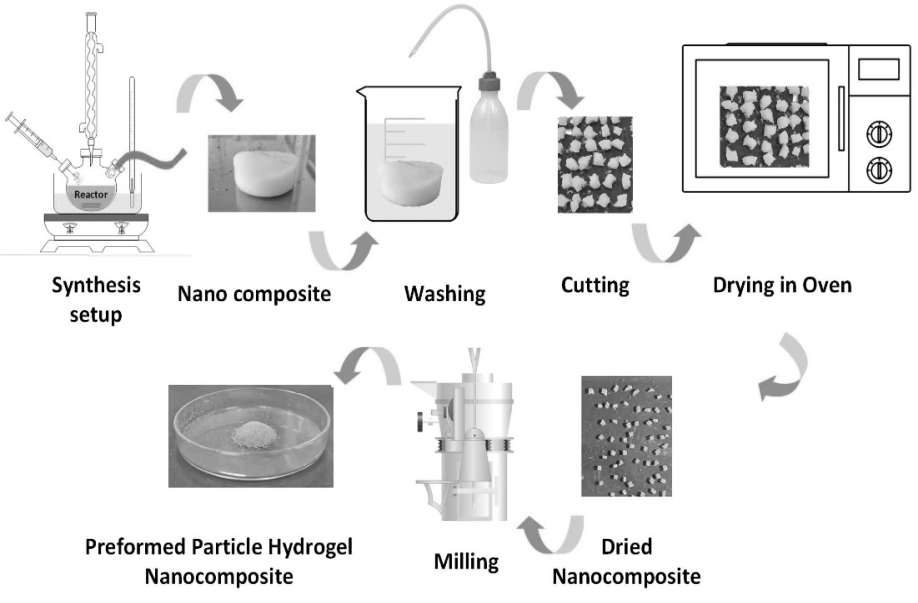
The following monomers were used to make hydrogel nanocomposites: acrylamide (AM), 2-acrylamide-2- methylpropane sulfonic acid (AMPS), maleic acid (MA), and acrylic acid (AAC). Cross-linkers of polyethyleneimine (PEI) and N, N′-methylene bisacrylamide (MBA) and a reaction initiator of ammonium persulfate (APS) were also used. The AM, MA, and MBA used in this research were obtained as solid powders and the AAC as a colorless liquid from Merck Company, Germany. The second cross-linker, linear PEI, was bought as a 50% by weight aqueous solution from Sigma-Aldrich, Germany, while AMPS with a purity of 97% was purchased from Fisher Scientific, Germany. APS was purchased from the Iranian company Exir Chemical. The samples were prepared using formation water with a salinity of 200,000 ppm and distilled water (resistivity, 18.25 M cm). Al2O3 nanoparticles from Iran’s Neutrino Company, with a particle size of 10–20 nm, were used in the nanocomposite structure. To synthesize the nanocomposite, the AM, AMPS, MA, and AAC were dissolved in distilled water at room temperature with weight ratios of 1, 0.5, 0.25, and 0.25, respectively. Following that, they were gradually fed to the reaction reactor in a water bath at a temperature of 46 °C with a time interval of 5 minutes. The amount of 1 wt% of monomers, Al2O3 nanoparticles, was placed in 4 cc of distilled water for 45 minutes in an ultrasonic bath (Elma ultrasonic bath p300H) to obtain a completely homogeneous and dispersed solution of nanofluid. Dispersed nanofluid suspension at 56 °C was gradually added to the reaction container with a micropipette (FOUR E’S SCIENTIFIC) at a rate of 1 cc/min. At this stage, the reaction temperature was gradually increased to 66 °C, and then the solution of crosslinkers in the amount of 10 wt% of the monomers used was gradually added to the main solution. A 5 wt% weight of the used monomers from the solution of the APS initiator was added to the main solution, and the temperature was raised to 76°C to initiate the free radical polymerization process. The entire process was carried out under a constant flow of nitrogen to prevent the presence of oxygen during polymerization. To make sure there were no unreacted monomers in the hydrogel nanocomposite structure, the produced sample was washed several times with water after the polymerization process and relaxation period. The produced nanocomposite was subsequently heated to 65 degrees Celsius for 24 hours in a vacuum oven (Memmert). The dried hydrogel nanocomposite parts were ground into powder particles with a diameter of 150 μm using a Fritsch pellet mill. Figure 1 shows the preparation steps of preformed particle hydrogel nanocomposite [41].
To study swelling ability and investigate the effects of temperature and salinity on the efficiency of the sample, a quantity of dry gel is weighed and poured into a tea bag with a mesh size of 100 micrometers. Then tea bags containing dry polymer gel are submerged in brine and distilled water while being weighed at predetermined intervals. It is important to note that, in contrast to an aqueous environment, hydrogels do not swell in an oil environment, and this property causes disproportionate permeability reduction characteristics at hydrogel flooding [42]. Equation 1 was applied to determine the swelling ratio, where W0 represents the weight of the dry polymeric gel prior to swelling and Ws represents the weight of the polymeric hydrogel after swelling [43].
s W W ESR W − = (1)
0
0 X-ray diffraction (XRD) was employed with a device (Bruker AXS-D8 Advance Diffractometer) to determine the hydrogel nanocomposite structure’s crystalline or amorphous nature and to assess the dispersion of nanoparticles inside the structure [44, 45]. The TGA (Netzsch- TGA 209 F1 device) was used to measure the thermal stability of the sample [44, 46]. An Austrian-made rheometer (Anton Paar Co. MCR301) with a 50 mm-diameter plate was used for this investigation. In this context, the complex modulus (G*) was used as a representation of resistance to external stress. Equation 2, where G’ is the storage modulus and G” is the viscous modulus, is used to compute the complex modulus [37, 47].
* 2 2 ' " G G G = + (2)
In order to study the viscoelastic behavior of the sample, the gamma tangent was used according to equation 3.
( ) G tan G γ = ′′ ′ (3)
The morphology of the samples and the presence of porous structure were investigated using SEM and EDS tests (Tescan- VEGA equipment, Czech Republic) [48, 49].
Results and Discussion
Equilibrium Swelling
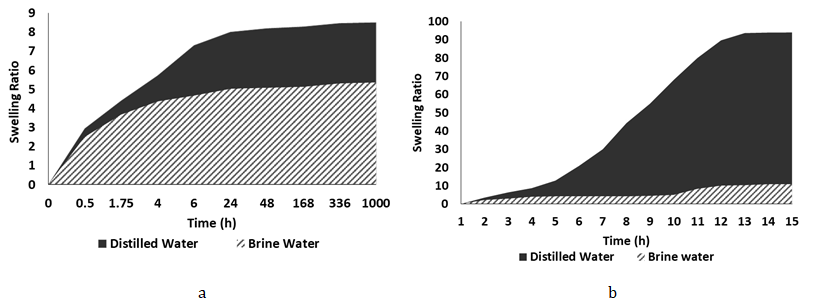
The hydrogel nanocomposites synthesized in this research have the ability to retain solvent in their structure due to their three-dimensional structure. The hydrogel’s swelling ability is affected by a variety of elements. The Flory’s network theory is used to compute the hydrogel swelling ratio. According to this theory, the osmotic pressure difference between the gel network and the external electrolyte solution is used to estimate the swelling ratio. By increasing the concentration of salt in the solvent, the amount of ions in the solution increases, and subsequently, with the decrease in osmotic pressure, the rate of swelling and equilibrium swelling ratio of the hydrogel nanocomposite decrease. If there are more polyvalent ions in the added salt, they will replace more monovalent ions, causing the osmotic pressure to drop even further. In the current investigation, the equilibrium swelling ratio of hydrogel nanocomposites in distilled water and salt water was investigated at ambient temperature (25°C) and reservoir temperature (90°C). For this purpose, the equilibrium swelling test was performed up until the equilibrium time (45 days). According to Figure 2, increasing the temperature of the distilled water environment and formation water from the ambient temperature (25°C) to the reservoir temperature (90°C) has caused an increase in the swelling rate from 8.5 to 94 and from 5.4 to 10.8, respectively. It is also evident that rising temperatures have sped up absorption rates in addition to raising equilibrium swelling ratios.
X-Ray Diffraction (XRD)
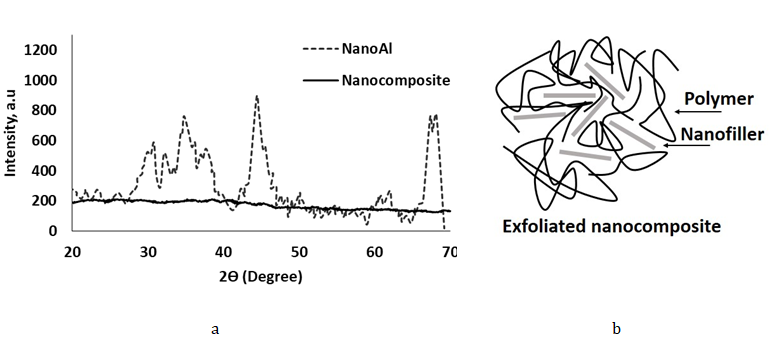
The research’s objective is to synthesize a nanocomposite that can be injected into oil reserves; therefore, it’s critical that the material be able to withstand high temperatures and stress. When nanoparticles are distributed uniformly and maximally throughout the hydrogel’s three-dimensional network, they can have the most impact on the structure of the hydrogel and result in the maximum improvement in structural strength and thermal stability. This nanoparticle distribution in the hydrogel is known as the exfoliated state. Figure 3 indicates that there is no overlap between the X-ray diffraction spectra of nanocomposite and nanoparticle. As a result, phase separation was not performed, and the nanoparticles were positioned between the polymer chain layers. So, the synthesis of the hydrogel nanocomposite and the presence of nanoparticles in the structure were both verified.
Thermal Strength Study
Owing to Iran’s oil reservoirs’ high temperature, it is crucial to assess the synthesized nanocomposite’s thermal strength. The results of the TGA test are shown in Figure 4. According to the results, weight loss occurs in three stages as the temperature increases. According to the results, the amount of weight loss is less than 0.5% up to a temperature of 80°C, less than 1.6% up to 120°C, and less than 6.3% of the weight is lost up to 200°C. The findings show that adding nanoparticles to the hydrogel, strengthens its thermal stability and improves its performance in harsh reservoir conditions. This case indicates the high ability of synthesized nanocomposite materials to be used in oil reservoirs with high temperatures.
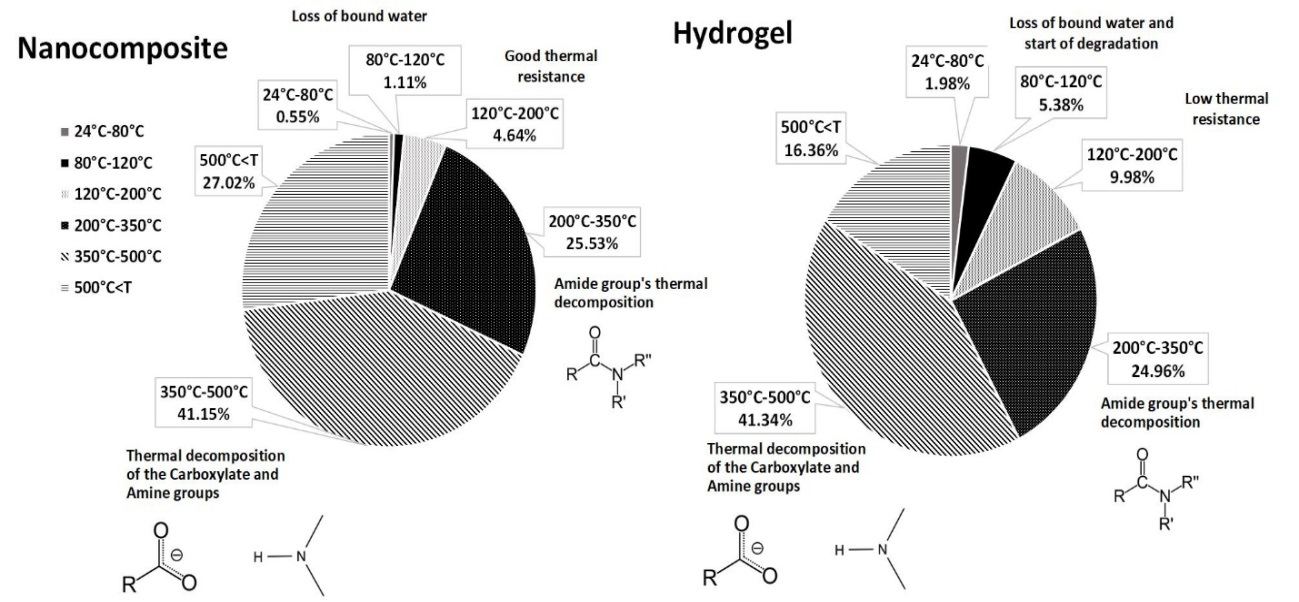
The weight loss between 80 and 120 °C is caused by the loss of bound water, or water that has been adsorbed on the surface of the particles. Up to 200 degrees Celsius, the nanocomposite maintains its stability, but the weight of the nanocomposite significantly drops between 200 and 350 °C as a result of the amide group’s thermal decomposition. The weight abruptly decreases after 350 °C as a result of the thermal decomposition of the carboxylate and amine groups. As shown in Figure 4, by adding nanoparticles to the hydrogel, the decomposition temperature increased; therefore, the thermal stability of the nanocomposite increased with the presence of nanomaterials.
Rheological Properties
Considering the operating environment of the nanocomposite hydrogel and the stresses applied to them during injection and passing through the porous media in the formation, these materials must maintain high structural strength and elastic properties under the high temperature and pressure of the operating environment. For this purpose, strain sweep, frequency sweep and stress-strain tests were used to examine the behavior of hydrogel nanocomposites under variations of strain and frequency. According to the results shown in Figure 5, at strains between 0.1% and 100% and frequencies between 1 and 100 Hz, the samples show linear viscoelastic behavior. But at strains higher than 100% and frequencies higher than 100 Hz, the nanocomposite structure begins to lose its viscoelastic nature, its degradation begins, and the sample turns from a semi-solid state to a liquid state. As shown in Figure 5c, the ultimate tensile stress, which is defined as the highest stress a material can withstand before fracturing, was reported as 4630 pascals for the synthesized sample. So the manufactured sample has a strength of up to a complex modulus of 12 kPa against the applied stresses and an ultimate tensile stress of 4.6 kPa; therefore, in comparison with traditional hydrogels, it has a very acceptable structural strength, which ensures that the Co [AM-AMPS-MALEIC-AAC]/PEI-MBA nanocomposite is strong enough to preserve its structural integrity inside the reservoir while operating under reservoir temperature and injection stresses. According to Figure 5, the elastic modulus is superior to the viscous modulus at frequencies between 1 and 100 Hz, and throughout this range, tan (ẟ) has values below 2, which denotes the viscoelastic structure.
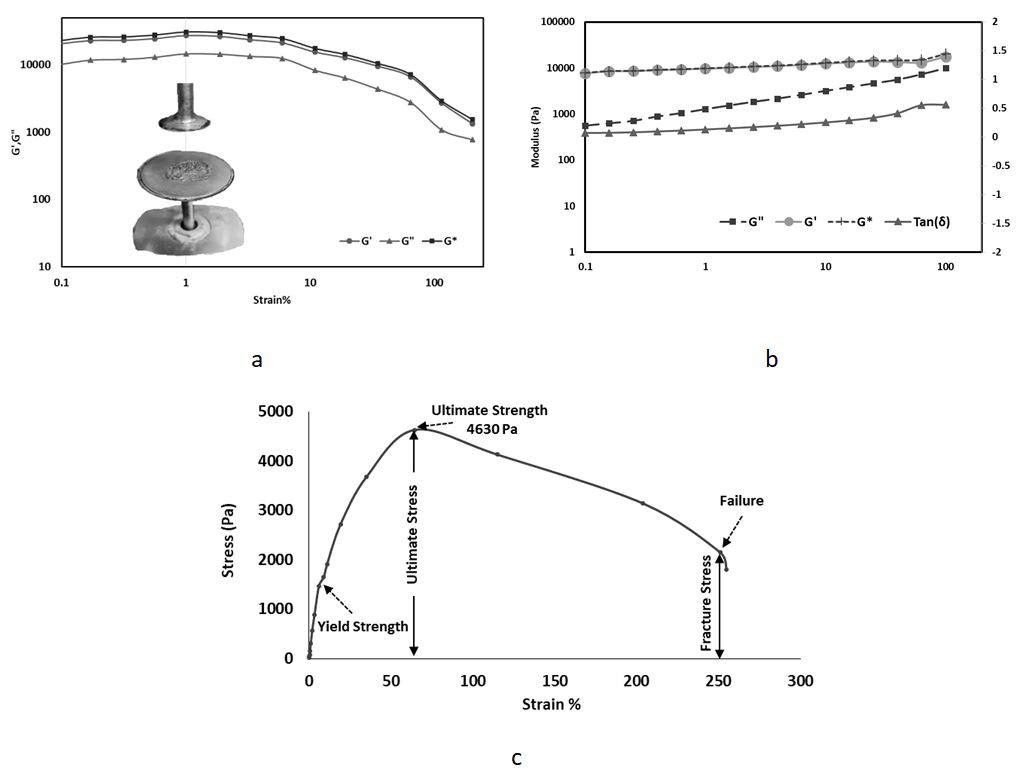
In Table 1, which compares the rheology of the nanocomposite with other common hydrogels, it can be seen that the designed and produced nanocomposite has a higher strength than other common hydrogels.
| Structure | Temperature (°C) | G’ | Ref | ||
|---|---|---|---|---|---|
| Poly(AM-co-AA)/TEMED/CMC | 25 | 1200 | [50] | ||
| Poly(Acrylamide-co-Acrylic Acid)/Xanthan Gum (XG) | 25 | 1000 | [51] | ||
| Poly(AM-co-AMPS)/PEI | 90 | 8000 | [38] | ||
| Co[AM-AMPS-MALEIC-AAC]/PEI-MBA | 90 | 18000 | |||
| Table 1: Rheological characteristics of conventional hydrogels and synthetic nanocomposite at frequency sweep tests. Morphological Properties hydrogel structure. Also, the presence and distribution of aluminum oxide nanoparticles in the structure of the sample In order to study the microscopic structure of the were confirmed. In addition, according to the results of the nanocomposite hydrogel, SEM and EDS tests were used. As SEM test, the manufactured sample has a dense and leaf-like illustrated in Figure 6, EDS results indicate the presence of structure, which creates a strong structure and increases the carbon, oxygen, and nitrogen, which can be justified by the ability of controlled swelling. |
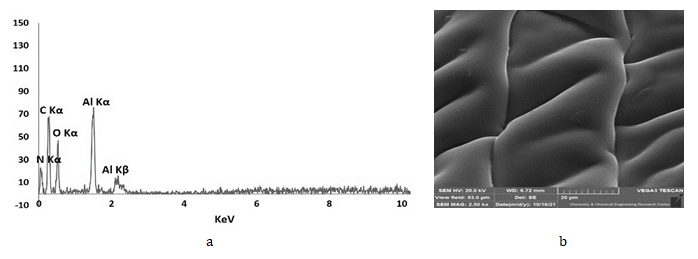
Based on the results, it can be concluded that the produced sample has the qualities required to be injected into the formation for the purpose of sand control. These qualities include structural strength, thermal stability, high viscoelasticity, and the maintenance of swelling in distilled water and formation water.
Conclusion
In this research, a Co [AM-AMPS-MALEIC-AAC]/PEI- MBA nanocomposite hydrogel with double crosslinking and aluminum oxide nanoparticles was designed and manufactured to control sand production and migration in oil reservoirs. The swelling behavior is one of the most important factors for ensuring the performance of nanocomposite hydrogel in harsh reservoir conditions. Due to the swelling value of 10.8 in the temperature and salinity of the reservoir (90°C, 200000 ppm), the synthesized material performed satisfactorily. According to the results of morphological tests like SEM and EDS, the produced sample had a porous, three-dimensional, homogeneous, and dense structure. The sample’s thermal stability was examined up to a temperature of 500°C, and considering the 0.6% weight loss of the sample up to 90°C, it is practicable to employ the sample in the temperature conditions of oil reservoirs. At frequencies between 0.1 and 200 Hz and 1% strain, the tan (ẟ) exhibits a gentle slope (less than 2), which indicates the formation of a three-dimensional structure in the nanocomposite. The superiority of the storage modulus compared to the loss modulus at strains between 0.1% and 200% in the strain sweep test indicates the maintenance of viscoelastic properties under various strains. Additionally, the maximum storage modulus of 27,000 Pa confirms the creation of a strong structure in the nanocomposite. The
results of the frequency sweep and strain sweep tests reveal the formation of a three-dimensional and strong structure in the sample, which causes no change in nanocomposite shape in the injection process into the porous medium and prevents the production of sand. Considering what the stress-strain test revealed, the produced nanocomposite has a maximum stress of 4630 pascals, so it was confirmed that the produced material has good resistance and efficiency under high- stress conditions. According to the outcomes of various experiments, the designed and synthesized nanocomposite has the requisite potential to control sand in Iranian reservoirs. Further studies are recommended to evaluate the effect of different nanomaterials in the further enhancement of thermal and structural strength; furthermore, in order to evaluate performance and ensure the conservation of the elasticity properties in the reservoir’s harsh conditions inside the porous media, core-flooding experiments and micromodels were also recommended.
References
-
Maduabuchi OF, Appah D, Okoro ES (2017) Relative study of internal gravel packing and chemical sand consolidation: sand control techniques of Niger Delta wells. Am J Eng Res 6(5): 261-268.
-
Saghandali F, Salehi MB, Hosseinzadehsemnani R, Moghanloo RG, Taghikhani V, et al. (2022) A Review on Chemical Sand Production Control Techniques in Oil Reservoirs. Energy & Fuels 36(10): 5185-5208.
-
Cartagena-Pérez DF, Alzate-Espinosa GA, Arbelaez- Londoño A (2022) Conceptual evolution and practice of sand management. Journal of Petroleum Science and Engineering November 210: 110022.
-
Miri R, Haftani M, Nouri A (2021) A review of fines migration around Steam Assisted Gravity Drainage wellbores. Journal of Petroleum Science and Engineering 205: 108868.
-
Mishra S, Ojha K (2015) Chemical Sand Consolidation: An Overview. Journal of Petroleum Engineering & Technology 5(2): 21-34.
-
Kurawle IB, Mahalle NA, Kaul M, Nair AV, Kulkarni NJ, et al. (2009) Silanol Resin consolidation system for deepwater completions and production optimisation. 8th European Formation Damage Conference, Society of Petroleum Engineers, Netherlands.
-
Yan M, Deng J, Yu B, Li M, Zhang B, et al. (2020) Comparative study on sanding characteristics between weakly consolidated sandstones and unconsolidated sandstones. Journal of Natural Gas Science and Engineering January 76: 103183.
-
Oyeneyin B (2015) Integrated Sand Management for Effective Hydrocarbon Flow Assurance 1st (Edn.), Elsevier, Amsterdam, Netherlands, pp: 278.
-
Dong C, Gao K, Dong S, Shang X, Wu Y, et al. (2017) A new integrated method for comprehensive performance of mechanical sand control screens testing and evaluation. Journal of Petroleum Science and Engineering 158: 775- 783.
-
Zhang R, Wang J, Liu S, Zhang Z, Ma L, et al. (2021) Modeling and Durability Behavior of Erosion-Corrosion of Sand Control Screens in Deepwater Gas Wells. ACS Omega 37(6): 23943-23951.
-
Yuan B, Moghanloo RG (2018) Nanofluid pre-treatment, an effective strategy to improve the performance of low- salinity waterflooding. Journal of Petroleum Science and Engineering 165: 978-991.
-
Ma C, Deng J, Dong X, Sun D, Feng Z, et al. (2020) A new laboratory protocol to study the plugging and sand control performance of sand control screens. Journal of Petroleum Science and Engineering 184: 106548.
-
Wang C, Pallares MJD, Haftani M, Nouri A (2020) Developing a methodology to characterize formation damage (pore plugging) due to fines migration in sand control tests. Journal of Petroleum Science and Engineering 186: 106793.
-
Aytkhozhina D, Mason D, Marulanda R, Orekha B, Villesca J, et al. (2015) Chemical sand consolidation - Developing a strategic capability across a wide portfolio. SPE/IADC Drilling Conference, Proceedings Exhibition, London, UK.
-
Daramola B, Alinnor CM (2021) Lessons Learned from Optimising Sand Control and Management Strategies in a Low Permeability Sandstone Oil Field. Offshore Technology Conference, Texas, USA.
-
Sun L, Li D, Pu W, Li L, Bai B, et al. (2020) Combining preformed particle gel and curable resin-coated particles to control water production from high-temperature and high-salinity fractured producers. SPE Journal 25(2): 938-950.
-
Wick W, Taneja S, Gupta I, Sondergeld CH, Rai CS, et al. (2020) Chemically Induced Formation Damage in Shale. Petrophysics 61(2): 239-249.
-
Zhao X, Qiu Z, Gao J, Ren X, Li J, et al. (2021) Mechanism and Effect of Nanoparticles on Controlling Fines Migration in Unconsolidated Sandstone Formations. SPE Journal 26(6): 3819-3831.
-
Hasannejad R, Pourafshary P, Vatani A, Sameni A (2017) Application of silica nanofluid to control initiation of fines migration. Petroleum Exploration and Development 44(5): 850-859.
-
Qiao C, Han J, Huang TT (2016) Compositional modeling of nanoparticle-reduced-fine-migration. Journal of Natural Gas Science and Engineering 35: 1-10.
-
Muneer R, Hashmet MR, Pourafshary P (2020) Fine Migration Control in Sandstones: Surface Force Analysis and Application of DLVO Theory. ACS omega 49(5): 31624-31639.
-
Ogolo NA (2013) The trapping capacity of nanofluids on migrating fines in sand. SPE Annual Technical Conference and Exhibition, Louisiana, USA.
-
Madadizadeh A, Sadeghein A, Riahi S (2022) A Comparison of Different Nanoparticles’ Effect on Fine Migration by Low Salinity Water Injection for Oil Recovery: Introducing an Optimum Condition. Journal of Energy Resources Technology 144(1): 013005.
-
Giraldo LJ, Diez R, Acevedo S, Cortés FB, Franco CA, et al. (2021) The effects of chemical composition of fines and nanoparticles on inhibition of formation damage caused by fines migration: Insights through a simplex-centroid mixture design of experiments. Journal of Petroleum Science and Engineering 203: 108494.
-
Schulte A, Alhusaini QFM, Schönherr H (2020) Anodic aluminum oxide nanopore template-assisted fabrication of nanostructured poly (vinyl alcohol) hydrogels for cell studies. ACS Applied Bio Materials 4(3): 2419-2427.
-
Chen CH, Jian JY, Yen FS (2009) Preparation and characterization of epoxy/γ-aluminum oxide nanocomposites. Composites Part A: Applied Science and Manufacturing 40(4): 463-468.
-
Mansouri M, Nakhaee A, Pourafshary P (2019) Effect of SiO2 nanoparticles on fines stabilization during low salinity water flooding in sandstones. Journal of Petroleum Science and Engineering 174: 637-648.
-
Lahalih SM, Ghloum EF (2010) Polymer compositions for sand consolidation in oil wells. SPE Annual Technical Conference and Exhibition, Tunisia.
-
Zhang F, Ouyang J, Ma X, Feng X (2013) A new phenolic resin for sand control in wells. Chemistry and Technology of Fuels and Oils 5: 425-429.
-
Yrausquin PE, Liu W, Zhou B, Lenwoue KAR (2019) Experimental study on sand control in unconsolidated sandstones by chemical injection and hydraulic fracturing. 53rd US Rock Mechanics/Geomechanics Symposium, USA.
-
Abanum AM, Dulu A (2013) Laboratory studies of chemicals for sand consolidation (scon) in the niger delta fields. Society of Petroleum Engineers Nigeria Annual Int Conf and Exhibition, Nigeria.
-
Talaghat MR, Esmaeilzadeh F, Mowla D (2009) Sand production control by chemical consolidation. Journal of Petroleum Science and Engineering 67(1-2): 34-40.
-
Zhang F, Ouyang J, Xintong M, Feng X (2013) Synthesis of phenolic resin and its sand consolidation. Advanced Materials Research 647(2): 774-776.
-
Singh R, Mahto V, Vuthaluru H (2018) Development of a novel fly ash-polyacrylamide nanocomposite gel system for improved recovery of oil from heterogeneous reservoir. Journal of Petroleum Science and Engineering 165: 325-331.
-
Luo Q, Tang K, Bai L, Li K, Sun P, et al. (2022) Development of in-situ starch grafted copolymerized gels for conglomerate reservoir conformance control and oil recovery improvement. Journal of Petroleum Science and Engineering 210: 110005.
-
Li Z, Wang Y, He H, Yuan F, Liu H, et al. (2021) Insights into the Effects of Salinity on the Transport Behavior of Polymer-Enhanced Branched-Preformed Particle Gel Suspension in Porous Media. Energy and Fuels 35(2): 1104-1112.
-
Marandi SZ, Salehi MB, Moghadam AM (2018) Sand control: Experimental performance of polyacrylamide hydrogels. Journal of Petroleum Science and Engineering 170: 430-439.
-
Aqcheli F, Salehi MB, Pahlevani H, Taghikhani V (2020) Rheological properties and the micromodel investigation of nanosilica gel-reinforced preformed particle gels developed for improved oil recovery. Journal of Petroleum Science and Engineering 192: 107258.
-
Aldhaheri M, Wei M, Zhang N, Bai B (2020) Field design guidelines for gel strengths of profile-control gel treatments based on reservoir type. Journal of Petroleum Science and Engineering 194: 107482.
-
Elsharafi M, Bai B (2015) Minimizing formation damage for preformed particle gels in mature reservoirs. SPE Asia Pacific Enhanced Oil Recovery Conference, Malaysia.
-
Zareie C, Sefti MV, Bahramian AR, Salehi MB (2018) A polyacrylamide hydrogel for application at high temperature and salinity tolerance in temporary well plugging. Iranian Polymer Journal 8(27): 577-587.
-
Salehi MB, Soleimanian M, Moghadam AM (2019) Examination of disproportionate permeability reduction mechanism on rupture of hydrogels performance. Colloids and Surfaces A: Physicochemical and Engineering Aspects 560: 1-8.
-
Zareie C, Bahramian AR, Sefti MV, Salehi MB (2019) Network-gel strength relationship and performance improvement of polyacrylamide hydrogel using nano- silica; with regards to application in oil wells conditions. Journal of Molecular Liquids 278: 512-520.
-
Hassanzadeh-Afruzi F, Heidari G, Maleki A (2022) Magnetic Nanocomposite Hydrogel based on Arabic Gum for Remediation of Lead(II) from Contaminated Water. Materials Chemistry Horizons 1(2): 107-122.
-
Zhang L, Zhou F, Zhang S, Wang Y, Wang J, et al. (2019) Investigation of Water-Sensitivity Damage for Tight Low-Permeability Sandstone Reservoirs. ACS Omega 4(6): 11197-11204.
-
Hezari S, Olad A, Dilmaghani A (2022) Modified gelatin/ iron- based metal-organic framework nanocomposite hydrogel as wound dressing: Synthesis, antibacterial activity, and Camellia sinensis release. International Journal of Biological Macromolecules 218: 488-505.
-
Solomon MJ, Almusallam AS, Seefeldt KF, Somwangthanaroj A, Varadan P, et al. (2001) Rheology of polypropylene/clay hybrid materials. Macromolecules 34(6): 1864-1872.
-
Ali JA, Kolo K, Manshad AK, Stephen KD (2021) Emerging applications of TiO2/SiO2/poly(acrylamide) nanocomposites within the engineered water EOR in carbonate reservoirs. Journal of Molecular Liquids 322: 114943.
-
Amiri S, Asghari A, Vatanpour V, Rajabi M (2021) Fabrication of chitosan-aminopropylsilane graphene oxide nanocomposite hydrogel embedded PES membrane for improved filtration performance and lead separation. J Environ Manage 294: 112918.
-
Jafarigol E, Salehi MB, Mortaheb HR (2021) Synergetic effects of additives on structural properties of acrylamide-based hydrogel. Journal of Dispersion Science and Technology 42(6): 910-919.
-
Jafarigol E, Ghotli RA, Hajipour A, Pahlevani H, Salehi MB, et al. (2021) Tough dual-network GAMAAX hydrogel for the efficient removal of cadmium and nickle ions in wastewater treatment applications. Journal of Industrial and Engineering Chemistry 94: 352-360.
- Nigeria’s Vulnerability in the Face of Global Energy Policy
- A Simulation Study of Investigation of Optimum Oil Production Performance by Applying Various Gas Injection Methods in Oil Reservoir
- Characterization of Permo-Triassic Reservoirs through Thermal Maturity Assessment of Westphalian Source Rocks in the Cheshire Basin
- Influence of Microwax on the Rheological and Thermal Behaviour of a Wax Crude Oil
- Real-Time Monitoring and Performance Optimization of Steam Injection in Heavy Oil Reservoirs Using Fiber Optic Sensing and Integrated Predictive Simulation Models
- Rapid On-Site Determination of the Total Petroleum Hydrocarbon Content of Soils by Handheld Fourier Transform Near-Infrared Spectroscopy: Development of a Global, Site- and Scanner- Independent Calibration Model