
Recent Advances in Biowaste-Derived Bifunctional Catalysts in Biodiesel Production: A Mini-Review
There is a growing need for alternative energy sources due to rising concerns about global warming, the depletion of fossil fuels, and the consequences of particulates generated during their usage. In this regard, biodiesel serves as a renewable and comparatively clean alternative to fossil fuels because it is non-toxic, environmentally friendly, sustainable, biodegradable, and made from renewable sources like animal fats or edible/inedible oils. Additionally, it requires minimal modification to be used with the current fuel infrastructure when blended with petrodiesel. Animal fat or oil is (trans)esterified with a catalyst to produce biodiesel. Due to their improved adherence to the 12 Principles of Green Chemistry, solid catalysts are currently surpassing homogeneous catalysts. Besides, bifunctional solid catalysts are more highly desired than their monofunctionalized analogues because they can enhance product selectivity and make it easier for coordinated, one-pot processes to convert nonedible oils to biodiesel. The objective of this mini- review is to evaluate the developments in bio-waste-derived bifunctional catalysts for the synthesis of biodiesel from non-edible oils between 2019 to the present.
Introduction
Ever-increasing global energy demand combined with decreasing supply of fossil fuels and fast- rising CO2 emissions have enhanced the interest in the production of biofuels. Biodiesel offers strong substitutes for fossil fuels since it can be made from sustainable and renewable resources (biomass), are safe, and emit less CO and NOx than conventional fossil fuels [1, 2]. Additionally, biofuels may be utilised in ordinary diesel engines by blending them with petrodiesel with just minor modifications [3]. As a result, it is believed that the catalytic transformation of widely available and renewable biomass as a sustainable energy source is essential for supporting the concepts of a carbon- neutral and waste-free economy [4, 5]. Although catalysis is crucial for the generation of biodiesel [6], the elevated reactivity of homogeneous catalysts is overpowered by some significant issues including wastewater formation, instrument corrosion, and catalyst reusability [7, 8]. As a result, solid catalysts have become viable, environmentally friendly alternatives. They generate less harmful waste, have only moderate corrosion problems, and are simple to reuse as they can be easily separable from the reaction mixture. Consequently, the production of biofuels using solid catalysts is a fast-growing area of present-day chemistry [9, 10]. Therefore, it is highly desirable to develop next-generation solid catalysts from renewable resources for the industrial scale production of biodiesel.
A potential liquid biofuel called biodiesel, may be made from both edible and inedible oils, waste cooking oil (WCO), and animal fats [11, 12, 13]. It has various benefits over fossil fuels, including being renewable, non-hazardous producing less CO2 emissions, yet not emitting unburned hydrocarbons or SO2 during burning due to its high incorporation of 10- 12% oxygen [14, 15, 16]. Furthermore, it doesn’t require much modification to be used directly in modern petrodiesel engines [17, 18].
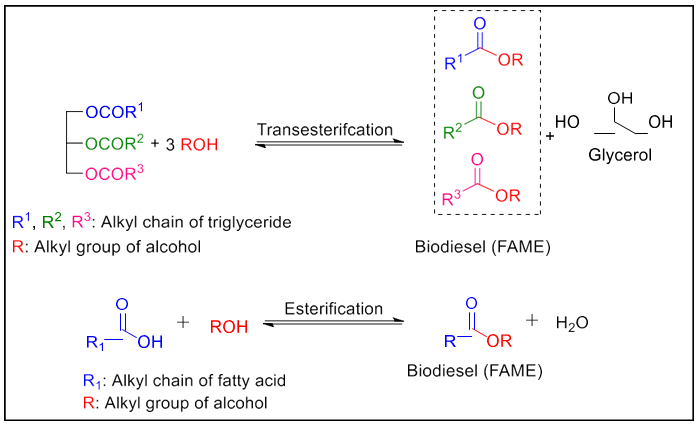
Long-chain triglycerides (TAGs) and free fatty acids (FFAs) are the two components of biomass, which are transformed into biodiesel by esterification and transesterification (Figure 1) [19]. Transesterification can be effectively catalyzed by solid acid and base catalysts to produce biodiesel and glycerol [10, 20]. However, Despite the high reactivity of the base catalyst, it is not desirable for the esterification reaction as it forms soap on reaction with FFA. On the other hand, an acid catalyst can facilitate both esterification and transesterification [21, 14]. The main drawback of making biodiesel is that it is currently manufactured from edible plant oils to a greater than 95% extent. This increased the cost of food and may result in food shortages in emerging and low- income nations [7, 22]. Because feedstock accounts for up to 75% of manufacturing expenses, using this resource is difficult to justify and escalates production costs [23]. In this context, the exploitation of non-edible oils offers a suitable procedure for the cost-effective production of biodiesel [24]. However, the high FFA concentration of non-edible oils prevents the use of solid base catalysts [25, 26]. This has developed the idea of utilizing a concerted, two-step process involving. FFA esterification with acid-active sites followed by TAG transesterification with base active sites in a bifunctional catalyst highly desirable. It would encourage the use of inedible oil feedstocks by minimizing the complicated product isolation and separation steps and presenting a two-step method [27, 28]. Due to its growing popularity, several review papers on the generation of biodiesel utilising heterogeneous catalysts have been published [29, 30, 31, 32, 33]. However, the application biowaste derived bifunctional catalysts towards biodiesel production is not covered extensively [27, 28]. In this mini-review, we bring up-to- date discussion of the different types of biowaste-derived bifunctional catalysts available for the (trans)esterification of non-edible oils specifically.
Biowaste-Derived Bifunctional Catalyst
There are many substantial downsides to (trans) esterification of non-edible oils employing heterogeneous inorganic catalysts: Extended reaction time, high reaction temperatures, and high methanol/oil molar ratios are not unusual [34]. Aside from these useful considerations, the production of catalysts from inorganic sources usually resulted in materials with high levels of stability (reusability), but it also typically required unsustainable, costly, and toxic chemicals as well as lengthy, multi-step procedures [35]. In this context, biowaste-derived bifunctional catalyst gaining enormous attention as their preparation involves cheap raw materials, easily available, non-toxic and biodegradable [36, 37]. They offer to address the issues with waste disposal and reduce the cost of (trans) esterifying non-edible oils into biodiesel. In this section, various biowaste- derived bifunctional catalysts used in the synthesis of biodiesel are addressed (Table 1).
A bifunctional solid catalyst made from corncobs (CC) was described for the (trans) esterification of neem seed oil (NSO) into biodiesel [38]. There were three steps in the catalyst’s preparation. To synthesize sulfonated corncob (CC- SO4), the corncobs were first dried in the sun, milled into a powder and partially carbonized at 280°C, then treated with sulfuric acid. The second process involved carbonising dried poultry droppings (PD) at 280°C, treating them with 0.1 M KOH, and then calcining them at 900 °C for 6 h (KOH@ PD). CC-SO4 and KOH@PD were then magnetically stirred together to form the catalyst. The catalyst that resulted had an excellent biodiesel yield of 92.89%. The reusability test revealed that the catalyst can be used for two consecutive cycles with a biodiesel yield of 89.26%. Similarly, KOH- modified sulfonated corncob (KOH@CC-SO4) was utilized in the (trans) esterification of Waste Cooking Oil (WCO) containing high FFA content and showed a high biodiesel yield of 97.8% under the optimized reaction conditions. A two-step process was involved in the preparation of the catalyst. At first, the cleaned and dried corn cobs were milled followed by treated with conc. sulfuric acid to form sulfonic acid functionalized activated carbon (CC-SO4). Secondly, the CC-SO4 was modified with KOH via wet impregnation. The catalyst prepared with a corncob/H2SO4 (weight/volume) ratio of 5:1 at 700°C for 4 h displayed the highest surface area (1311 m2/g) with an acid density of 1.12 mmol/g. Although this catalyst could be employed for up to five consecutive reaction cycles, maintaining a 92% FFA conversion, the authors noted the necessity to address the leaching of KOH sites [39]. Additionally, a solid catalyst derived from rice husk was utilized for the preparation of biodiesel. The carbonized rice husk was impregnated with different amounts of KOH and Fe2O3 to introduce basic and magnetic characteristics, respectively. The maximum base density (4.43 mmol/g) was found in the catalyst loaded with 20% KOH and 5% Fe, while the surface area (57.89 m2/g) and acid density (24.59 mmol/g) were only modest. Since production is known to be dependent on the basic sites of the catalyst, it demonstrated the highest activity of the synthesized catalysts (98.6% biodiesel output). The biodiesel output was decreased to 40% after 6 cycles due to catalyst instability, which may be due to catalyst poisoning [40]. In another study, different amounts of K2O and NiO-modified carbonized rice husk (RH) based magnetic bifunctional catalyst was prepared for the production of biodiesel. The aggregation of potassium oxides and nickel on the carbon framework is responsible for the uneven shape shown in the FESEM micrographs (Figure 2) of the synthesized catalysts. On increasing nickel levels, it was noticed that the carbon framework’s pore size shrank, most likely as a result of pore blockage by crystallization. Among synthesized catalysts, RH-Ni (5%)-K(20%) had the greatest biodiesel production (98.2%, depreciated to 71.0% after 5 cycles) [41].
![Figure 2: FESEM micrographs of (a) RH-Ni (1%)-K(20%) (b) RH-Ni (5%)-K(20%) (c) RH-Ni (10%)-K(20%). Scale bars: 10 mm (a), 5 mm (b, c) Reproduced from Hazmi, et al. [41].](/fulltextimages/10404/fig_2.png)
A solid bifunctional catalyst derived from the bio-waste palm kernel shell (PKS) was prepared for the synthesis of biodiesel from WCO. The preparation of the catalyst involved a two-step process:
- Calcination of PKS at high temperature to generate activated carbon (AC).
- Impregnation of different amounts of K2CO3 and CuO to introduce surface basicity and acidity, respectively.
The catalyst loaded with 30% K2CO3 and 5% CuO resulted in a very high surface area (438.08 m2/g) with high surface acidity (27.02 mmol/g) and basicity (8.86 mmol/g), respectively, thus giving good biodiesel yield of 95%. Reusability experiments revealed a considerable depreciation in the product yield to 80% after 5 consecutive cycles, suggesting leaching of the catalyst acidic and basic sites [42]. In another study, a hydrothermally carbonized catalyst was derived from waste PKS to produce activated carbon (PKSAC). After being treated with NaOH, the surface area drastically increased from 3.57 to 3368.60 m2/g, and different concentrations of K2CO3 and Cu(NO3)2 were then added to introduce surface acidity and basicity. The combination of PKSAC-K(20%)-Cu(5%) led to a maximum FAME production of 95.4%, which may have been a result of the comparatively high base and acid densities of 5.73 and 1.48 mmol/g, respectively. However, this performance was not sustained throughout the course of further testing [43]. A solid bifunctional catalyst with an Angel wing shell (AWS) basis was recently developed through a two-step procedure.
Dried AWS was calcined at 900 °C for 2 h to convert it into calcined AWS (CAWS) followed by treated with sulfuric acid to introduce acidic sites (CAWS-SO4). Then the catalyst was employed for the (trans) esterification of palm fatty acid distillate (PFAD) to produce biodiesel. To investigate its impact on the acidity and basicity of the catalyst, the concentration of sulfuric acid was changed from 3 to 11 M. Initially, an increase in sulfuric acid concentration led to an increase in the acidity of the catalyst, with CAWS-SO4 (5) and CAWS-SO4 (7) (for example, generated using 5 M or 7 M H2SO4 being discovered to be 2.14 and 4.73 mmol/g, respectively. However, when the quantity of sulfuric acid further increased, the catalyst surface was damaged, which resulted in a reduction in acidity. In contrary, low sulfuric acid concentration CAWS-SO4 (3) led to the introduction of highest base density of 1.33 mmol/g. A high biodiesel yield of 97.4% was accomplished utilizing CAWS-SO4 (7) catalyst, predictable with catalyst activity for esterification being principally subject to the presence of acidic sites. Catalyst reusability, however, once more, proven to be limited [44].
| Entry | Catalyst | Feedstock | Reaction conditionsa | Yield (%) | Ref. |
|---|---|---|---|---|---|
| 1 | CC-SO4-KOH@PD | Neem Seed Oil | 62, 2.6, 1.2, 15:1. | 92.9 | [38] |
| 2 | KOH@CC-SO 4 | Waste Cooking Oil | 45, 1, 1, 18:1. | 97.8 | [39] |
| 3 | KOH@RH-Fe O 2 3 | Waste Cooking Oil | 75, 4, 4,12:1. | 98.6 | [40] |
| 4 | RH-Ni (5%)-K (20%) | Waste Cooking Oil | 65, 2, 4, 12:1. | 98.2 | [41] |
| 5 | PKS-K(30%)-Cu(5%) | Waste Cooking Oil | 80, 4, 5, 12:1. | 95 | [42] |
Table 1: Various biowaste-derived solid bifunctional catalysts for the production of biodiesel.
aReaction temperature (°C), reaction time (h), catalyst loading (wt.%), methanol/oil molar ratio, Table 1: Various biowaste-derived solid bifunctional catalysts for the production of biodiesel.
Summary and Concluding Remarks
The synthesis of biodiesel from edible and, more critically moving ahead, non-edible oils has shown significant promise for solid, readily reusable catalysts. Bifunctionalized analogues compared to the monofunctionalized catalyst enhance the selectivity for the intended product(s) and make it easier to catalyze the transformation of more complicated substrates and mixtures in one-pot processes. They also make the product-catalyst separation more effective. These elements work together to produce a variety of economic, safety, and sustainability advantages. Here, current developments in the use of solid bifunctional catalysts with acid-base and Lewis-Brnsted functionalities to synthesise the increasingly attractive fuel/additive biodiesel from sustainable biomass, notably from inedible forms thereof, are reviewed. The important conclusions may be summed up as follows:
- The generation of biodiesel from non-edible oil is an extremely urgent goal since it would resolve the food vs. fuel conflict that affects most of the existing state-of-the- art.
- Furthermore, these catalysts would use readily accessible and inexpensive feedstocks, which would have a negative structural impact on production costs.
- To assist the conversion of TAGs and FFAs, it is extremely desirable to produce a solid catalyst that is affordable, stable, metal-free, sustainable, renewable, and effective.
- Bifunctional catalysts are thought to hold potential for biodiesel generation from non- edible oils, where high FFA concentration is frequently a problem. In contrast, the employment of single-functionality solid catalysts necessitates time-consuming, sometimes expensive two-step methods.
- The improvement of the solid catalyst’s surface hydrophobicity promotes FAME anti- hydrolysis activity and prevents water molecules from reagents or byproducts of FFA esterification from interacting with the catalyst’s active sites, boosting catalytic stability and reusability.
- Due to the simplicity of quick, quantitative separation of the catalyst from the reaction mixture, adding magnetic behaviour to solid bifunctional catalysts improves durability and reusability. While this is already a characteristic of research on, for instance, metal oxide catalysts, it has not yet been established in the field of biowaste-based bifunctional catalysts, where it may be a great approach to assure catalyst recycling.
- The development of bio-waste-derived bifunctional solid catalysts for the generation of biodiesel is a field that is expanding because it uses components that are easily accessible, renewable, non-toxic, and biodegradable. It is tempting to be able to maximise process cost- effectiveness, and concerns with trash disposal are eliminated by reusing bio-waste. However, the area of catalyst stability needs to develop before problems like magnetic cyclability can be looked into. The current state-of-the-art falls behind that of inorganic catalysts in that, as a result of active site degradation, product yields quickly decline with catalyst reuse. catalyst reuse. This now lags behind inorganic catalysts in certain respects; a common aspect of the state-of-the-art is that product yields rapidly decline with catalyst reuse owing to active site degradation.
References
-
Mahmudul HM, Hagos FY, Mamat R, Adam AA, Ishak WFW, et al. (2017) Production, characterization and performance of biodiesel as an alternative fuel in diesel engines-A review. Energy Rev 72: 497-509.
-
Changmai B, Vanlalveni C, Ingle AP, Bhagat R, Rokhum L, et al. (2020) Widely used catalysts in biodiesel production: a review. RSC Adv 10(68): 41625-41679.
-
Bayat A, Baghdadi M, Bidhendi GN (2018) Tailored magnetic nano-alumina as an efficient catalyst for transesterification of waste cooking oil: optimization of biodiesel production using response surface methodology. Energy Convers Manag 177: 395-405.
-
Li H, Fang Z, Smith RL, Yang S (2016) Efficient valorization of biomass to biofuels with bifunctional solid catalytic materials. Prog Energy Combust Sci 55: 98-194.
-
Bajwa DS, Peterson T, Sharma N, Shojaeiarani J, Bajwa SG, et al. (2018) A review of densified solid biomass for energy production. Renew Sustain Energy Rev 96: 296- 305.
-
Lee AF, Bennett JA, Manayil JC, Wilson K (2014) Heterogeneous catalysis for sustainable biodiesel production via esterification and transesterification. Chem Soc Rev 43: 7887-7916.
-
Changmai B, Rano R, Vanlalveni C, Rokhum L (2021) A novel Citrus sinensis peel ash coated magnetic nanoparticles as an easily recoverable solid catalyst for biodiesel production. Fuel 286: 119447-119457.
-
Shahbaz M, yusup S, Inayat A, Patrick DO, Ammar M, et al. (2017) Optimization of hydrogen and syngas production from PKS gasification by using coal bottom ash. Renew Sustain Energy Rev 241: 284-295.
-
Su F, Guo Y (2014) Advancements in solid acid catalysts for biodiesel production. Green Chem 16(6): 2934-2957.
-
Atadashi IM, Aroua MK, Abdul AAR, Sulaiman NMN (2013) The effects of catalysts in biodiesel production: A review. J Ind Eng Chem 19(1): 14-26.
-
Pathak G, Das D, Rajkumari K, Rokhum L (2018) Exploiting waste: towards a sustainable production of biodiesel using Musa acuminata peel ash as a heterogeneous catalyst. Green Chem 20(10): 2365-2373.
-
Kouzu M, Hidaka JS (2012) Transesterification of vegetable oil into biodiesel catalyzed by CaO: A review. Fuel 93: 1-12.
-
Changmai B, Sudarsanam P, Rokhum SL (2020) Biodiesel production using a renewable mesoporous solid catalyst. Ind Crops Prod 145: 111911-111920.
-
Sani YM, Daud WMAW, Abdul AAR (2014) Activity of solid acid catalysts for biodiesel production: A critical review. Appl Catal A Gen 470: 140- 161.
-
An H, Yang WM, Chou SK, Chua KJ (2012) Combustion and emissions characteristics of diesel engine fueled by biodiesel at partial load conditions. Appl Energy 99: 363-371.
-
Tatur M, Nanjundaswamy H, Tomazic D, Thornton M (2009) Effects of Biodiesel Operation on Light-Duty Tier 2 Engine and Emission Control Systems. SAE Int J Fuels Lubr 1(1): 119-131.
-
Teo SH, Goto M, Taufiq-Yap YH (2015) Biodiesel production from Jatropha curcas L. oil with Ca and La mixed oxide catalyst in near supercritical methanol conditions. J Supercrit Fluids 104: 243-250.
-
Rajkumari K, Rokhum L (2020) A sustainable protocol for production of biodiesel by transesterification of soybean oil using banana trunk ash as a heterogeneous catalyst. Biomass Conv Biorefine 10(4): 839-848.
-
Laskar IB, Rajkumari K, Gupta R, Chatterjee S, Paul B, et al. (2018) Waste snail shell derived heterogeneous catalyst for biodiesel production by the transesterification of soybean oil. RSC Adv 8(36): 20131-20142.
-
Semwal S, Arora AK, Badoni RP, Tuli DK (2011) Biodiesel production using heterogeneous catalysts. Bioresour Technol 102(3): 2151-2161.
-
Mardhiah HH, Ong HC, Masjuki HH, Lim S, Lee HV, et al. (2017) A review on latest developments and future prospects of heterogeneous catalyst in biodiesel production from non-edible oils. Renew Sustain Energy Rev 67: 1225-1236.
-
Nabi MN, Rasul MG (2018) Influence of second generation biodiesel on engine performance, emissions, energy and exergy parameters. Energy Convers Manag 169: 326-333.
-
Chavan SB, Kumbhar RR, Madhu D, Singh B, Sharma YC, et al. (2015) Synthesis of biodiesel from Jatropha curcas oil using waste eggshell and study of its fuel properties. RSC Adv 5(78): 63596-63604.
-
Banković-Ilić IB, Stamenković OS, Veljković VB (2012) Biodiesel production from non-edible plant oils. Renew Sustain Energy Rev 16(6): 3621-3647.
-
Avhad MR, Marchetti JM (2015) A review on recent advancement in catalytic materials for biodiesel production. Renew Sustain Energy Rev 50: 696-718.
-
Nurfitri I, Pragas G, Hindryawati N, Yusoff MM, Genesan S, et al. (2013) Potential of feedstock and catalysts from waste in biodiesel preparation: A review. Energy Convers Manag 74: 395-402.
-
Mansir N, Teo SH, Rashid U, Saiman MI, Tan YP, et al. (2018) Modified waste egg shell derived bifunctional catalyst for biodiesel production from high FFA waste cooking oil. A review. Renew Sustain Energy Rev 82: 3645-3655.
-
Zhang H, Li H, Hu Y, Xu CC, Yang S, et al. (2019) Advances in production of bio-based ester fuels with heterogeneous bifunctional catalysts. Renew Sustain Energy Rev 114: 109296-109321.
-
Galadima A, Muraza O (2014) Biodiesel production from algae by using heterogeneous catalysts: A critical review. Energy 78: 72-83.
-
Boey PL, Maniam GP, Hamid SA (2011) Biodiesel production via transesterification of palm olein using waste mud crab (Scylla serrata) shell as a heterogeneous catalyst. Bioresour Technol 100(24): 6362-6368.
-
Chua SY, Periasamy LA, Goh CMH, Tan YH, Mubarak NM, et al. (2020) Biodiesel synthesis using natural solid catalyst derived from biomass waste-A review. J Ind Eng Chem 81: 41-60.
-
Said NH, Ani FN, Said MFM (2015) Review of the Production of Biodiesel From Waste Cooking Oil Using Solid Catalysts. J Mech Eng Sci 8: 1302-1311.
-
Dhawane SH, Kumar T, Halder G (2018) Recent advancement and prospective of heterogeneous carbonaceous catalysts in chemical and enzymatic transformation of biodiesel. Energy Convers Manag 167: 176-202.
-
Yan S, Salley SO, Simon-Ng KY (2009) Simultaneous transesterification and esterification of unrefined or waste oils over ZnO-La2O3 catalysts. Appl Catal A Gen 353(2): 203-212.
-
Chaveanghong S, Smith SM, Smith CB, Luengnaruemitchai A, Boonyuen S, et al. (2018) Simultaneous transesterification and esterification of acidic oil feedstocks catalyzed by heterogeneous tungsten loaded bovine bone under mild conditions. Renew Energy 126: 156-162.
-
He D, Zhao W, Li P, Liu Z, Wu H, et al. (2019) Bifunctional biomass-derived 3D nitrogen-doped porous carbon for oxygen reduction reaction and solid-state supercapacitor. Appl Surf Sci 465: 303-312.
-
Han F, Yun S, Shi J, Zhang Y, Si Y, et al. (2020) Efficient dual- function catalysts for triiodide reduction reaction and hydrogen evolution reaction using unique 3D network aloe waste-derived carbon-supported molybdenum- based bimetallic oxide nanohybrids. Appl Catal B Environ 273: 119004-119019.
-
Akhabue CE, Osa-Benedict EO, Oyedoh EA, Otoikhian SK (2020) Development of a bio-based bifunctional catalyst for simultaneous esterification and transesterification of neem seed oil: modeling and optimization studies. Renew Energy 152: 724-735.
-
Naeem MM, Al-Sakkari EG, Boffito DC, Gadalla MA, Ashour FH, et al. (2021) One-pot conversion of highly acidic waste cooking oil into biodiesel over a novel bio- based bi-functional catalyst. Fuel 283: 118914-118930.
-
Hazmi B, Rashid U, Taufiq-Yap YH, Ibrahim ML, Nehdi IA, et al. (2020) Supermagnetic Nano-Bifunctional Catalyst from Rice Husk: Synthesis, Characterization and Application for Conversion of Used Cooking Oil to Biodiesel. Catalysts 10(2): 225-245.
-
Hazmi B, Rashid U, Ibrahim ML, Nehdi IA, Azam M, et al. (2021) Synthesis and characterization of bifunctional magnetic nano-catalyst from rice husk for production of biodiesel. Environ Technol Innov 21: 101296-101310.
-
Abdullah RF, Rashid U, Taufiq-Yap YH, Ibrahim ML, Ngamcharussrivichai C, et al. (2020) Synthesis of bifunctional nanocatalyst from waste palm kernel shell and its application for biodiesel production. RSC Adv 10: 27183-27193.
-
Abdullah RF, Rashid U, Ibrahim ML, Hazmi B, Alharthi FA, et al. (2021) Bifunctional nano-catalyst produced from palm kernel shell via hydrothermal-assisted carbonization for biodiesel production from waste cooking oil. Renew Sustain Energy Rev 137: 110638- 110652.
-
Nur OS, Rashid U, Sufri MM (2019) Esterification of palm fatty acid distillate (PFAD) to biodiesel using Bi- functional catalyst synthesized from waste angel wing shell (Cyrtopleura costata). Renew Energ 131: 187-196.
- Nigeria’s Vulnerability in the Face of Global Energy Policy
- A Simulation Study of Investigation of Optimum Oil Production Performance by Applying Various Gas Injection Methods in Oil Reservoir
- Characterization of Permo-Triassic Reservoirs through Thermal Maturity Assessment of Westphalian Source Rocks in the Cheshire Basin
- Influence of Microwax on the Rheological and Thermal Behaviour of a Wax Crude Oil
- Real-Time Monitoring and Performance Optimization of Steam Injection in Heavy Oil Reservoirs Using Fiber Optic Sensing and Integrated Predictive Simulation Models
- Rapid On-Site Determination of the Total Petroleum Hydrocarbon Content of Soils by Handheld Fourier Transform Near-Infrared Spectroscopy: Development of a Global, Site- and Scanner- Independent Calibration Model