
A Brief Review of Wellbore Stability in Coal Beds: Technological Improvements and Challenges
Coal Bed methane is a vital energy resource and has been developing rapidly for the last two decades. Also, India's commitment to become a gas-based economy emphasizes more on increasing domestic gas production. Hence, there is a tremendous potential that can be exploited from coal bed gases. Wellbore stability is a critical factor throughout the life cycle of any well, particularly wherever coal formations are present in the subsurface, as coal beds possess several challenges mainly because of the low fracture gradient of coal and several natural fracture networks present in the coal beds. This review paper provides an overview of the factors influencing the wellbore stability of different types of wellbore modelling techniques, namely the analytical model, Poro-elastic model which is the most widely used technique and gives results with reasonable accuracy, Thermo-hydro-mechanical (THM) coupling model, and other numerical simulation techniques like finite element model used for calculating of and the stress distribution around the wellbore in the case of vertical and horizontal wells, as this is the crucial criterion for calculating fracture gradient. Amongst which, the THM coupling method is the most advanced modelling technique and is used when high thermal stresses are present. After this, it discusses the different drilling fluids used for drilling in the coal seams like oil based muds, degradable polymer based drilling fluids which have minimum formation damage and foam based drilling fluids which have efficient cuttings carrying capacity. Also, their limitations and advantages and the effects on permeability damage and tensile fractures caused by the drilling fluids. Thus, giving an overall review of the technological improvements in the CBM extraction processes.
Introduction
Coal Bed methane is a vital energy resource and has been developing rapidly for the last two decades. Also, India’s future focuses more on becoming a gas-based economy; hence, there is tremendous potential that can be exploited from coal bed gases, primarily methane. However, with the opportunity of exploitation, there are several challenges in the extraction of the gases from the coal bed. These include wellbore stability in the coal seams and permeability reduction in the beds due to the drilling fluid losses into the formation, among many others. The complexity in exploring coalbed methane arises from the heterogeneous nature of coal and the lower fracture gradient of coal, which leads to borehole instability, formation damage, and other operational issues. Also, coal seams are often associated with high methane content, which adds risk related to gas leakage and blowouts [1]. Hence modelling wellbore stability in both vertical and horizontal wells in coal beds is essential for optimising drilling operations. Accurate models help design appropriate drilling fluids and select the optimal mud weight to prevent wellbore collapse and minimise formation damage [2]. Drilling fluids play a crucial role in maintaining wellbore integrity, yet their selection requires careful consideration of the specific characteristics of coal formations. The interaction between drilling fluids and coal can lead to various issues, including fluid loss, clay swelling, and reduced permeability [3, 4]. These challenges must be tackled to overcome the efficient extraction of coal gases. Also, after the efficient drilling of the wells in the coal beds, there are tremendous challenges: a) hydraulic fracturing is needed in several cases for commercial gas production, b) production of coal fines that reduce the near- wellbore permeability is, c) the installations of progressive cavity pumps are needed to increase the flow of water before commercial levels of gas production can be initiated.
Factors Affecting Wellbore Stability
Wellbore stability is a crucial part in the drilling, completion and production of coal bed methane (CBM) reservoirs. The complex geo-mechanical properties of coal seams and the unique functional challenges associated with CBM extraction make wellbore stability a very concerning problem. Wellbore stability is often influenced by various factors, such as in-situ stress conditions, coal seam characteristics, pore pressure, gas desorption, drilling fluid properties, and the presence of natural fractures and cleats.
1. In-situ stress conditions
The integrity of wellbores in CBM reservoirs is significantly influenced by the in-situ stress regime. The wellbore’s susceptibility to shear failure or tensile fracturing is directly determined by the direction and amplitude of the vertical and horizontal loads. Severe instability issues, such as the collapse or breakout of the wellbore, can be the consequence of substantial gradients in horizontal stress. In order to plan efficient drilling programs in CBM fields, it is essential to comprehend the stress distribution around the wellbore, as the improper management of these stresses may lead to excessive drilling difficulties [5].
2. Coal seam geo-mechanical properties
The wellbore stability can be significantly influenced by the unique geo-mechanical characteristics of coal seams, which include their severe brittleness and low compressive strength. Coal’s inadequate uniaxial compressive strength increases its susceptibility to sloughing and escapes during drilling. Additionally, the probability of fracturing increases as drilling conditions become more severe, as coal has a comparatively low tensile strength in comparison to other sedimentary minerals. Because of these attributes, it is necessary to implement precise well design and employ appropriate drilling fluids to mitigate instability [6].
3. Gas desorption and pore pressure The stability of the wellbore is contingent upon the pressure within the cavities of the coal seam. The effective stress on the wellbore is reduced by elevated pore pressures, which in turn increases its susceptibility to failure. The desorption of methane gas during drilling in CBM reservoirs can lead to a significant reduction in pore pressure, which in turn affects the tension distribution around the wellbore. Wellbore instability may result from inadequate regulation of this process, particularly when drilling is not balanced [7].
4. Properties of drilling fluids
The drilling fluid’s density and composition are the primary factors in maintaining wellbore stability. In order to prevent wellbore collapse or fracturing and maintain equilibrium between formation pressures, an optimal mud weight is necessary. Water-based drilling lubricants, which are frequently used in coal bed methane (CBM) operations, have the potential to cause coal swelling, including wellbore expansion and instability. The meticulous selection of drilling fluids with appropriate rheological characteristics is essential for the preservation of wellbore integrity during the drilling process [8].
5. Inherent cleats and fractures
The mechanical properties of the water reservoir are significantly impacted by the cleat system in the coal strata. The stability of a wellbore can be influenced by both beneficial and detrimental naturally occurring fissures and cleats. One potential benefit is that they can function as conduits for fluid movement, which could potentially reduce the pressure within pores and enhance overall stability. Additionally, these fractures have the potential to create areas of vulnerability that could lead to the collapse or instability of the wellbore in specific stress scenarios. The orientation of these fractures in relation to the wellbore is particularly important in determining the stability of the drilled well [9].
6. Temperature effects
Thermal impacts can also affect the integrity of the wellbore as a result of temperature fluctuations during drilling and production. The mechanical characteristics of the coal and the adjacent formation can be altered as a result of thermal strains in the coal fissure caused by extreme temperature fluctuations. In particular, these thermal stresses may exacerbate existing stability issues or introduce new ones in deep CBM reservoirs, where temperature gradients are more pronounced [10].
7. Cavity development and coal swelling This phenomenon, coal swelling, can lead to wellbore enlargement and instability when it comes into contact with water-based drilling fluids. The wellbore’s effective diameter is increased by swelling, which results in a lower level of support from the drilling fluid and an increased likelihood of wellbore collapse. In addition, the stability of the wellbore is further compromised by the formation of cavities as a result of coal softening and attrition during drilling, which emphasizes the necessity of selecting drilling fluids that minimize contact with the coal seam [11].
Modelling Borehole Stability in CBM Wells
There are various methods of modelling the wellbore that include both analytical and numerical methods.
Analytical Models
The analytical model uses simpler methods like calculation of the radial, tangential and axial stress components at any point around the wellbore. They provide approximate values of the failure stress criteria. These include calculation of the factors by various methods like the Mohr-Coulomb failure criteria and others. The Linearized Mohr-Coulomb failure criteria assumes that the intermediate principal stress has no influence on failure. The governing fundamental equations for the Linearized Mohr-Coulomb failure criteria are given by the following Equations 1-3.
$$ \begin{array}{l} \sigma_ {1} = C _ {0} + \sigma_ {3} (1) \\ \left(\mu_ {\mathrm {i}} ^ {2} + 1\right) ^ {1 / 2} + \mu_ {\mathrm {i}} ^ {2} = \tan^ {2} \left(\pi / 4 + \phi / 2\right) (2) \\ \end{array} $$ $$ \left(\mu_ {\mathrm {i}} ^ {2} + 1\right) ^ {1 / 2} + \mu_ {\mathrm {i}} ^ {2} = \tan^ {2} \left(\pi / 4 + \phi / 2\right) $$ $$ \begin{array}{l} + \mu_ {\mathrm {i}} = \tan \left(\% 4 + \% 2\right) (2) \\ \phi = \tan^ {- 1} \mu_ {\mathrm {i}} (3) \\ \end{array} $$ Where Co is solved-for as a fitting parameter, σ1, σ2, σ3 are the principal stresses, and μ is the coefficient of internal friction.
This criterion predicts failure stress values with reasonable accuracy in ideal clean sandstone formations with an error of about 10% [12], but in the coal seams where various cleat networks are present, the results are not so accurate and show large deviations.
It is a convenient method to calculate the failure criteria for preliminary calculations when other options are not available.
Thermo-mechanical Model
Thermo-mechanical models are applied when significant temperature changes occur during drilling. This phenomenon is more common during underbalanced drilling. When fluid temperatures deviate significantly from formation temperatures Thermo-mechanical models better capture the thermal expansion of the coal matrix and the stress changes induced by temperature gradients around the wellbore.
The governing fundamental equations can be divided into two thermal and mechanical constitutive equations. These are represented by Equations 4 and 5.
$$ f _ {i} + \sigma_ {i j, j} = 0 \tag {4} $$
$$ \varepsilon_ {\mathrm {i j}} = \frac {1}{2} \left(u _ {\mathrm {j . i}} + u _ {\mathrm {i . j}}\right) $$ (5) Where σij.j and fi are the components of the stress matrix and net body force, respectively; εij is strain tensor, uj.i and ui.j represent ꝺuj/ꝺxi and ꝺui/ꝺxj, respectively, where u represents the change in position in the j or i directions [13].
Numerical Simulation Techniques
Numerical models provide a more detailed and realistic representation of the actual and complex interactions between stress, strain, and pore pressure around the wellbore. There are various methods such as the Finite Element Method (FEM) and Finite Volume method which are widely used to simulate borehole stability in CBM wells. Hongyan Qu investigated the mechanism and control of the wellbore stability of coal seams in the Qinshui basin through theoretical modelling, laboratory experiments and field operation. They obtained the variation of the collapse pressure, pore pressure and breaking (fracturing) pressure with depth. The curve which they obtained was shown in Figure 1.
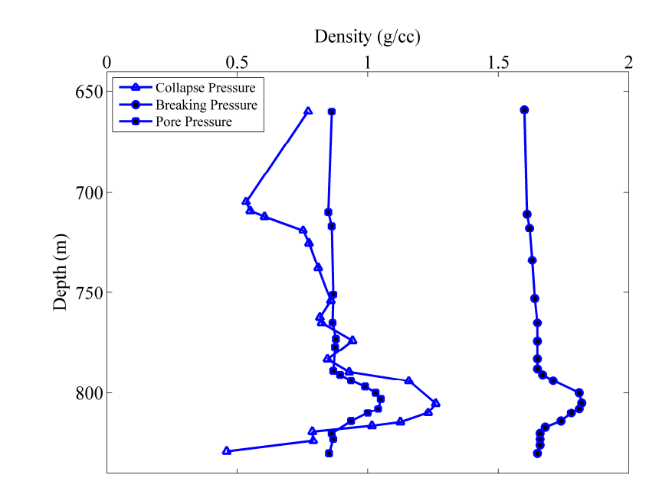
It could be inferred from the graph that breaking (fracturing) pressure would be dependent on the pore pressure and when pore pressure increases the breaking (fracturing) pressure also increases.
Linear Elastic Borehole Stability Model
One of the easiest ways to evaluate the stability of wellbore is by using a linear elastic wellbore model to predict the stresses around the wellbore. These calculated stresses can then be compared to the rock’s strength to see if shear failure might occur. If the borehole is drilled in line with the main in-situ stress direction and we assume the borehole is much longer than its diameter, it is possible to calculate the stress distribution around the wellbore [14]. The critical wellbore pressure is given by Equation 6.
( ) ( ) 1 3 3 1 1
$$ = \frac {3 \sigma_ {1} - \sigma_ {3} + A _ {\mathrm {p}} \Delta \mathrm {P} - \mathrm {U C S} + \alpha (\mathrm {N} - 1) \mathrm {P} _ {\mathrm {m}}}{\mathrm {N} + 1} \tag {6} $$
Where, Pw(critical) is the critical wellbore pressure (Pcollapse <
Pw(critical) < Pfracturing); σ1 and σ2 are the maximum and minimum
principal stresses in the plane perpendicular to the wellbore
axis; Ap is the poro-elastic constant; α is Biot’s coefficient; ν
is the Poisson’s ratio (Static); ΔP = Pm – Pf is the difference
in mud pressure and formation pore pressure; Pm is the
mud pressure; Pf is the formation pore pressure; UCS is
unconfined compressive strength; N = (1+sinφ)/(1-sinφ) is
a dimensionless parameter of frictional strength ; Where φ is
the angle of friction; Pw is the wellbore pressure [14].
p m w critical A P UCS N P P N
This model, however, is not ideal for soft rocks since it does not consider more complex interactions, such as non- linear elasticity, strain softening, strain hardening or changes in permeability around the wellbore due to stress. Despite these limitations, the linear elastic model offers several advantages: it is comparatively easy to calculate, either by manual calculations or with the aid of excel programs or other modules, and it requires fewer input parameters than more complex models, making it a practical choice for preliminary assessments. Additionally, it provides quick insights into stress conditions around the borehole without needing extensive field data [14].
Furthermore, the model can be extended to handle 3D stress conditions, where the wellbore is not properly aligned with the principal in-situ stress direction. Although the 3D equations aren’t provided here, they are documented in works by Aadnoy and Fjaer [15].
This method helps assess the risks of various well trajectories and allows for quick sensitivity analyses without needing large amounts of data. It’s especially useful when the important parameters, such as rock compressive strength and Poisson’s ratio are not well defined. When field data is known to us, it can be used to calibrate the parameters obtained from the model so that the results can provide reasonably accurate predictions.
Elastoplastic Borehole Stability Models
The previously discussed model overlooks a critical aspect of borehole stability: after yielding, rock may weaken but still retain some residual strength. As the rock yields, stress redistribution takes place, and the stress carried by the affected region can significantly impact the well’s stability. In petroleum engineering, designing drilling fluid properties and densities has been effective in controlling the size of the yielded zone to ensure borehole stability [14]. Figure 2 illustrates an ideal elastic-brittle-plastic model. In this model, the key section of the stress-strain diagram is the post-peak region.
![Figure 2: Stress- strain behaviour: Actual vs. idealized elastic-brittle-plastic model [14].](/fulltextimages/13823/fig_2.png)
The behaviour of material is initially considered to be linear elastic until it reaches its peak strength, then transitioning into strain weakening, later exhibiting plastic deformation at a constant residual stress. Although this model is not universally applicable, as some materials exhibit more complex behaviour, more advanced numerical models and other algorithms are available for those cases. For instance, Vaziri & Palmer [16] and Manogharan [17] account for nonlinear elastic behaviour before a perfectly plastic state, while Van den Hoek [18] and Xiao Y [19] consider linear strain hardening and softening. Customizable models, like those in the FLAC software (Itasca Consulting Group Inc.,), can incorporate a variety of complex material behaviours. However, many sedimentary rocks can be reasonably represented by the idealized model in Figure.2. Semi-analytical solutions for this model have been provided by Detournay and Fairhurst [20] and Wang & Dusseault [21], offering an advantage since they don’t require numerical modelling. This elastoplastic approach is demonstrated for a near-horizontal well in the Ardley coal zone in central Alberta, chosen for its potential in coalbed methane extraction and CO2 sequestration (Bachu & Stewart) [22]. Similar studies on the deeper Mannville Group coals were conducted by McLellan & Hawkes [23], with successful horizontal wells drilled in these coals at 1000 m depth in north-central Alberta, Canada [14].
The Figure 3 depicts geophysical log data from the Ardley coal zone in a vertical oil well in the Three Hills Creek Field, located about 20 km southeast of Red Deer, Alberta. Coal seams between 1 and 3 meters thick are visible in the logs.
![Figure 3: Geophysical logs for ACL Three Hills Creek well 14-05-036025W4 [14].](/fulltextimages/13823/fig_3.png)
The caliper logs show the wellbore has expanded to almost 400 mm in these coal seams, i.e., about 100% larger than the original bit diameter of 200 mm. Despite these enlargements, the wellbore remained relatively stable because the coal seams were thin. Thin coal seams limit the overall breakout volume, reducing the impact on wellbore stability. If the coal seams had been thicker, the overall breakout volume would have been significantly larger, leading to severe wellbore instability issues. Also, if similar borehole expansion occurs during horizontal drilling, the larger volume of excess cavings could present significant operational challenges. Wellbore stability studies are thus pivotal to establish the minimum mud weight of drilling fluid necessary to restrict further borehole enlargement in horizontal section of boreholes within the coal seam area [14].
Thermo-hydro-mechanical Coupling Model
During underbalanced drilling in CBM formations, wellbore stability is influenced by the Thermo-Hydro- mechanical coupling process, which involves applying the conservation of momentum, mass, and energy along with relevant constitutive laws for fluid flow, heat transfer, and stress gradients and deformation around the wellbore, as illustrated in Figure 4.
![Figure 4: Thermo-Hydro-Mechanical coupling: Interrelated dynamics [24].](/fulltextimages/13823/fig_4.png)
Due to the complexity of the coupling process, certain assumptions should be considered to simplify the modelling: (a) The coal is considered as a linear elastic isotropic homogeneous porous medium that meets the plane-strain hypothesis; (b) Gas flowing in coal obeys the Darcy’s law (single phase flow); (c) Effects of unstable or abruptly changing wellbore temperature and pressure are ignored [24].
The Thermo-Hydro-Mechanical coupling model of coal deformation is established on the stress equilibrium estimation of a representative elementary volume (REV). In drilling process, coal deformation is caused by the overall changes of gas pressure, external loading, desorption contents of absorbed gas, and wellbore temperature. The relationship between stress-strain for a non-isothermal gas-desorbing CBM wellbore are given below by Equations 7-12 [25], $$ \sigma_ {\mathrm {i j}} = 2 \mathrm {G} \varepsilon_ {\mathrm {i j}} + \frac {2 \mathrm {G} \nu}{1 - 2 \nu} \varepsilon_ {\mathrm {k k}} \delta_ {\mathrm {i j}} - \alpha p \delta_ {\mathrm {i j}} - K \alpha_ {\mathrm {T}} \left(\mathrm {T} - \mathrm {T} _ {0}\right) \delta_ {\mathrm {i j}} - K \varepsilon_ {\mathrm {s}} \delta_ {\mathrm {i j}} \tag {7} $$ $$ G = \frac {\mathrm {E}}{2 (1 + \nu)} \tag {8} $$ ( ) E K ν = − (9) ( ) 3 1 2 K K α = −
1 (10) s
$$\varepsilon_{kk} = \varepsilon_{11} + \varepsilon_{22} + \varepsilon_{33}$$
$$\varepsilon_s = \varepsilon_l \frac{P}{P + P_L}$$
Where, $\sigma_{ij}$ is the component of the total stress tensor; $\varepsilon_{ij}$ is the component of the total strain tensor; $\varepsilon_{kk}$ is the volumetric strain; $G$ is the shear modulus of coal; $E$ is the Young’s modulus of coal; $K$ is the drained bulk modulus of coal; $K_s$ is the bulk modulus of coal skeleton; $v$ is the drained Poisson’s ratio of coal; $\alpha$ is the Biot coefficient; $\delta_{ij}$ is the Kronecker delta (1 when $i=j$ and 0 when $i \neq j$); $p$ is the pore pressure; $T$ is temperature; $T_0$ is original coal reservoir temperature; $\alpha_T$ is the coefficient of volumetric thermal expansion of the coal skeleton; $\varepsilon_s$ is the volumetric matrix shrinkage strain induced by gas desorption [26, 27], $\varepsilon_L$ is the coefficient of sorption-induced volumetric strain, $P_L$ is the Langmuir pressure constant.
**Drilling Fluids Used for Drilling Coal Beds**
As discussed above, drilling in the coal formations is a difficult task for various reasons, such as the low fracture gradient and the presence of microfractures in the seams, more specifically in the horizontal wells and formation damage due to overbalance drilling using conventional drilling mud. There are various methods to tackle these issues, such as using multiple types of lighter drilling fluids that operate under underbalanced conditions while steering through the coal seams. Also, coal seams have high water sensitivity due to the presence of clay in the coal beds, which swells in the presence of water and the solids present in the drilling mud enter into fracture network and block the channels present in coal beds hence reducing the productivity of the coal beds.
There are various methods to tackle these issues using multiple types of lighter drilling fluids that operate under underbalanced conditions while steering through the coal seams, these include:
Oil based mud (OBM): Oil based drilling fluids can be used with proper additives to drill in the coal seams. These OBMs are of relatively low density which help in reducing the formation damage. Also, due to the absence of water the problems of clay swelling are also solved using OBM. These oil based muds have relatively higher costs and due to the environmental concerns of the OBM these are used only in the case of severe water sensitivity cases where other drilling fluids fail to provide adequate performance.
Degradable polymer drilling fluid: The degradable polymer drilling fluids used for drilling coal beds are of low density, high yield point, low fluid loss, high cutting carrying capacity and minimize reservoir damage. Also due to the degradable nature, the drilling fluid which have entered the formation as filtration loss, can be decomposed using particular enzymes reducing the viscosity and particle size of the filtrate, hence reducing of formation damage [28].
Solid free polymer drilling fluid: The solid free polymer drilling fluid has low viscosity and are designed to minimize the formation damage by reducing the fluid invasion. These muds prevent clay swelling and maintain wellbore stability, fluid loss control, and enhanced cuttings suspension [29].
Foam drilling fluid system: Foam drilling fluids are lightweight and used extensively in underbalanced drilling in CBM drilling. The major advantages of foam drilling fluids are minimized formation damage, low density fluid, and high cutting carrying capacity for effective cuttings removal [30].
**Conclusion**
This paper reviews in detail various factors affecting the wellbore stability, such as in-situ stress conditions, coal seam geo-mechanical properties, gas desorption, drilling fluid properties, inherent cleats and fractures, temperature effects, and cavity development. We also reviewed different wellbore modelling techniques, such as analytical models, thermo-mechanical models, and numerical simulation techniques, to predict and manage stress distribution around the wellbore. Analytical models provide approximate values of failure stress criteria, while thermo-mechanical models consider thermal expansion and stress changes induced by temperature gradients. Numerical simulation techniques, such as the finite element method offers detailed representations of stress, strain, and pore pressure interactions around the wellbore. Each model has its own advantages and disadvantages, and the respective model can be selected based on the level of accuracy required and the amount of data available for prediction. Also, we have discussed various types of drilling fluids used in drilling in coal beds. Drilling fluids play a crucial role in maintaining wellbore integrity, and their selection requires careful consideration of coal formation characteristics. This work highlights the importance of accurate wellbore modelling to design appropriate drilling fluids and select optimal mud weight to prevent wellbore collapse and minimize formation damage.
**References**
- Canadian Institute of Mining, Metallurgy and Petroleum (2015) Innovations in applied and theoretical rock mechanics. 13th International Congress of Rock Mechanics, Montréal, Canada.
- Gao D, Bi Y, Xian B (2022) Technical advances in well type and drilling & completion for high-efficient development of coalbed methane in China. Natural Gas Industry B 9(6): 561-577.
3. Guo Z, Hussain F, Cinar Y (2015) Experimental Study of the Permeability Damage Associated with Fines Production from a Bituminous Coal during Water Injection. SPE-174233-MS, SPE European Formation Damage Conference and Exhibition, Budapest, Hungary.
4. Barr K (2009) A Guideline to Optimize Drilling Fluids for Coalbed Methane Reservoirs. SPE Rocky Mountain Petroleum Technology Conference, SPE 123175, Denver, Colorado.
5. Jia L, Li B, Li J, Wang Z, We X, et al. (2023) The effect of stress, pressure and temperature on CBM migration with elastic–plastic deformation. Geoenergy Sci Eng 221: 211405.
6. Mondal D, Ghosh S, Naveen P, Kumar M, Majumder A, et al. (2021) An integrated study on the geochemical, geophysical and geomechanical characteristics of the organic deposits (Coal and CBM) of eastern Sohagpur coalfield, India. Gondwana Res 96: 122-141.
7. Liu T, Liu S, Lin B, Fu X, Zhu C, et al. (2020) Stress response during in-situ gas depletion and its impact on permeability and stability of CBM reservoir. Fuel 266: 117083.
8. Tao X, Zheng Z, Yu H, Li Y, Zhang Z, et al. (2024) Internal blocking and bonding to strengthen the mechanical properties and prevent collapse and leakage of fragmented coalbed methane (CBM) reservoirs by cohesive drilling fluids. Geoenergy Sci Eng 241: 213136.
9. Fekete P, Bruno LA, Dosunmu A, Odagme S, Sanusi A, et al. (2015) The Effect of Wellbore Stability in Naturally Fractured Reservoirs. SPE Nigeria Annual International Conference and Exhibition, Lagos, Nigeria, SPE-178267- MS.
10. Meng M, Chen P, Ren R (2019) Statistic evaluation of failure criteria in wellbore stability with temperature effects. Fuel 252: 730-752.
11. Patel A, Goh C, Towler B, Rudolph V, Ruffordschool TE (2016) Screening of Nanoparticles to Control Clay Swelling in Coal Bed Methane Wells. IPTC-18713-MS, The International Petroleum Technology Conference, Bangkok, Thailand.
12. Ai-Awad MNJ (1422) Simple Correlation to Evaluate Mohr-Coulomb Failure Criterion Using Uniaxial Compressive Strength. Journal of King Saud University - Engineering Sciences 14(1): 137-144.
13. Shahbazi M, Najafi M, Marji MF, Rafiee R (2024) A thermo-mechanical simulation for the stability analysis of a horizontal wellbore in underground coal gasification. Petroleum 10(2): 243-253.
14. Hawkes CD (2007) Assessing the mechanical stability of horizontal boreholes in coal. Canadian Geotechnical Journal 44(7).
15. Aadnoy BS, Looyeh R (2011) Petroleum Rock Mechanics. Elsevier.
16. Vaziri HH, Palmer ID (1998) Evaluation of openhole cavity completion technique in coalbed methane reservoirs. Int J Rock Mech Min Sci 35(4-5): 523-524.
17. Manogharan P, Wood C, Marone C, Elsworth D, Rivière J, et al. (2021) Nonlinear elastodynamic behavior of intact and fractured rock under in-situ stress and saturation conditions. J Mech Phys Solids 153: 104491.
18. Van Den Hoek PJ, Hertogh GMM, Kooijman AP, Bree Ph, Kenter CJ, et al. (2000) A New Concept of Sand Production Prediction: Theory and Laboratory Experiments. SPE Drill & Compl 15(4): 261-273.
19. Xiao Y, Qiao Y, He M, Li H, Cheng T, et al. (2022) A unified strain-hardening and strain-softening elastoplastic constitutive model for intact rocks. Comput Geotech 148: 104772.
20. Detournay E, Fairhurst C (1987) Two-dimensional elastoplastic analysis of a long, cylindrical cavity under non-hydrostatic loading. International Journal of Rock Mechanics and Mining Sciences & Geomechanics Abstracts 24(4): 197-211.
21. Wangt Y, Dusseaultt MB (1991) Borehole Yield and Hydraulic Fracture Initiation in Poorly Consolidated Rock Strata Part I. Impermeable Media. International Journal of Rock Mechanics and Mining Sciences & Geomechanics Abstracts 28(4): 235-246.
22. Bachu S, Stewart S (2002) Geological sequestration of anthropogenic carbon dioxide in the Western Canada Sedimentary Basin: suitability analysis. J Can Pet Technol 41(2): 32-40.
23. Mclellan P, Hawkes C (2002) Assessing borehole instability risks for horizontal wells in coals and fractured shales. In Proceedings of the 4th Annual Unconventional Gas and Coalbed Methane Conference, Calgary, Alta.
24. Liu J, Ma T, Fu J, Fan X, Zhang Q (2022) Fully coupled thermo-hydro-mechanical model for wellbore stability analysis of a CBM horizontal well. In 56th U.S. Rock Mechanics/Geomechanics Symposium, American Rock Mechanics Association (ARMA).
25. Zhang H, Liu J, Elsworth D (2008) How sorption-induced matrix deformation affects gas flow in coal seams: A new FE model. Int J Rock Mech Min Sci 45(8): 1226-1236.
26. Cui X, Bustin RM (2005) Volumetric strain associated with methane desorption and its impact on coalbed gas production from deep coal seams. Am Assoc Pet Geol Bull 89(9): 1181-1202.
27. Durucan S, Ahsanb M, Shia JQ (2009) Matrix shrinkage and swelling characteristics of European coals. Energy Procedia 1(1): 3055-3062.
28. Lyu S, Wang S, Chen X, Shah SM, Li R, et al. (2019) Experimental study of a degradable polymer drilling fluid system for coalbed methane well. J Pet Sci Eng 178: 678-690.
29. Sun P, Han M, Cao H, Liu W, Zhang S, et al. (2020) Development and performance evaluation of solid-free drilling fluid for CBM reservoir drilling in central hunan. Energies (Basel) 13(18): 4857.
30. Cheng J, Hou W, Luo W, Yu B, Song S, et al. (2024) Preferred Ratio and Properties of Microfoam Drilling Fluid for Gas Extraction in Soft Coal Seams. Energy Fuels 38(11): 9606-9623.
References
-
Canadian Institute of Mining, Metallurgy and Petroleum (2015) Innovations in applied and theoretical rock mechanics. 13th International Congress of Rock Mechanics, Montréal, Canada.
-
Gao D, Bi Y, Xian B (2022) Technical advances in well type and drilling & completion for high-efficient development of coalbed methane in China. Natural Gas Industry B 9(6): 561-577.
-
Guo Z, Hussain F, Cinar Y (2015) Experimental Study of the Permeability Damage Associated with Fines Production from a Bituminous Coal during Water Injection. SPE-174233-MS, SPE European Formation Damage Conference and Exhibition, Budapest, Hungary.
-
Barr K (2009) A Guideline to Optimize Drilling Fluids for Coalbed Methane Reservoirs. SPE Rocky Mountain Petroleum Technology Conference, SPE 123175, Denver, Colorado.
-
Jia L, Li B, Li J, Wang Z, We X, et al. (2023) The effect of stress, pressure and temperature on CBM migration with elastic–plastic deformation. Geoenergy Sci Eng 221: 211405.
-
Mondal D, Ghosh S, Naveen P, Kumar M, Majumder A, et al. (2021) An integrated study on the geochemical, geophysical and geomechanical characteristics of the organic deposits (Coal and CBM) of eastern Sohagpur coalfield, India. Gondwana Res 96: 122-141.
-
Liu T, Liu S, Lin B, Fu X, Zhu C, et al. (2020) Stress response during in-situ gas depletion and its impact on permeability and stability of CBM reservoir. Fuel 266: 117083.
-
Tao X, Zheng Z, Yu H, Li Y, Zhang Z, et al. (2024) Internal blocking and bonding to strengthen the mechanical properties and prevent collapse and leakage of fragmented coalbed methane (CBM) reservoirs by cohesive drilling fluids. Geoenergy Sci Eng 241: 213136.
-
Fekete P, Bruno LA, Dosunmu A, Odagme S, Sanusi A, et al. (2015) The Effect of Wellbore Stability in Naturally Fractured Reservoirs. SPE Nigeria Annual International Conference and Exhibition, Lagos, Nigeria, SPE-178267- MS.
-
Meng M, Chen P, Ren R (2019) Statistic evaluation of failure criteria in wellbore stability with temperature effects. Fuel 252: 730-752.
-
Patel A, Goh C, Towler B, Rudolph V, Ruffordschool TE (2016) Screening of Nanoparticles to Control Clay Swelling in Coal Bed Methane Wells. IPTC-18713-MS, The International Petroleum Technology Conference, Bangkok, Thailand.
-
Ai-Awad MNJ (1422) Simple Correlation to Evaluate Mohr-Coulomb Failure Criterion Using Uniaxial Compressive Strength. Journal of King Saud University - Engineering Sciences 14(1): 137-144.
-
Shahbazi M, Najafi M, Marji MF, Rafiee R (2024) A thermo-mechanical simulation for the stability analysis of a horizontal wellbore in underground coal gasification. Petroleum 10(2): 243-253.
-
Hawkes CD (2007) Assessing the mechanical stability of horizontal boreholes in coal. Canadian Geotechnical Journal 44(7).
-
Aadnoy BS, Looyeh R (2011) Petroleum Rock Mechanics. Elsevier.
-
Vaziri HH, Palmer ID (1998) Evaluation of openhole cavity completion technique in coalbed methane reservoirs. Int J Rock Mech Min Sci 35(4-5): 523-524.
-
Manogharan P, Wood C, Marone C, Elsworth D, Rivière J, et al. (2021) Nonlinear elastodynamic behavior of intact and fractured rock under in-situ stress and saturation conditions. J Mech Phys Solids 153: 104491.
-
Van Den Hoek PJ, Hertogh GMM, Kooijman AP, Bree Ph, Kenter CJ, et al. (2000) A New Concept of Sand Production Prediction: Theory and Laboratory Experiments. SPE Drill & Compl 15(4): 261-273.
-
Xiao Y, Qiao Y, He M, Li H, Cheng T, et al. (2022) A unified strain-hardening and strain-softening elastoplastic constitutive model for intact rocks. Comput Geotech 148: 104772.
-
Detournay E, Fairhurst C (1987) Two-dimensional elastoplastic analysis of a long, cylindrical cavity under non-hydrostatic loading. International Journal of Rock Mechanics and Mining Sciences & Geomechanics Abstracts 24(4): 197-211.
-
Wangt Y, Dusseaultt MB (1991) Borehole Yield and Hydraulic Fracture Initiation in Poorly Consolidated Rock Strata Part I. Impermeable Media. International Journal of Rock Mechanics and Mining Sciences & Geomechanics Abstracts 28(4): 235-246.
-
Bachu S, Stewart S (2002) Geological sequestration of anthropogenic carbon dioxide in the Western Canada Sedimentary Basin: suitability analysis. J Can Pet Technol 41(2): 32-40.
-
Mclellan P, Hawkes C (2002) Assessing borehole instability risks for horizontal wells in coals and fractured shales. In Proceedings of the 4th Annual Unconventional Gas and Coalbed Methane Conference, Calgary, Alta.
-
Liu J, Ma T, Fu J, Fan X, Zhang Q (2022) Fully coupled thermo-hydro-mechanical model for wellbore stability analysis of a CBM horizontal well. In 56th U.S. Rock Mechanics/Geomechanics Symposium, American Rock Mechanics Association (ARMA).
-
Zhang H, Liu J, Elsworth D (2008) How sorption-induced matrix deformation affects gas flow in coal seams: A new FE model. Int J Rock Mech Min Sci 45(8): 1226-1236.
-
Cui X, Bustin RM (2005) Volumetric strain associated with methane desorption and its impact on coalbed gas production from deep coal seams. Am Assoc Pet Geol Bull 89(9): 1181-1202.
-
Durucan S, Ahsanb M, Shia JQ (2009) Matrix shrinkage and swelling characteristics of European coals. Energy Procedia 1(1): 3055-3062.
-
Lyu S, Wang S, Chen X, Shah SM, Li R, et al. (2019) Experimental study of a degradable polymer drilling fluid system for coalbed methane well. J Pet Sci Eng 178: 678-690.
-
Sun P, Han M, Cao H, Liu W, Zhang S, et al. (2020) Development and performance evaluation of solid-free drilling fluid for CBM reservoir drilling in central hunan. Energies (Basel) 13(18): 4857.
-
Cheng J, Hou W, Luo W, Yu B, Song S, et al. (2024) Preferred Ratio and Properties of Microfoam Drilling Fluid for Gas Extraction in Soft Coal Seams. Energy Fuels 38(11): 9606-9623.
- Nigeria’s Vulnerability in the Face of Global Energy Policy
- A Simulation Study of Investigation of Optimum Oil Production Performance by Applying Various Gas Injection Methods in Oil Reservoir
- Characterization of Permo-Triassic Reservoirs through Thermal Maturity Assessment of Westphalian Source Rocks in the Cheshire Basin
- Influence of Microwax on the Rheological and Thermal Behaviour of a Wax Crude Oil
- Real-Time Monitoring and Performance Optimization of Steam Injection in Heavy Oil Reservoirs Using Fiber Optic Sensing and Integrated Predictive Simulation Models
- Rapid On-Site Determination of the Total Petroleum Hydrocarbon Content of Soils by Handheld Fourier Transform Near-Infrared Spectroscopy: Development of a Global, Site- and Scanner- Independent Calibration Model